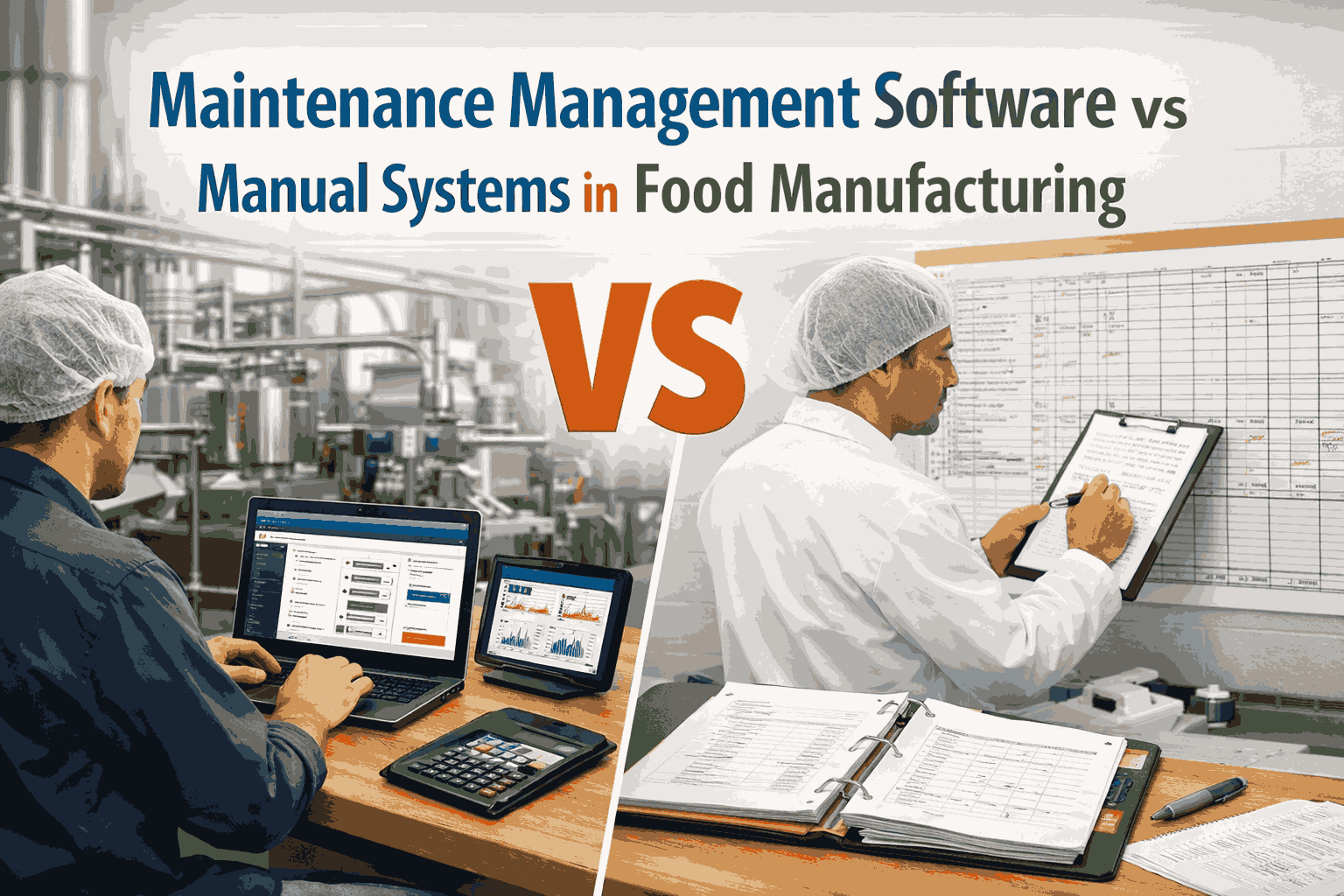
Food manufacturers operating across multiple facilities face a persistent and costly challenge: when every plant runs its own maintenance procedures, compliance gaps widen, audit failures multiply, and equipment reliability becomes geography-dependent rather than engineering-driven. A single unplanned breakdown at a high-output food facility can cost anywhere from $50,000 to $300,000 per hour in lost production, spoiled inventory, and emergency labor. Maintenance management standardization across a food manufacturing network is no longer a back-office improvement project — it is a direct driver of uptime, food safety, regulatory compliance, and enterprise profitability. With Oxmaint's CMMS platform, food manufacturers are transforming inconsistent, paper-heavy maintenance programs into unified, digitally governed systems that deliver measurable results at every site in their network.
Maintenance Management Standardization Across Food Manufacturing Networks
How leading food manufacturers eliminate compliance inconsistency, reduce unplanned downtime, and build audit-ready operations across every facility — using one unified governance framework powered by Oxmaint.
Why Fragmented Maintenance Creates Network-Wide Risk
When every plant develops its own ad-hoc maintenance program, each local workaround becomes a potential liability for the entire brand. Regulatory bodies do not evaluate individual sites in isolation — they assess whether your organization can consistently demonstrate food safety across all facilities. Here is what fragmentation actually costs at scale.
Four Pillars of Network-Wide Maintenance Standardization
A maintenance governance framework converts site-level practices into network-wide standards — without removing the local operational flexibility that plant managers need to respond to daily conditions. Each pillar directly addresses a specific, recurring failure mode of fragmented multi-site maintenance programs.
SOP Digitization
Convert paper-based maintenance procedures into digital, version-controlled SOPs that live inside the CMMS and are accessible to every technician at every site. When a procedure changes, every facility gets the update instantly — not after months of manual distribution.
Compliance Consistency
Enforce PM schedules and inspection checklists uniformly across all facilities. The system flags overdue tasks, escalates non-compliance to site managers and corporate leadership, and generates audit-ready reports automatically.
Centralized Asset Registry
Maintain a single source of truth for every piece of equipment across every facility in your network. Full asset maintenance history, failure patterns, parts consumption, and warranty data are visible from one dashboard.
Maintenance Governance KPIs
Define and track maintenance performance indicators — MTTR, MTBF, PM compliance rate, planned-versus-reactive ratio, work order backlog — at both the individual site and network levels simultaneously.
Fragmented Maintenance vs. Standardized Operations with Oxmaint
The operational gap between facilities running independent maintenance programs and those governed by a unified CMMS framework is measurable, significant, and directly visible in audit outcomes, downtime rates, and technician productivity. Sign up for Oxmaint to start bridging this gap across your network today.
| Operational Area | Fragmented Approach | Standardized with Oxmaint |
|---|---|---|
| SOP Access | Paper binders with site-specific versions | Digital, version-controlled, network-wide instant access |
| PM Compliance Tracking | Site managers report manually, once per month | Real-time dashboard across all sites and all assets |
| Audit Preparation Time | 2 to 5 days of manual record compilation per audit | Instant, automated audit-ready reports on demand |
| New Site Onboarding | 6 to 12 months to replicate local maintenance practices | Weeks using validated network templates |
| Technician Turnover | Critical knowledge lost permanently when staff leave | All knowledge captured and preserved in digital SOPs |
| Cross-Site Benchmarking | Not possible due to incompatible data formats and silos | Continuous, automatic, and immediately actionable |
| Unplanned Downtime Rate | High and unpredictable — varies wildly by site | Up to 40% reduction across the network within 12 months |
How Food Manufacturers Roll Out Network-Wide Standardization
Successful standardization follows a proven phased approach — validating the framework at a pilot site before scaling across the entire network with battle-tested templates. Book a demo to walk through how Oxmaint accelerates each phase for your specific operation.
Pilot Site Assessment and SOP Digitization
Audit existing maintenance procedures at your highest-volume facility. Identify documentation gaps, convert all SOPs into structured digital checklists in Oxmaint, and configure the asset registry with complete equipment data. This pilot site becomes the validated template and benchmark for rolling out to all remaining facilities in the network.
PM Schedule Enforcement and Compliance Baseline
Activate preventive maintenance schedules across the pilot site and enforce them through automated reminders and escalation alerts. Establish KPI baselines — PM compliance rate, work order backlog, MTTR, MTBF — that will be used to measure improvement across the network.
Network-Wide Rollout Using Validated Templates
Deploy the proven SOPs, inspection checklists, PM schedules, and asset configuration templates to all remaining facilities. Oxmaint's multi-site architecture allows corporate maintenance leadership to monitor all locations from a single dashboard simultaneously.
Continuous Improvement and Governance Maturity
Use cross-site benchmarking data to identify top-performing facilities and replicate their best practices network-wide. Update SOPs in real time — changes propagate instantly to every facility, every technician, every device. Achieve full governance maturity with sustained audit readiness and measurable year-over-year reliability improvements.
Features Built Specifically for Multi-Site Food Manufacturers
Every feature in Oxmaint is engineered to eliminate the information silos that cause maintenance fragmentation across food manufacturing networks. Unlike generic work order systems, Oxmaint is built for the compliance, food safety, and operational reliability demands that define this industry. Schedule a demo to see these capabilities applied to your specific network configuration.
Digital SOP Library
Store, version-control, and distribute maintenance procedures across all sites simultaneously. Every technician accesses the correct, current procedure on mobile or desktop — with full offline capability for areas without reliable connectivity.
Multi-Site PM Scheduling
Configure preventive maintenance schedules once at the corporate level and deploy instantly across the entire network. Automate task assignment by site, shift, and technician skill level — with escalation alerts that ensure nothing falls through the cracks between facilities.
Audit-Ready Compliance Reports
Generate complete maintenance documentation for FDA, SQF, BRC, and FSMA audits in under five minutes. Every completed task, technician signature, timestamp, and corrective action is captured automatically and retrievable on demand at any site.
Cross-Site Benchmarking Dashboard
Compare critical maintenance KPIs — PM compliance rate, MTTR, MTBF, work order backlog, planned-versus-reactive ratio — across every facility side by side. Identify which sites lead and which need immediate intervention.
Mobile Technician Application
Technicians complete checklists, attach photos, log equipment observations, and close work orders directly from the production floor on any mobile device. Data syncs automatically when back online — creating an unbroken, timestamped maintenance audit trail.
Centralized Asset Registry
Every piece of equipment across every facility in one searchable, structured database. Full maintenance history, failure event patterns, parts consumption, vendor information, and warranty data — instantly available to any authorized user anywhere in the network.
How Standardization Addresses Every Major Regulatory Framework
Food manufacturing maintenance operates under multiple overlapping regulatory requirements that are evaluated simultaneously during audits. A standardized CMMS-driven maintenance program addresses each framework systematically — and produces the documentation evidence that satisfies auditors across every facility in your network.
Preventive Controls for Human Food rules require documented equipment maintenance as a core component of your Food Safety Plan. Digital PM records with technician signatures, timestamps, and corrective action logs satisfy this requirement completely across every site, simultaneously updated and audit-ready at all times.
SQF Code Edition 9 requires a documented, implemented preventive maintenance program covering all food contact and critical equipment. Oxmaint's complete audit trail — covering every inspection, every corrective action, and every PM completion — provides the evidence package that SQF auditors require.
BRC Issue 9 requires a planned preventive maintenance system with documented records demonstrating consistent implementation. A standardized CMMS ensures every facility can produce compliant records regardless of local staffing changes, technician turnover, or site-level operational variations throughout the year.
All GFSI-recognized certification schemes require systematic, documented, and verifiable maintenance management across facilities. A unified governance framework demonstrates consistent application of food safety engineering principles across the entire enterprise — the highest standard of evidence that GFSI benchmarking evaluates.
What the Data Says About Maintenance Standardization in Food Manufacturing
Industry research consistently confirms what plant managers already experience: the gap between reactive, fragmented maintenance programs and proactive, standardized operations is enormous — and entirely closable with the right platform and governance approach.
Everything You Need to Know About Maintenance Standardization
These are the questions that maintenance directors, plant managers, and food safety leaders ask most often when evaluating a network-wide maintenance standardization initiative. If you have additional questions specific to your organization, book a demo and speak directly with an Oxmaint implementation specialist.


