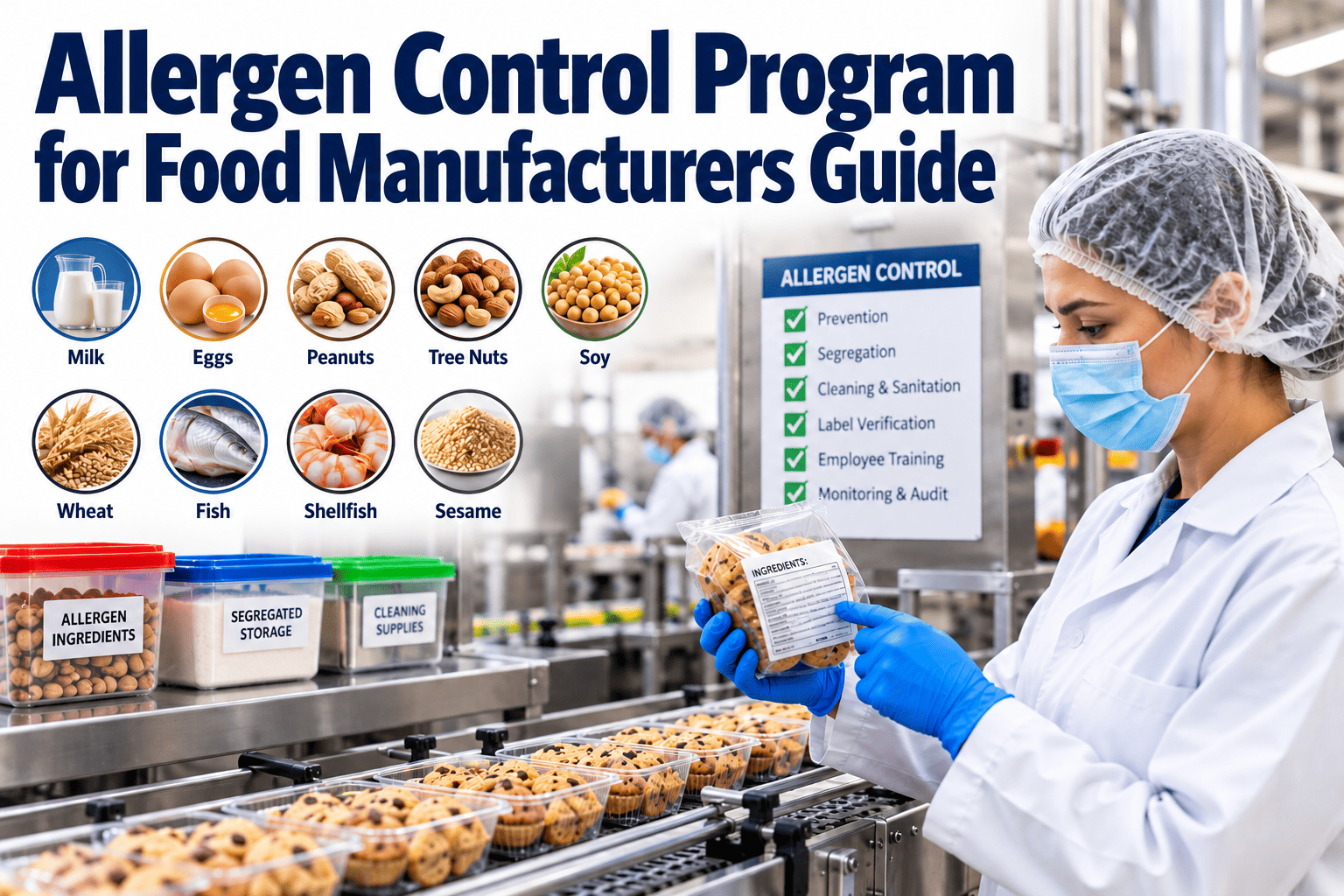
One shared mixer, one mislabelled bag of rework, one cleaning step skipped during a rushed changeover: that is how an allergen incident usually starts. An allergen control program gives food manufacturers a documented way to stop cross-contact before it reaches the pack. It covers ingredients, scheduling, cleaning, labeling and training, and it only holds up when the equipment is maintained well enough to be cleaned. This guide explains each element and shows where a maintenance management system keeps the program running day to day.
Allergen Control Program for Food Manufacturers
Build a program that controls cross-contact from receiving to shipping, and keep the equipment behind it clean, sound and documented.
Follow the allergen from the dock to the truck
Cross-contact can enter at every step. A program works when each step has an owner, a control and a record.
Receiving
Wrong ingredient, damaged bags, unverified supplier statements.
Storage
Open bags above other ingredients, shared racks, unmarked totes.
Weighing and rework
Shared scoops, unlabelled rework, powder dust in the air.
Processing
Shared mixers, conveyors, slicers, fryers and hard-to-clean parts.
Packaging
Wrong film, wrong label, mixed-up changeover.
Shipping
Damaged cartons, mixed pallets, missing lot records.
Know your allergen list before you build the program
In the United States, nine foods are recognised as major food allergens. Sesame became the ninth on January 1, 2023.
Other markets use different lists. If you export, build your allergen inventory around every destination country, and confirm current rules with your regulatory contact.
Score cross-contact risk by likelihood and consequence
A simple matrix helps rank which lines, ingredients and tasks need the strictest controls first.
How to use the matrix
- Rows run from low to high likelihood, bottom to top
- Columns run from minor to severe consequence, left to right
- Likelihood rises with shared equipment, powders and manual handling
- Consequence rises with undeclared allergens in products for sensitive consumers
- Every high or critical score needs a named control and verification method
Eight elements every allergen control program needs
Under FSMA preventive controls rules in the United States, allergen controls cover cross-contact and labeling. These eight elements put that into practice.
Policy and team
Name an allergen lead, define responsibilities and set a written policy approved by management.
Allergen inventory and matrix
List every allergen in every ingredient, product and line, including shared equipment.
Supplier and ingredient control
Collect allergen statements, review spec changes and verify what arrives against the order.
Storage and handling
Segregate allergens, label containers, colour-code tools and control rework and spills.
Scheduling and changeovers
Sequence production to limit cross-contact and define a full changeover for each allergen switch.
Cleaning and validation
Write allergen-specific cleaning procedures and prove with testing that they work.
Labeling and packaging
Match every label to the formula and check labels at setup and during runs.
Training, verification and review
Train everyone who touches product, verify the controls and review the plan on a schedule.
Control allergens before they reach your dock
Many allergen failures begin with an ingredient change nobody noticed. Supplier control closes that gap.
Approve and monitor suppliers
- Request allergen statements for every ingredient and update them annually
- Ask suppliers to notify you of formula, facility or processing changes
- Review shared-line and cross-contact practices at the supplier
- Keep a current ingredient allergen list tied to item codes
Verify at receiving
- Match the delivery label to the purchase order and the approved item
- Reject damaged or leaking packaging that could spread powder
- Record lot numbers so any issue can be traced forward
- Move allergen ingredients straight to their marked storage location
Make allergens obvious on the floor
People follow controls they can see. Simple visual rules reduce mix-ups during busy shifts.
- Store allergen ingredients in marked areas, below or away from non-allergen items
- Use sealed, lidded and labelled containers for open ingredients and rework
- Assign color-coded scoops, bins and tools to specific allergens or zones
- Keep tools and containers from moving between allergen and non-allergen areas
- Clean up spills of powders and liquids at once, using the right procedure for the allergen
- Label rework with product, allergens, date and the products it may be added to
Airborne powder such as flour, milk powder or sesame can travel. Consider dust extraction, enclosed transfer and airflow direction when you assess risk.
A repeatable allergen changeover in six steps
Use one written procedure per line and allergen. Operators should never have to decide what is good enough.
Stop and clear
Remove all product, rework and packaging from the line and mark them as the previous product.
Dismantle
Open guards, hoppers and removable parts according to the cleaning instruction for that line.
Clean
Follow the validated method, whether dry removal, wet cleaning or both, with the specified tools.
Inspect and test
A second person checks visually and runs the required allergen test before approval.
Reassemble and set up
Install the correct packaging and labels, and confirm the recipe and settings for the next product.
Sign off
Record times, names and results. The next product starts only after sign-off.
Who owns what in the allergen program
Unclear ownership is the quiet reason many plans stall. Write responsibilities down and review them when staff change.
| Role | Main responsibilities | Records owned |
|---|---|---|
| Quality and food safety | Risk assessment, allergen matrix, validation and verification | Matrix, test results, review notes |
| Production | Scheduling, changeovers, rework control and line sign-off | Changeover sheets, rework logs |
| Maintenance | Equipment condition, cleanability, tool control and repair hygiene | Work orders, inspection checklists |
| Purchasing and receiving | Supplier statements, change notices and receiving checks | Supplier files, receiving records |
| Packaging and labeling | Artwork approval, label checks and packaging control | Label samples, version records |
| Management | Resources, policy approval and annual review | Policy, review minutes |
Treat maintenance staff and contractors as part of the allergen team. They often open equipment and move tools between zones.
Start with a line-by-product allergen matrix
The matrix shows which allergens are in the recipe and which are present on the line. The example below is illustrative.
| Product | Line | In recipe | Also on line | Changeover needed |
|---|---|---|---|---|
| Plain crackers | Line 1 | Wheat | Sesame, milk | Full wet clean after sesame |
| Seeded crackers | Line 1 | Wheat, sesame | Milk | Dry clean to plain, wet clean to milk |
| Cheese snack | Line 1 | Wheat, milk | Sesame | Full wet clean after sesame |
| Fruit bar | Line 2 | Tree nuts | Peanuts | Full wet clean between nut types |
| Oat bar | Line 2 | None in recipe | Tree nuts, peanuts | Run first after full clean |
Sequence production so the cleaning burden stays manageable
Where possible, run products without an allergen first and allergen-containing products later, then clean before the next cycle.
- Dedicate lines, utensils or shifts to the most hazardous allergens where practical
- Do not start a restricted product until cleaning is signed off
- Control rework: only add it to the same product or one that already contains the allergen
- Record start and end times, product codes and cleaning sign-off for every changeover
Prove that allergen cleaning actually works
A cleaning procedure is only trusted after it is tested. Choose methods that detect allergen protein, not just general dirt.
| Method | What it shows | Limitation |
|---|---|---|
| Visual inspection | Residue, product build-up, damaged surfaces | Cannot see trace allergen protein |
| Allergen-specific swab or lateral flow test | Presence of the target allergen protein | Needs proper technique and the right test for the allergen |
| Laboratory ELISA testing | Quantitative allergen results on swabs or product | Slower and costlier, best for validation |
| ATP testing | General organic residue | Does not confirm allergen removal |
- Dry cleaning suits low-moisture lines, but validate it for each allergen
- Wet cleaning needs complete drying so water does not carry residue
- Revalidate after equipment, recipe or cleaning chemical changes
Keep your allergen program backed by maintenance records
Schedule cleaning-critical inspections, track equipment condition and keep sign-offs in one place.
Equipment condition decides whether cleaning works
Cleaning teams cannot remove residue from places they cannot reach. Maintenance controls the condition of those places.
Maintenance gaps that hide allergens
- Cracked welds and pitted surfaces that trap residue
- Worn gaskets and seals on mixers and hoppers
- Frayed or porous conveyor belts
- Dead legs and hollow rollers with trapped product
- Shared tools moved between allergen zones
Controls maintenance can own
- Inspection tasks for cleanability before changeovers
- Replacement schedules for seals, belts and gaskets
- Color-coded tools stored by zone
- Allergen-aware procedures for repair work on shared lines
- Records of every repair on allergen-critical equipment
Repairs on shared lines can spread allergens too
A technician moving from an allergen line to a clean line can carry residue on tools, clothing and parts.
- Plan major repairs for planned stops, so cleaning and changeover follow the work
- Use zone-specific toolboxes and clean tools before they leave an allergen area
- Clean and cover replacement parts before installation
- Remove debris, packaging and temporary materials once the job is complete
- Ask production to inspect the line before restart and sign off the work order
- Record the part, the person and the time on the work order for traceability
Tie each program element to a work order or checklist
Oxmaint does not replace your allergen plan. It schedules and records the maintenance tasks that keep the plan working.
Two controls people often underestimate
Undeclared allergens are a leading cause of food recalls. Labels and training are the most direct defense.
Labeling controls
- Review label artwork against the approved formula
- Check labels at setup, at roll changes and after breaks
- Remove unused packaging at changeover
- Lock label versions to product codes
- Treat precautionary statements as a last step, not a replacement for good controls
Training controls
- Train all staff on allergen basics at hire
- Give extra training to cleaning and changeover teams
- Include maintenance and contractors
- Keep records of dates, content and trainer
- Retrain after incidents or procedure changes
Be ready to respond to an allergen incident
Even strong programs face deviations. A tested response plan limits the damage.
- Define who can stop a line and who decides the fate of held product
- Use lot records to find every pallet, customer and shipment involved
- Open a corrective work order if equipment condition contributed to the event
- Test the recall and traceability process on a schedule, not only after an incident
- Update the risk assessment and training once the root cause is known
Why allergen programs fail in practice
Most failures come from drift, not from a missing procedure.
| Failure | Why it happens | Prevention |
|---|---|---|
| Outdated allergen matrix | New products or ingredients are added without review | Tie matrix review to change control |
| Skipped or shortened cleaning | Schedule pressure and unclear sign-off | Require sign-off before the next run starts |
| Unvalidated cleaning | Procedure assumed effective | Test and revalidate after changes |
| Rework mix-ups | Containers unlabelled or reused | Label, segregate and record rework |
| Equipment too worn to clean | Maintenance not linked to sanitation needs | Add cleanability checks to preventive plans |
| Contractor and temporary staff gaps | Training only covers permanent employees | Train and record everyone entering the zone |
Measure the program, then review it on a schedule
Verification confirms the controls are working. Review confirms the plan still matches what the plant makes.
| Activity | Typical frequency | Evidence |
|---|---|---|
| Changeover sign-off | Every allergen switch | Signed checklist and test result |
| Label check at setup | Every run | Label sample and checker initials |
| Allergen swab testing | Per validation plan | Test log by line and date |
| Equipment cleanability inspection | Planned preventive schedule | Work order history |
| Program review | At least annually and after changes | Review record and updated plan |
Allergen control program questions
What should an allergen control program include?
Allergen inventory, supplier control, segregation, scheduling, cleaning validation, labeling, training and verification. Review it regularly.
Is ATP testing enough to verify allergen cleaning?
No. ATP shows general residue, not allergen protein. Use allergen-specific tests for validation and verification.
How does maintenance affect allergen control?
Worn seals, cracks and hard-to-clean parts trap residue. Schedule inspections and replacements in Oxmaint to keep equipment cleanable.
Does precautionary labeling replace good controls?
No. Precautionary statements should not replace good manufacturing practices and cross-contact controls.
Can Oxmaint store allergen-related maintenance records?
Yes, as work orders, checklists and reports. Book a demo to see how it fits your changeover routines.
Give your allergen program the maintenance backbone it needs
Plan inspections, repairs and records for every shared line in one maintenance workflow.


