A pasteurizer's temperature sensor drifted 2.3 degrees below the critical limit at 2:47 AM on a Thursday — 14 minutes before the shift supervisor's next scheduled manual check. In those 14 minutes, 1,800 liters of dairy product passed through the unit below the kill temperature for Listeria monocytogenes. The batch was shipped. The recall cost $2.1 million. The brand damage lasted 18 months. Had the CMMS been integrated with the HACCP monitoring system, the deviation would have triggered an automated alert at 2:47 AM, initiated a product hold at 2:48 AM, and generated a corrective action work order at 2:49 AM — all before a single contaminated liter left the facility. HACCP and CMMS are not two separate systems. They are two halves of the same food safety equation: HACCP defines what must be controlled, CMMS ensures the equipment doing the controlling actually works. When these systems operate in silos — paper-based HACCP logs disconnected from digital maintenance records — critical control points fail silently, calibrations lapse without notice, and corrective actions exist only in someone's memory. Want to connect your maintenance system directly to your HACCP critical control points? Book a demo and see the integration live, or start a free trial to test it with your own HACCP plan.
Your HACCP Plan Is Only as Reliable as the Equipment Behind It
OxMaint links every critical control point to its maintenance schedule, calibration record, and real-time sensor data — so a CCP deviation triggers a corrective action work order before contaminated product leaves the line.
What HACCP-CMMS Integration Actually Means
HACCP defines the seven principles of food safety management — hazard analysis, CCP identification, critical limits, monitoring, corrective actions, verification, and recordkeeping. A CMMS manages the equipment, calibration schedules, and maintenance work orders that keep those CCPs functioning. Integration means every CCP-critical asset in your facility has its maintenance history, calibration status, and real-time condition data visible inside the same system that tracks your HACCP compliance. When a pasteurizer's temperature probe is due for calibration, the CMMS flags it before the next production run — not after an auditor finds the gap. When a metal detector triggers a deviation, the corrective action work order generates automatically with the equipment's full service history attached. The result: zero lag between "something went wrong" and "here is the documented response." Explore how this works in practice — start a free trial and map your first CCP to its maintenance schedule today.
Hazard Analysis
Identify biological, chemical, and physical hazards at every production step — then link each hazard to the equipment condition data that determines whether your controls actually work.
CCP Identification
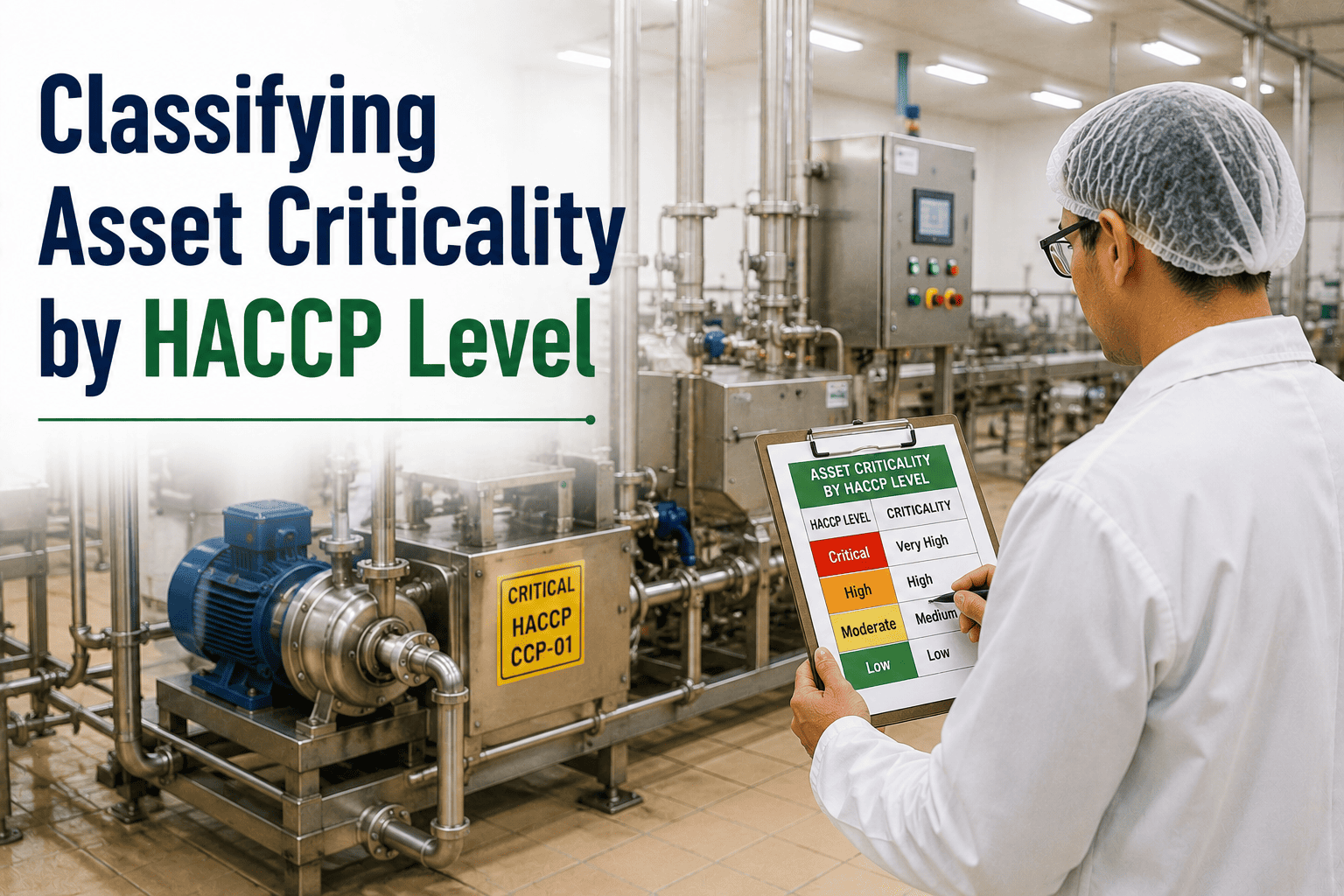
Pinpoint the exact production steps where control prevents or eliminates hazards — cooking, chilling, pasteurization, metal detection — and tag the specific equipment assets responsible.
Critical Limits
Set measurable boundaries — 72 degrees C for 15 seconds in pasteurization, 1.5mm ferrous detection threshold — and configure the CMMS to flag when equipment drifts toward those limits.
Monitoring
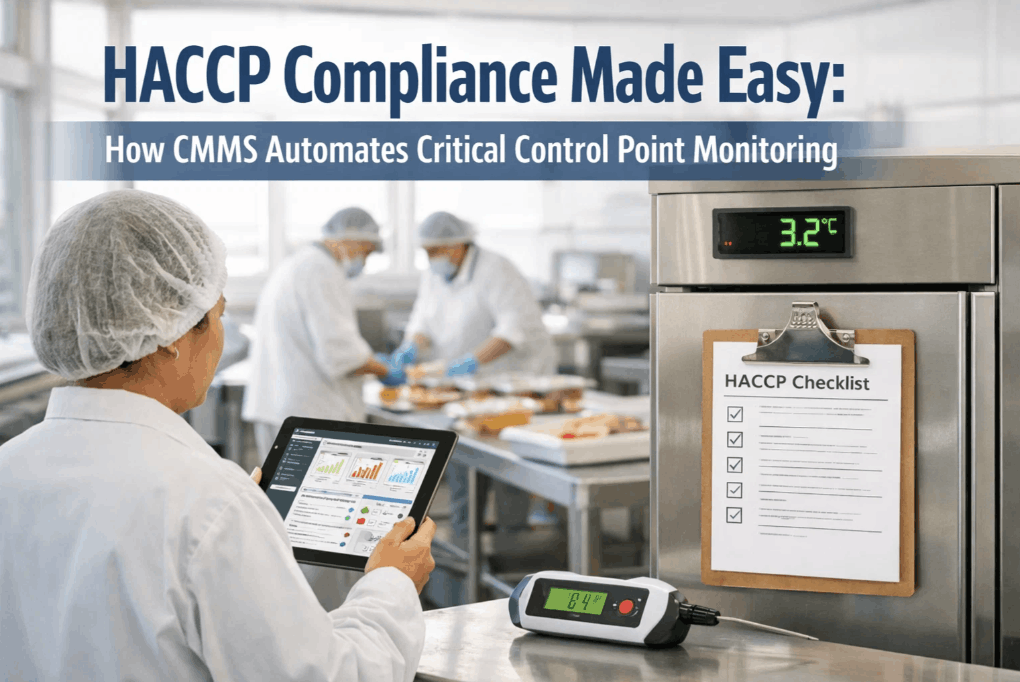
Continuous or scheduled observation of CCP parameters — automated via IoT sensors feeding directly into the CMMS, replacing clipboard logs with timestamped digital records every 30 seconds.
Corrective Actions
When a CCP deviation occurs, the CMMS auto-generates a corrective action work order — product hold, equipment inspection, recalibration — with full traceability and assigned technicians.
Verification and Records
Calibration logs, sensor readings, maintenance history, and corrective action records — all linked to each CCP in a single audit-ready digital trail. No paper. No gaps. No missing signatures.
Where HACCP Plans Fail Without Maintenance Integration
Most HACCP failures are not food safety knowledge failures. They are equipment reliability failures — a sensor out of calibration, a seal degraded beyond tolerance, a gasket that should have been replaced two months ago. These are the silent breakdowns that turn compliant HACCP plans into recall events. Here is where the gap between food safety and maintenance creates real risk. Book a demo to see how OxMaint closes these gaps in real time.
Calibration Drift Goes Undetected
Temperature probes, pH meters, and pressure gauges drift over time. Without CMMS-tracked calibration schedules tied to each CCP, a sensor reading "72 degrees C" might actually be 69.7 degrees C — below kill temperature, but no one knows until the audit.
Corrective Actions Lost in Paper Trails
A CCP deviation happens at 3 AM. The operator logs it on paper. The paper sits in a binder. No work order is created. No technician is dispatched. The auditor finds the gap 6 months later — and the batch was shipped 5 months and 29 days ago.
Metal Detector Maintenance Gaps
Metal detectors are CCPs in 87% of food manufacturing HACCP plans. But sensitivity verification tests are often skipped during production pressure. Without CMMS-enforced PM schedules, a detector running at degraded sensitivity passes contaminated product undetected.
Sanitation Equipment Breakdowns
CIP (Clean-in-Place) systems are critical prerequisite programs supporting every CCP. When CIP pumps, spray nozzles, or chemical dosing systems fail mid-cycle, incomplete sanitation creates contamination pathways — but no HACCP log captures the maintenance root cause.
How OxMaint Connects Every CCP to Its Equipment
OxMaint does not replace your HACCP plan. It ensures the equipment your HACCP plan depends on is maintained, calibrated, and documented — so when the auditor asks "prove this CCP was under control on March 14th," you have the sensor data, calibration certificate, and maintenance history in one click. Ready to see this in your facility? Start a free trial and connect your first CCP asset today.
| Capability | Paper-Based HACCP + Separate Maintenance | HACCP Integrated with OxMaint CMMS |
|---|---|---|
| CCP Monitoring | Manual checks every 1-2 hours | Continuous IoT sensor data, auto-logged every 30 seconds |
| Calibration Tracking | Spreadsheet or binder — missed schedules invisible | Auto-scheduled PM with CCP-linked calibration alerts |
| Deviation Response | Manual paper log, delayed escalation | Auto-generated work order + product hold in under 2 minutes |
| Corrective Action Docs | Paper forms, inconsistent detail, missing signatures | Digital records with timestamps, photos, technician sign-off |
| Audit Preparation | Days of binder assembly, cross-referencing logs | One-click audit report — CCP history, maintenance, calibration |
| Recall Traceability | Manual batch-to-equipment mapping, hours to compile | Instant asset-to-batch linkage with full maintenance trail |
CCP Equipment Categories That Demand CMMS Integration
Not every piece of equipment in a food plant is CCP-critical. But the ones that are — the pasteurizers, metal detectors, cook ovens, and CIP systems — cannot afford a single missed calibration or unplanned breakdown. These are the equipment categories where HACCP-CMMS integration delivers the highest food safety and compliance value.
Pasteurizers, Cook Ovens, Retorts
Temperature sensor calibration, heating element condition, flow rate consistency. A 1.5 degree C drift below critical limit converts a safe product into a pathogen growth environment. CMMS tracks sensor calibration dates, heating element degradation trends, and triggers PM before drift reaches deviation threshold.
Metal Detectors, X-Ray Systems
Sensitivity verification, reject mechanism reliability, conveyor speed calibration. A metal detector that passes its 2.0mm ferrous test ball but misses a 2.5mm stainless steel fragment is a CCP failure hiding behind a passed test. CMMS enforces multi-standard sensitivity checks at shift intervals.
Blast Chillers, Cold Storage, Freezers
Compressor performance, refrigerant levels, door seal integrity, defrost cycle timing. A cold storage unit that takes 6 hours to pull product from 60 degrees C to 5 degrees C instead of the required 4 hours creates a pathogen multiplication window. CMMS monitors compressor run-time trends to predict cooling capacity loss before it becomes a CCP deviation.
CIP Systems, Sanitizer Dispensers
Chemical concentration accuracy, flow rates, contact time, spray coverage. A CIP system delivering 180 ppm sanitizer concentration instead of the required 200 ppm leaves biofilm intact — creating Listeria harborage that no HACCP log will capture. CMMS tracks pump calibration, nozzle replacement cycles, and chemical dosing accuracy.
The HACCP-CMMS Integration Workflow
Integration is not about adding more software. It is about connecting the food safety decisions your quality team makes with the maintenance actions your technicians execute — in a single system, with a single audit trail. Walk through a live demo of this workflow — book a demo and bring your HACCP plan to the call.
Map CCPs to Equipment Assets
Every CCP in your HACCP plan is linked to the specific equipment asset in OxMaint — pasteurizer unit, metal detector serial number, cold storage compressor. The asset record contains the critical limits, monitoring frequency, and calibration requirements defined in your HACCP plan.
Configure CCP-Triggered Maintenance
Set calibration schedules, PM frequencies, and condition-based triggers for each CCP asset. When a temperature sensor approaches its calibration due date, OxMaint generates the work order 48 hours in advance — before the CCP becomes non-compliant.
Connect IoT Sensors for Continuous Monitoring
Temperature probes, pH sensors, and pressure transducers feed real-time data into OxMaint. Every reading is timestamped and stored against the CCP record. Pre-alert thresholds trigger notifications before critical limits are breached — giving maintenance teams the window to intervene.
Auto-Generate Corrective Action Work Orders
When a CCP deviation occurs — temperature breach, failed sensitivity test, concentration drop — OxMaint automatically creates a corrective action work order with the deviation details, affected product batch, equipment history, and required response steps. The quality team and maintenance team see the same record.
Generate Audit-Ready HACCP Reports
Pull a complete CCP compliance report — monitoring data, calibration certificates, deviation events, corrective actions, verification records — in one click. FDA, USDA, GFSI, and BRC auditors see the full picture: food safety controls backed by documented equipment reliability.
Measurable Impact: HACCP-CMMS Integration Results
Frequently Asked Questions
Does OxMaint replace our existing HACCP plan or food safety software?
What CCP equipment types does OxMaint support for HACCP integration?
How does the system handle CCP deviations and corrective actions?
Is OxMaint compliant with GFSI, BRC, SQF, and FSSC 22000 audit requirements?
Your Next Audit Starts With Equipment You Can Prove Was Maintained
OxMaint connects every critical control point in your HACCP plan to the calibration records, maintenance history, and real-time sensor data that auditors demand — so your food safety compliance is backed by documented equipment reliability, not paper promises.