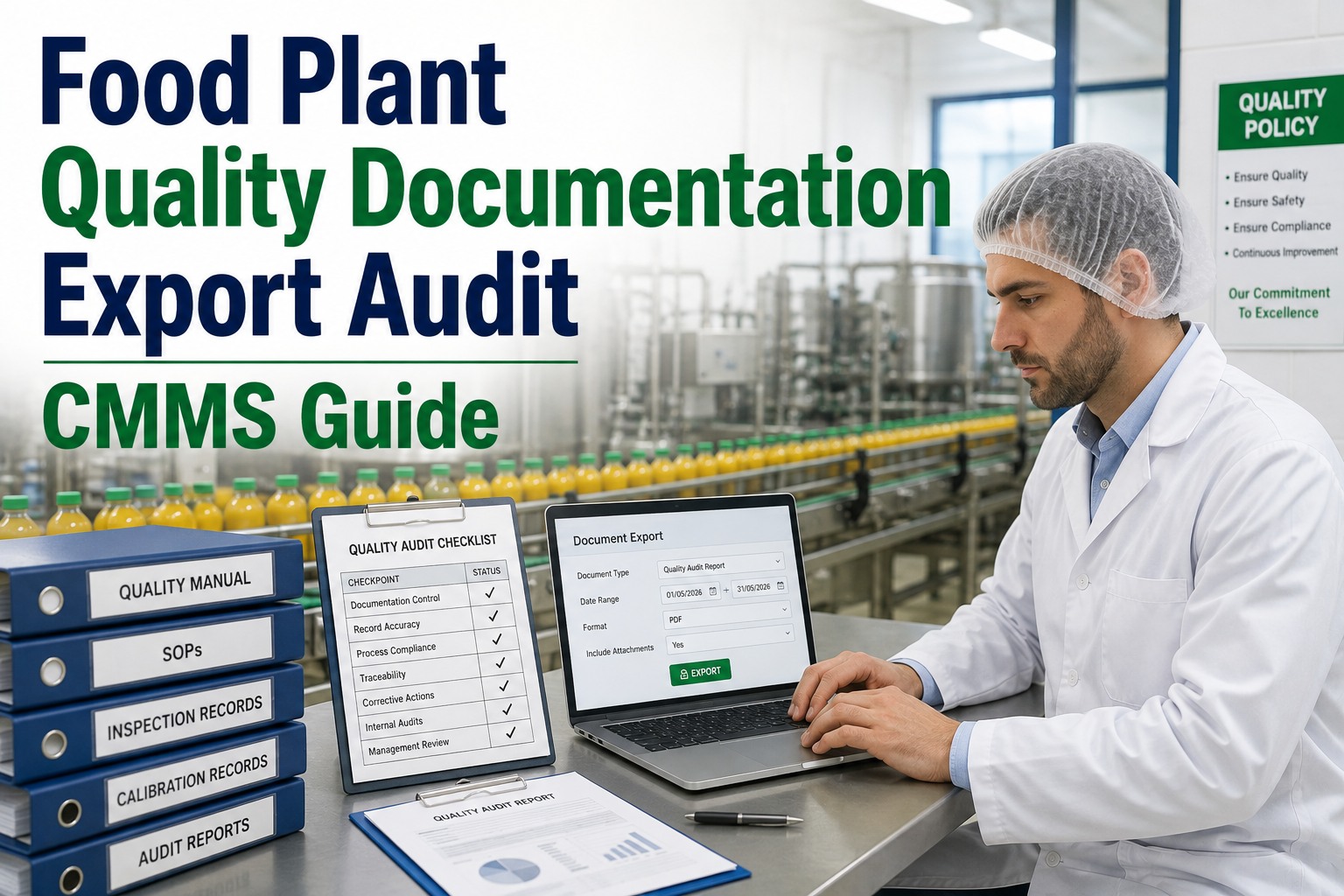
A quality manager at a Vermont dairy plant watched auditors swab seven surfaces. All seven came back positive for Listeria monocytogenes—a resident strain linked to illnesses in 2021 and 2022. The cleaning equipment looked fine. The CIP cycles ran on schedule. But when FDA asked for sanitation records proving those cycles achieved validated parameters, the documentation fell apart. In June 2025, FDA issued a warning letter citing "inadequate sanitation and documentation." The pattern repeats across food plants nationwide: 149 warning letters to human food facilities between 2017-2023 cited sanitation and documentation failures. The difference between passing and failing isn't the cleaning—it's proving the cleaning worked.
Sanitation Report Template
CIP System Inspection Report
Standardized documentation template for food & beverage plants
149
FDA warning letters citing sanitation failures (2017-2023)
15
days to respond before enforcement escalates
6-9
months until FDA reinspection verifies corrections
What Your CIP Inspection Report Must Document
BRCGS Issue 9 Section 4.11.7 explicitly requires validation documentation confirming CIP system design and operation. FDA and SQF auditors expect the same evidence. A complete inspection report captures identification data, TACT parameters, verification test results, and authorization signatures. Facilities ready to start building digital sanitation reports discover that standardized templates eliminate the gaps auditors cite most often.
01
Report Identification
Report #
Date/Shift
CIP Circuit ID
Equipment
Previous Product
Next Product
Operator ID
02
TACT Parameters
Time per phase
Flow rate (m/s)
NaOH concentration
Acid concentration
Temperature readings
Target vs. actual
03
Verification Testing
ATP swab results
pH readings
Conductivity
Visual inspection
Allergen test (if applicable)
04
Authorization
Operator signature
QA verification
Release authorization
Deviation notes
CAPA reference
TACT Parameter Documentation Template
Every CIP cycle depends on four interdependent parameters. When any parameter drifts outside validated ranges, the entire cycle's effectiveness becomes questionable. Your report must capture target ranges and actual readings for each—because auditors will check.
T
Time
Caustic wash:
15-30 min
Acid wash:
10-20 min
Rinse phases:
5-10 min
A
Action
Flow velocity:
1.5-2.1 m/s
Flow type:
Turbulent
Spray coverage:
100%
C
Concentration
NaOH (caustic):
0.5-2.0%
Acid (nitric/phos):
0.5-1.5%
Sanitizer:
Per SOP
T
Temperature
Caustic wash:
65-80°C
Acid wash:
50-70°C
Rinse water:
40-50°C
Teams wanting to see how digital systems auto-capture these parameters can book a quick demo and learn how facilities eliminate manual logging errors while generating audit-ready documentation automatically.
Cycle Phase Timing Record
Auditors verify that cleaning occurred before production resumed by checking timestamps. Reports without precise start/end times for each phase raise immediate red flags about overall documentation reliability.
Pre-Rinse
Start ___ End ___ Duration ___
Caustic Wash
Start ___ End ___ Duration ___
Intermediate Rinse
Start ___ End ___ Duration ___
Acid Wash
Start ___ End ___ Duration ___
Sanitization
Start ___ End ___ Duration ___
Final Rinse
Start ___ End ___ Duration ___
Total Cycle Time:
_______ minutes
Generate Audit-Ready Reports Automatically
Oxmaint captures every parameter, timestamps each phase, and produces compliance documentation that satisfies FDA, BRCGS, and SQF auditors.
Verification Testing & Release Authorization
Documentation without verification testing is incomplete. FDA expects objective evidence—ATP readings, pH measurements, visual inspection results—proving that cleaning achieved sanitation targets before equipment was released for production.
Location 1:
___ RLU
Location 2:
___ RLU
Location 3:
___ RLU
Limit: <150 RLU
Result: Pass / Fail
pH Level:
_______
Conductivity:
___ μS/cm
Turbidity:
___ NTU
pH Target: 6.5-7.5
Result: Pass / Fail
Residue:
Yes / No
Odor:
Yes / No
Surface:
Good / Fair / Poor
Target: No residue, no odor
Result: Pass / Fail
All verification tests passed. Equipment released for production.
Expert Perspective: What Auditors Actually Check
Industry Insight
"Important checks for CIP validation are: temp, flow rate, time, check of no dead ends, check that the chemical is appropriate and the right concentration. The chemical used and concentration, time, temp etc will be specific for YOUR process, which is why every CIP system needs a validation—and every cycle needs documentation proving those validated parameters were achieved."
— BRCGS Food Safety Practitioner
Speed Matters
Auditors expect records in seconds. Searching filing cabinets signals poor compliance culture.
Deviations Reveal Culture
How you handle out-of-spec conditions matters more than having perfect results every time.
Traceability Required
Each report must link to equipment, batches, and operators. Digital systems create these automatically.
Facilities that create a free Oxmaint account get access to customizable CIP report templates that capture all required fields and generate audit-ready documentation automatically.
Start Building Audit-Ready CIP Documentation
FDA, SQF, and BRCGS auditors arrive with one question: can you prove your CIP system consistently achieves validated sanitation targets? This template covers every section they'll review. The facilities that pass aren't running different equipment—they're documenting the same processes in ways that prove compliance. Ready to eliminate documentation gaps? Schedule a demo and see how digital reporting transforms audit preparation.
Transform Your CIP Documentation
Join food plants using Oxmaint to standardize sanitation reports, automate parameter capture, and pass audits with confidence.
Frequently Asked Questions
What should a CIP inspection report include?
A complete CIP inspection report should include report identification (date, shift, equipment, operator), TACT parameter documentation (time, action/flow rate, concentration, temperature for each phase), cycle phase timing records with start/end timestamps, post-cycle verification test results (ATP swabs, pH, visual inspection), deviation and corrective action records if parameters fell outside validated ranges, and authorization signatures from both operator and QA personnel before releasing equipment for production.
What CIP documentation do BRCGS auditors require?
BRCGS Issue 9 Section 4.11.7 requires validation documentation confirming CIP system design and operation are suitable for intended use. This includes schematic diagrams showing no dead zones, spray coverage verification, and validated parameters for temperature, flow rate, time, and chemical concentration. Auditors expect cycle records proving these validated parameters were achieved for each cleaning run, plus corrective action documentation for any deviations encountered.
How long must CIP sanitation records be retained?
FDA FSMA requires food facilities to retain records for at least two years. However, GFSI certification schemes typically require longer retention—usually matching product shelf life plus one year, or a minimum of three years. Many facilities retain CIP records for seven years to cover potential litigation periods. Digital CMMS systems make long-term retention practical without physical storage costs while enabling instant retrieval during audits.
What verification testing should follow each CIP cycle?
Post-CIP verification typically includes ATP bioluminescence testing to confirm surface cleanliness (limits usually below 150 RLU), final rinse water quality checks (pH 6.5-7.5, neutral conductivity), visual inspection for residue or odor, and allergen testing when production involves allergen changeovers. All test results must be documented with timestamps, test locations, readings obtained, and pass/fail determination before equipment release.
How does CMMS software improve CIP sanitation reporting?
CMMS software transforms CIP reporting through automated parameter logging that captures every cycle without manual entry, scheduled preventive maintenance ensuring inspections happen on time, calibration tracking with automatic reminders, deviation alerts when parameters drift outside validated ranges, audit-ready reporting that produces compliance documentation instantly, and trend analysis identifying potential problems before failures occur. Facilities using digital reporting eliminate manual entry errors and demonstrate stronger compliance culture to auditors.