EPA Section 608 isn't a guideline — it's an enforceable rule that applies to every cold storage facility running HCFC-22, R-404A, R-410A or any regulated refrigerant above the 50-pound charge threshold. A single unaddressed leak on a 1,200 lb ammonia or Freon system can trigger 30-day repair deadlines, mandatory third-party verification, and penalties that scale with refrigerant tonnage lost. This guide walks through leak detection cadence, repair timelines, recordkeeping, and the CMMS-driven compliance program that keeps operations defensible under EPA enforcement — ready to operationalize in minutes when you Start Free Trial.
EPA Section 608 Compliance · Cold Storage
Can your cold storage facility prove leak detection compliance in 48 hours of an EPA audit?
Section 608 enforcement is intensifying. Facilities losing more than 30% of refrigerant charge annually now face mandatory retrofit or retirement plans, third-party verification, and fines reaching $60,617 per kilogram vented. The difference between a clean audit and a six-figure penalty is the detection cadence — and the documentation trail behind it.
Leak Detection Cadence · Frequency Rules
The 608 inspection calendar every facility must run
Leak inspection frequency is dictated by refrigerant charge size and leak rate — not by preference. Once an appliance crosses a leak-rate trigger, the clock starts on mandatory follow-up surveys and a 30-day repair window.
Annual inspection
Once per calendar year. Commercial refrigeration systems with a full charge between 50 and 500 pounds of regulated refrigerant require at minimum one documented leak inspection — electronic or bubble-method — logged with technician certification ID, date, and findings.
Semi-annual inspection
Every 6 months. Industrial process refrigeration and commercial refrigeration appliances holding 500 pounds or more must be inspected twice per calendar year, performed by a certified technician under Section 608. Records must trace back to a universal certification number.
Follow-up survey
Within 30 days of repair completion. Any appliance that exceeded the 30% (commercial) or 20% (industrial process) annual leak rate requires a verification test post-repair, plus a second follow-up inspection performed by an independent third party within 12 months.
Leak Rate Thresholds · The Math
Calculating the 12-month rolling leak rate
The EPA doesn't ask whether a system leaks — it asks how much, over what window, and whether you documented it. The 12-month rolling leak rate is the single most important compliance number for any cold storage operation.
Systems below 50 lbs are exempt from periodic inspection, but any comfort-cooling appliance crossing 10% annual leak rate must be repaired within 30 days.
Appliances used in industrial process refrigeration (food processing, chemical manufacturing) cross the threshold at 20% — triggering repair, verification, and follow-up obligations.
Retail food, cold storage warehouses, and supermarket rack systems carry the 30% commercial refrigeration threshold — the most common trigger for cold storage operators.
Any appliance that leaks 50% or more of its charge for two consecutive years must be retrofit, converted, or retired — a documented plan submitted to the EPA within 30 days.
A 1,200 lb R-404A cold storage rack leaking 360 lbs
A regional cold storage warehouse operates a 1,200 lb R-404A system. Over 12 months the maintenance team added 360 lbs of refrigerant to keep it running. The leak rate = (360 ÷ 1,200) × 100 = 30% — exactly at the commercial refrigeration threshold. The system must be repaired within 30 days, verified by an independent technician, and re-inspected within 12 months. At $9/lb for R-404A, that's $3,240 lost to refrigerant alone — before factoring compressor wear, energy penalty, and the audit exposure. A CMMS that flags the third top-off event would have triggered intervention at 10% leakage, saving roughly $2,160 in refrigerant cost and averting the threshold breach entirely.
Repair Timeline · 30-Day Window
The Section 608 repair sequence, step by step
From detection to verified closure, the 608 repair workflow is a chain of documented steps. Miss one — or miss its deadline — and the entire appliance enters non-compliance.
Leak identified and logged
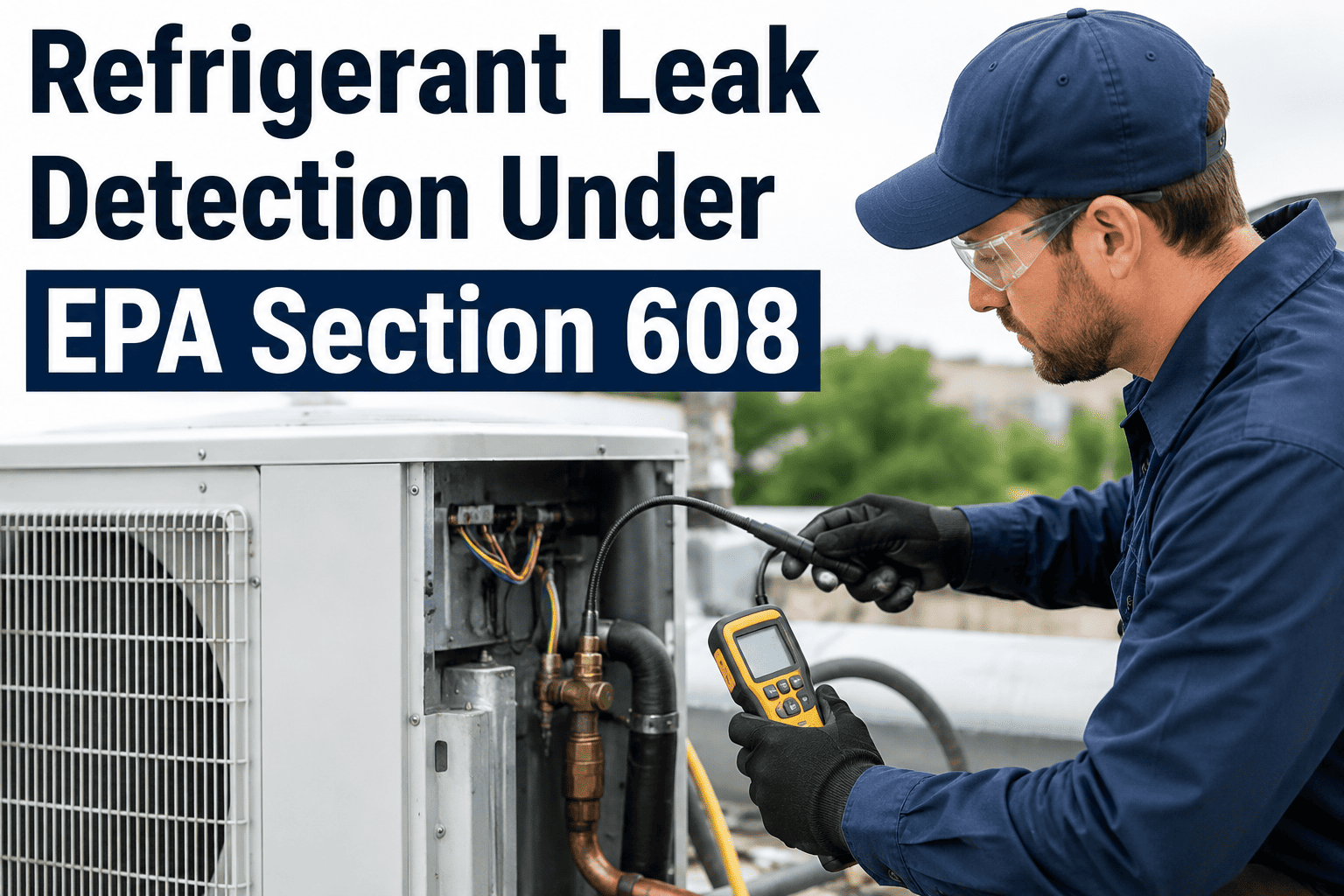
A certified technician detects a leak using an electronic leak detector meeting SAE J1627 or J2791 sensitivity standards, or an alternative approved method. The finding is logged in the CMMS with asset ID, refrigerant type, charge size, location, and method used.
Physical repair completed
The leak is repaired — valve replacement, joint re-weld, coil replacement, shaft seal swap — within 30 calendar days of detection. Extensions are available only for industrial process refrigeration under specific hardship conditions, and must be requested in writing.
Initial verification test
Within 30 days of repair the technician performs a verification test using an electronic detector or bubble test on every repaired joint and component. Results are recorded — pass or fail — in the compliance file.
Follow-up inspection by independent party
If the appliance exceeded its leak rate threshold, an independent certified technician — not the one who performed the repair — conducts a follow-up leak inspection within 12 months of the repair. The CMMS auto-schedules this obligation so it doesn't slip.
3-year documentation retention
All leak inspection, repair, verification, and follow-up records must be retained for a minimum of 3 years and made available to EPA upon request. The CMMS stores these against the asset record — searchable by serial number, refrigerant, or technician.
Recordkeeping Requirements · Audit Defense
The 8 records an EPA inspector will ask for first
EPA enforcement isn't theoretical — inspectors arrive with a records request list, not a clipboard. Every appliance over 50 lbs must have these documents current and retrievable within 24 hours of the request.
| # | Required Record | When | Retention |
|---|---|---|---|
| 01 | Appliance inventory: serial number, location, refrigerant type, full charge size | Maintained continuously | 3 years |
| 02 | Leak inspection reports with method, date, and technician certification number | Each inspection | 3 years |
| 03 | Refrigerant purchases and inventory logs (cylinders in/out) | Each transaction | 3 years |
| 04 | Refrigerant added per appliance — quantity and date | Each top-off | 3 years |
| 05 | Repair documentation: description, parts, labor hours, technician ID | Each repair | 3 years |
| 06 | Initial verification test results (post-repair) | Within 30 days of repair | 3 years |
| 07 | Follow-up inspection by independent certified technician | Within 12 months | 3 years |
| 08 | Retrofit/retirement plan (if 50% threshold breached 2 consecutive years) | Within 30 days of determination | 3 years |
Turn your leak detection program into an audit-proof system
Oxmaint's CMMS auto-schedules inspections, tracks refrigerant additions per asset, and flags threshold breaches before they become EPA violations — so your 608 compliance runs itself.
CMMS Compliance Program · Built for 608
How a CMMS operationalizes every 608 obligation
A spreadsheet won't survive an EPA audit. A CMMS built for refrigerant compliance turns the 608 rulebook into automated workflows — detection, documentation, and verification — without a single manual reminder.
Auto-scheduled inspections
Annual, semi-annual, and follow-up surveys generate as work orders 30 days before due — assigned to the certified technician on record, with the asset's charge size and leak history attached.
Threshold breach alerts
Every refrigerant top-off is logged against the asset's full charge. When the 12-month rolling leak rate crosses 20%, 30%, or 50%, the CMMS fires an alert to the facility manager and compliance lead — before the threshold is breached.
Audit-ready records
All inspection, repair, verification, and follow-up documents are stored against the asset record — exportable as a 608 compliance packet in PDF format within 60 seconds of an EPA request.
Technician certification tracking
Section 608 certification numbers are tied to each technician profile. Expired certifications block work order assignment — ensuring no inspection is ever invalidated by a lapsed credential.
Leak trend analytics
Rolling 12-month leak rate per asset, refrigerant loss in dollars, and year-over-year comparison — surfaced on a single dashboard so the compliance team sees which systems are trending toward breach.
Independent verification routing
When a threshold breach occurs, the CMMS auto-creates a follow-up work order routed to a third-party certified technician — separated from the original repair technician to satisfy 608's independence requirement.
Cost of Non-Compliance · The Penalty Math
What an unaddressed leak actually costs
The cost of inaction compounds fast. Refrigerant loss is the visible expense — but energy penalties, compressor damage, and EPA fines dwarf the refrigerant bill within a single cooling season.
A 180-asset cold storage operator spending $42K/yr on refrigerant top-offs
A mid-sized cold storage operator with 180 refrigerated assets was spending $42,000 annually on emergency refrigerant top-offs across 30 leaking systems — none tracked against leak rate thresholds. After implementing a CMMS-driven leak detection program, 22 of the 30 systems were repaired within the first quarter, reducing annual refrigerant spend to $11,400 (a 73% reduction). The remaining 8 systems were flagged for retrofit planning. Total program payback: 4.2 months. EPA audit exposure eliminated. The same CMMS now auto-schedules all 180 assets' inspections, tracks 14 technician certifications, and generates a compliance packet on demand.
FAQ · Section 608 Leak Detection
Answers to the questions cold storage operators ask most
What refrigerant charge size triggers Section 608 leak inspection requirements?
Any appliance containing 50 or more pounds of regulated refrigerant falls under Section 608's periodic leak inspection requirements. Below 50 pounds, appliances are exempt from scheduled inspections — but technicians must still use certified recovery equipment and cannot knowingly vent refrigerant. The 50-pound threshold applies to the full charge of the appliance, not to individual circuits.
How is the leak rate calculated and what triggers a mandatory repair?
The leak rate is the ratio of refrigerant added to the appliance's full charge, measured over a rolling 12-month period. For commercial refrigeration the trigger is 30%, for industrial process refrigeration 20%, and for comfort cooling 10%. Once exceeded, repair must occur within 30 days, followed by an initial verification test and — if the threshold was crossed — a follow-up inspection by an independent certified technician within 12 months. You can operationalize this entire workflow when you Start Free Trial with Oxmaint.
What records must be kept and for how long under Section 608?
Facilities must maintain appliance inventory (serial number, refrigerant type, charge size), leak inspection reports, refrigerant purchase and inventory logs, refrigerant added per appliance, repair documentation, verification test results, follow-up inspection reports, and any retrofit/retirement plans. All records must be retained for a minimum of 3 years and produced to EPA upon request within 24 hours.
Can a facility get an extension on the 30-day repair deadline?
Extensions are available only for industrial process refrigeration appliances under specific conditions: component delivery delays, force majeure events, or when an appliance requires a retrofit that cannot be completed within 30 days. The facility must submit a written extension request to the EPA before the deadline expires, documenting the specific hardship. Commercial refrigeration appliances do not qualify for extensions.
How does a CMMS help with EPA Section 608 compliance?
A CMMS like Oxmaint automates the four pillars of 608 compliance: scheduling inspections per asset and charge tier, logging refrigerant additions against each appliance's rolling leak rate, routing verification and follow-up work orders to appropriately certified technicians, and generating audit-ready compliance packets on demand. It eliminates the spreadsheet gaps that cause missed deadlines and undocumented repairs. To see the 608 compliance module configured for your facility, Book a Demo.
Start Your 608 Compliance Program
Stop losing refrigerant. Start passing audits.
Deploy Oxmaint's CMMS in under 24 hours. Auto-schedule leak inspections, track refrigerant per asset, flag threshold breaches before they trigger EPA penalties, and generate compliance packets on demand.
Free 14-day trial · No credit card