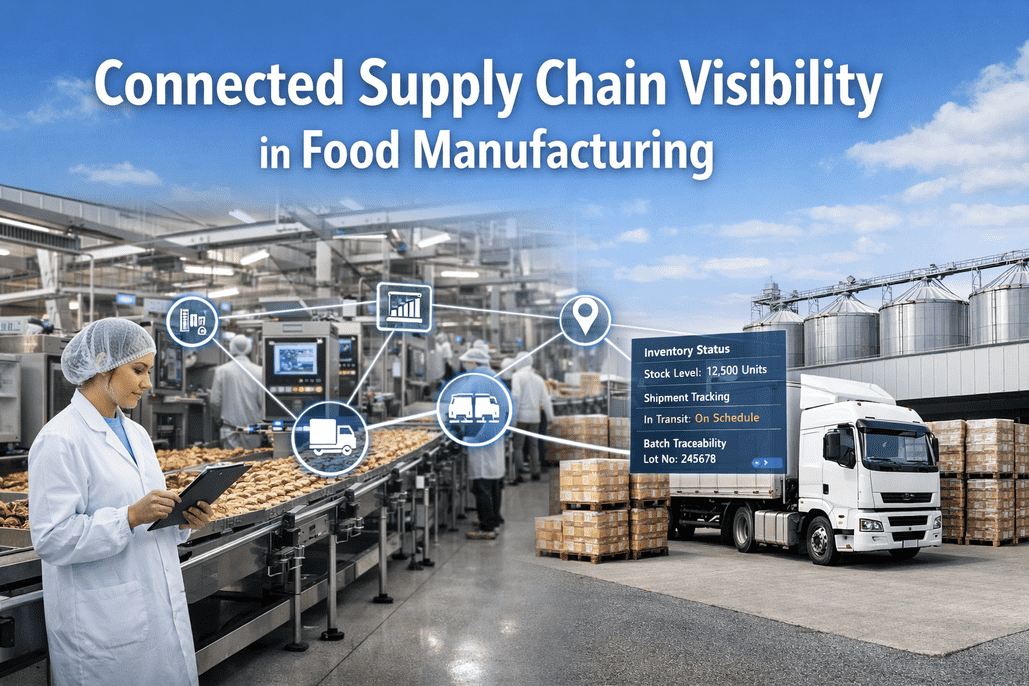
A mid-sized dairy processor in Wisconsin ran out of a critical packaging material on a Tuesday morning — not because their supplier failed to ship, but because no one in their facility had visibility into how fast the line was consuming it. The purchase order was in a spreadsheet. The inventory count was on a whiteboard. The production schedule was in someone's head. Three disconnected systems, zero connected visibility. Production halted for six hours. Overtime ran through the night. The missed delivery window cost $78,000 in contract penalties. The inventory that triggered it was worth $3,200. Sign up for Oxmaint to connect your asset tracking, inventory management, and production coordination into one live system — and eliminate the blind spots that cause exactly this kind of loss.
The Cost of Supply Chain Blind Spots in Food Manufacturing
Annual inventory shrinkage losses
globally — food manufacturers alone
Companies with supplier visibility gaps at tier 1
of food manufacturers (McKinsey)
Suppliers affected by manual-process delays
moderate to significant production impact
Supply chain IT spending increased in 2025
of organizations — digital transformation surge
Where Visibility Breaks Down: The 6 Critical Supply Chain Gaps
Food supply chain visibility doesn't fail at one point — it fractures across six interconnected stages. Each gap operates independently, but together they create a system where disruptions propagate invisibly until they become production crises. Book a demo to see how Oxmaint connects all six stages in a single trackable system.
Raw Material
Receiving
Lot numbers logged on paper — no link to supplier certificates or incoming QC
Ingredient
Inventory
Counts updated manually — discrepancies discovered only when stock runs out mid-production
Production
Floor
Equipment status and consumption rates invisible to procurement — no trigger for replenishment
WIP &
Staging
Work-in-progress quantities unknown in real time — bottlenecks invisible to shift supervisors
Finished
Goods Store
No real-time lot tracking — recalls require manual document search across multiple systems
Outbound
Dispatch
Dispatch records disconnected from lot traceability — FSMA 204 compliance at risk
⚠ Supply chain disruptions occur on average every 3.7 years — and cost companies ~8% of annual revenue. With no visibility, the response time doubles.
Market Reality Check
The Food Traceability Market Is Growing at 13% CAGR
The global food traceability market was valued at $13 billion in 2024 and is projected to reach $45 billion by 2034. Companies investing in supply chain visibility now are capturing the operational advantage — while those relying on manual systems are absorbing a compounding cost disadvantage.
65%
held by food & beverage manufacturers
Food Traceability Market Growth
Actual
Projected
FSMA Section 204: The Traceability Deadline That Cannot Be Ignored
The FDA's Food Traceability Rule under FSMA Section 204 — which came into effect with compliance expectations building from January 2026 — requires food manufacturers handling high-risk foods on the Food Traceability List to maintain Key Data Elements (KDEs) at every Critical Tracking Event (CTE). Manual systems cannot meet this standard reliably or defensibly. Sign up for Oxmaint to build FSMA 204-aligned traceability records into your day-to-day inventory and production workflows.
Critical Tracking Events (CTEs)
Records required at: receiving, transformation, creation, and shipping of high-risk foods. Each CTE must be documented with specific data elements — lot codes, quantities, locations, and dates.
ReceivingTransformationShipping
Key Data Elements (KDEs)
For each CTE, specific KDEs must be captured and retained: traceability lot codes, product descriptions, location identifiers, quantity and unit of measure, and references to preceding CTEs in the chain.
Lot CodesLocation IDsQty & UOM
24-Hour Recall Response
FDA can require complete traceability records to be produced within 24 hours of a recall event request. If your records live in paper binders or disconnected spreadsheets, this deadline is effectively impossible to meet.
24-hr DeadlineInstant ExportAudit Trail
51% of food companies cite production efficiency as their top reason to digitize. 48% cite better data for decision-making.
Both goals require the same foundation: a connected system where inventory, assets, and production data live in one place and update in real time.
How Oxmaint Closes the Visibility Gaps Across Your Supply Chain
Oxmaint's Asset & Inventory Tracking module connects the physical movement of materials, components, and finished goods to a live digital record — giving procurement, production, and QA teams a shared view of what is where, how much is left, and what needs to happen next. Book a demo to see live inventory and asset tracking in a food manufacturing workflow.
Real-Time Inventory Levels
Live inventory counts updated automatically as materials are received, consumed in production, or transferred between stores — eliminating the manual count cycle and its inevitable lag.
↓ 35% inventory discrepancies with connected tracking
Every incoming lot is tagged on receipt and tracked through every production stage — transformation, packaging, and dispatch. When a recall happens, full forward and backward traceability is available in seconds, not days.
24-hr FDA recall response capability built-in
Set minimum stock thresholds per ingredient or material. When inventory drops below the defined level, automatic alerts notify procurement before production is at risk — not after it has already stopped.
Zero unplanned stockouts when thresholds are set
Track where every critical asset — tools, equipment, portable instruments, spare parts — is in the facility at any time. End the 20-minute searches for the torque wrench and the missing calibration kit.
↑ 25% technician productivity from asset location visibility
Supplier Document Management
Certificates of analysis, supplier specs, and allergen declarations attached directly to incoming lot records — linked to the production batches that used them. Auditors get the full picture in one filtered export.
SQF / BRC document requirements met automatically
Inventory Consumption Analytics
Track actual material consumption rates against production orders — and compare them against standard BOMs. Variance alerts flag waste, yield losses, and over-consumption before they become cost line items in the month-end P&L.
↓ 15% inventory cost reduction from consumption visibility
Frequently Asked Questions
Questions food manufacturers ask before investing in connected supply chain visibility — answered without the sales pitch.
What exactly does "supply chain visibility" mean for a food manufacturer specifically?
For a food manufacturer, supply chain visibility means knowing — in real time — the status of every incoming material (lot, quantity, quality status), the current inventory level of every ingredient, the production consumption rate of materials on active lines, and the location and traceability of finished goods from production to dispatch. It is not about visibility into your suppliers' systems; it is about removing the blind spots within your own facility's four walls where most inventory and production losses actually occur.
How does connected inventory tracking help with food recalls specifically?
When a recall is triggered by a contaminated ingredient lot, connected inventory tracking lets you answer two questions instantly: (1) Which production batches used that lot? and (2) Where did those batches go — are they in finished goods storage, have they shipped, and to which customers? With paper records or disconnected systems, answering these questions takes days. With Oxmaint's lot-linked inventory and production records, the complete forward and backward traceability chain is available as a filtered report in under 60 seconds — meeting the FDA's 24-hour traceability record request requirement under FSMA Section 204.
Sign up free to start building these records from day one.
Is this relevant to smaller food manufacturers or only large enterprise operations?
Supply chain visibility is arguably more critical for smaller food manufacturers — not less. Larger facilities have dedicated procurement teams and ERP systems that provide some level of oversight. Smaller facilities often have one person managing inventory on a spreadsheet and one person managing production on a whiteboard, with no connection between the two. A stockout at a small facility is proportionally more damaging. FSMA 204 traceability requirements apply to the food category — not the company size. Oxmaint is priced and designed for single-facility food manufacturers, not just enterprise accounts.
What is the difference between inventory management and supply chain visibility?
Inventory management is a subset of supply chain visibility. Traditional inventory management tells you what you have in stock right now. Supply chain visibility connects that stock figure to where it came from (supplier lot, CoA, incoming QC result), where it went (which production batches consumed it, at what rate), and where the output went (which finished goods lots, to which customers). Supply chain visibility makes inventory management actionable — turning a stock count into an operational intelligence layer that prevents shortages, enables recalls, and supports compliance documentation simultaneously.
How long does implementation take and what data do we need to get started?
Getting started with Oxmaint requires an asset and ingredient list — which most facilities already have in some form, even if it is a spreadsheet. The initial setup involves loading your materials, setting reorder thresholds, and configuring your receiving and consumption workflows. Most food facilities complete this in one to two working days. Historical data migration is optional and not required to start capturing live traceability records from day one.
Book a demo for a walkthrough of the exact setup process for food manufacturing.
How does Oxmaint's inventory tracking support BRC and SQF audit documentation?
BRC Global Standard (Clause 3.9) and SQF Edition 9 both require documented traceability systems covering raw material receipt through finished goods dispatch, with the ability to trace product within four hours. Oxmaint maintains a continuous, timestamped audit trail linking supplier documents to incoming lots, production records to ingredient consumption, and finished goods to dispatch records — all filterable by date, lot, product, or supplier. One-click export generates the complete traceability package an auditor requests, without any manual document assembly.
Asset & Inventory Tracking for Food Manufacturing
You Can't Manage What You Can't See.
Oxmaint connects your receiving, inventory, production, and dispatch into one live system — so your team always knows what is where, what is running low, and where every lot has been from door to door.
✅ FSMA 204 traceability ready
✅ BRC & SQF aligned
⚡ Live in 1–2 days
? No credit card required
Production Consumption Tracking
✓
Lot & Batch Traceability
✓
Dispatch & Recall Records
✓