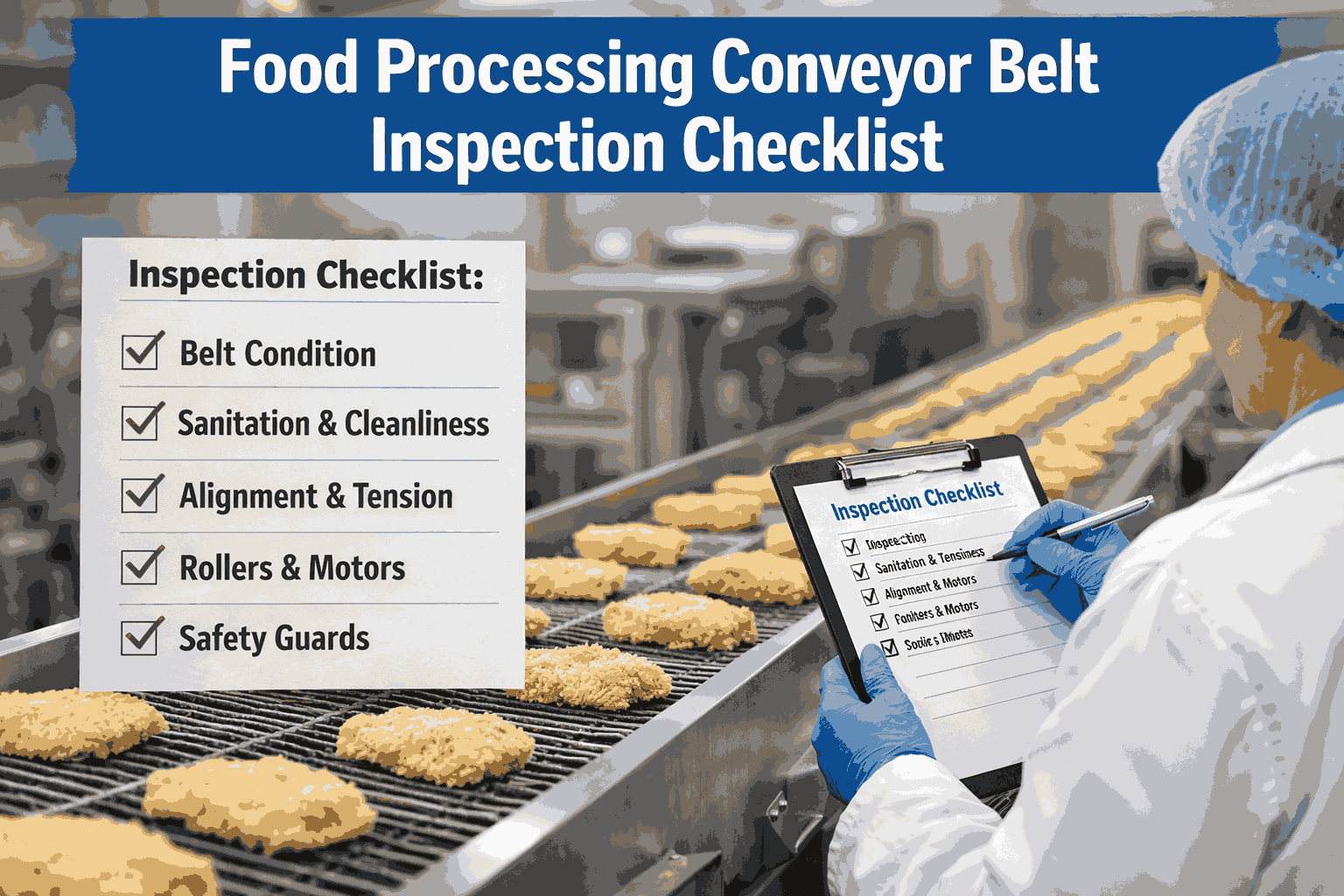
A snack food manufacturer in Texas was replacing conveyor belts every 8 months—far below the expected 18-month lifespan. When a new maintenance manager implemented systematic conveyor inspection with documented reports, the team discovered that operators were running belt tension 40% higher than specification to compensate for tracking issues caused by worn lagging on the tail pulley. Fixing the root cause and establishing proper inspection protocols extended belt life to 22 months and reduced annual conveyor maintenance costs by $67,000. The difference wasn't expensive equipment or new technology—it was structured inspection that caught problems early and documented findings that informed better decisions.
Asset Management / Inspection Guide
Conveyor Inspection Guide and Report Template for Food Manufacturing
Comprehensive inspection protocols. Standardized reporting. Extended equipment life.
Failures Preventable by Inspection
15 min
per conveyor
Standard Inspection Time
Why Structured Conveyor Inspection Matters
Conveyors are deceptively simple machines—belts, pulleys, bearings, and frames. This simplicity leads many facilities to treat conveyor maintenance as reactive: run it until something breaks, then fix it. But conveyor failures in food manufacturing don't just stop production—they create food safety risks, contaminate products, and damage expensive downstream equipment. A belt that sheds fragments contaminates product. A bearing that seizes can ignite combustible dust. A misaligned conveyor dumps product onto floors that require sanitation shutdown.
Effective conveyor inspection transforms maintenance from reactive to predictive. Trained inspectors can identify bearing wear by sound and temperature weeks before failure. Belt tracking issues visible during inspection prevent the edge damage that leads to unexpected breakage. Worn components spotted early can be scheduled for replacement during planned downtime instead of causing emergency stops during peak production.
73%
Of conveyor failures in food manufacturing facilities are preceded by observable warning signs that systematic inspection would detect. These aren't subtle instrumentation readings—they're visible wear patterns, audible bearing noise, measurable belt tension changes, and temperature variations that any trained technician can identify with basic tools and a structured inspection protocol.
The key to effective inspection isn't just looking at equipment—it's looking at the right things in a consistent way and documenting findings so trends become visible over time. A standardized inspection report captures conditions systematically, enabling comparison between inspections and identification of developing problems before they cause failures.
Complete Conveyor Inspection Points
A thorough conveyor inspection covers six major system areas. Each area has specific inspection points, acceptance criteria, and common failure indicators:
The belt is the primary wear component and first indicator of system problems. Belt condition reflects tension, tracking, and load conditions throughout the conveyor.
Inspection Points:
Surface wear pattern and depth
Edge condition and fraying
Splice integrity and alignment
Tracking position across width
Failure Indicators:
Uneven wear indicates misalignment
Edge damage indicates tracking problems
Pulleys drive and guide the belt. Lagging condition, crown profile, and alignment directly affect belt tracking and life. Pulley problems cause chronic belt issues.
Inspection Points:
Lagging condition and adhesion
Crown profile for belt tracking
Shaft alignment and runout
Buildup and material accumulation
Failure Indicators:
Worn lagging causes belt slip
Material buildup affects tracking
Bearings support all rotating components. Bearing condition is critical for reliability and food safety—failed bearings can contaminate product with grease or metal particles.
Inspection Points:
Temperature (infrared or contact)
Sound (ultrasonic or stethoscope)
Vibration and shaft play
Seal condition and lubrication
Failure Indicators:
Temperature rise indicates wear
High-frequency noise precedes failure
Motors, gearboxes, chains, and belts transfer power to move the conveyor. Drive system condition affects speed control, efficiency, and reliability.
Inspection Points:
Motor temperature and amp draw
Gearbox oil level and condition
Chain/belt tension and wear
Coupling alignment and condition
Failure Indicators:
Oil discoloration indicates wear
Chain stretch causes timing issues
The frame provides the foundation for all conveyor components. Structural issues cause alignment problems that accelerate wear on belts, bearings, and pulleys.
Inspection Points:
Frame level and alignment
Support leg condition and mounting
Fastener tightness
Wear plate condition
Failure Indicators:
Frame deflection under load
Loose mounting causes vibration
Guards, emergency stops, and interlocks protect personnel. Safety system inspection is both a reliability and compliance requirement in food manufacturing.
Inspection Points:
Guard presence and condition
E-stop function and accessibility
Pull cord operation
Interlock function verification
Failure Indicators:
Bypassed or damaged guards
Slow E-stop response
Get the Complete Inspection Report Template
Download our ready-to-use conveyor inspection report template with all inspection points, acceptance criteria, and documentation fields—customized for food manufacturing requirements.
Inspection Report Template Structure
An effective conveyor inspection report captures findings systematically for trending and action. Use this structure for consistent documentation:
01
Header Information
Asset ID and name, location, inspection date and time, inspector name, inspection type (routine/comprehensive/post-repair), conveyor runtime since last inspection. This enables filtering and trending across inspections.
02
Operating Conditions
Was the conveyor running during inspection? Product type being conveyed, ambient temperature, any recent changes to operation or product. Context helps interpret findings and compare between inspections.
03
Component Condition Ratings
Each major component rated on consistent scale: Good (no action), Fair (monitor/plan), Poor (action required), Critical (immediate action). Standardized ratings enable trending and prioritization across multiple conveyors.
04
Measurements and Readings
Actual values for key parameters: belt tension, bearing temperatures, motor amps, gearbox oil level, belt tracking position. Quantitative data enables objective trending rather than subjective assessment.
05
Photo Documentation
Photos of any abnormal conditions, wear patterns, or items requiring attention. Visual documentation supports work planning, enables remote review, and creates historical record of component degradation over time.
06
Actions and Follow-up
Required actions with priority and timing: immediate, within week, next PM, next shutdown. Clear action items ensure findings translate into maintenance activities. Links to generated work orders for tracking.
Inspection Frequency Guidelines
Different inspection levels serve different purposes. Match frequency to conveyor criticality and the type of issues you're trying to detect:
Purpose:
Detect obvious problems before production starts
Verify conveyor is safe to operate
Catch acute changes from previous shift
Duration/Scope:
2-3 minutes per conveyor. Visual and auditory check only. Report anything different from normal—sounds, smells, visible damage, tracking issues.
Purpose:
Monitor component wear progression
Verify operating parameters
Identify developing issues before failure
Duration/Scope:
10-15 minutes per conveyor. Includes bearing temperature check, belt tracking verification, tension check, and drive inspection. Documented on standard form.
Purpose:
Complete assessment of all components
Detailed measurements and documentation
Planning input for maintenance scheduling
Duration/Scope:
30-45 minutes per conveyor. All inspection points with measurements. May require conveyor stopped for some checks. Full documentation with photos.
Purpose:
Deep inspection of wear components
Predictive testing (vibration, thermography)
Capital planning and replacement scheduling
Duration/Scope:
1-2 hours per conveyor. Requires conveyor stopped. May include belt removal for pulley inspection, gearbox oil sample, detailed bearing analysis.
Purpose:
Complete system evaluation
Major component replacement decisions
Compliance documentation update
Duration/Scope:
Half day per conveyor during shutdown. Complete disassembly inspection of critical components. Structural assessment. Full documentation for asset records.
Purpose:
Verify repair quality and completeness
Establish new baseline after changes
Document as-left condition
Duration/Scope:
15-30 minutes depending on repair scope. Focus on repaired components plus related systems. Verify proper operation under load before returning to production.
Inspection Tools and Equipment
Effective conveyor inspection requires appropriate tools. Matching tools to inspection tasks ensures accurate assessment without over-investing in equipment:
Basic Tools (Every Inspection)
Required for all inspection levels
Flashlight for visual inspection of dark areas
Infrared thermometer for bearing temperatures
Belt tension gauge for tension verification
Straight edge for alignment and tracking checks
Mobile device for photo documentation and reporting
Standard Tools (Weekly/Monthly)
Enhanced capability for routine inspections
Ultrasonic bearing detector for early wear detection
Stroboscope for observing running components
Clamp meter for motor current measurement
Measuring tape and calipers for wear measurement
Mirror and borescope for hidden areas
Advanced Tools (Quarterly/Annual)
Detailed assessment and predictive capability
Vibration analyzer for bearing and shaft condition
Thermal imaging camera for comprehensive thermal survey
Laser alignment tools for pulley and shaft alignment
Oil sampling equipment for gearbox analysis
Belt wear gauge and splice inspection tools
Digitize Your Conveyor Inspections
Oxmaint provides mobile inspection tools with built-in checklists, photo capture, automatic work order generation, and trend analysis—turning inspection findings into preventive action.
ROI of Systematic Inspection
Investing time in structured conveyor inspection delivers measurable returns through extended component life, reduced failures, and better maintenance planning:
Early detection of tension, tracking, and alignment issues prevents accelerated wear. Components reach or exceed design life instead of failing prematurely.
Example Impact:
Previous belt life: 8 months
After inspection program: 14 months
Belt cost: $2,400
Annual savings: $1,700 per conveyor
73%
Preventable Failures Caught
Most conveyor failures show warning signs detectable through inspection. Catching problems early prevents emergency repairs and production disruption.
Failure Cost Avoided:
Emergency repair cost: $3,500 average
Production downtime: $4,200 average
Per failure avoided: $7,700
38%
More Planned vs Reactive
Inspection findings drive planned maintenance instead of emergency response. Planned work costs less and disrupts production less than reactive repairs.
Planning Benefits:
Planned repair cost: 35% lower
Parts availability: 95% vs 60%
Labor efficiency: 40% better
89%
Contamination Risk Reduction
Detecting bearing wear, belt degradation, and lubrication issues before failure prevents contamination events that could cause recalls or production holds.
Risk Mitigation:
Contamination incident cost: $50K-$500K
Inspection cost per year: $3K-$8K
Risk reduction: Significant
Typical Annual ROI for 20-Conveyor Food Manufacturing Facility
Food Safety Inspection Requirements
Conveyor inspection in food manufacturing must address food safety requirements beyond mechanical reliability:
SAN
Sanitary Design
Inspect conveyors for features that affect cleanability and prevent harborage of bacteria or allergens.
Belt surface condition for cleanability
Frame welds and joints sealed properly
No dead spaces or harborage points
Proper drainage of washdown water
LUB
Lubrication Safety
Verify food-grade lubricants are used appropriately and that lubrication points don't create contamination risk.
Food-grade lubricant verification
Seal integrity at lubrication points
No excess grease migration
Lubricant documentation current
MTL
Metal Detection
For conveyors upstream of or integrated with metal detection, verify proper function and reject capability.
Detector sensitivity verification
Reject mechanism function test
Reject bin/collection confirmation
Test piece documentation
DOC
Compliance Documentation
Maintain inspection records that support food safety audits and regulatory compliance requirements.
Timestamped inspection records
Inspector identification and training records
Corrective action documentation
Trend reports for FSMA compliance
Best Practices for Effective Inspection
Maximize the value of your conveyor inspection program with these proven practices:
1
Inspect Running and Stopped
Some conditions only show when conveyor is running (tracking, sound, vibration). Others require stopped inspection (belt condition, splice integrity). Plan for both.
2
Use All Your Senses
Look for wear, listen for bearing noise, feel for vibration and heat, smell for burning or overheating. Experienced inspectors use all senses to detect problems.
3
Measure, Don't Just Observe
Subjective observations are valuable, but measurements enable trending. Record actual belt tension, bearing temperatures, and motor amps—not just "looks OK."
4
Document with Photos
A picture is worth a thousand words for wear patterns and developing problems. Photo documentation supports work planning and creates historical record.
5
Act on Findings
Inspection without action is wasted effort. Every finding needs a disposition: fix immediately, schedule repair, monitor at next inspection, or document as acceptable.
6
Review Trends Regularly
Look at inspection data over time, not just individual reports. Trends reveal developing problems and help optimize PM schedules based on actual wear rates.
Frequently Asked Questions
How often should conveyors be inspected?
Inspection frequency depends on conveyor criticality and operating conditions. Most food manufacturing facilities use a tiered approach: operator walkthroughs every shift (2-3 minutes), routine maintenance inspection weekly (10-15 minutes), comprehensive inspection monthly (30-45 minutes), and detailed assessment quarterly (1-2 hours). Critical conveyors—those where failure stops production or creates food safety risk—may need more frequent inspection.
What are the most important conveyor inspection points?
The highest-value inspection points are bearings (temperature and sound for early wear detection), belt condition (tracking, tension, edge wear), and drive components (motor temperature, gearbox oil, chain tension). These components fail most frequently and show the most detectable warning signs. After these fundamentals, expand to structural inspection, safety systems, and detailed component assessment based on your specific conveyor types and failure history.
What tools are needed for conveyor inspection?
Basic inspection requires minimal tools: flashlight, infrared thermometer, belt tension gauge, straight edge, and a mobile device for documentation. For enhanced weekly inspections, add an ultrasonic bearing detector and clamp meter. Advanced quarterly assessments may use vibration analyzers, thermal cameras, and laser alignment tools. Start with basics and add tools as your program matures and demonstrates value.
How do we document inspection findings effectively?
Effective documentation uses standardized forms with consistent rating scales (Good/Fair/Poor/Critical), captures actual measurements rather than just observations, includes photos of abnormal conditions, and generates clear action items with priorities. Digital inspection tools on mobile devices make documentation faster and enable automatic trending and work order generation. The key is consistency—same format, same criteria, every time.
How quickly will we see results from a conveyor inspection program?
Most facilities see measurable improvement within 8-12 weeks of implementing structured inspection. Initial inspections often identify existing problems that can be addressed immediately for quick wins. Within 3-6 months, trending data begins revealing failure patterns and enabling predictive scheduling. Full program maturity—where inspection data drives all conveyor maintenance decisions—typically takes 12-18 months of consistent execution.
Start Inspecting Smarter Today
Oxmaint provides complete conveyor inspection tools—mobile checklists, photo documentation, automatic work orders, and trend analytics—everything you need to transform inspection findings into reliability improvement.