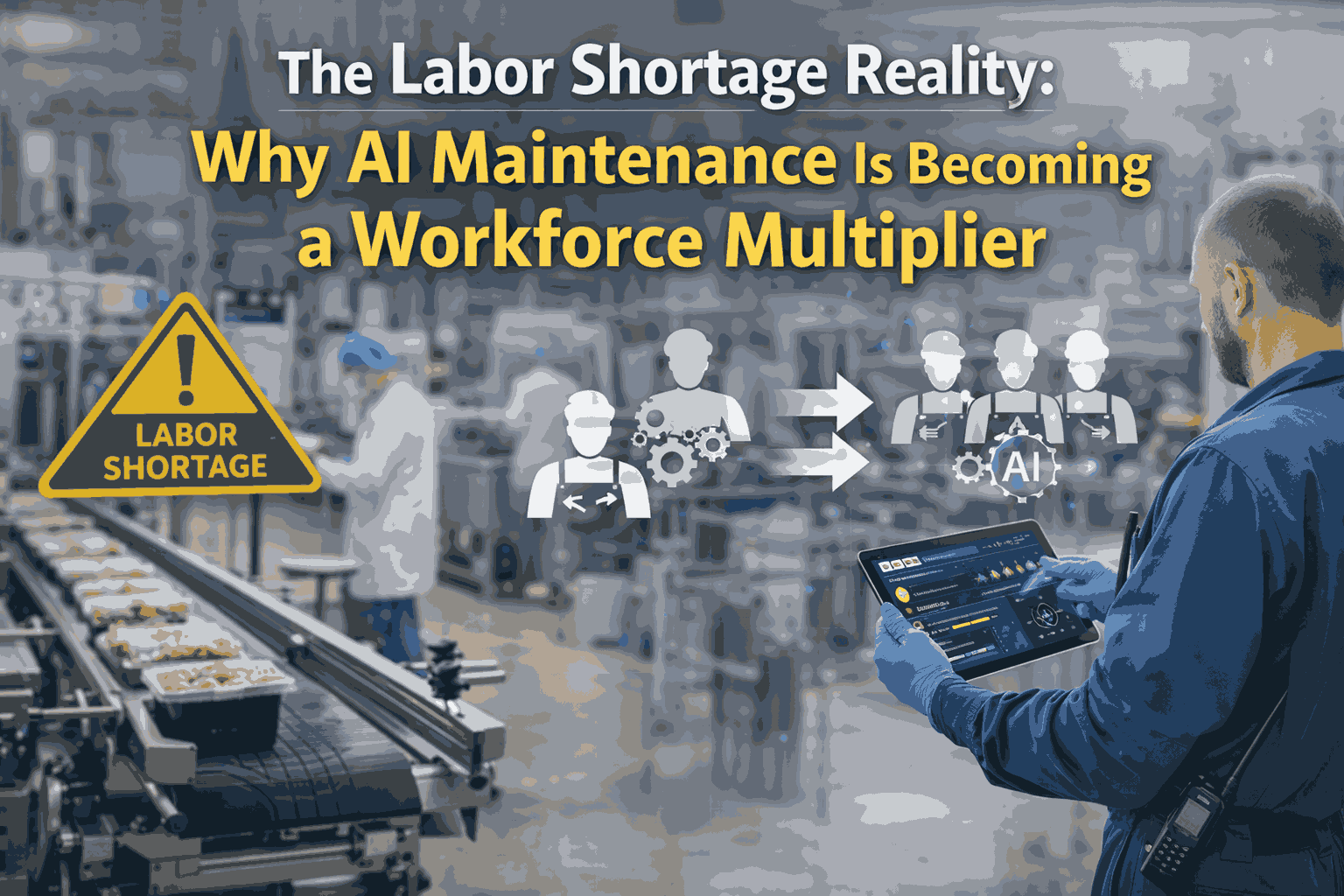
There are 622,000 unfilled manufacturing jobs in the U.S. right now. By 2030, Deloitte projects 2.1 million of those positions will remain vacant permanently. Food processing plants — already operating 24/7 with razor-thin margins — are absorbing the worst of it. The answer isn't hiring faster. It's working smarter. From production lines and quality control to maintenance and logistics, manufacturers are struggling to recruit, train, and retain skilled workers As demand for packaged and processed food continues to rise, workforce gaps are directly impacting productivity, compliance, and profitability.
Automation & AI
Labor Shortages in Food Manufacturing
How AI Maintenance Systems Are Letting Fewer People Do More — Without Burning Out
622K
Unfilled U.S. manufacturing jobs (Jan 2024)
2.1M
Jobs projected unfilled by 2030 (Deloitte)
7.5%
Rise in food manufacturing unit labor costs (2024 BLS)
40%
Facilities reporting overtime surge due to shortages
Where the Workforce Is Breaking Down
Inability to attract qualified workers
Increased overtime due to shortages
Reduced production capacity
Shortage of skilled maintenance technicians
Facilities still on reactive maintenance
Sources: FTI Consulting 2024, McKinsey, 2025 State of Industrial Maintenance
Food manufacturing isn't struggling because plants are shrinking. Capacity utilization is running above pre-COVID levels. The problem is that the people needed to sustain that output are vanishing — and the ones who remain are stretched thin.
The average age of industrial fixed assets is now 24 years — the oldest in nearly 70 years. Older machines need more attention. But the technicians who know those machines are retiring, and replacements aren't coming fast enough. Mean time to repair has climbed from 49 minutes to 81 minutes since 2022, driven almost entirely by skills gaps.
The $1 trillion annual cost of unfilled manufacturing positions by 2030 isn't an abstract number. It shows up in your overtime budget, your unplanned downtime log, and your quality incident reports.
The Hidden Maintenance Problem
Mean Time To Repair — Up 65%
The average repair now takes 81 minutes, up from 49. Technicians spend hours diagnosing before they even start fixing — because institutional knowledge walked out the door with the last retiree.
Facilities Still Reactive
More than half of food facilities spend less than half their time on scheduled maintenance. With a lean team, every unplanned breakdown is a crisis — pulling your best people off planned work to fight fires.
Per Hour of Unplanned Downtime
Plant Engineering estimates unscheduled downtime costs over $250,000 per hour in lost productivity, wasted labor, and spoiled materials — a cost no short-staffed plant can absorb.
Admin Time Eliminated by AI Work Orders
Capgemini 2025 found plants using AI-assisted work order generation trimmed administrative effort by 38% within six months. That's nearly two hours back per technician per day.
What AI Maintenance Actually Does for a Short-Staffed Plant
AI doesn't replace your maintenance team. It makes each person on it dramatically more effective.
01
Predictive Failure Alerts — Before the Breakdown
AI models analyze temperature, vibration, runtime, and historical failure data to flag assets trending toward breakdown — days or weeks in advance. Plants combining predictive AI with automated work orders report a 75% decrease in unplanned downtime (IDC 2025). One technician managing alerts is more effective than three technicians reacting to failures.
75% reduction in unplanned downtime — IDC 2025
02
Auto-Generated Work Orders — Zero Admin Lag
When a sensor detects an anomaly or a PM interval arrives, the system creates a fully populated work order — asset code, required parts, safety steps, technician assignment — without a manager touching anything. Work order backlogs fell 32% at AI-pilot sites (Deloitte 2024).
32% reduction in work order backlog — Deloitte 2024
03
Mobile-First Execution — No Desk, No Delays
Technicians receive tasks on their phones, complete digital checklists at the machine, scan QR codes for asset history, and upload photos — all without walking back to a terminal. Frost & Sullivan found mobile-first workflows save 58 minutes per technician per day. That's the equivalent of adding a part-time team member without hiring.
58 minutes saved per technician daily — Frost & Sullivan
04
Knowledge Capture — What Leaves When Veterans Retire
39% of maintenance leaders cite knowledge capture as the most valuable AI use case (2025 State of Industrial Maintenance). AI-assisted CMMS platforms capture tribal knowledge into searchable procedures, so a junior technician servicing Line 4 for the first time has the same effective knowledge as a 20-year veteran.
92% first-attempt success rate for junior techs with AI-assisted procedures
What Oxmaint-Powered Plants Are Achieving
42%
Reduction in total maintenance costs — from $840K to $487K annually
89%
Elimination of unplanned downtime — from 33 days per year to 3.6
25%
Technician productivity increase from CMMS-focused digital tools (Gartner)
70%
Fewer breakdowns with AI + machine learning-powered maintenance (Deloitte)
How Oxmaint Closes the Gap
Built for Plants Running Lean
Core Platform
AI-Powered Maintenance Scheduling
Oxmaint's AI engine analyzes your asset history, production schedule, and failure patterns to generate optimized maintenance plans — automatically. No scheduler needed. The system prioritizes critical assets, balances technician workloads, and adjusts in real time when priorities shift.
Reduces scheduling admin by up to 60%
Workforce Tools
Digital Work Orders on Mobile
Every work order reaches technicians on their phones — with asset history, required parts, step-by-step instructions, and photo documentation built in. Completion is logged instantly. Nothing falls through the cracks.
58 min/day saved per technician
Intelligence
Predictive Failure Detection
Connect IoT sensors and let Oxmaint flag anomalies before they become failures. AI detects asset degradation 3–5 months ahead of functional failure — turning emergency repairs into planned maintenance events.
75% fewer unplanned breakdowns
Knowledge
Tribal Knowledge Preservation
Capture and store every procedure, fix, and best practice your veteran technicians have accumulated. When they retire, that knowledge stays. New hires reach full productivity faster — with AI-guided step-by-step instructions at the point of work.
15% faster new hire onboarding (Gartner)
Analytics
Real-Time Workforce & Asset Dashboard
See which technicians are available, which assets are at risk, and which work orders are overdue — all from one screen. Stop managing by gut feel. Make staffing and maintenance decisions backed by live data, not spreadsheets.
Full operational visibility across all shifts
We went from firefighting daily equipment failures to having full visibility and control over our maintenance operations. Our technicians are more productive because they're doing planned work instead of emergency repairs. The CMMS paid for itself in seven months.
Mike Patterson — Maintenance Manager, Valley Fresh Dairy
Do More With Less — Starting Now
Is Your Plant Ready for AI Maintenance Automation?
If any of these sound familiar, Oxmaint was built for you.
Your maintenance team is short-staffed and stretched across too many assets
Unplanned breakdowns pull technicians off scheduled work every week
Experienced technicians are nearing retirement and taking their knowledge with them
Work orders are managed on paper, whiteboards, or spreadsheets
Overtime costs are rising because reactive maintenance takes longer than planned work
You have no real-time visibility into which assets are at risk of failing today
Frequently Asked Questions
Common Questions About AI Maintenance Automation
Everything you need to know about implementing AI-powered maintenance in your food manufacturing facility.
Your Team Is Small. Make It Powerful.
Stop Losing Ground to Labor Shortages
Oxmaint gives short-staffed food plants the AI tools to predict failures, automate scheduling, and preserve the expertise of every technician on the floor — so your team of five performs like a team of fifteen.
No credit card required
Setup in 24 hours
Cancel anytime