Enterprise Maintenance Management for Multi-Plant Food Operations

By Johnson on February 27, 2026

enterprise-maintenance-management-multi-plant-food-operations

A global snack manufacturer operating 12 plants across three countries discovered that their Chicago facility resolved conveyor breakdowns in 45 minutes—while the same failure in their São Paulo plant took over 6 hours. The difference wasn't talent; it was process. Chicago had standardized PM checklists in a centralized CMMS, while São Paulo relied on paper logs and tribal knowledge. After rolling out enterprise maintenance management across all 12 facilities, average repair time dropped 52%, compliance audit scores rose by 38%, and spare parts costs fell by $1.2M annually—because every plant finally operated from the same playbook. Sign up for Oxmaint to centralize maintenance across your food manufacturing plants today.

Enterprise CMMS / Multi-Plant Operations

Enterprise Maintenance Management for Multi-Plant Food Operations

When you operate food processing facilities across multiple locations, inconsistency is your biggest enemy. Different plants using different maintenance processes leads to unpredictable downtime, failed audits, and millions in preventable losses. Enterprise maintenance management brings every facility onto one platform—with standardized workflows, real-time visibility, and centralized KPI tracking.

82%
of food companies experienced unplanned downtime in the past 3 years
$30K
average cost per hour of unplanned downtime in food processing
42%
of unplanned downtime caused by equipment failures
3-5x
typical ROI from enterprise maintenance programs

The Multi-Plant Maintenance Problem

Food enterprises with multiple facilities face a compounding challenge: every location develops its own maintenance habits, creating dangerous blind spots that a single-site approach can never solve.

01
Siloed Data
Each plant tracks maintenance differently—spreadsheets here, paper logs there, maybe a local CMMS elsewhere. Corporate has no unified view of asset health, making it impossible to benchmark performance or allocate resources intelligently across facilities.
02
Inconsistent Compliance
FDA, FSMA, SQF, BRC, ISO 22000—regulations demand documentation at every plant. When each facility interprets compliance differently, one failed audit can shut down operations and trigger recalls costing millions.
03
Knowledge Trapped Locally
When a technician at Plant A solves a recurring mixer failure, that knowledge rarely reaches Plant B facing the same problem. Tribal knowledge stays local while the same failures repeat across your network.
04
Spare Parts Waste
Without cross-plant inventory visibility, facilities over-stock critical spares independently. One plant may have three surplus motors while another expedites the same part at premium cost—wasting capital on both ends.

Decentralized vs. Centralized Maintenance

The gap between fragmented and enterprise-wide maintenance management shows up in every metric that matters. Sign up for Oxmaint to centralize your operations.

Decentralized

Each plant manages independently

Cross-Plant VisibilityNone
Audit ReadinessWeeks of prep
PM Compliance Rate55-70%
Best Practice SharingAd hoc / verbal
Parts Spend Efficiency20-30% overspend
Inconsistent results, repeated failures
VS

Enterprise CMMS

Unified platform, standardized processes

Cross-Plant VisibilityReal-time dashboards
Audit ReadinessInstant reports
PM Compliance Rate92-98%
Best Practice SharingBuilt into workflows
Parts Spend EfficiencyOptimized cross-site
Consistent reliability across every plant

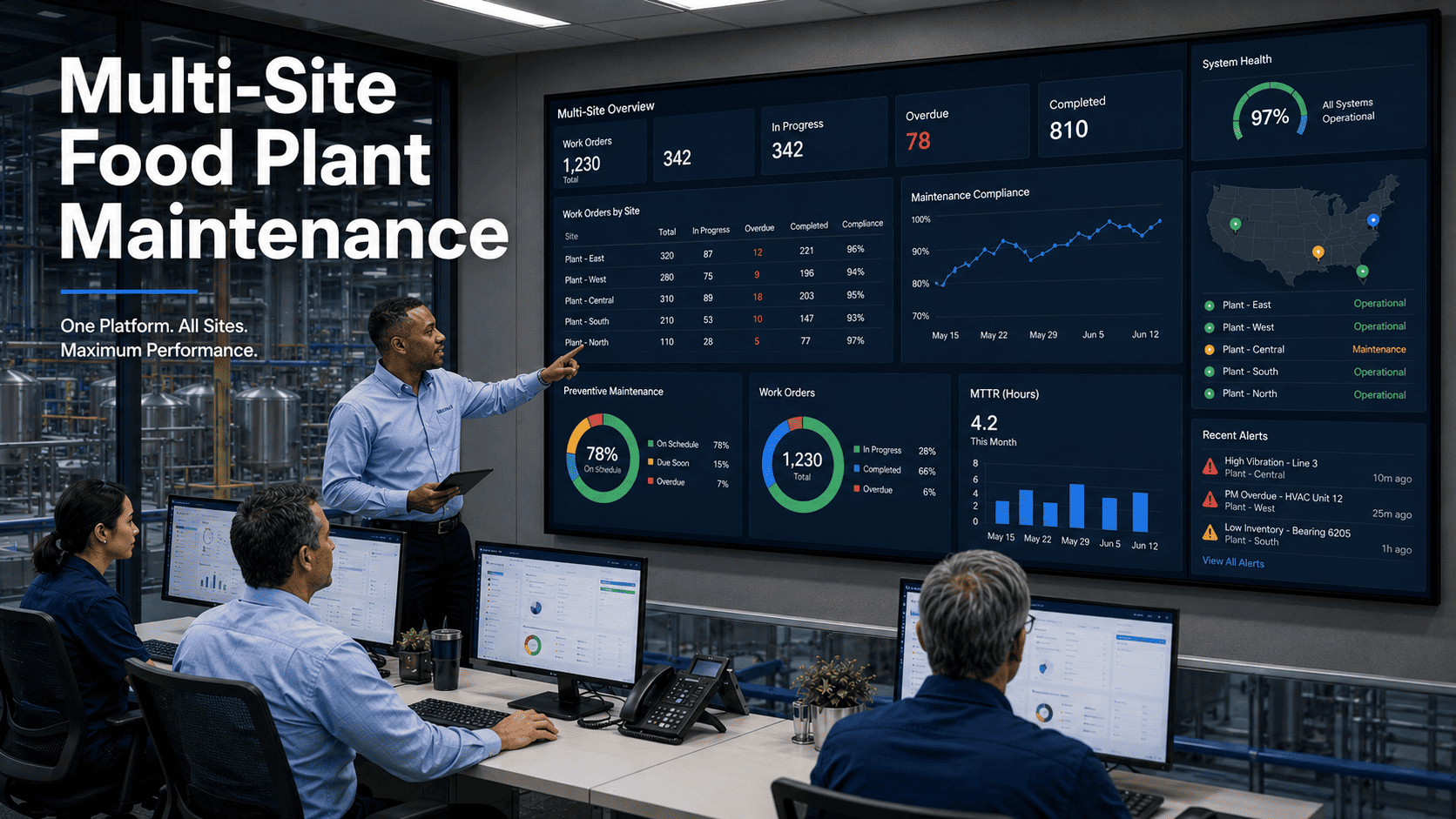
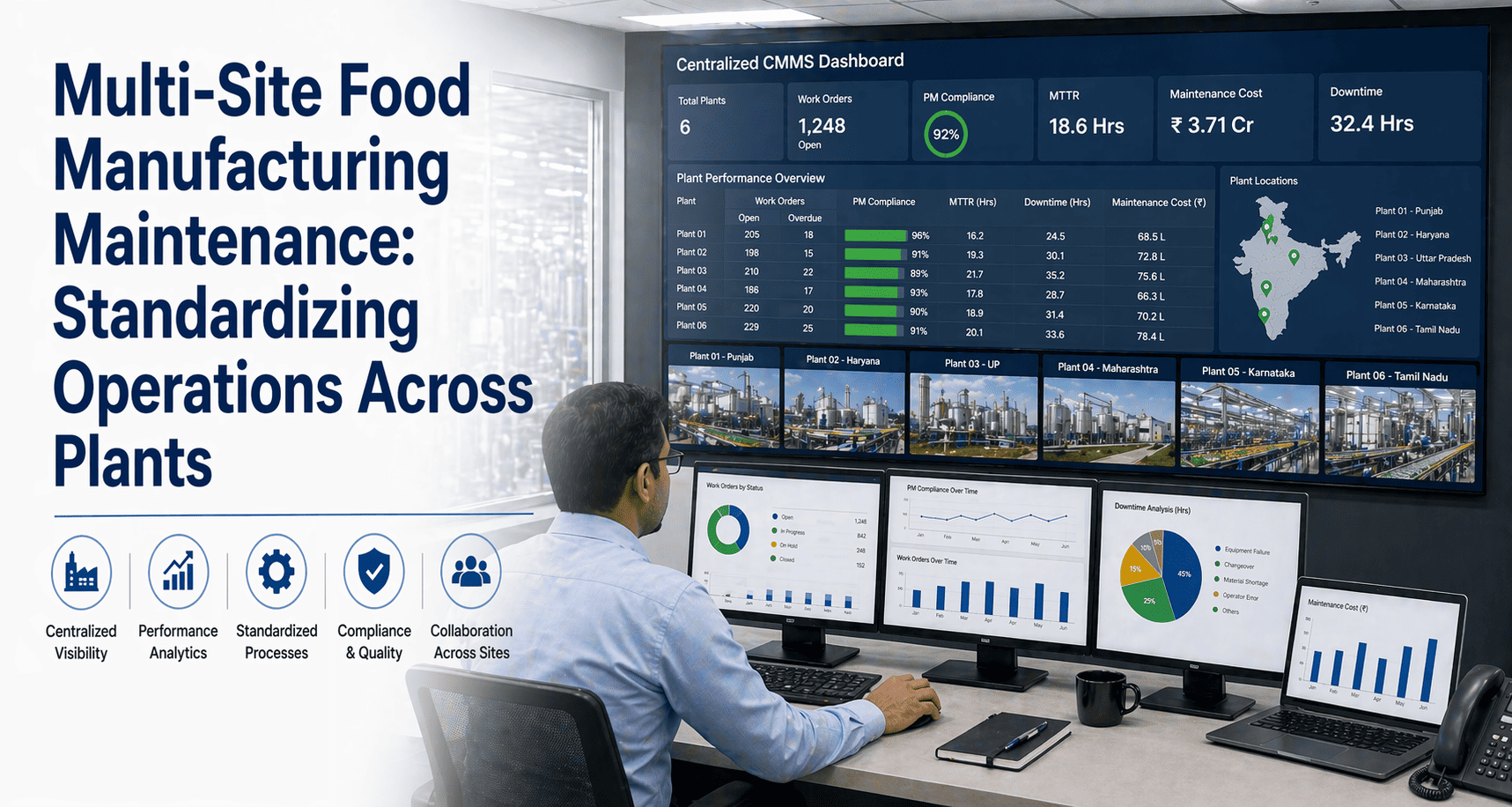
See Every Plant on One Dashboard

Oxmaint gives food enterprise leaders real-time visibility into maintenance performance across all facilities—from one login.

The Enterprise Maintenance Framework

Successful multi-plant food companies follow a structured framework to centralize maintenance without losing the agility each facility needs.

Standardize SOPs Across Sites

Create unified PM checklists, work order workflows, and inspection procedures. Every plant follows the same playbook—ensuring a conveyor PM in Dallas looks identical to one in Detroit. This eliminates variance that causes compliance gaps and repeat failures.

Centralize Asset Hierarchy

Build a single asset registry that maps every piece of equipment across all plants into one structured hierarchy. This enables corporate teams to compare the reliability of identical assets in different environments and identify systemic issues before they spread.

Deploy Cross-Plant KPI Dashboards

Track MTBF, MTTR, PM compliance, and unplanned downtime percentage across every facility from a single dashboard. When one plant's numbers drift, you see it immediately—not during the next quarterly review when it's too late.

Enable Knowledge Transfer

When technicians solve problems, those solutions become standardized procedures accessible to every plant. Root cause analyses, repair histories, and lessons learned flow automatically across facilities—turning individual wins into enterprise-wide improvements.

Multi-Plant Compliance Made Simple

Food enterprises must satisfy overlapping regulatory frameworks at every facility. A centralized CMMS keeps all plants audit-ready at all times. Book a demo to see how Oxmaint handles multi-site compliance.

FDA / FSMA
Preventive controls, hazard analysis, and traceable maintenance documentation—generated automatically from every work order across every plant.
SQF / BRC
International food safety certification requires consistent maintenance evidence. Standardized digital records eliminate the manual effort of preparing for each audit separately.
ISO 22000
Management system requirements demand cross-facility consistency. Enterprise CMMS ensures identical procedures, documentation standards, and corrective action workflows.
HACCP
Critical control point monitoring tied to equipment maintenance. When a freezer compressor gets serviced, the CMMS logs it as part of your HACCP plan automatically.

What Enterprise Maintenance Delivers

Food companies that centralize maintenance management across multiple plants consistently report measurable improvements within the first year.

40%
Reduction in unplanned downtime through standardized PM and cross-plant trend monitoring
52%
Faster mean time to repair with shared repair histories and standardized procedures
95%+
PM compliance rate across all plants through automated scheduling and tracking
18%
Reduction in spare parts spend through cross-plant inventory visibility

Oxmaint Enterprise Features for Food Operations

Purpose-built capabilities for food companies managing maintenance across multiple processing facilities. Schedule a demo to see these in action.

Multi-Site Dashboard

View KPIs, work order status, and asset health for every plant from a single corporate dashboard—with drill-down capability to individual equipment.

Standardized PM Templates

Create once, deploy everywhere. Master PM checklists push to all facilities with local customization options—ensuring consistency without rigidity.

Cross-Plant Analytics

Compare MTBF, MTTR, downtime, and compliance metrics side-by-side across plants. Identify top performers and replicate their practices system-wide.

Escalation Workflows

Critical failures auto-escalate to regional or corporate maintenance leaders. No issue stays hidden at a plant level when it needs enterprise-level attention.

Mobile-First for Technicians

Technicians on the plant floor receive work orders, log completions, and capture photos from any device—even offline in cold storage areas.

ERP and IoT Integration

Connect with your existing ERP for parts procurement and production scheduling. Receive equipment sensor data to trigger condition-based work orders automatically.

Frequently Asked Questions

How long does it take to roll out enterprise CMMS across multiple food plants?
Most food enterprises start with a pilot at one facility, then roll out to additional plants in phases. Oxmaint's cloud-based architecture means each new plant can be onboarded in days, not months—with standardized templates already configured from the pilot. A typical 5-plant deployment completes within 8-12 weeks. Sign up for Oxmaint to start your pilot today.
Can each plant maintain some local flexibility within the enterprise system?
Absolutely. Oxmaint supports a "standardize globally, customize locally" approach. Corporate sets the master PM templates, KPI targets, and compliance workflows. Individual plant managers can add location-specific tasks, adjust scheduling around their production calendars, and configure alerts for their unique equipment mix.
What if our plants currently use different maintenance systems?
This is the most common starting point. Oxmaint handles data migration from spreadsheets, legacy CMMS platforms, and paper-based systems. Historical work order data and asset records can be imported to preserve institutional knowledge during the transition.
How does centralized maintenance help with food safety audits?
Auditors want to see consistent, documented maintenance practices. Enterprise CMMS provides instant access to complete maintenance histories, PM completion records, and corrective action logs for any asset at any plant. What used to require weeks of file-pulling becomes a few clicks. Book a demo to see audit reporting in action.
Does Oxmaint support multi-language and multi-currency for international operations?
Yes. Food enterprises operating across regions need localized interfaces for technicians while maintaining unified reporting for corporate leadership. Oxmaint supports multiple languages, time zones, and currency formats within the same enterprise deployment.

One Platform. Every Plant. Total Visibility.

Stop managing maintenance plant-by-plant. Oxmaint gives food enterprise leaders the centralized control, standardized processes, and cross-plant analytics needed to drive reliability at scale—while keeping every facility audit-ready.
Share This Story, Choose Your Platform!