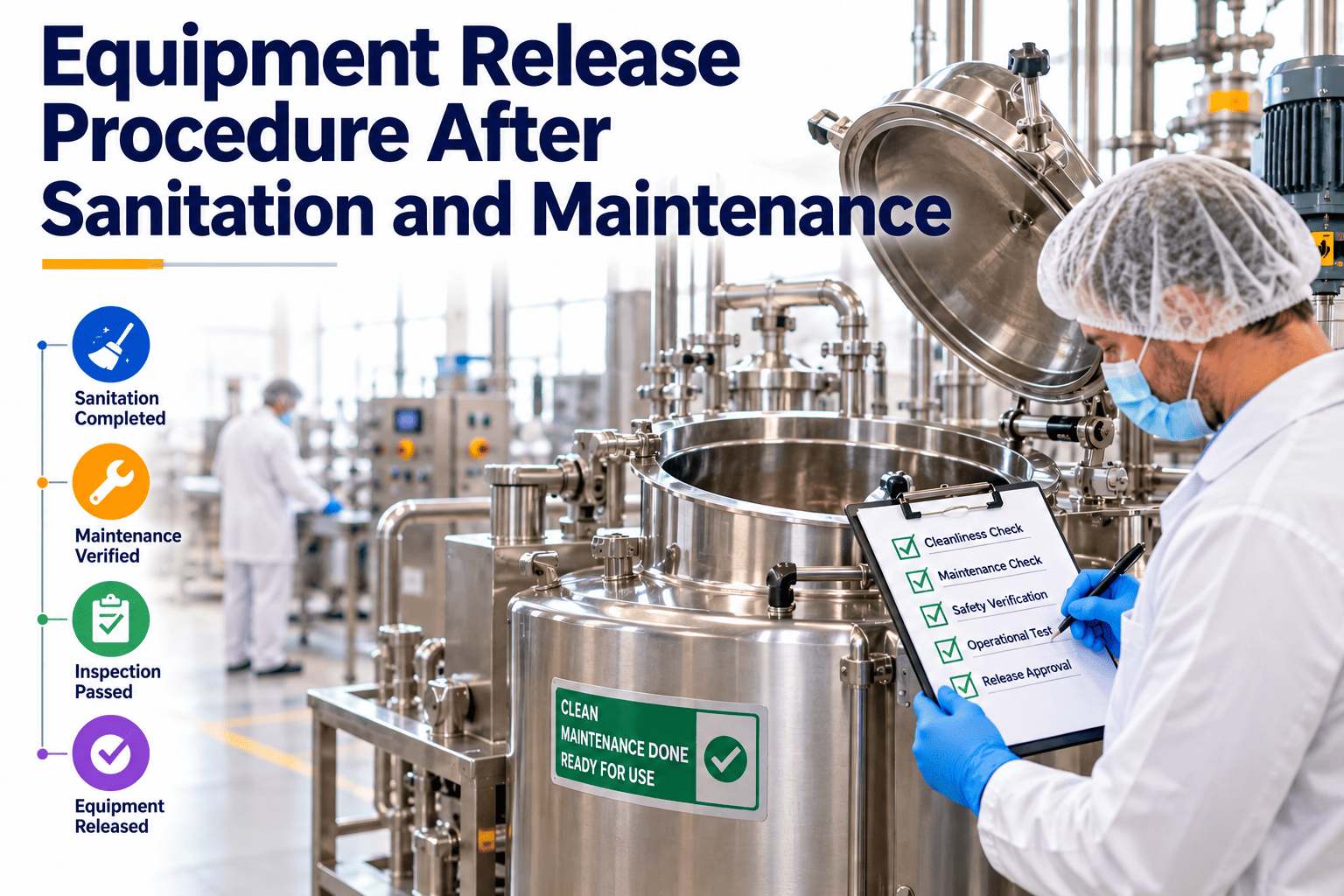
The most expensive minutes in a food plant are the ones after cleaning or repair, when everyone assumes someone else has confirmed the equipment is ready. Without a defined release procedure, a line can restart with a guard missing, a tool left inside, sanitizer residue on a belt or an open work order nobody closed. This article explains who should verify and release equipment, in what order, and with what evidence, and how maintenance management software can enforce the sequence.
Equipment Release Procedure After Sanitation and Maintenance
Define who verifies and releases equipment after cleaning or repair so production starts safely, with clear holds, signatures and evidence at each handoff.
Why release procedures go missing
Most plants have a cleaning procedure and a repair procedure, but the handoff between them is informal. That gap is where preventable incidents start.
Typical failure scenarios
- Maintenance finishes a repair after sanitation has ended and nobody re-cleans the area.
- Sanitation assumes maintenance removed all fasteners, wire and tools, and maintenance assumes the opposite.
- A supervisor verbally releases a line while an inspection item is still open.
- Lockout devices remain on a machine that production believes is ready.
- Equipment is released wet, with sanitizer pooled in low points or electrical enclosures.
- Different shifts use different criteria, so release decisions change with the person on duty.
Consequences
- Foreign material in product.
- Allergen or microbial carryover.
- Repeat repairs on newly restarted equipment.
- Rework, holds and delayed shipments.
- Records that cannot support a customer complaint or audit.
A six-stage release sequence
Each stage has an owner, an input and an output. Skipping a stage requires a written exception, not a verbal shortcut.
Work completion
The technician or sanitation lead states that the job is finished, closes the task and lists any parts, chemicals or components changed.
Tool and material count
Tools, fasteners, wire, tape, rags and packaging are counted out and accounted for before covers close.
Post-repair cleaning
Any area touched by maintenance is cleaned and sanitized according to the sanitation procedure before inspection.
Verification inspection
An authorized person inspects cleanliness, assembly and dryness, and records findings with time stamps.
Functional check
Guards, interlocks and safety devices are tested, and the line is run empty where the process allows.
Formal release
The designated releaser signs, removes the hold tag and informs production before the first product loads.
Who verifies, who releases
Define roles in the procedure itself, not in the head of a long-serving supervisor. The table below is a typical starting point to adapt to your organization.
| Activity | Performs | Verifies | Releases |
|---|---|---|---|
| Routine cleaning without repair | Sanitation crew | Sanitation supervisor | Quality or authorized supervisor |
| Planned preventive maintenance | Maintenance technician | Maintenance lead | Quality after sanitation verification |
| Corrective repair on product-contact parts | Maintenance technician | Maintenance lead and sanitation | Quality |
| Repair during production | Maintenance technician | Quality with production | Quality, with product risk assessment |
| Allergen changeover | Sanitation crew | Qualified inspector plus test as required | Quality |
Separate the doer from the approver
The person who performed the work should not be the only person who approves its release.
Making a hold visible and hard to ignore
A release procedure fails if a hold is easy to bypass. Combine a physical signal with a record.
Physical tag
Use a uniquely colored hold tag at the machine, with the reason, date, time and name of the person who applied it.
System status
Mark the asset as unavailable in the maintenance system so planners and production see the hold without walking the floor.
Defined authority
List who can lift each type of hold, and require a recorded reason and signature when it is lifted.
What to capture on the release record
A release record should let someone who was not present reconstruct what was done, who checked it and why the line was allowed to run. Short, structured fields beat long free-text notes.
| Field | Details to record | Purpose |
|---|---|---|
| Equipment identity | Asset name, tag number, line and location | Links the release to a specific machine |
| Trigger | Sanitation, planned maintenance, repair or changeover, with work order number | Shows why release was needed |
| Work summary | Parts changed, chemicals used, areas opened | Defines the scope of verification |
| Checks completed | Tool count, lockout cleared, cleaning verified, function tested | Proves each stage occurred |
| Findings and actions | Defects found, corrective action, re-inspection result | Shows problems were closed |
| Decision | Release, release with restriction or hold | Records the outcome clearly |
| Signatures | Performer, verifier, releaser with date and time | Provides accountability |
The tool count that prevents most repair-related contamination
Repairs introduce items that do not belong in a food plant. A simple discipline of counting them in and out removes much of that risk.
Count in
Before work starts, the technician lists tools, consumables and spare fasteners, and a second person confirms the list or a tool shadow board is used.
Control during work
Use detectable tools and consumables where possible, cover open product zones, and keep parts and offcuts in marked containers.
Count out
After work, every item is accounted for before covers are closed. Any missing item triggers a search and a documented decision before release.
Where release procedures fail in practice
Understanding the usual failure modes helps you design controls that people can follow at speed.
Release by habit
Experienced supervisors release equipment by looking at it and trusting their instincts. This works until a new person covers the shift without that experience. Written criteria and a checklist make the standard transferable.
Pressure to restart
When orders are late, the release step feels like a delay. Give releasers explicit authority to hold a line, and track holds as a quality control rather than a production failure.
Paper that gets lost
Tags and sheets disappear between shifts. A shared system status and time-stamped digital sign-off keep the current state visible to everyone who needs it.
Unclear scope
A technician replaces one bearing but disturbs a guard, a seal and a cable. Recording what was opened, not only what was fixed, lets the inspector check everything touched.
Preparing people to verify and release
Authority to release equipment is a responsibility, and it should rest on documented training. Competence is built in stages and renewed on a schedule.
Learn the standard
Review the written procedure, hygiene rules and allergen plan.
Shadow an expert
Observe several releases and discuss borderline decisions.
Perform with oversight
Complete releases while a qualified person reviews the record.
Authorize and refresh
Grant sign-off rights and retrain after procedure changes or incidents.
Questions your release records should answer quickly
Customers and certification bodies often ask for examples of a specific event. Test your system by choosing a repair at random and tracing it from start to restart.
- Who did the work and what exactly was changed?
- When was the area cleaned and sanitized relative to the repair?
- Who inspected it and what criteria did they use?
- Who released it and at what time?
- Were any exceptions or restrictions granted and why?
- What was the first product run after release?
- Were there complaints, rejections or findings afterward?
- How was the process reviewed after any incident?
Introducing the procedure in four phases
Plants that change everything at once usually revert within weeks. A staged rollout builds trust and exposes practical problems while they are still small.
| Phase | Focus | Typical activities | Exit signal |
|---|---|---|---|
| Map | Understand current practice | Observe real releases on each shift, list informal steps and note where records are missing | Agreed picture of how release actually happens |
| Define | Write roles and criteria | Draft the sequence, tiers of repair risk and checklists with sanitation, maintenance and quality together | Procedure approved and training material ready |
| Pilot | Test on one line | Run the new workflow in Oxmaint, collect feedback and adjust forms and permissions | Consistent use across all shifts on the pilot line |
| Extend | Scale and review | Roll out line by line, review indicators monthly and audit sample releases | Stable lead times and few rejected releases |
Involve the people who press start
Production supervisors should help shape the procedure. If they see the hold as a protection for them as well as for product, they are far more likely to support it under pressure.
Signs the procedure has taken hold
Look for behavior changes on the floor rather than only for completed forms. These observations show whether the release step is part of how work gets done.
First thirty days
- Every release has a named verifier and releaser.
- Hold tags are used and removed with a recorded reason.
- Staff ask what the criteria are before the inspection, not after.
By ninety days
- Rejected releases fall as crews learn the criteria.
- Work orders no longer close without tool counts.
- Shift handovers include the status of open holds.
Ongoing
- Monthly review leads to design or maintenance fixes.
- New hires are trained on release before authorization.
- Audit tracing of a random repair takes minutes, not hours.
Keep the procedure current
Equipment, products and staff change, so the release procedure should be reviewed on a fixed schedule and after every serious incident or near miss.
Triggers for an immediate review
- New equipment, a line modification or a change in allergen profile.
- A foreign material complaint or rejected shipment linked to a repair.
- A customer or certification finding about release records.
- Repeated rejected releases on the same asset or shift.
Enforce the sequence instead of relying on memory
Link work orders, sanitation tasks and release sign-off so no line restarts with an open step.
What must be true before sign-off
Criteria differ slightly after sanitation, after maintenance and after both. Use the matching column so inspectors do not apply the wrong standard.
After sanitation only
- Cleaning steps were completed in order and recorded.
- Surfaces are visibly clean and free of chemical residue.
- Required sanitizer concentration was verified.
- Equipment is reassembled and dry.
After maintenance
- Work order is complete with parts and actions recorded.
- Lockout is cleared and the clearance is documented.
- Tools and materials are counted and removed.
- Lubricants are food grade and no excess remains.
After repair on product-contact parts
- The area was cleaned and sanitized after the repair, not before.
- Welds, replacements and fasteners meet hygiene requirements.
- A foreign material check was done, including metal detector or X-ray function where applicable.
- Quality has inspected and approved.
Before first product
- Safety devices and interlocks function as designed.
- Line has been run empty or tested as the process allows.
- Production has confirmed the product and allergen plan.
- The releaser has signed with time and name.
Emergency repairs, night shifts and outside contractors
Procedures break under pressure. Decide the rules for difficult cases in advance.
| Situation | Risk | Required control |
|---|---|---|
| Breakdown during production | Foreign material and contamination near open product | Stop and protect product, isolate the area, assess product on hold, follow the full release before restart |
| Night or weekend work | No quality person on site | Designate an on-call releaser or require a second trained person and quality review at start of next shift |
| Outside contractor work | Unfamiliar hygiene rules, unrecorded tools and materials | Contractor induction, tool inventory, escort and mandatory handover before release |
| Partial repair with deferred completion | Equipment released with known defect | Documented risk assessment, restrictions on use and a dated follow-up work order |
Turning the procedure into a workflow
The release procedure works best when the maintenance and sanitation tasks live in the same system and cannot close out of order.
Work order
Maintenance task opens against the asset with lockout and safety steps.
Closure checklist
Technician confirms tool count, parts and lockout removal before closing.
Sanitation task
Cleaning and verification is scheduled for the same asset after the repair.
Inspection
Inspector completes the pre-op form with photos and notes.
Release record
Authorized sign-off updates the asset status and unlocks production.
Indicators of a healthy release process
Track a few indicators and review them with maintenance, sanitation, quality and production together.
Release lead time
Time between work completion and signed release.
Releases rejected
Share of release attempts returned for rework, by cause.
Post-restart issues
Events within a short time of restart linked to the repair.
Open exceptions
Releases granted with restrictions and still not closed.
Equipment release procedure FAQs
Should maintenance or sanitation sign off first?
Maintenance completes and clears its work first, then sanitation cleans the area, then a separate inspector verifies and releases. That order prevents rework.
Who is authorized to release equipment?
Name roles in your procedure, usually quality or trained supervisors. Authorization should be recorded in training files and enforced by system permissions.
Do minor repairs need the full sequence?
Use a risk-based tiering. Product-contact repairs always need full release, while minor non-contact work may use a shorter checklist defined in advance.
Can this be tracked in a CMMS?
Yes. Oxmaint links work orders, inspections and asset status so releases follow a recorded path.
How do we introduce this without slowing production?
Start with one line, measure lead time and refine. A demo can show how plants stage the rollout.
Make every restart a verified restart
Give maintenance, sanitation and quality one shared release workflow with signatures you can retrieve in seconds.