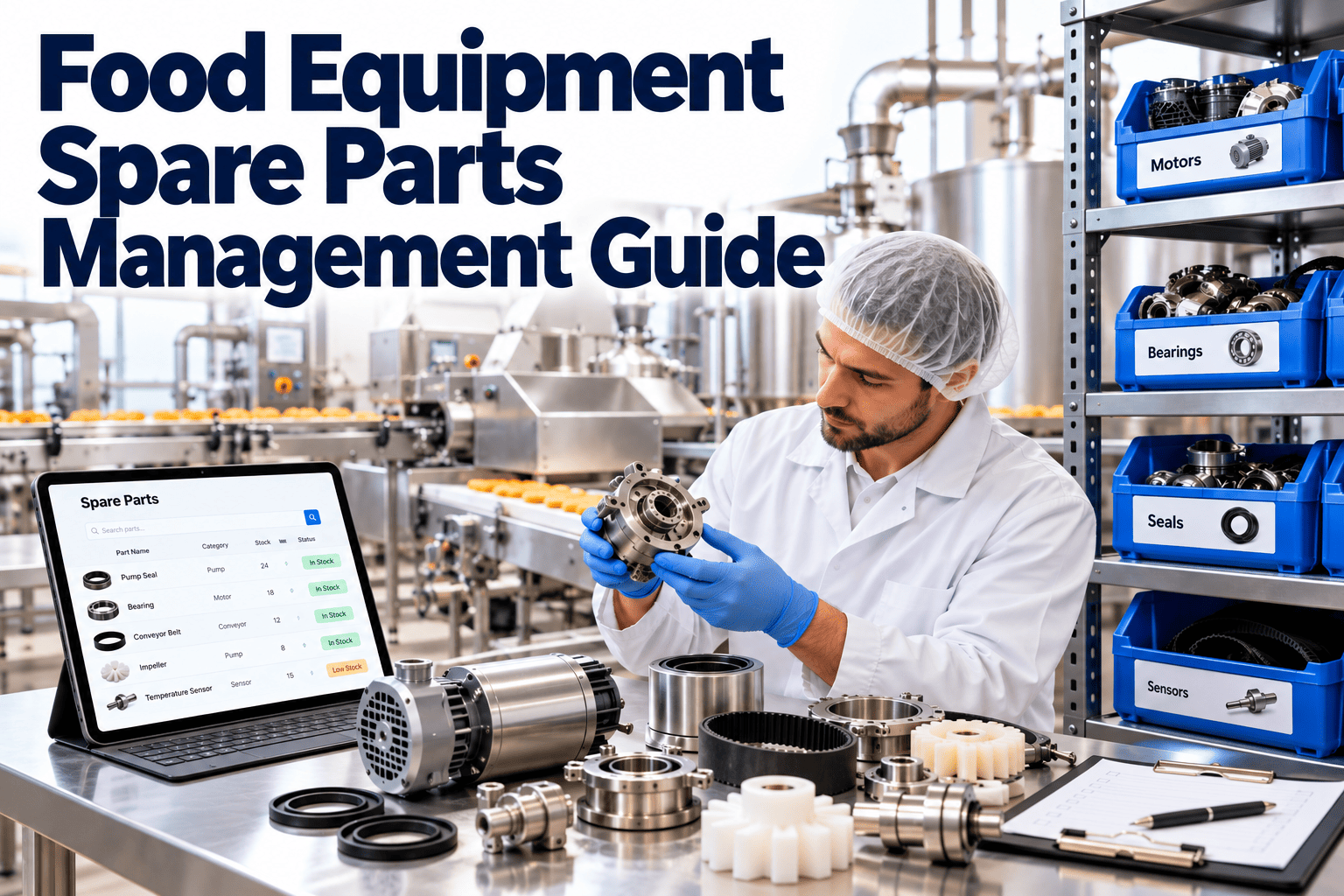
A missing gearbox seal can stop a filler for days, while a shelf full of rarely used parts quietly ties up cash. Food plants face a third problem as well: parts that touch product must be compatible with food safety requirements, so a convenient substitute is not always acceptable. Good spare parts management balances downtime risk, lead time, cost and approval status for every item in the storeroom. Tracking those decisions in Oxmaint links each part to the asset, the work order and the reorder rule.
Food Plant Maintenance
Food Equipment Spare Parts Management Guide
Stock the right wear parts, approve food-contact materials and keep downtime from waiting on a delivery.
Start with criticality, not with the catalog
Ask about the asset
- Does failure stop the line?
- Is there a backup unit?
- Could failure create a food safety event?
Ask about the part
- How long does delivery take?
- Can it be repaired or rebuilt?
- Is the supplier local or sole source?
Ask about use
- How often is it consumed?
- Is wear predictable?
- Does it shelf-age, like seals and belts?
Typical food plant parts and how to stock them
| Part family | Why it matters | Stocking approach |
|---|---|---|
| Conveyor belts and modular sections | Wear from washdown and product contact | Keep spare sections for critical lines |
| Bearings and seals | Washdown and chemicals shorten life | Min and max levels by size |
| Gaskets and door seals | Cooling failures can become deviations | Stock for refrigeration and ovens |
| Cutting blades and knives | Wear and metal contamination risk | Issue by count, return worn items |
| Motors, drives and sensors | Long lead time, high downtime | One spare for critical assets |
| Temperature probes | Monitoring depends on them | Calibrated spares on the shelf |
Control food-contact part approval
Specify
Record the material and food-contact requirement for each part.
Approve
Quality reviews the supplier documentation before the part is stocked.
Label
Mark and store approved parts separately from general stock.
Issue
Issue against a work order so the part history stays traceable.
Know what is in the storeroom before the line stops
Link parts, assets and work orders with reorder points you can trust.
Set reorder points with a simple rule
- Use work order history to estimate real consumption.
- Raise safety stock for single-source or imported parts.
- Review max levels so slow movers do not pile up.
- Count critical items on a regular cycle, not once a year.
Storeroom habits that prevent downtime
- Bin locations that match the system record
- Kits for planned shutdown jobs
- Shelf-life dates on rubber and elastomer parts
- Vendor repair options for motors and gearboxes
Measures to track
The cost of getting spares wrong
Too few spares
A missing part turns a short repair into a long stop. Rush freight, overtime and lost production usually cost more than carrying the part.
Too many spares
Excess stock ties up cash, takes storeroom space and can age on the shelf. Rubber, seals and some lubricants have limited shelf life.
Wrong parts
Approximate substitutes can create fit, performance and food safety problems. In a food plant, an unapproved material in a food-contact zone can become a compliance issue.
Untracked parts
- Parts taken without a work order break usage history
- Bin locations drift away from system records
- Duplicate stock appears under different part numbers
- Obsolete parts stay on the shelf for years
A step-by-step spare parts strategy
1. Build the asset list
List production-critical assets first, such as fillers, ovens, mixers, slicers, packaging machines and refrigeration compressors.
2. Create bills of materials
Link each asset to its common parts, including bearings, seals, belts, sensors and drive components. Use manufacturer manuals and technician experience.
3. Rank criticality
Score each part by downtime impact, safety or food safety impact, lead time and availability of alternatives.
4. Set stocking rules
- Critical, long lead time: hold at least one spare
- Critical, short lead time: low minimum with a reliable supplier
- Non-critical, common wear item: min and max levels
- Non-critical, easy to buy: order on demand
5. Review regularly
Review slow movers, repeated emergency purchases and parts used more than expected. Adjust levels from real work order data.
Food-contact parts and sanitary design
Why approval matters
Parts that touch food, packaging or product zones need materials suitable for that use. Gaskets, seals, belts, gloves and lubricants can all become compliance issues if they are not approved.
Approval records
- Supplier material documentation
- Approval by quality or food safety team
- Part number, material and approved use
- Date of approval and next review
Lubricants
Use food-grade lubricants where incidental contact is possible and keep them separate from general lubricants. Label grease guns and containers clearly.
Metal and fragment risk
Track what parts are issued to maintenance and what is returned. Missing small parts such as screws, washers and fragments of blades must be accounted for and investigated.
Storeroom organization
Layout principles
- Group parts by asset or part family consistently
- Label shelves and bins with the same part numbers used in the system
- Separate food-contact approved parts
- Store wash-sensitive electronics in a dry area
- Keep a clear receiving and return process
Cycle counting
Count critical and fast-moving parts more often than slow movers. A short regular count finds errors earlier than an annual shutdown count.
Kitting for planned work
Prepare kits for planned shutdown tasks such as belt replacement or gearbox service. Kits reduce delays and make it clear when a part is missing.
Returns and warranty
Record returned or repaired items so warranty claims and repair cost history are not lost.
Working with suppliers
Lead time awareness
Record real lead time, not catalog lead time. Update it when deliveries slip.
Vendor-managed options
Consignment stock and repair exchanges can reduce cash tied up in expensive items such as motors and gearboxes.
Local sourcing for emergencies
Identify a local source for common wear parts and a plan for urgent delivery of long lead items.
Documentation
Keep certificates, material declarations and manuals attached to the part or asset record so they are available when needed.
Using a CMMS for spare parts
Link parts to assets and work orders
When parts are issued against a work order, consumption data builds automatically. That data supports better reorder points than guesses.
Reorder alerts
Min and max levels can flag shortages before a stockout. Review critical items weekly and fast movers daily.
Visibility across shifts
A shared inventory view prevents duplicated orders and wasted searching, especially when several technicians use the same storeroom.
Preventive planning
Preventive maintenance tasks can list required parts so the storeroom can prepare them before the job.
Calculating safety stock and lead time risk
Lead time variability
If a part usually arrives in two weeks but sometimes takes six, plan for the longer delay on critical items. Safety stock covers the gap between normal and worst realistic lead time.
Usage variability
Wear parts used evenly need less safety stock than those used in bursts, such as parts that fail after a harsh washdown or seasonal production peak.
Worked example
If a bearing is used at about one per month and delivery takes about six weeks, the reorder point should cover at least the usage during that period plus a buffer. For a critical bearing on a single-line process, add a full spare.
Review after failures
After a stockout, record why it happened. Was usage underestimated, lead time longer than expected, or the part never recorded in the system?
Critical spares by equipment type
Filling and packaging lines
- Seal bars, heating elements and cutters
- Belts, chains and sprockets
- Sensors, photo-eyes and encoders
- Vacuum pumps and filters
Mixing, cooking and thermal equipment
- Agitator seals and bearings
- Heating elements, burners and thermocouples
- Valves and gaskets
- Temperature controllers and probes
Refrigeration
- Door gaskets and strip curtains
- Fan motors and defrost heaters
- Contactors, relays and controllers
- Drain line heaters and expansion valves
Processing and cutting
- Blades, knives and wear plates
- Drive belts and couplings
- Gearbox seals
- Guarding hardware and interlock switches
Obsolete, slow-moving and duplicate stock
Identify slow movers
List parts with no issues for a long period. Decide whether each is a critical insurance spare or truly excess.
Handle obsolete items
Equipment that has been retired often leaves stock behind. Return, sell or dispose of it according to policy, and clear the record.
Merge duplicates
The same bearing may appear under different part numbers or suppliers. Clean master data so usage is not split between records.
Use a regular review
A quarterly review of slow movers and critical spares keeps the storeroom aligned with the plant as equipment changes.
Spare parts and preventive maintenance
Plan parts into tasks
Preventive tasks should list parts and quantities. That lets the storeroom prepare kits before the shutdown.
Use failure history
Parts consumption in work orders shows which assets consume the most parts. Those assets may need redesign, better lubrication or a different part.
Align with shutdowns
Before a planned shutdown, review the job list, confirm parts are in stock and place orders early for long lead items.
Avoid emergency buying
- Maintain reliable reorder points
- Keep supplier contacts and account details ready
- Document alternatives approved by quality
- Keep a list of repair vendors for critical components
Tracking costs and value
Cost per asset
Link parts cost to the asset so you can see which equipment is expensive to run. High cost can justify replacement.
Inventory value
Track the value of stock and compare it with downtime risk. A balanced inventory protects uptime without excessive cash tied up.
Downtime cost
Estimate the cost of an hour of downtime for each line. This makes it easier to justify a critical spare.
Reporting for decision makers
- Value of critical spares on hand
- Number of stockouts
- Parts spend by asset and category
- Slow-moving stock value
- Emergency purchase count
Rolling out a spare parts program in phases
Phase 1: Critical assets
Start with the assets whose failure stops production. Build parts lists and stocking rules for them.
Phase 2: Common wear items
Add bearings, belts, gaskets and sensors used across several machines.
Phase 3: Clean up data
Standardize part names and numbers, assign locations and set min and max levels.
Phase 4: Review and refine
Use work order history and downtime events to adjust stocking rules each quarter. Oxmaint can keep these changes tied to assets and parts.
Receiving, inspecting and issuing parts
Receiving checks
Check part number, quantity and condition against the purchase order. For food-contact parts, confirm the material documentation arrived and the item matches the approved specification.
Quarantine when needed
Hold parts that fail inspection or lack approval records in a marked area until quality decides. Do not let them drift onto general shelves.
Issuing against work orders
Every part leaving the storeroom should be tied to a work order or a recorded request. That keeps stock accurate and builds the usage history needed for reorder decisions.
Returns
- Unused parts go back to the correct bin
- Used or damaged parts are tagged and recorded
- Warranty items are held for the supplier
- Scrap is disposed of according to procedure
Common spare parts mistakes in food plants
Stocking by habit
Buying what was always bought without reviewing use leaves the shelf full of the wrong things.
Ignoring shelf life
Seals, gaskets and some adhesives age. Record receipt dates and rotate stock.
Mixing approved and unapproved parts
Keep food-contact approved parts clearly separated and labeled.
Skipping critical spares for expensive items
A motor or controller that costs a lot may still be the right spare if its failure stops the plant for weeks.
Spare parts questions
Which parts deserve a spare first?
Start with critical assets that have long lead times and no backup.
Can we substitute a similar part?
Only if quality approves it, especially for food-contact parts.
How do we find usage data?
From work orders that record parts issued per asset in Oxmaint.
Should seals be stocked in bulk?
No. Rubber ages, so stock by use rate and check shelf-life.
Can we see this in a demo?
Yes, book a demo to review inventory workflows.
Right part, right place, right approval
Reduce waiting time on parts and keep food-contact stock under control.