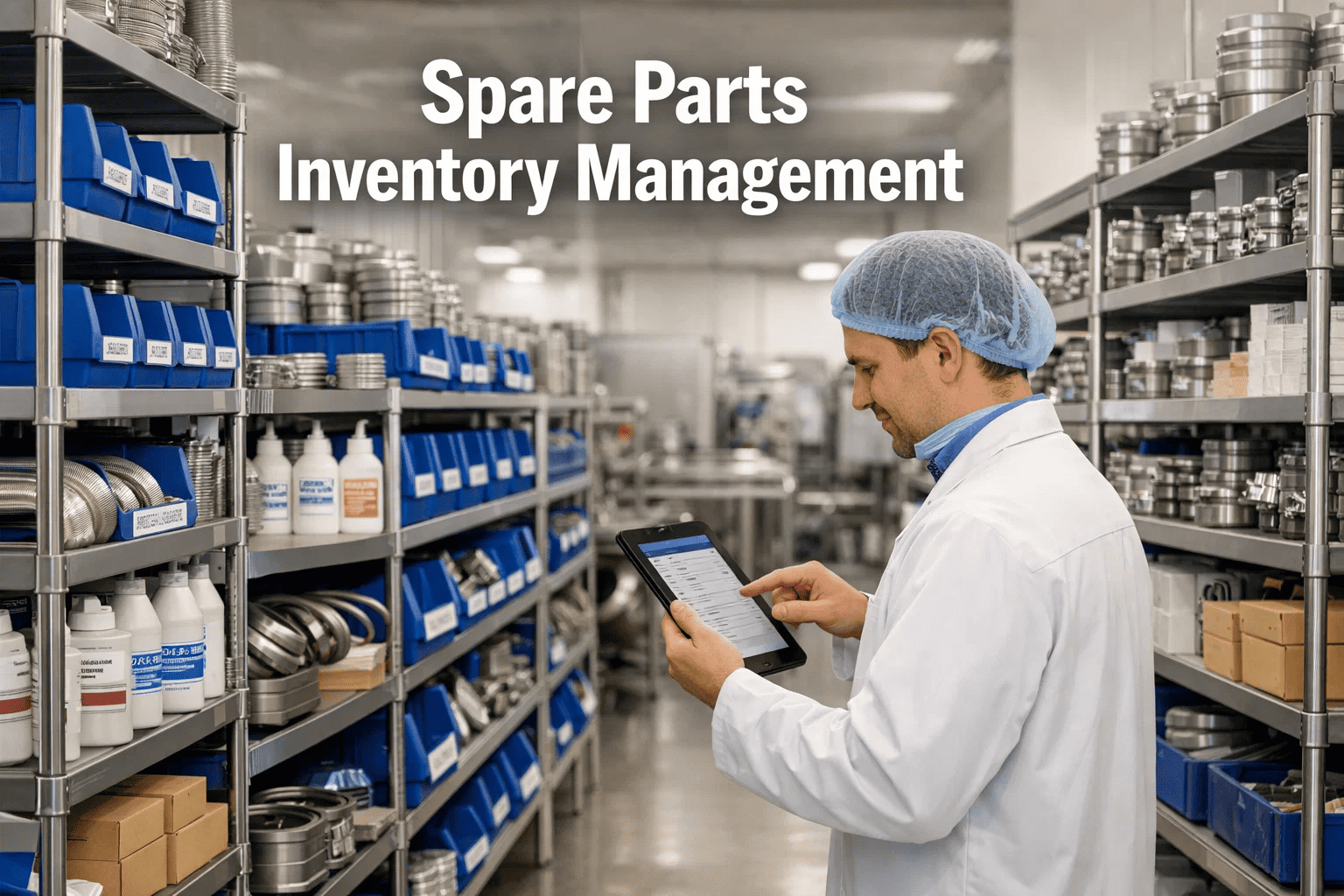
Food manufacturing facilities operate in one of the most unforgiving production environments in industry. When a critical piece of equipment fails — a filler, a conveyor drive, a sealer, or a pump — and the right spare part is not immediately available, the consequences extend far beyond a delayed shift. Production stops mean spoiled raw materials, missed delivery windows, regulatory exposure, and revenue loss that compounds by the hour. Yet across the industry, spare parts inventory management for food manufacturing remains reactive, fragmented, and dangerously underfunded — until a costly breakdown makes the true price of poor MRO inventory planning impossible to ignore.
Why Spare Parts Inventory Failures Are Unique in Food Manufacturing
Food manufacturing imposes operational constraints that other industries simply do not face. Equipment must maintain strict sanitary standards, meaning replacement parts often carry food-grade material certifications — stainless steel grades, FDA-compliant lubricants, EPDM seals — that cannot be substituted with generic alternatives. Lead times on compliant spare parts from approved vendors routinely exceed two to four weeks, creating an inventory gap that a reactive "order when broken" strategy cannot bridge. Sign up free to see how Oxmaint automates reorder points so your food plant is never caught waiting on a critical part.
Unlike discrete manufacturing, where a production line can often be paused and restarted without material loss, food manufacturing carries the additional risk that a four-hour equipment downtime can render an entire batch non-conforming. This direct link between equipment availability and product quality elevates maintenance parts procurement from a support function to a core operational discipline.
Identifying Critical Spares: The Foundation of Food Plant Inventory Strategy
The first and most consequential decision in building a food plant spare parts program is determining which parts are truly critical. Not every component warrants safety stock — over-stocking low-impact parts ties up capital and warehousing space while providing no production protection. Effective critical spare identification requires a structured approach that evaluates three intersecting factors: failure consequence, vendor lead time, and part replaceability. Book a demo to see how Oxmaint's criticality register helps food plants classify and manage critical spares with zero guesswork.
Building a CMMS-Based Reorder Point System for Food Manufacturing MRO
Manual spare parts reorder management — spreadsheets, visual bin checks, and memory-dependent purchasing — is the single most common root cause of stockout events in food plants. A Computerized Maintenance Management System (CMMS) with integrated MRO inventory management eliminates this fragility by automating reorder point triggers based on actual consumption data, vendor lead times, and safety stock formulas. The result is a system that self-manages replenishment while giving inventory and maintenance managers real-time visibility into parts availability across the entire facility. Try Oxmaint free and experience automated reorder management built specifically for food manufacturing operations.
Effective CMMS-driven reorder points in food manufacturing are calculated using a standard formula: Reorder Point = (Average Daily Usage × Vendor Lead Time) + Safety Stock. The safety stock component must account for demand variability — seasonal production peaks, planned major maintenance shutdowns, and equipment age-related wear rates — all of which are readily available from CMMS work order history. The discipline is in keeping this data current: a reorder point calculated on year-old usage data may be dangerously understated for aging equipment entering its wear-out phase.
Key Reorder Point Parameters for Food Plant Spare Parts
| Parameter | Data Source | Review Frequency | Impact on Stockout Risk |
|---|---|---|---|
| Average daily consumption | CMMS work order history | Quarterly | High |
| Vendor lead time | Approved vendor list / purchase history | Semi-annually | High |
| Safety stock multiplier | Demand variability analysis | Annually or at season change | Medium |
| Minimum order quantity (MOQ) | Vendor contracts | At contract renewal | Medium |
| Part criticality classification | Maintenance criticality register | At major equipment change | High |
| Shelf life / expiry (lubricants, seals) | Manufacturer data sheets | At each receipt | Low–Medium |
Stockout Prevention Strategies: From Reactive Purchasing to Predictive Inventory
Preventing production stops in food manufacturing requires a fundamental shift from reactive spare parts procurement to a predictive, data-driven MRO inventory model. The reactive model — purchasing a replacement only after failure has occurred — is endemic in facilities without integrated CMMS inventory management, and it consistently produces the worst possible outcome: extended downtime while emergency freight charges accumulate and food-grade parts sourcing hits its inevitable lead time wall.
Integrating Spare Parts Management with Maintenance Planning and Scheduling
The most effective food plant spare parts programs are not managed in isolation — they are fully integrated with the facility's maintenance planning and scheduling workflow. When a CMMS connects work order generation, preventive maintenance scheduling, and parts inventory management into a unified data environment, the result is a maintenance operation that can reliably guarantee parts availability for every planned job and respond to unplanned failures with dramatically reduced mean time to repair (MTTR).
Integration between maintenance planning and MRO inventory management produces three measurable operational improvements. First, planned maintenance jobs are never delayed by parts shortfalls because the parts check happens at the planning stage, not the execution stage. Second, parts consumption is recorded automatically at work order closure, keeping inventory records accurate without requiring manual storeroom transactions. Third, recurring failure patterns become visible through CMMS analytics, enabling maintenance teams to negotiate vendor stocking agreements for the highest-frequency consumables. Book a live demo to see how Oxmaint connects maintenance scheduling with live parts inventory in a single workflow.
What a Fully Integrated Food Plant CMMS Inventory Workflow Looks Like
Common Spare Parts Inventory Mistakes in Food Plants — and How to Fix Them
Even well-resourced food manufacturing facilities make predictable spare parts inventory mistakes that undermine production reliability. Identifying these failure patterns is the fastest route to measurable improvement in stockout prevention and maintenance performance metrics.
The most damaging mistake is maintaining a spare parts catalog that exists only in the minds of experienced technicians — undocumented, unstructured, and catastrophically vulnerable to workforce turnover. When a senior maintenance technician retires or departs, they often take institutional knowledge of which spares to keep, where they are stored, and which vendor to call with them. CMMS-based spare parts catalog management eliminates this single point of failure. A second widespread mistake is the "collect everything" storeroom culture, where obsolete parts from decommissioned equipment accumulate for years, consuming space and capital. Get started with Oxmaint to build a structured, searchable spare parts catalog linked directly to your asset register and work order history.
Vendor Management and Parts Procurement Best Practices
Spare parts procurement for food manufacturing operates under constraints that general MRO purchasing does not. Food-grade material certifications, regulatory compliance documentation, allergen management requirements, and FSMA traceability obligations mean that not every supplier who can provide a lower-cost component can be an approved vendor. The approved vendor list must be formally managed, regularly audited, and integrated with your CMMS purchasing workflows so that technicians and planners cannot inadvertently source components outside compliance boundaries.
Vendor-managed inventory (VMI) arrangements for high-velocity consumables — seals, gaskets, filter cartridges, lubricants — offer a compelling value proposition for food plants managing complex MRO catalogs. Under a VMI agreement, the supplier monitors consumption data (often through CMMS integration) and proactively replenishes stock to agreed levels, shifting the inventory management burden while guaranteeing availability. For facilities with mature supplier relationships, VMI can meaningfully reduce storeroom management overhead while improving service levels for high-frequency parts. Book a demo to explore how Oxmaint integrates vendor management directly into your MRO workflow.
Measuring Spare Parts Inventory Performance: KPIs That Matter
Spare parts inventory management in food manufacturing cannot be improved without measurement. The following key performance indicators provide the data foundation for a continuous improvement cycle in MRO inventory performance. Tracking these metrics monthly within your CMMS transforms spare parts management from an intuition-driven activity into an evidence-based operational discipline that directly supports production reliability goals.
Spare parts inventory management for food manufacturing is not a cost center to be minimized — it is a production reliability investment that pays dividends every time a line continues running when it would otherwise have stopped. The facilities that get this right share a common foundation: a CMMS that connects asset data, maintenance work orders, and MRO inventory into a single system of record; a disciplined approach to critical spare identification and reorder point setting; and a culture that measures and continuously improves inventory performance against production reliability goals. The tools and strategies are available. The only variable is the organizational commitment to deploy them. Start your free trial with Oxmaint and build a spare parts program your production team can rely on.