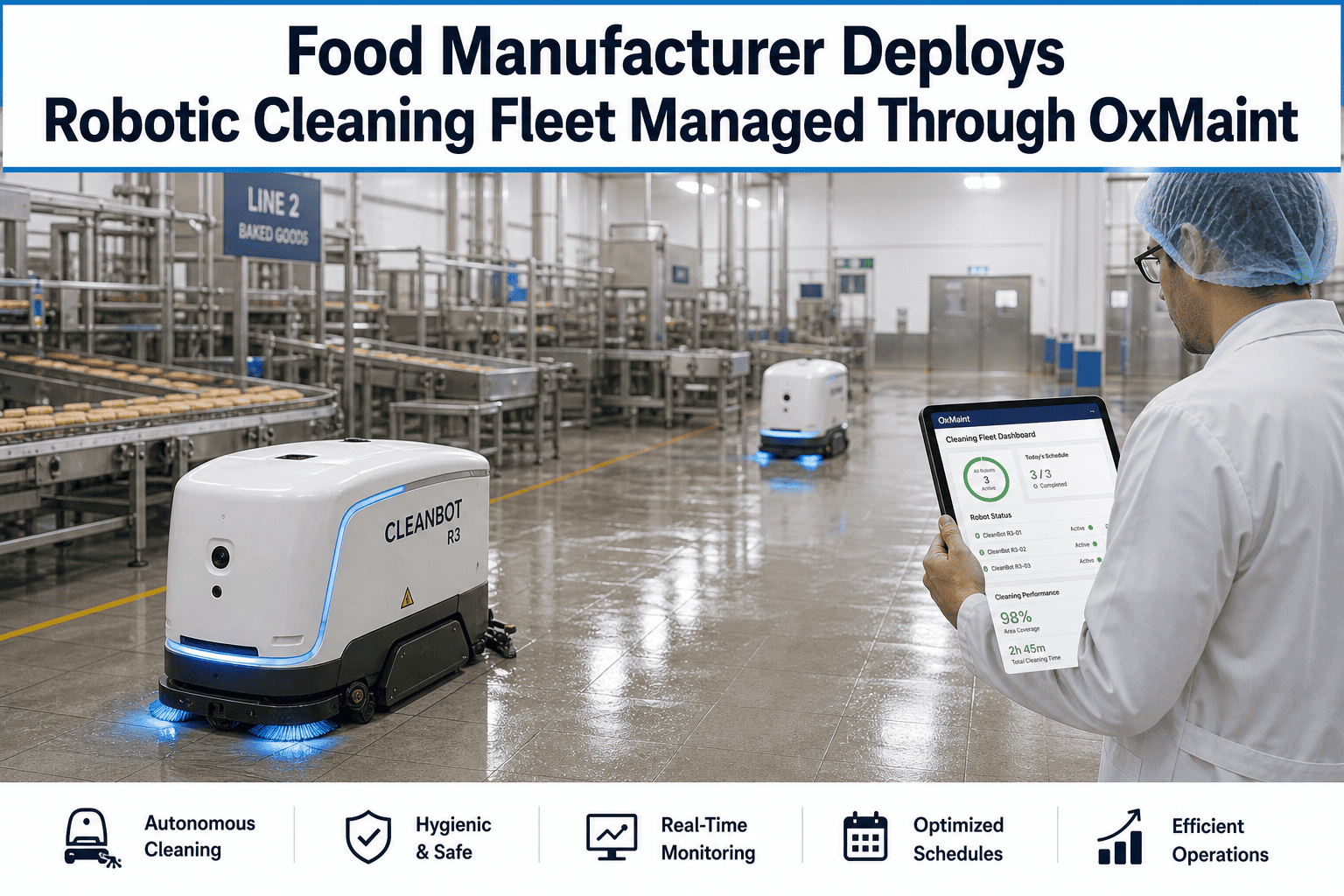
A mid-sized food manufacturing facility in the Midwest faced mounting pressure to modernize sanitation without disrupting production schedules or compromising food safety standards. Manual cleaning protocols were consuming 18% of total labor hours while audit findings repeatedly flagged inconsistent hygiene documentation. The deployment of an autonomous robotic cleaning fleet integrated with OxMaint CMMS transformed their approach to facility sanitation, delivering measurable improvements in hygiene compliance, labor efficiency, and maintenance visibility. Industry data shows that food plants allocating more than 15% of labor to manual cleaning operations are prime candidates for automation — but only when the robotic fleet operates within a unified maintenance management system that tracks performance, schedules preventive maintenance on the robots themselves, and maintains audit-ready sanitation records. Book a demo to see how OxMaint manages robotic asset fleets alongside traditional equipment — or start a free trial and configure your first autonomous cleaning schedule today.
Case Study · Robotics & Automation · Food Manufacturing
Food Manufacturer Deploys Robotic Cleaning Fleet Managed Through OxMaint
How a food manufacturing facility deployed autonomous cleaning robots managed through OxMaint CMMS, reducing manual cleaning labor by 62%, improving hygiene audit scores by 34%, and maintaining complete sanitation traceability across 24/7 production operations.
62%
Reduction in manual cleaning labor hours after robotic deployment
34%
Improvement in third-party hygiene audit scores within 6 months
100%
Sanitation cycle documentation captured automatically in CMMS
8
Autonomous cleaning robots managed through single OxMaint platform
The Challenge — Manual Cleaning Consuming 18% of Labor Budget
Before robotic deployment, the facility operated three daily cleaning shifts covering 85,000 square feet of production floor, warehouse space, and high-traffic corridors. Manual processes created documentation gaps, inconsistent coverage, and labor cost pressure that made the cleaning operation unsustainable at current production volumes.
Labor Inefficiency
12 full-time sanitation workers dedicated to floor cleaning and surface sanitization consumed $540,000 annually in direct labor cost. Peak production periods required temporary labor at premium rates, adding unpredictability to cleaning budgets.
Documentation Gaps
Paper-based cleaning logs created incomplete audit trails. Third-party audits identified 23 instances where sanitation cycles could not be verified due to missing or illegible documentation over a 12-month period.
Inconsistent Coverage
Manual cleaning quality varied by shift and operator. High-traffic zones near production lines required attention every 4 hours but actual cleaning frequency ranged from 3 to 7 hours depending on staffing availability.
Scheduling Conflicts
Cleaning crews competed with production schedules for floor access. Delayed production changeovers frequently pushed sanitation windows into overtime periods, adding 22% premium labor cost to cleaning operations.
See How Robotic Assets Integrate Into Your CMMS
OxMaint tracks autonomous cleaning robots as managed assets with scheduled maintenance, performance metrics, and automated documentation — giving facility managers complete visibility into both traditional equipment and robotic systems from one platform. Ready to modernize your sanitation operations? Start a free trial or book a demo to see robotic fleet management in action.
The Solution — 8-Robot Fleet Managed Through OxMaint CMMS
The facility deployed eight autonomous floor-cleaning robots covering production floors, warehouse aisles, and high-traffic corridors. Every robot operates as a tracked asset in OxMaint with scheduled maintenance intervals, real-time performance monitoring, and automated sanitation cycle documentation that feeds directly into compliance reporting systems.
Asset Registration
Robot Fleet as Managed Assets
Each robot registered in OxMaint asset hierarchy with unique ID, manufacturer specs, warranty period, and maintenance schedule. Preventive maintenance for sensors, brushes, and battery systems tracked identically to traditional equipment.
Automated Documentation
Sanitation Cycle Logging
Every cleaning cycle automatically logged in OxMaint with start time, completion time, coverage area, and sanitation solution used. Audit-ready records generated without manual data entry, eliminating documentation gaps that triggered previous audit findings.
Performance Tracking
Real-Time Fleet Monitoring
Dashboard displays active robots, battery status, current zone coverage, and completed square footage per shift. Facility managers identify underperforming units and optimize cleaning routes based on production schedule changes.
Preventive Maintenance
Scheduled Robot Servicing
OxMaint triggers work orders for brush replacement every 500 operating hours, sensor calibration every 90 days, and battery health checks monthly. Maintenance technicians receive mobile notifications with service instructions and parts lists.
Zone Scheduling
Production-Aligned Cleaning
Cleaning schedules synchronized with production changeover windows. High-risk allergen zones receive automated post-changeover sanitation with verification documentation required before next production run authorization.
Compliance Integration
Audit Trail Generation
Automated reports compile sanitation cycle data, maintenance records, and performance metrics for regulatory audits. Third-party auditors access read-only dashboards showing 12-month sanitation history without requesting paper documentation.
Before vs After — Sanitation Operations Transformation
| Metric |
Before Robotic Deployment |
After OxMaint Integration |
| Sanitation labor cost (annual) |
$540,000 (12 FTE) |
$205,000 (4 FTE oversight) |
| Documentation completion rate |
76% (paper logs) |
100% (automated CMMS logging) |
| High-traffic zone cleaning frequency |
3–7 hours (inconsistent) |
Every 4 hours (scheduled) |
| Audit findings (hygiene gaps) |
23 findings in 12 months |
3 findings in 12 months |
| Overtime labor for cleaning delays |
22% of total cleaning hours |
4% (emergency only) |
| Time to compile audit documentation |
18 hours per audit |
2 hours (automated reports) |
The facility achieved payback on robotic investment in 14 months through labor reduction and eliminated overtime costs. Improved audit scores reduced insurance premiums by $42,000 annually.
Results — 62% Labor Reduction with Improved Compliance
$335K
Annual Labor Savings
Sanitation labor cost reduced from $540,000 to $205,000 annually. Four oversight technicians manage robot fleet versus 12 manual cleaning workers previously required.
87%
Fewer Audit Findings
Third-party hygiene audits dropped from 23 findings to 3 findings over 12 months. Complete sanitation traceability eliminated documentation-related citations.
100%
Schedule Adherence
High-traffic zones receive cleaning every 4 hours without deviation. Production-aligned scheduling eliminates conflicts between cleaning and manufacturing operations.
14 Mo
ROI Payback Period
Total robotic investment recovered in 14 months through labor savings, overtime elimination, and reduced insurance premiums from improved audit performance.
How OxMaint Manages Robotic Assets Alongside Traditional Equipment
The platform treats autonomous robots as first-class assets with the same preventive maintenance scheduling, work order management, and lifecycle tracking applied to conveyors, mixers, and packaging lines. Facility managers see robotic and traditional equipment performance from unified dashboards without switching systems.
Unified Asset Registry
Robots in Equipment Hierarchy
Cleaning robots registered under Facility Systems with manufacturer data, warranty tracking, and parts inventory. Asset condition scoring alerts managers when robot performance degrades before sanitation quality suffers.
Automated Work Orders
Scheduled Robot Maintenance
Preventive maintenance triggered by operating hours and calendar intervals. Technicians receive mobile work orders with robot-specific service procedures, required parts, and safety protocols for battery handling.
Performance Analytics
Fleet Efficiency Dashboards
Real-time visibility into square footage cleaned per shift, battery utilization, and sanitation solution consumption. Managers identify robots requiring recalibration or route optimization based on coverage variance.
Compliance Documentation
Audit-Ready Sanitation Records
Every cleaning cycle automatically documented with timestamp, zone coverage, and solution concentration. Regulatory reports generated on demand showing 12-month sanitation history by production area.
Integration Capability
Robot System Connectivity
OxMaint integrates with autonomous robot management platforms via API. Cleaning cycle data flows automatically from robot controllers into CMMS without manual data entry or duplicate systems.
Lifecycle Tracking
Robot Replacement Forecasting
Condition-based lifecycle models predict robot replacement timing based on operating hours, maintenance frequency, and performance degradation. CapEx planning includes robotic fleet refresh cycles alongside traditional equipment.
Frequently Asked Questions
How does OxMaint track autonomous cleaning robots differently from traditional equipment?
OxMaint registers robots as managed assets with preventive maintenance schedules based on operating hours rather than calendar time. The platform tracks robot-specific metrics like battery cycle count, sensor calibration dates, and brush wear indicators that traditional equipment does not require. Automated cycle logging captures sanitation data without manual input, while standard equipment still requires technician-entered completion records.
Start a free trial to configure robotic asset tracking in your facility.
What maintenance do autonomous cleaning robots require?
Standard preventive maintenance includes brush replacement every 500 operating hours, sensor calibration quarterly, battery health checks monthly, and firmware updates as released by manufacturers. OxMaint schedules these tasks automatically based on robot runtime tracked through system integration. Reactive maintenance addresses navigation errors, cleaning solution pump failures, and battery degradation detected through performance monitoring dashboards.
Can robotic cleaning documentation satisfy food safety audits?
Yes, when robots integrate with CMMS platforms that capture timestamped cycle records, zone coverage maps, and sanitation solution concentrations. Third-party auditors accept automated documentation that meets the same traceability standards as manual logs — meaning every cleaning event must have verifiable start time, completion time, area covered, and operator oversight confirmation. OxMaint generates audit reports showing 12-month sanitation history by production zone with drill-down capability to individual cleaning cycles.
Book a demo to see compliance reporting for robotic sanitation systems.
What ROI timeline should facilities expect from robotic cleaning deployment?
Facilities with annual manual cleaning labor costs exceeding $400,000 typically achieve payback in 12 to 18 months. The case study facility spent $540,000 on manual sanitation and recovered robotic investment in 14 months through labor reduction, overtime elimination, and lower insurance premiums from improved audit scores. Smaller facilities with lower labor costs see extended payback periods of 24 to 36 months but still achieve positive ROI over the robots' 7 to 10 year operational lifespan.
Manage Robotic and Traditional Assets on One Platform
OxMaint gives food manufacturers unified visibility into autonomous cleaning fleets and conventional production equipment — same preventive maintenance scheduling, same performance dashboards, same audit-ready documentation system — so automation investments integrate seamlessly into existing maintenance operations. Want to see how robotic asset management works in practice? Book a demo or start a free trial today.