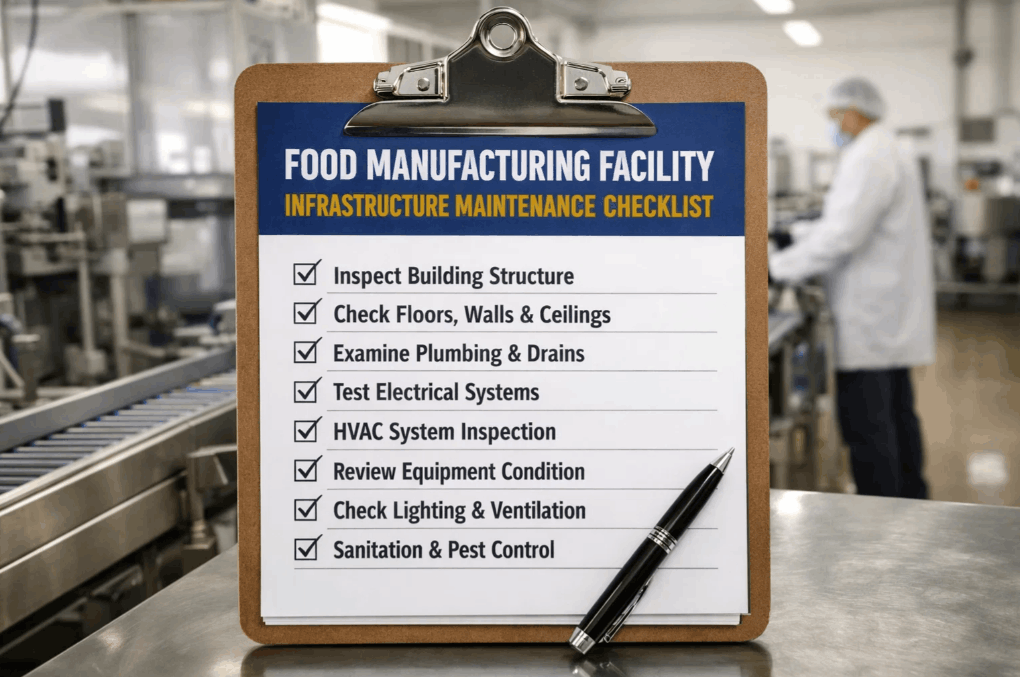
Food manufacturing facility infrastructure is the physical foundation of your GMP compliance program. Cracked floor coatings, deteriorating wall panels, blocked floor drains, inadequate lighting at inspection points, and roof infiltration aren't just maintenance issues — they are direct food safety risks that trigger regulatory findings during FDA inspections, SQF audits, BRC assessments, and customer verification visits. This food manufacturing facility infrastructure maintenance checklist gives facilities managers a frequency-based framework covering floors, walls and ceilings, drains, lighting, doors and airlocks, roof and structure, and exterior grounds — every building system from drain covers to dock levelers, aligned to the inspection intervals that protect your HACCP program and keep your facility audit-ready.
1. Floor Maintenance Checklist
Food plant floors operate under continuous thermal shock, chemical exposure, heavy equipment traffic, and wet cleaning cycles that degrade even purpose-specified coatings and sealants over time. Floor integrity failures — cracks, spalling, delamination, and pooling water — are among the most cited infrastructure deficiencies in third-party food safety audits and FDA inspections. Track floor PM intervals with OxMaint.
Daily: Inspect for Standing Water and Drainage Failures
Walk all food contact, food handling, and wet processing zones to identify areas of standing water or inadequate drainage slope. Standing water on food plant floors is a Listeria harborage risk and a direct GMP non-conformance — document and correct the same shift where possible, or apply immediate corrective action barriers.
Weekly: Check Floor Coating Integrity in Processing Areas
Inspect epoxy, urethane, or troweled overlay coatings in processing and packaging zones for cracks, chips, blistering, or delamination at cove bases. Map and photograph defect locations. Uncoated concrete exposed by coating failure absorbs cleaning chemicals, harbors bacteria, and cannot be effectively sanitized — sign up free on OxMaint to schedule and track patching repairs before the next scheduled downtime window.
Monthly: Inspect Floor-Wall Cove Junctions and Sealant Joints
Check cove base integrity along all wall-floor junctions in wet areas, particularly where sanitizer concentrations are highest. Inspect control joint sealants for cracking, shrinkage, or separation that creates harborage voids below the floor surface. Cove base failures are a top-five finding in BRC and SQF infrastructure audits.
Quarterly: Assess Drainage Slope Adequacy with Flow Test
Pour a measured volume of water across the floor surface in processing zones and time drainage to floor drains. Areas retaining water for more than 60 seconds indicate slope failure or drain restriction requiring corrective action. Document test locations and results to demonstrate proactive GMP infrastructure management to auditors.
Annually: Commission Full Floor Condition Survey and Repair Plan
Engage a flooring specialist to conduct a complete facility floor condition assessment, mapping all defects, substrate moisture levels, and coating adhesion values. Use the survey to build a capital repair schedule prioritized by food safety zone classification — high-care and high-risk areas first, dry storage and utility corridors last.
2. Walls, Ceilings, and Overhead Surfaces Checklist
Walls and ceilings in food manufacturing environments are direct physical food contamination sources when surface integrity deteriorates. Paint flaking from overhead structures, condensation dripping from uninsulated pipework, and damaged panel joints that allow pest ingress are all GMP infrastructure failures that require systematic inspection and documented corrective action to satisfy FSMA, BRC Issue 9, and SQF Edition 9 audit requirements.
Weekly: Inspect Overhead Areas for Condensation and Drip Points
Walk processing and packaging areas with attention to overhead pipes, ductwork, and structural beams for active condensation or dried mineral deposits indicating historical drip events. Any overhead drip point above exposed product, open containers, or food contact surfaces requires immediate engineering correction — drip shields are a temporary measure, not a permanent control.
Monthly: Check Wall Panel Joints, Sealant, and Surface Coatings
Inspect wall panel joints in wet processing, chilling, and packaging areas for sealant gaps, cracking, or microbial discoloration indicating moisture infiltration behind panels. Check painted wall surfaces in dry areas for peeling, blistering, or impact damage that exposes substrate. Book a demo with OxMaint to see how facilities managers log GMP zone findings and prioritize repair sequencing based on food safety risk.
Monthly: Inspect Ceiling and Overhead Structure for Peeling and Debris
Inspect suspended ceilings, ceiling tiles, structural steel, and overhead equipment frames for loose material, flaking paint, dust accumulation, and signs of water staining. In high-care production zones, any loose overhead material is a physical contamination risk — remove and remediate before the next production run rather than scheduling for routine maintenance cycles.
Quarterly: Inspect Insulation on Cold Pipes and Surfaces for Integrity
Check pipe insulation jacketing in chilled and frozen areas for cracks, gaps, or compression damage that allows moisture ingress and mold colonization within insulation material. Damaged insulation above food zones is a significant finding in HACCP prerequisite program audits. Document insulation condition by system and schedule replacement where vapor barrier integrity is compromised.
Annually: Deep-Clean and Inspect Structural Steel and Framework
During scheduled facility shutdowns, clean overhead structural steel, beams, cable trays, and duct exteriors and inspect for corrosion, loose fasteners, and accumulated product debris. Apply food-safe protective coatings to corroding steel sections. Document structural steel condition as part of the facility's annual GMP infrastructure compliance review.
3. Floor Drains and Drainage Systems Checklist
Floor drains in food manufacturing facilities are the primary harborage risk for Listeria monocytogenes and other environmental pathogens. Drain maintenance in food plant environments goes beyond preventing blockages — it requires a systematic approach to cover integrity, trap function, backflow prevention, and environmental monitoring alignment that satisfies FSMA preventive controls and HACCP prerequisite program requirements.
Daily: Verify Drain Covers Are in Place and Undamaged
Confirm all drain covers in food handling and processing areas are correctly seated, undamaged, and free of cracks or missing sections that create physical contamination hazards. Damaged drain covers are a direct food safety non-conformance — replace immediately from on-site stock rather than documenting for deferred repair.
Weekly: Flush and Inspect Drain Baskets and Trap Seals
Remove drain covers and baskets in processing areas, clean debris, inspect basket integrity, and verify trap seal water levels are maintained. Dry trap seals allow drain gas and pest ingress into food areas — add water to evaporated traps and investigate if evaporation rate indicates trap damage or ventilation imbalance in the drainage system.
Monthly: Clean and Sanitize Drain Channels and Outlet Boxes
Thoroughly clean the interior surfaces of all drain channels, outlet boxes, and sumps in wet processing zones using mechanical brushing followed by chemical sanitization. Drain channels with visible biofilm, organic accumulation, or discoloration must be included in the facility's environmental monitoring program — book a free demo to see how OxMaint links drain records to your Listeria risk assessments at harborage-prone locations.
Quarterly: Inspect Drain Lines for Blockage and Backflow Risk
Conduct flow tests on all production area drains to confirm free discharge without sluggish drainage that indicates partial blockage developing in the drain line. Test backflow prevention devices where installed. Partial blockages cause flood events during peak cleaning, creating cross-contamination risks between zones with different GMP classifications.
Annually: CCTV Inspection of Underground Drainage Infrastructure
Commission a CCTV drain survey of underground drainage infrastructure in production and high-care areas to identify cracked or collapsed sections, root intrusion, and joint separation that creates pest entry pathways and structural subsidence risk beneath production floors. Document findings and schedule remediation within the capital works planning cycle.
Looking to automate drain inspection scheduling and link findings to your environmental monitoring program? Book a free OxMaint demo and see how food facility teams manage GMP infrastructure records digitally.
4. Lighting Systems Checklist
Lighting in food manufacturing facilities is both a regulatory requirement and a food safety control. Insufficient illumination at inspection points, sorting stations, and quality checkpoints compromises product defect detection. Unguarded or unshielded light fittings in food zones are a physical contamination risk requiring documented control in your HACCP prerequisites. Lighting infrastructure must be maintained to the lux levels specified in GMP regulations and customer codes of practice.
Daily: Check for Failed Fittings and Exposed Lamp Breakages
Walk all food handling, inspection, and packaging areas at the start of each production shift to identify failed light fittings, flickering lamps, and any shattered or cracked cover panels. Report any unguarded lamp failure in a food zone immediately — activate the glass and brittle plastic contamination control procedure before the area returns to production use.
Weekly: Inspect Protective Covers and Shatter-Resistant Sleeves
Check all light fitting protective covers, polycarbonate diffusers, and shatter-resistant sleeves in food zone areas for cracks, yellowing, missing fasteners, or condensation ingress that indicates seal failure. Cracked or compromised covers must be replaced before the next production run — document replacement in the glass and brittle plastic register as a control record.
Monthly: Measure Illumination Levels at Critical Inspection Points
Use a calibrated lux meter to measure illumination at all designated inspection stations, hand-sorting lines, and quality checkpoints. Compare readings against the facility's specified lux levels — typically 540 lux at inspection points and 220 lux in general production areas per GMP and SQF requirements. Sign up free to log measurements and schedule fitting upgrades where levels have fallen below specification.
Annually: Full Lighting Audit and Lux Level Compliance Review
Commission a comprehensive lighting audit covering all production, storage, laboratory, and welfare areas, mapping lux levels against current regulatory and customer code of practice requirements. Use the audit to identify zones requiring lamp upgrades, fitting additions, or reflector cleaning to restore specified illumination standards. Retain the audit report as a HACCP prerequisite compliance document.
5. Doors, Windows, and Airlock Maintenance Checklist
Doors and airlocks in food manufacturing facilities are primary pest exclusion controls, zone segregation barriers, and temperature management infrastructure. Door seal failures in chilled and frozen areas drive energy cost increases and condensation issues. Damaged strip curtains, self-closing mechanism failures, and mesh screen deterioration are direct GMP non-conformances that create pest entry pathways and zone cross-contamination risks between areas of different hygiene classifications.
Daily: Check Self-Closing Mechanisms and Door Seal Integrity
Inspect all self-closing doors on external openings, production zone boundaries, and high-care area access points to confirm closers operate correctly and doors return to fully closed without gaps. Check perimeter seals on chilled room and blast freezer doors for compression damage or detachment. Any door that does not close fully and seal completely is a pest exclusion failure requiring same-day repair.
Weekly: Inspect Strip Curtains, Fly Screens, and Air Curtain Operation
Check strip curtains on raw material intake and dispatch dock openings for torn, missing, or stiffened strips that reduce pest exclusion effectiveness. Test air curtain units on external and processing area doorways for correct airflow velocity and blade angle. Inspect all fly screens and insect mesh on windows and ventilation openings for holes, loose fixings, or frame damage.
Monthly: Inspect Dock Levelers, Vehicle Dock Seals, and Bumpers
Check dock leveler operation, lip extension alignment, and dock seal inflatable or foam cushion integrity on all receiving and dispatch bays. Inspect dock bumpers for secure mounting. Gaps between the vehicle and dock seal during loading and unloading operations create pest entry opportunities and temperature excursion risks in chilled and frozen product handling areas.
Quarterly: Test Airlock Pressure Differential and Air Handling Performance
Measure air pressure differentials across high-care area airlocks and high-risk zone positive pressure boundaries using a manometer. Confirm that positive pressure differentials are maintained at design specifications during production and that air handling units serving airlocks are operating at the designed air change rates. Log measurements as a critical prerequisite program control record.
Annually: Full Door and Pest Exclusion Infrastructure Audit
Conduct a complete facility door and pest exclusion audit mapping all external and internal access points, their pest exclusion controls, and documented inspection frequencies. Commission repairs or upgrades on any door frame, threshold, seal, or mechanism that cannot be maintained to GMP exclusion standards. Submit audit findings to the pest control contractor for alignment with the facility pest management program.
6. Roof, Building Envelope, and Exterior Grounds Checklist
Roof integrity and exterior grounds maintenance are upstream controls that prevent water infiltration, structural damage, and pest pressure from reaching food production areas. A single roof membrane failure above a production area or an unmaintained exterior that provides rodent harborage adjacent to the building perimeter can trigger a product recall, a facility shutdown, or a major audit non-conformance that requires corrective action closure before certification is reinstated.
Monthly: Inspect Roof Drainage and Gutter Clearance
Check all roof gutters, downspouts, internal drains, and overflow outlets for debris accumulation and blockage. Blocked roof drainage causes ponding that accelerates membrane deterioration and increases water infiltration risk through seams and penetrations. Document inspection and record any areas of standing water on the roof surface for inclusion in the building maintenance work order log.
Monthly: Inspect Building Perimeter for Pest Harborage and Entry Points
Walk the full external building perimeter with attention to gaps at service penetrations, utility entry points, expansion joints, and foundation junctions. Identify vegetation growth, stored materials, or accumulated debris adjacent to the building wall that provides rodent and insect harborage. Coordinate findings with the external pest control contractor for concurrent treatment and exclusion work.
Quarterly: Inspect Roof Membrane, Flashings, and Penetration Seals
Conduct a walking inspection of accessible roof areas, checking membrane condition for blistering, splits, and lap seam separation. Inspect all flashing conditions at parapet walls, skylights, exhaust stacks, and HVAC penetrations. Seal any open penetrations to prevent water infiltration and pest entry routes into ceiling and roof void spaces above production areas — book a demo to manage roof inspection records and corrective action tracking with OxMaint.
Quarterly: Maintain Grounds, Vegetation Control, and Hardstanding
Cut grass and vegetation within the facility perimeter to prevent rodent harborage, maintain hardstanding surfaces free of cracks and potholes that collect water and debris, and ensure all external waste storage areas are correctly bunded, covered, and positioned at a minimum distance from the building as specified in your GMP site standard. Document grounds maintenance as part of the site pest management prerequisite program.
Annually: Commission Specialist Roof Condition Survey and Life Cycle Assessment
Engage a roofing specialist to conduct a comprehensive roof condition assessment including thermographic survey to identify wet insulation, membrane adhesion testing, and remaining service life projection. Use the assessment to inform the capital works budget for roof replacement or major refurbishment, prioritized by the food safety consequence of water infiltration in the areas below each roof section.
Frequently Asked Questions
The most common questions from facilities managers about food manufacturing infrastructure inspection frequencies, GMP requirements, and building maintenance compliance in food plant environments.
Drain covers and basket integrity should be verified daily before production. Full drain basket cleaning and trap seal checks should be performed weekly. Interior drain channel and outlet box sanitization should be completed monthly. Line flow tests to detect developing blockages are appropriate quarterly. Underground drainage infrastructure benefits from CCTV survey on an annual or biennial basis depending on drain age and history of blockage events.
GMP standards typically require a minimum of 540 lux at product inspection and quality assessment points, 220 lux in general production and processing areas, and 110 lux in storage areas. BRC Issue 9 and SQF Edition 9 specify illumination requirements as part of prerequisite program infrastructure standards. Customer codes of practice sometimes specify higher levels — always verify against the most stringent standard applicable to your facility's certification scope.
BRC Issue 9 and SQF Edition 9 require documented evidence of planned preventive maintenance schedules, completed inspection records with date, inspector identity, and findings, corrective action records for all deficiencies identified, and re-inspection confirmation that repairs were effective. Infrastructure records covering floors, walls, drains, lighting, and pest exclusion are reviewed as part of the Prerequisite Programme (PRP) documentation review during third-party audits.
A CMMS like OxMaint automates infrastructure PM work order generation at required frequencies, stores inspection records with photographic evidence, links corrective actions to findings for traceability, and generates compliance reports formatted for BRC, SQF, FDA, and customer audit review. This eliminates paper log gaps, missed PM intervals, and the inability to rapidly produce historical maintenance evidence that most audit findings in the infrastructure category trace back to.
Floor and drain maintenance deficiencies are consistently among the most cited infrastructure findings across BRC, SQF, FSSC 22000, and FDA inspections. Specifically: cracks and damaged coatings in food handling zones, inadequate drainage slope causing pooling, damaged drain covers, and evidence of historical condensation drip from overhead surfaces above food contact zones. All of these are preventable through structured PM programs with documented inspection and corrective action records.




.png)