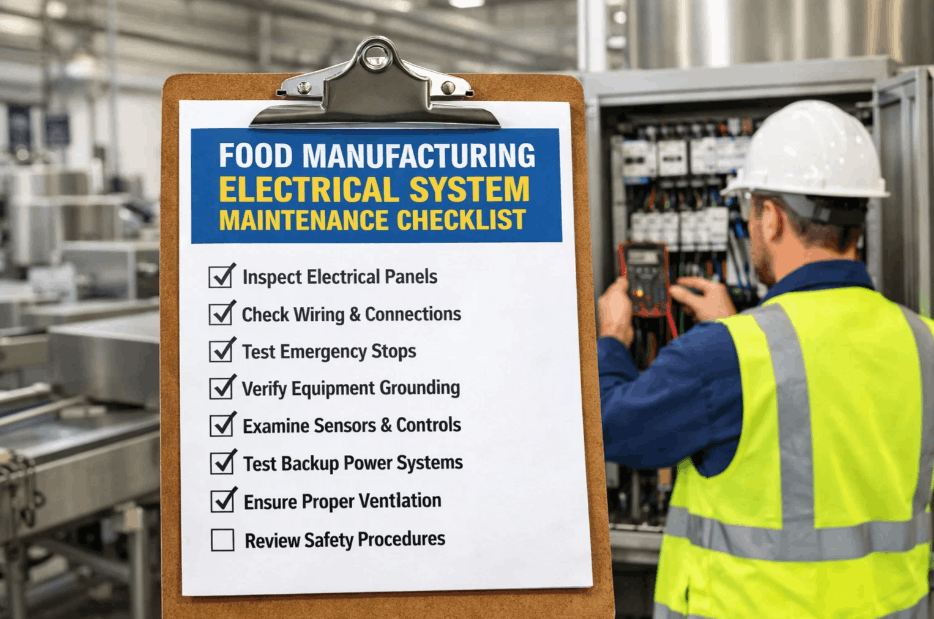
Food manufacturing facilities operate in some of the harshest electrical environments in industrial settings — high humidity, washdown pressure, temperature extremes, corrosive cleaning agents, and continuous production cycles demand that every electrical system component be maintained to the highest standard. An unplanned electrical failure doesn't just mean downtime; it can trigger OSHA citations, NFPA 70E violations, equipment fires, and production shutdowns that cost tens of thousands per hour. This checklist gives electrical technicians and facility maintenance teams a structured, audit-ready framework covering every critical electrical subsystem — from motor and VFD inspections through control panels, conduit systems, grounding verification, and washdown-rated equipment integrity. Sign up free to schedule and track electrical PM tasks with OxMaint.
1. Electric Motor Inspection and Preventive Maintenance
Electric motors drive pumps, conveyors, compressors, mixers, and nearly every mechanical system in a food plant. They operate in wet, dusty, and chemically aggressive environments that accelerate insulation breakdown, bearing failure, and winding contamination. A proactive motor PM program prevents catastrophic failures during production and avoids costly emergency replacements on critical drive systems. Book a demo to start managing motor PM schedules in OxMaint.
Inspect Motor Enclosure Integrity and IP Rating Compliance
Verify that motor enclosures are rated for the installation environment — TEFC or IP66/IP69K for washdown zones, explosion-proof ratings in dust or solvent areas. Inspect conduit entries, drain plugs, and gasket seals for damage that allows moisture or cleaning chemical ingress. A compromised enclosure will allow winding contamination that progressively degrades insulation resistance until failure.
Test Winding Insulation Resistance with Megohmmeter
Perform insulation resistance (IR) testing on all critical motors annually using a calibrated megohmmeter at the appropriate test voltage for motor nameplate rating. Record readings and compare against baseline. A downward trend in IR values — especially below 1 MΩ — indicates moisture intrusion or insulation degradation requiring immediate investigation before in-service failure occurs.
Lubricate Bearings Per Manufacturer Schedule and Operating Conditions
Regrease motor bearings at manufacturer-specified intervals adjusted for ambient temperature, load factor, and operating hours. Overgreasing is as damaging as undergreasing — excess lubricant generates heat, contaminates windings, and accelerates seal failure. Use only the specified lubricant type and apply via grease fitting while motor is running to distribute evenly through the bearing race.
Monitor Motor Operating Temperature and Current Draw
Use a calibrated infrared thermometer or thermal imager to measure motor surface temperature during normal operation. Compare measured current draw on all three phases against nameplate full-load amperage. Phase imbalance greater than 2% or operating temperature above Class F insulation limits indicates mechanical overload, bearing wear, or supply voltage problems requiring corrective action.
Check Motor Alignment and Coupling Condition
Verify shaft alignment between motor and driven equipment using dial indicator or laser alignment tool at quarterly intervals or after any maintenance requiring motor removal. Misalignment causes elevated vibration, accelerated bearing wear, and coupling fatigue. Inspect flexible coupling elements for wear, cracking, and set screw tightness before returning any motor to service.
2. Variable Frequency Drive (VFD) Inspection and Maintenance
VFDs are among the most sensitive and highest-value electrical components in food manufacturing — controlling conveyor speed, pump flow, fan output, and mixer operation with precision. Food plant environments expose VFDs to airborne dust, condensation, and vibration that degrade internal components if enclosures and cooling systems are not maintained. A failed VFD on a critical process drive can halt an entire production line. Sign up free to see how OxMaint automates VFD PM scheduling across food manufacturing facilities.
Inspect VFD Enclosure, Ventilation Filters, and Cooling Fans
Clean or replace VFD enclosure air filters at intervals appropriate for the installation environment — monthly in dusty or high-particulate areas, quarterly in cleaner environments. Verify that internal cooling fans are operating and airflow paths are unobstructed. Elevated internal temperature is the primary cause of capacitor degradation, IGBT failure, and control board damage in food plant VFDs.
Check DC Bus Capacitor Condition and Thermal Imaging of Power Terminals
Inspect DC bus capacitors for signs of bulging, electrolyte leakage, or discoloration annually. Use a thermal imager to scan input and output power terminals, bus bars, and rectifier sections for hotspots indicating high-resistance connections. Loose or corroded power terminals in VFDs generate localized heat that causes progressive insulation failure and can result in arc flash events during normal operation.
Review VFD Fault Log and Parameter Backup
Download and review the VFD fault history log at each PM interval to identify recurring faults — overcurrent trips, DC bus overvoltage, ground faults, or overtemperature alarms — that indicate developing mechanical or electrical issues before they cause unplanned downtime. Back up all drive parameters to a USB or CMMS record so configuration can be restored rapidly after drive replacement.
Verify Input Line Reactor, Output Filter, and Cable Condition
Inspect input line reactors for overheating and output dV/dt filters for physical damage. Check VFD output cables for insulation abrasion, particularly at conduit entry points where cable movement under vibration causes chafing. Long cable runs without proper output filtering generate reflected wave voltages that stress motor winding insulation and reduce motor service life significantly.
3. Electrical Control Panel and MCC Maintenance
Motor Control Centers and distribution panels are the nerve centers of food plant electrical systems — housing breakers, contactors, overload relays, PLCs, and power distribution equipment that must operate reliably in production environments. Dust accumulation, vibration, and thermal cycling degrade connections and components over time. Neglected panel maintenance is a leading cause of arc flash events, nuisance trips, and production-critical equipment failures in food manufacturing facilities. Book a demo to see how OxMaint tracks panel and MCC PM work orders in food plants.
Perform Thermographic Survey of All Panel Busbars and Connections
Conduct infrared thermography on all MCC busbars, breaker terminals, contactor connections, and neutral/ground bars annually under loaded conditions. Identify hotspots exceeding 10°C above ambient or adjacent connection temperature as requiring immediate investigation. High-resistance connections generate heat that degrades conductor insulation, accelerates busbar oxidation, and creates arc flash hazards at normal operating current levels.
Inspect and Torque All Panel Terminal Connections
Retorque all power and control terminal connections to manufacturer-specified torque values at annual PM intervals using a calibrated torque screwdriver or wrench. Thermal cycling causes copper conductors to expand and contract, progressively loosening connections even in vibration-free environments. Document torque verification as part of the panel PM record to demonstrate compliance with NFPA 70B maintenance standards.
Test Overload Relay Trip Settings and Contactor Contact Condition
Verify that motor overload relay trip settings correspond to motor nameplate full-load amperage and service factor. Inspect contactor main contacts for pitting, erosion, and welding that reduce interrupting capacity and increase contact resistance. Replace contactors showing contact wear beyond the manufacturer's specified minimum thickness — worn contacts arc during switching and generate copper oxide deposits that worsen resistance over time.
Clean Panel Interiors and Verify Enclosure Sealing
Remove accumulated dust, debris, and insect contamination from panel interiors using dry compressed air or vacuum rated for electrical use. Verify that panel door gaskets are intact and that all unused conduit knockouts are sealed with appropriate fittings. Dust accumulation on bus bars and electronic components creates conductive contamination paths that cause insulation faults and control system malfunctions under high-humidity conditions.
Verify Arc Flash Labels, PPE Availability, and Lockout/Tagout Procedures
Confirm that all panels display current arc flash hazard labels calculated per NFPA 70E and that appropriate PPE — arc-rated FR clothing, face shield, and insulated gloves — is available at each work location. Review and update lockout/tagout procedures for all panel-fed equipment to reflect any electrical system modifications since the last update. Outdated LOTO procedures and missing arc flash labels are citable OSHA violations during routine inspections.
4. Conduit, Cable, and Raceway System Inspection
Food plant conduit and cable systems endure daily washdown with high-pressure hot water, steam, and caustic cleaners that attack conduit fittings, cable jackets, and junction box integrity. Damaged conduit systems allow moisture ingress that causes ground faults, short circuits, and insulation tracking failures across multiple circuits simultaneously. A systematic raceway inspection program catches deterioration before it becomes an emergency. Sign up free to start scheduling conduit and raceway inspections in OxMaint today.
Inspect All Conduit Fittings, Seals, and Junction Box Covers
Walk all electrical conduit runs quarterly and inspect liquidtight fittings, conduit connectors, and junction box covers for cracks, missing seals, and corrosion. Verify that all junction box covers are properly fastened and gasketed. Open junction boxes in washdown areas and inspect for water accumulation, corrosion on terminal blocks, and conductor insulation damage from moisture intrusion.
Check Cable Tray Fill, Support, and Cable Jacket Condition
Inspect cable trays for correct fill percentage per NEC 392 requirements and verify that all cable supports and tray sections are securely fastened without sagging. Examine cable jacket condition for abrasion, chemical attack, UV degradation in exposed locations, and mechanical damage at tray edges. Overfilled cable trays create thermal problems that accelerate insulation aging across all contained conductors.
Test Ground Fault Circuit Interrupter Outlets in Wet Locations
Test all GFCI receptacles in wet process areas, washdown zones, and outdoor locations monthly using the built-in test and reset buttons, and annually with a calibrated GFCI tester that verifies trip time meets NEC requirements. Non-functioning GFCI protection in washdown areas is a Class I OSHA violation and poses a direct electrocution hazard to personnel working with powered equipment in wet conditions.
Verify Conduit System Bonding Continuity Through All Fittings
Use a low-resistance ohmmeter to verify bonding continuity through all metallic conduit fittings, particularly liquidtight flexible conduit sections where the conduit itself does not provide a reliable ground path without a bonding jumper. Bonding failures in metallic conduit systems create floating equipment ground potentials that expose personnel to shock hazard and prevent overcurrent devices from clearing faults within safe time limits.
5. Grounding and Bonding System Verification
An effective equipment grounding and bonding system is the foundation of both personnel safety and electrical system reliability in food manufacturing. Ground system degradation is invisible during normal operation but becomes catastrophic during a fault condition — the difference between a breaker tripping in milliseconds and a sustained arc that causes fire, equipment destruction, or electrocution. Grounding verification must be a scheduled PM task, not an afterthought. Book a demo to track grounding inspection records in OxMaint.
Test Ground Electrode System Resistance Annually
Measure the resistance of the facility ground electrode system using a calibrated fall-of-potential or clamp-on ground resistance tester at annual intervals. NEC 250.53 requires a maximum resistance of 25 ohms for a single ground electrode; lower values are required for facilities with sensitive electronic equipment. Soil conditions change seasonally — test during dry periods when resistance is typically highest to identify deficiencies.
Inspect Equipment Grounding Conductors and Bonding Connections at All Process Equipment
Visually inspect and resistance-test equipment grounding conductor connections at all motors, panels, conveyors, tanks, and process equipment annually. Verify that bonding connections are mechanically secure, free of corrosion, and made with listed grounding hardware. Stainless steel process equipment in food plants is frequently rebuffed or recoated without reinstating grounding connections — audit all equipment after any surface treatment work.
Verify Neutral-to-Ground Separation in Subpanel Boards
Confirm that neutral and ground conductors are bonded only at the service entrance panel and remain separated in all downstream subpanels. Neutral-to-ground bonds in subpanels create objectionable neutral current on grounding conductors, cause nuisance GFCI trips, interfere with electronic equipment operation, and create hazardous touch potentials on equipment enclosures in normal operation.
6. Washdown-Rated and Food-Zone Electrical Equipment
Electrical equipment installed in food-contact and processing zones must meet specific IP ratings, material specifications, and hygiene standards that standard industrial electrical equipment does not satisfy. Incorrect equipment selection or degraded washdown-rated components create both regulatory compliance failures during USDA or FDA inspections and elevated risk of moisture-related electrical failures during daily sanitation. Sign up free to see how OxMaint helps food plant teams track washdown equipment PM compliance across production zones.
Verify IP69K Rating Integrity on All Processing Zone Electrical Equipment
Inspect all electrical enclosures, control stations, sensor housings, and luminaires in processing and sanitation zones for valid IP69K rating markings and physical condition consistent with that rating. Equipment with damaged seals, missing fasteners, or cracked housings no longer provides the pressure and temperature resistance required for daily high-pressure hot water washdown and should be replaced, not repaired with sealant.
Inspect Food-Grade Conduit, Fittings, and Cable Specifications in Product Contact Zones
Verify that conduit, fittings, cable jackets, and enclosures installed above or adjacent to open food product are constructed from materials approved for incidental food contact — typically FDA-compliant stainless steel, polypropylene, or PVDF. Standard galvanized steel conduit and painted enclosures are not appropriate in open-product areas and will be cited during USDA and SQF audits regardless of electrical functionality.
Check Luminaire Lens Integrity and Shatter-Resistant Protection in Production Areas
Inspect all light fixture lenses in production, packaging, and processing areas for cracks, yellowing, and physical damage that could allow lamp fragment contamination of food products. Verify that shatter-resistant sleeves or polycarbonate lens covers are in place and undamaged. A cracked lens above an open product line is a foreign material contamination hazard subject to customer complaint, recall liability, and regulatory enforcement.
Test Sanitation-Zone Disconnect Switches for Proper Operation and Sealing
Exercise all local disconnect switches, emergency stops, and isolation switches in sanitation zones quarterly to verify correct operation under load and confirm that actuator mechanisms have not seized from corrosion or chemical exposure. Inspect switch body seals and actuator shaft seals for integrity. A disconnect that fails to open under load during an electrical emergency eliminates the primary safety mechanism for equipment isolation.
7. Power Quality Monitoring and Electrical Safety Compliance
Power quality problems — harmonic distortion, voltage sags, transient overvoltages, and phase imbalance — are amplified by the high density of VFD loads and switching equipment in food manufacturing. Poor power quality degrades motor insulation, causes VFD trips, corrupts PLC and control system data, and reduces the service life of every connected electrical load. Combined with NFPA 70E compliance requirements, power quality monitoring and electrical safety management must be treated as ongoing operational programs, not one-time commissioning activities. Book a demo to learn how OxMaint helps food plants manage electrical compliance programs end to end.
Conduct Annual Power Quality Survey at Main Service Entrance and MCC Bus
Install a calibrated power quality analyzer at the main service entrance and key MCC distribution points to measure total harmonic distortion, voltage imbalance, power factor, and transient events over a minimum 7-day period. THD exceeding IEEE 519 limits at the point of common coupling — typically 5% for voltage and 8–12% for current depending on system — indicates harmonic mitigation measures are needed to protect downstream equipment.
Verify Surge Protective Device Condition and Status Indicators
Inspect surge protective devices at the service entrance, subpanels, and sensitive electronic equipment locations for status indicator lights showing that MOV components remain intact. SPDs with failed status indicators provide no surge protection and should be replaced immediately. Food plant environments with frequent motor starting and utility switching events generate internal surges that degrade SPD components over 3–5 years regardless of external surge events.
Review and Update Arc Flash Study After Any Electrical System Modifications
Verify that the facility arc flash hazard analysis remains current following any changes to the electrical system — transformer additions, breaker replacements, conductor resizing, or utility service modifications — that alter fault current levels or clearing times. NFPA 70E requires arc flash studies to be updated whenever electrical system changes could affect incident energy calculations. Outdated labels underestimate PPE requirements and create unacceptable worker exposure.
Audit Electrical Safety Training Records and PPE Inspection Logs
Confirm that all qualified electrical workers have current NFPA 70E electrical safety training documented within the required retraining interval — typically every three years or when job tasks change. Verify that arc-rated PPE is being inspected before each use, laundered per manufacturer requirements, and retired when damaged or when arc rating can no longer be verified. Document all training completions and PPE inspection records in the CMMS for regulatory audit access.
Frequently Asked Questions
Below are the most common questions electrical technicians and facility managers ask about food plant electrical maintenance schedules, NFPA 70E compliance, and PM program management.
Motor PM frequency depends on operating environment and criticality. In washdown and high-humidity food plant environments, quarterly inspections of enclosure integrity, operating temperature, and current draw are appropriate for critical drive motors. Annual tasks should include insulation resistance testing, bearing lubrication verification, and alignment checks. Motors operating in dust-heavy or chemically aggressive areas may require more frequent enclosure inspections — monthly in some cases.
NFPA 70E applies to all facilities with electrical systems operating at 50 volts or greater, including all food manufacturing operations. Key requirements include arc flash hazard analysis, PPE selection based on incident energy calculations, establishment of limited and restricted approach boundaries, energized electrical work permit procedures, and qualified worker training. Food plants face additional scrutiny because washdown environments create elevated electrical shock and arc flash risks that require stricter protective measures than dry industrial settings.
IP69K is the gold standard for food processing washdown areas where high-pressure (up to 100 bar) hot water (up to 80°C) is used for daily sanitation. IP66 provides protection against high-pressure water jets but at lower pressure and temperature than IP69K — this may be acceptable in some secondary areas. IP65 is suitable only for areas with splashing water or low-pressure spray and is not appropriate for direct washdown exposure. Always verify equipment ratings against the actual sanitation protocols used at your facility.
A CMMS like OxMaint automates recurring electrical PM work order generation for every asset — motors, VFDs, panels, conduit systems — so no inspection falls through the cracks due to scheduling oversight. It stores equipment service history, calibration records, and inspection findings in a searchable database that can be produced instantly during regulatory or customer audits. Corrective actions from inspection findings are tracked from discovery through closure with full accountability, eliminating the paper chase that makes audit preparation difficult in facilities relying on spreadsheets and manual logs.
Arc flash studies must be updated whenever electrical system changes occur that could alter fault current levels or clearing times — including transformer replacements or additions, changes to utility service agreements, breaker upgrades or replacements, conductor resizing, or addition of large VFD loads that affect system impedance. NFPA 70E recommends reviewing studies at least every five years even without system changes. In practice, food plant expansion, equipment upgrades, and utility service modifications make more frequent reviews necessary to maintain accurate arc flash labels and PPE requirements.




.png)