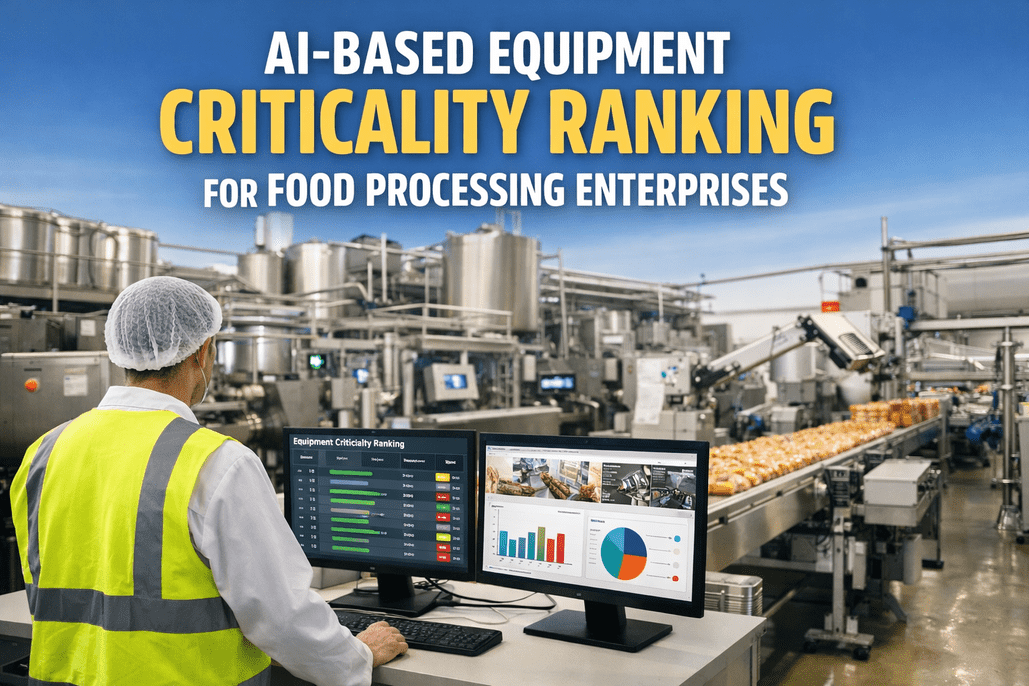
Two conveyors break down the same week. One sits outside a CCP and waits a shift for a technician. The other feeds directly into a critical control point, and the same wait becomes a food safety event. Most plants run both through the identical work order queue. Sign up to classify every asset by its true HACCP consequence and route work orders by criticality, not by whoever complained loudest.
What This Guide Covers
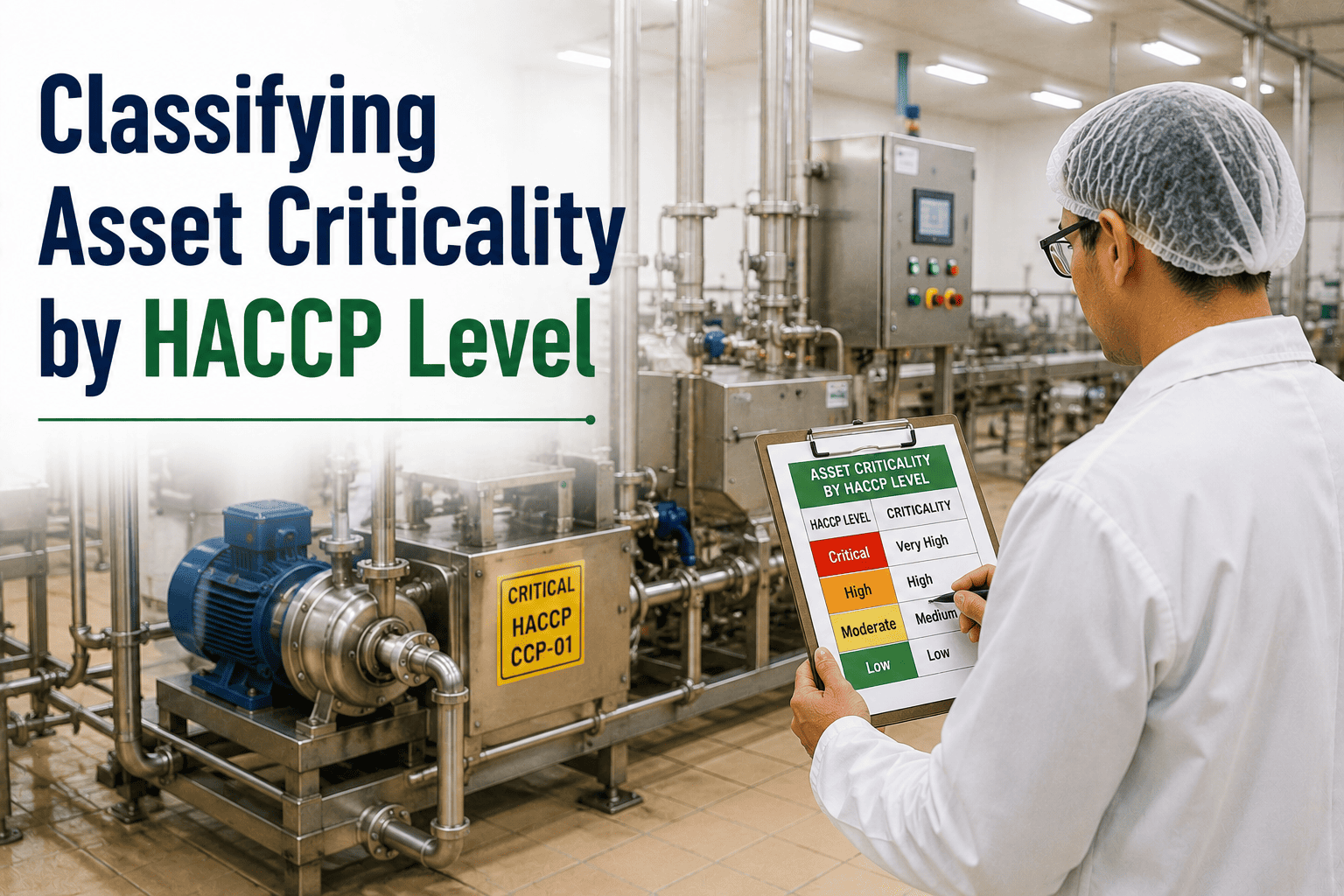
Classifying asset criticality by HACCP level means scoring every piece of equipment by its real food safety consequence — not just downtime cost — so CCP-supporting assets get shorter PM intervals, faster response, and tighter material specifications, while non-critical assets don't compete with them for the same attention.
Why Standard Criticality Scoring Falls Short In Food Plants
| The Gap |
What It Actually Costs The Plant |
| Criticality scored only on downtime cost |
A cheap, low-output asset sitting on a CCP gets ranked below a high-cost machine that has nothing to do with food safety |
| CCP linkage kept in the HACCP plan, not the CMMS |
Maintenance and food safety teams work from two different pictures of what actually matters most |
| One PM interval standard applied plant-wide |
A critical asset gets serviced on the same clock as a low-risk one, leaving the highest-consequence equipment under-protected |
| Parts and materials sourced without a criticality check |
A non-food-grade part quietly ends up on an asset that touches product |
A Four-Tier Criticality Structure Built On HACCP
Tier 1 — CCP-Direct
The asset controls a critical control point itself, like a metal detector or a cook step — failure means an immediate food safety event
Tier 2 — CCP-Supporting
Feeds directly into or immediately downstream of a CCP — failure creates food safety risk within one production cycle
Tier 3 — Quality-Relevant
Affects product quality or a prerequisite program, but doesn't sit on or feed a CCP directly
Tier 4 — General Production
Standard operational criticality applies — downtime cost and safety risk, with no direct food safety linkage
Route Every Work Order By Real Consequence
OxMaint ties each asset's HACCP tier straight into PM intervals, spare parts specification, and work order priority. Sign up for a free trial to build your criticality structure, or book a demo to see it mapped to your CCPs.
Turning Tiers Into Daily Maintenance Decisions
1
Shorten PM Intervals As Tier Rises
A Tier 1 asset earns a tighter, non-negotiable PM schedule; a Tier 4 asset can safely run on a standard interval
2
Lock Material Specification To The Tier
Food-grade lubricants, gaskets, and fasteners are required and enforced on Tier 1 and 2 assets, not left to whichever part is on the shelf
3
Give Tier 1 And 2 Work Orders Priority By Default
A breakdown on a CCP-supporting asset should never sit in the same queue as a general production repair
4
Review Tiers When The HACCP Plan Changes
A new process step or reassessed hazard should update asset criticality in the CMMS, not just the paper plan
Reliability Effort Should Follow Food Safety Risk
A criticality matrix built only on cost and downtime will always underrate the cheap sensor sitting on a CCP. Tying classification to HACCP consequence means the plant's limited maintenance hours land where a failure would actually reach the consumer — not just where it would show up on a downtime report.
Frequently Asked Questions
Q
How is HACCP-based criticality different from standard asset criticality?
Standard criticality typically scores downtime cost, safety, and production impact. HACCP-based criticality adds a direct question — does this asset sit on or feed a critical control point — which can move a low-cost asset to the top of the priority list.
Q
Who should own the criticality classification, maintenance or food safety?
Both. The food safety team defines which assets touch a CCP; the maintenance team translates that into PM intervals, spare parts strategy, and work order priority. Neither picture is complete alone.
Q
Does every plant need four criticality tiers?
Four is a practical starting structure, but the count matters less than the principle — CCP-direct and CCP-supporting assets need to be visibly separated from everything else, however many tiers that takes.
Let Food Safety Risk Set The Maintenance Priority
OxMaint links every asset's HACCP tier to its PM schedule, parts specification, and work order priority — so the highest-consequence equipment never waits its turn. Sign up for a free trial to start classifying your assets, or book a demo to see the criticality matrix in action.