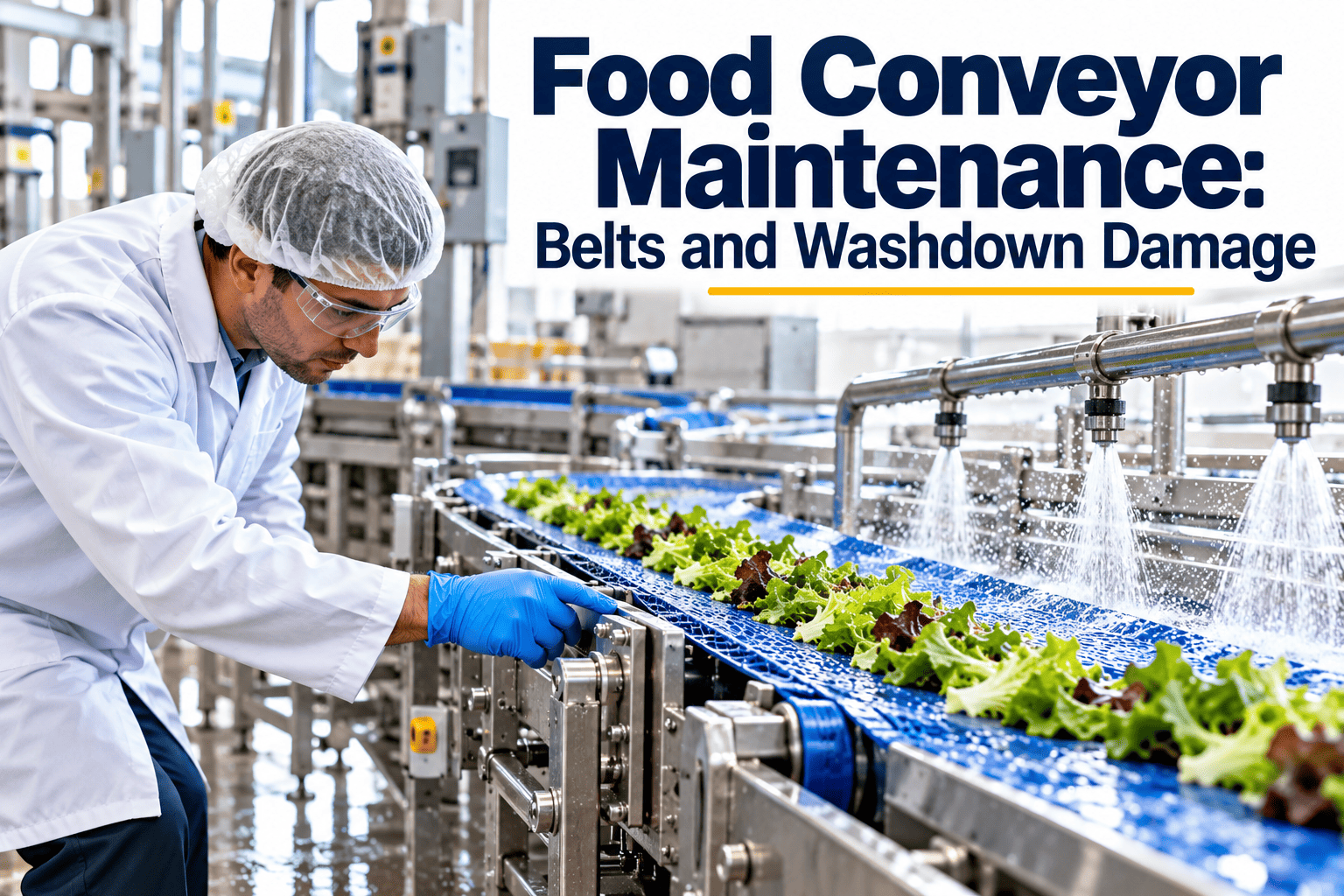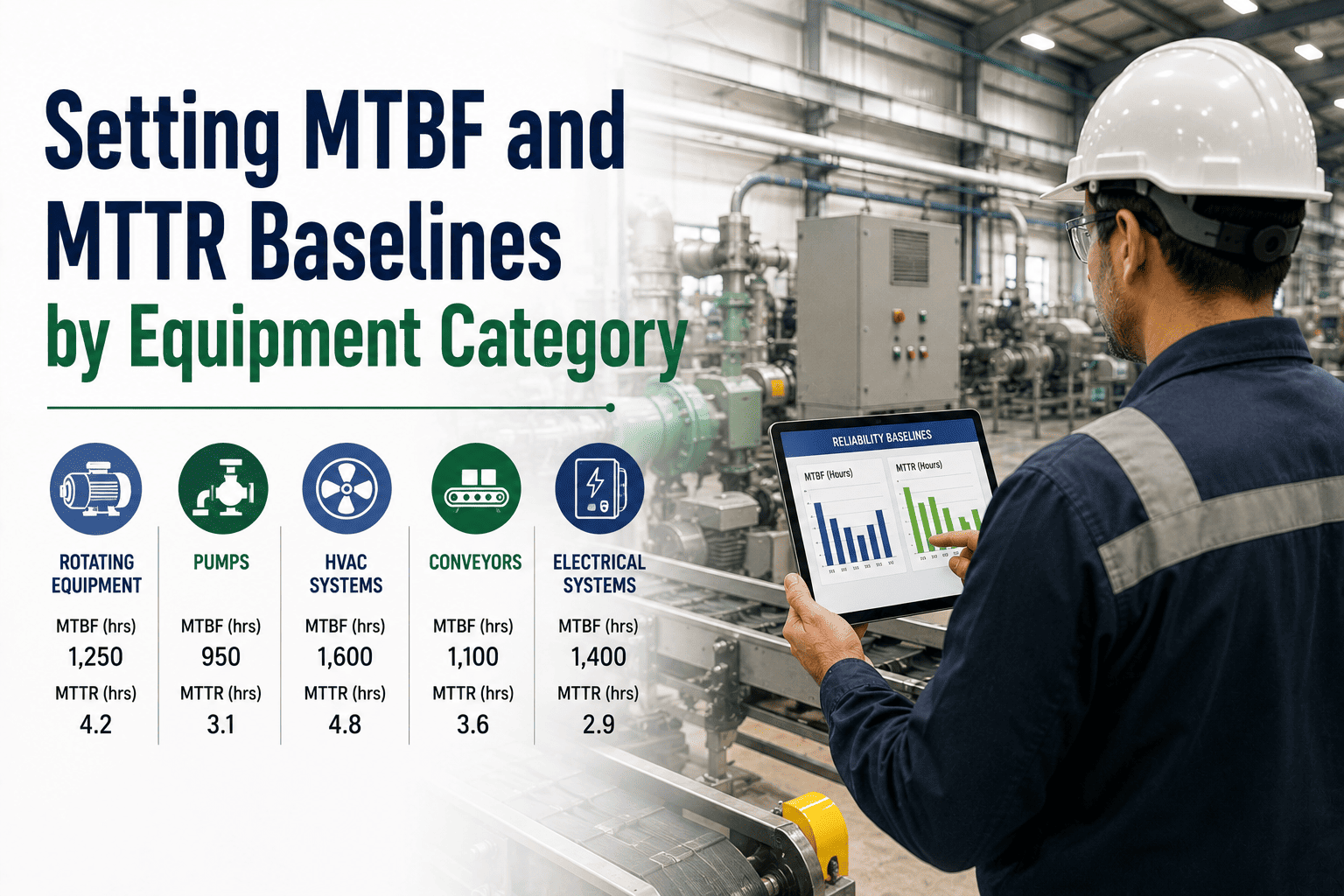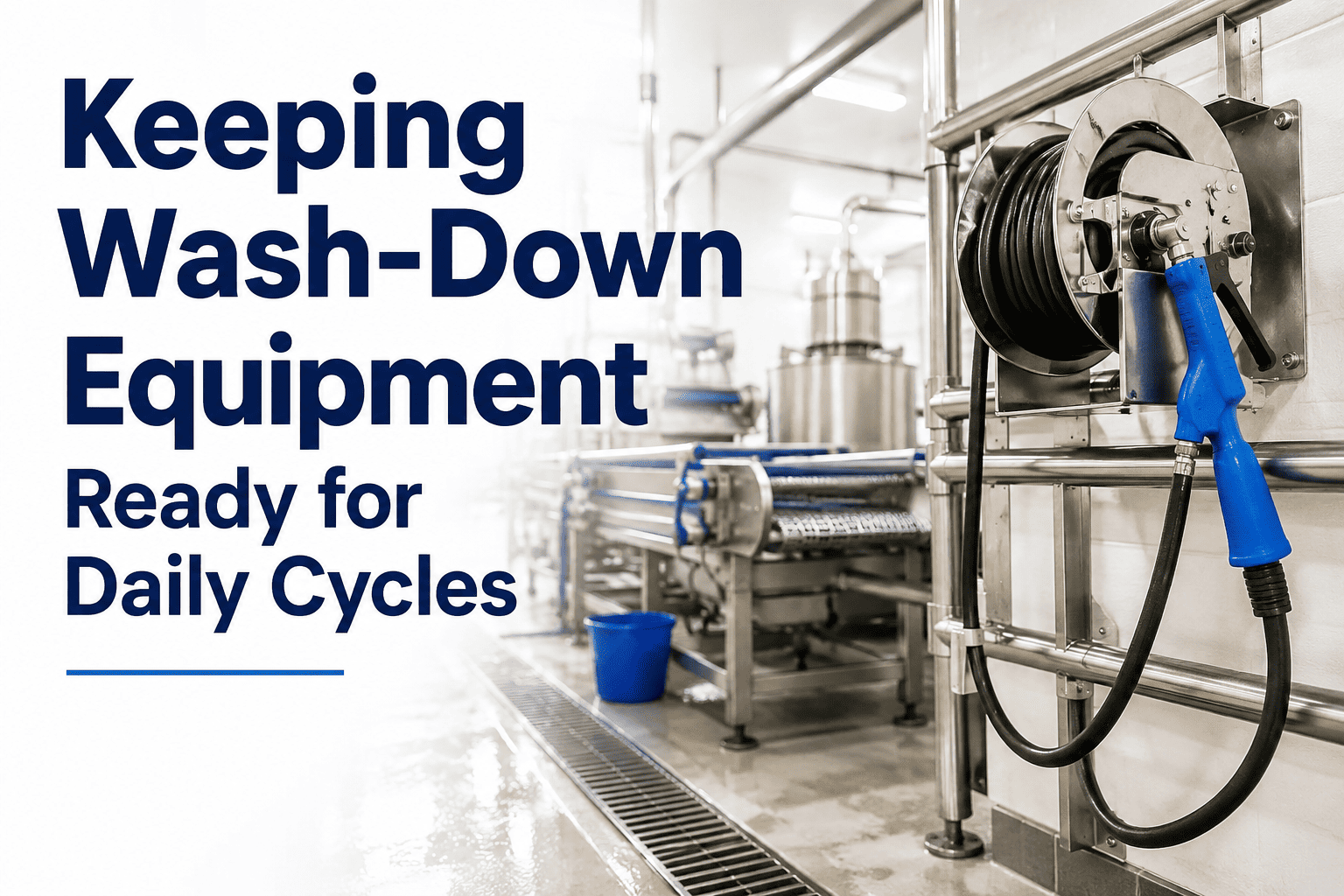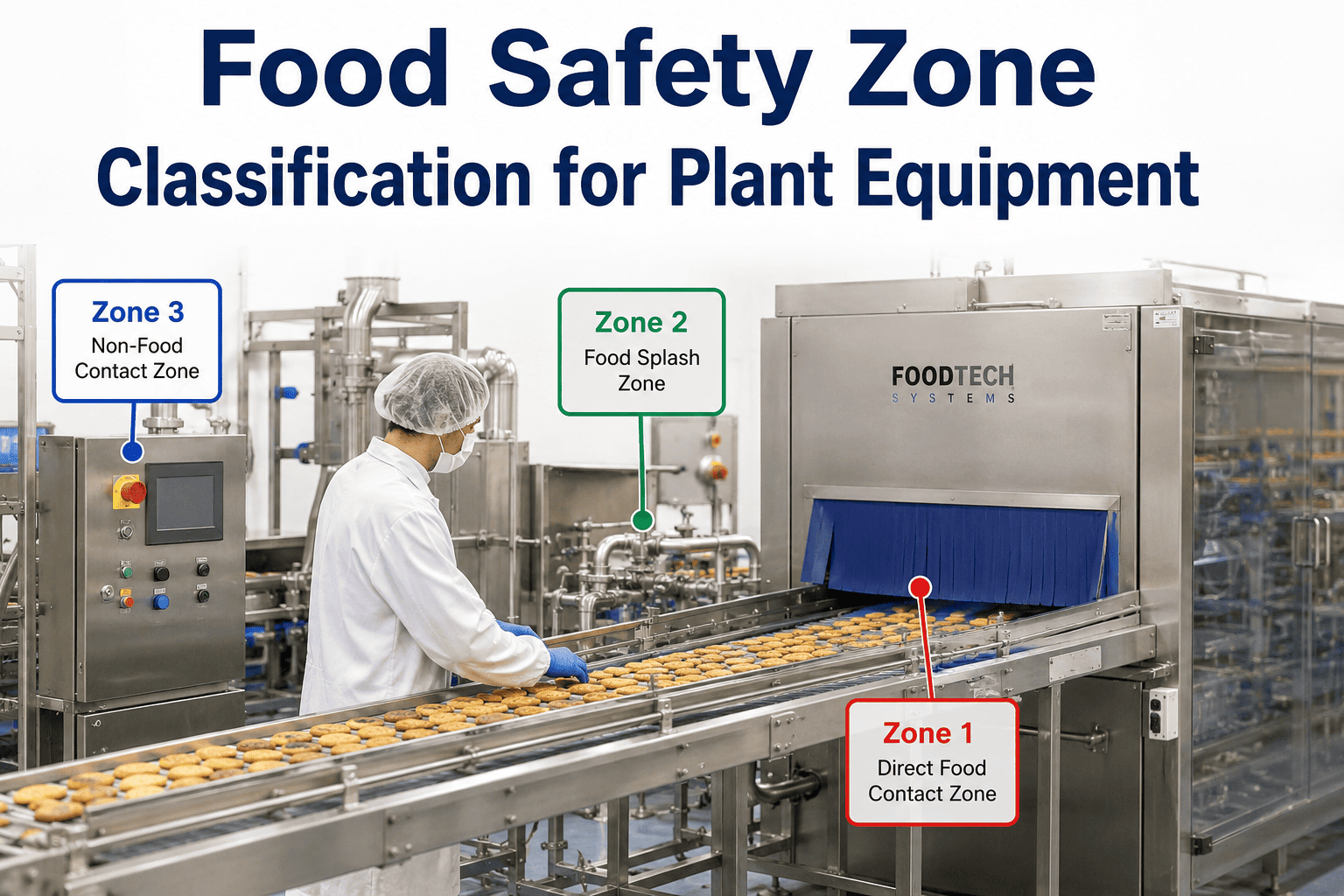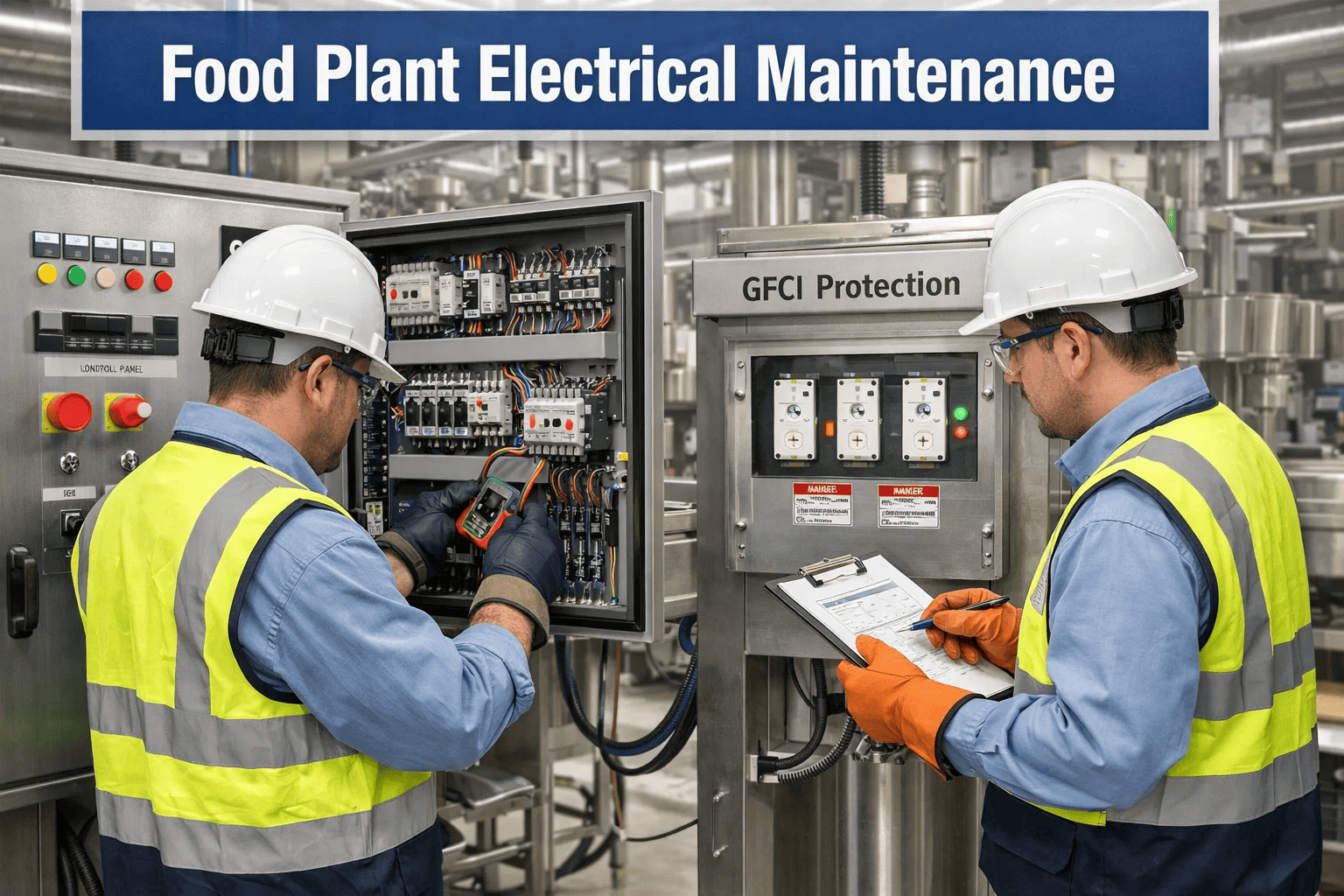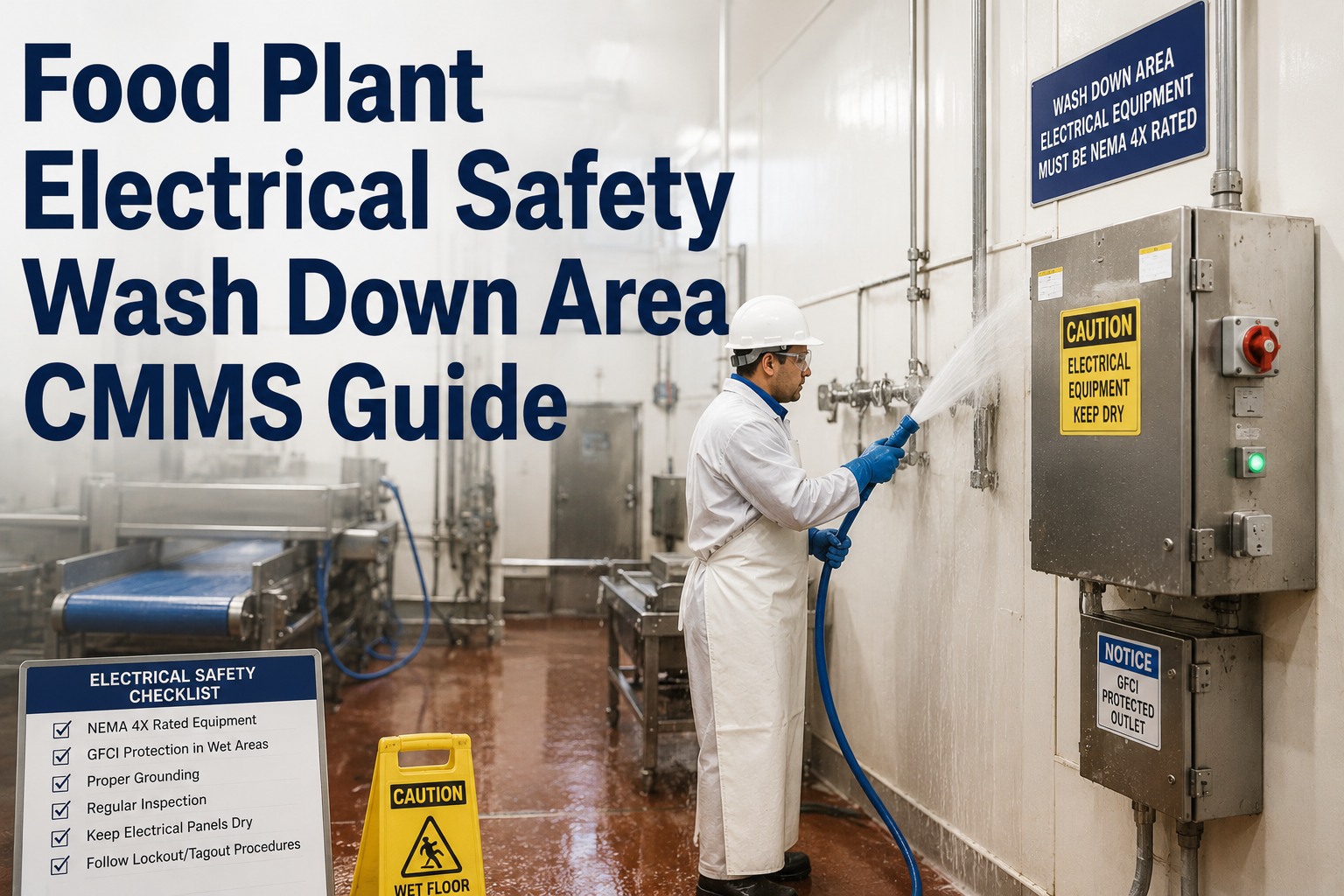
Wash-down zones are where food plants combine three of the most hostile conditions for electrical infrastructure into one operating environment — direct hose-directed water at pressures of 65+ GPM from 10 feet, aggressive caustic and acidic sanitation chemistry, and daily thermal cycling as equipment moves between production temperatures and post-clean cooldown. The regulatory floor is unambiguous: NEC requires GFCI protection on receptacles 60 A and below in wet areas, all enclosures must be NEMA 4X minimum (dust-tight, hose-directed water, corrosion-resistant), and IP69K applies where high-pressure/high-temperature spray sanitation is used. Material selection is not a preference — 304 stainless steel for general wash-down, 316 stainless for chlorine or chloride exposure, fiberglass where non-metallic is required. Sanitary construction is mandatory: sloped tops, gasketed doors, smooth crevice-free surfaces, elevated legs for undercleaning, BISSC-certified finishes on motors and gearmotors. Yet GFCI trip-function testing (quarterly or monthly per NEC/BS 7671), thermal imaging (quarterly), and torque verification (annual) are among the most commonly deferred electrical maintenance tasks in facility audit records — every deferred GFCI test is worker electrocution risk and OSHA exposure sitting in the queue. Below is the working guide — the enclosure decision matrix, the NEC/OSHA wet-zone requirements stack, the electrical PM cadence table, and the CMMS-driven programme that keeps wash-down electrical infrastructure both operationally reliable and worker-safe. Start free or book a demo.
Food Manufacturing · Wash-Down Zones · NEC · NEMA · OSHA · 2026
Food Plant Electrical Safety Wash-Down Area CMMS Guide
The enclosure rating decision matrix, NEC and OSHA wet-zone requirements, the electrical PM cadence for GFCI and thermal and torque testing, and the mobile-first CMMS that stops sanitation-zone electrical PMs from getting deferred.
-
NEMA 4X
minimum enclosure standard in wash-down zones
-
≤ 60 A
receptacles require NEC GFCI protection in wet areas
-
65 GPM
NEMA 4 hose-spray threshold from 10 ft distance
-
Quarterly
GFCI test cadence — the most deferred electrical PM
The Enclosure Decision Matrix
NEMA 4 · NEMA 4X · IP69K — What Actually Fits Each Wash-Down Zone
The rating alphabet soup collapses to a straightforward decision matrix once you map cleaning intensity, chemistry, and hygiene requirements. Below is the working side-by-side.
Standard Hose-Down
Handles hose-directed water and dust but no corrosion resistance. Rarely appropriate for direct food-contact wash-down zones — reserve for outer packaging and utility corridors.
Standard Wash-Down Baseline
The default wash-down zone standard. 304 SS for general use; 316 SS mandatory where chlorine sanitisers or coastal chloride exposure applies. Requires sloped tops, gasketed doors, elevated legs.
High-Pressure High-Temp Wash
Independent from NEMA — separate IEC classification. Where the plant uses high-pressure high-temperature sanitation, IP69K is required. Do not treat 4X as automatic IP69K.
NEC / OSHA Wet-Zone Requirements
The Non-Negotiables Every Wet Zone Must Meet
Regulatory floor for wash-down electrical infrastructure. Below is the working stack — each requirement, its code reference, and what it looks like in the field.
GFCI Protection — Receptacles ≤ 60 A
All 15A, 20A, 30A, 40A, 50A, and 60A receptacles in wet or damp locations must be GFCI protected. Higher-amperage circuits require SPGFCI (Special Purpose Ground Fault Circuit Interrupter) per NEC updates. GFCI trip-function test is quarterly minimum.
Enclosure Rating — Corrosion-Resistant Watertight
All electrical enclosures in wash-down zones must be NEMA 4X minimum. Sloped tops for runoff, gasketed doors, smooth crevice-free construction, elevated legs for undercleaning. Standard construction 304 SS; 316 SS where chlorine sanitisation applies.
Hygienic Design — No Bacterial Harbours
3-A Sanitary Standards for hygienic design of non-product contact surfaces. BISSC certification for gearmotors and equipment in bakery lines. No crevices, seams, or construction details that retain soil or liquid — cleanability is a design requirement not a preference.
Lockout/Tagout — Before Every Cleaning Event
OSHA 1910.147 requires energy isolation before sanitation cleaning. Every wash-down cycle is a LOTO event on the equipment being cleaned. Documented LOTO procedure per asset with trained-authorised-employee sign-off before cleaning begins.
Working Space — Clear Access Around Panels
Clear working space in front of every electrical panel and disconnect — 3 ft minimum for <150V nominal to ground, 3-4 ft for 151-600V. Panel access must remain clear during sanitation — mobile cleaning equipment cannot obstruct.
The Deferred-PM Problem
GFCI Tests Are the Most Deferred Electrical PM in Food Plants — That's a Worker on the Line.
Facility audit records consistently show GFCI trip-function testing (quarterly or monthly per code) as the most deferred wet-zone electrical PM. An untested GFCI that has lost trip function looks identical to a functional one from the outside — until a worker touches an energised conductor while standing in wet PPE on a wet floor. Oxmaint schedules GFCI trip tests as auto-generated PMs with mandatory sign-off and photo evidence per receptacle. The deferred-test failure mode is engineered out of the workflow.
The Electrical PM Cadence
What Runs on Which Interval — the Wet-Zone Schedule
Below is the working PM cadence for wash-down zone electrical infrastructure. Frequency runs on the shorter of standard practice or manufacturer specification or code minimum — whichever is most demanding.
| Task | Standard | Frequency | What It Prevents |
|---|---|---|---|
| GFCI trip-function test | NEC 210.8 | Quarterly (or monthly) | Silent GFCI failure · worker electrocution |
| NEMA 4X enclosure gasket integrity | NEMA / 3-A | Quarterly | Water ingress · corrosion · component failure |
| Thermal imaging of MCCs and panels | NFPA 70B | Quarterly under load | Loose connections · unbalanced loads · arcs forming |
| Torque verification on connections | OEM / NETA | Annual | Loose connections · thermal escalation · fire |
| Insulation resistance testing (IR) | IEEE 43 | Annual | Insulation degradation · ground faults · nuisance trips |
| Motor / gearmotor seal & IP verification | BISSC / IEC | Semi-annual | Water ingress · bearing failure · production stop |
Built for Food Plant Reliability & EHS
How Oxmaint Runs the Wash-Down Electrical Programme End to End
-
Zone-Coded Asset Register
Wet Zone / Dry Zone / Utility Tagged Per Asset
Every electrical asset tagged with zone classification (wet / dry / utility) and enclosure rating (NEMA 4 / 4X / IP69K). PM templates auto-configured per zone — wet-zone assets get GFCI, gasket, and IR tests scheduled automatically at code-minimum cadence.
-
GFCI PM Auto-Cadence
Quarterly Trip Tests — Cannot Slip Silently
GFCI trip-function tests auto-generate per receptacle at quarterly (or monthly) cadence with mandatory sign-off and photo evidence per unit. Overdue tests escalate to plant EHS lead — the deferred-test failure mode structurally eliminated.
-
LOTO Enforcement
Sanitation Cleaning Requires LOTO Sign-Off
Sanitation work orders on wet-zone equipment cannot proceed to execution until the documented LOTO procedure per asset is signed off by a trained authorised employee. Cleaning-before-lockout risk engineered out of the workflow.
-
Thermal + Torque + IR Loops
Quarterly / Annual / Annual — All Scheduled
Quarterly thermal imaging, annual torque verification, and annual insulation resistance tests scheduled as PMs with reading capture, photo evidence, and threshold alerting on out-of-tolerance results. NFPA 70B / IEEE 43 aligned.
-
FSMA-Ready Records
Full Audit Trail per Asset, Per Test
FSMA-aligned record retention — every GFCI test, gasket check, thermal scan, torque verification, and IR reading logged against the asset with technician identity and timestamp. FDA and state inspection requests answered by filter query in seconds.
-
Free Forever Plan
Pilot One Wash-Down Zone First
Cloud-based, mobile-first. Load one wash-down zone's electrical asset register, run GFCI quarterly PMs with photo evidence and LOTO sign-off for 30 days, then scale across the full plant.
Frequently Asked
Wash-Down Electrical Safety Questions
Is NEMA 4X the same as IP66 or IP69K?
No. NEMA and IP are separate classification systems and should not be treated as direct one-to-one equivalents. NEMA 4X provides corrosion-resistant watertight dust-tight protection against hose-directed water. IP66 covers dust-tight and powerful water jets. IP69K covers high-pressure high-temperature spray (1160-1450 PSI at 80°C) — the aggressive CIP standard. A NEMA 4X rating is not automatic IP69K performance. When high-pressure high-temperature sanitation applies, IP69K must be specified independently. Start free and tag asset ratings today.
304 or 316 stainless steel for enclosures?
304 stainless steel works for general wash-down where water and neutral chemistry dominate. 316 stainless steel is required wherever chlorine-based sanitisers are used (most meat, dairy, and beverage plants) or wherever coastal chloride exposure applies — 316 resists chloride-induced pitting and crevice corrosion that will fail 304 within months. Fiberglass is a strong choice for corrosive non-metallic applications. Get the material specification right at procurement — retrofit means full enclosure replacement.
Should GFCI tests be quarterly or monthly?
Quarterly is the widely-accepted floor per NEC and manufacturer guidance; monthly is required in higher-risk installations or where the AHJ or insurer requires shorter cadence. Best practice at food plants with hourly sanitation cycles is monthly trip-function tests with quarterly full trip-time verification — the frequency matches the environmental stress the GFCIs are being exposed to. When AHJ or insurance requires shorter cadence, that shorter cadence controls. Book a demo to see the GFCI PM cadence configuration.
Does LOTO apply to every wash-down cleaning event?
Yes for any equipment being cleaned where unexpected energisation or startup could cause injury. OSHA 1910.147 requires energy isolation before service or maintenance activities where employees could be exposed to hazardous energy. Sanitation is a service activity for LOTO purposes. Documented per-asset LOTO procedures with trained-authorised-employee sign-off before each cleaning cycle begins is the required workflow — and one of the most-cited OSHA findings when skipped.
Is there a free plan to pilot one wash-down zone?
Yes. Oxmaint offers a free forever plan — load one wash-down zone's electrical asset register with enclosure rating and zone classification, schedule GFCI quarterly and gasket/thermal PMs, and run for 30 days with photo evidence and LOTO sign-off before scaling to full-plant electrical infrastructure. Cloud-based, mobile-first — no server procurement to start. Sign up and pilot one wash-down zone today.
NEMA 4X · GFCI Quarterly · LOTO Enforced · FSMA-Ready
The Wash-Down Zone Is Where Sanitation and Electricity Meet. The CMMS Is Where They Stay Compatible.
Zone-coded asset register with enclosure rating tagged per unit. GFCI trip tests scheduled quarterly with mandatory photo evidence. Thermal imaging, torque verification, insulation resistance on their required intervals. LOTO enforced before every sanitation cleaning cycle. Oxmaint runs the entire wet-zone electrical programme as a live, retrievable, FSMA + OSHA + NEC defensible workflow.