Nobody schedules a two-hour changeover on purpose. It happens because half the crew is fetching gaskets, the CIP cycle is running to its worst-case timer, and the allergen sign-off is waiting for a supervisor two lines away. SMED does not add speed to a broken sequence; it rebuilds the sequence so the line only stops for the work that genuinely needs the line stopped. In food plants running 8 to 12 changeovers a week, applying SMED properly recovers 4 to 8 production hours weekly, which is the shortest path from wasted time to real capacity, unlockable with a free trial or a quick demo.
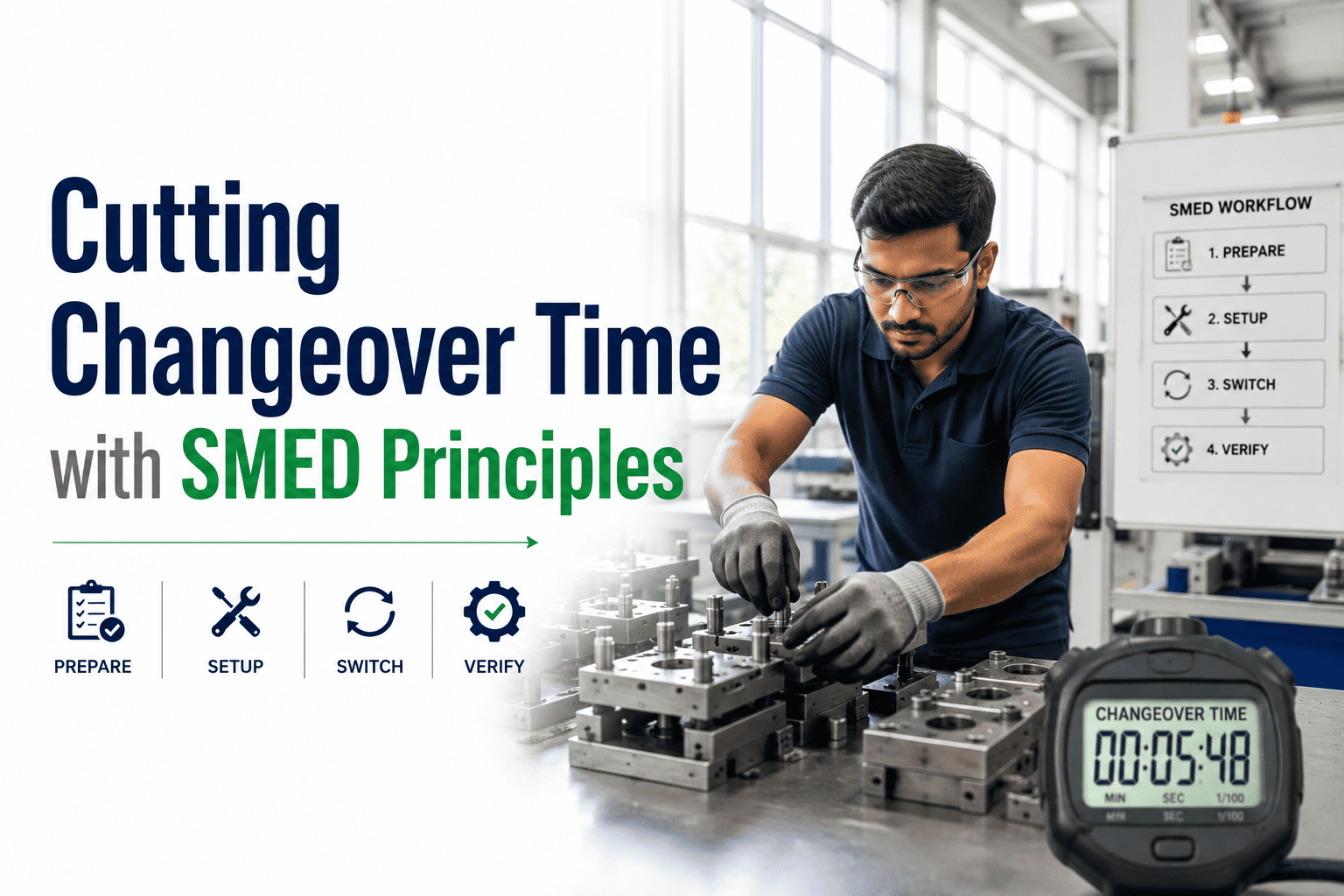
Cutting Changeover Time With SMED Principles
Every minute the line is stopped for a changeover is a minute nobody bills for. SMED plus a CMMS turns unstructured changeovers into repeatable, standardized work orders that a food plant can run the same way on every shift.
Internal Setup vs External Setup, The One Split That Changes Everything
SMED does not ask you to work faster. It asks you a simpler question, does this task actually need the line stopped? Any task that could be done while the previous product is still running is external setup, and moving those tasks out of the changeover window is where 60 percent of the time savings live.
Work that genuinely needs the line down, machine adjustments, contact-parts swap, allergen wet clean, ATP verification, first-piece sign-off.
- Physically swapping food-contact parts
- Wet cleaning and allergen wash-down
- ATP and allergen swab verification
- Product-specific machine adjustment
- First-piece HACCP verification
Work that can and should happen before the last unit of the previous product leaves the line, so the changeover window only carries the work that genuinely needs it.
- Kitting format parts and gaskets ahead of stop
- Pre-staging labels, films, and packaging
- Retrieving cleaning chemicals and tools
- Pre-heating or pre-mixing next product
- Assigning changeover team roles in advance
The Four-Stage SMED Journey, In Food-Plant Terms
SMED is not a single tool. It is a repeatable four-stage sequence that takes a chaotic changeover and rebuilds it into a standard operating procedure the whole crew can follow, changeover after changeover, without depending on the memory of the most experienced operator on shift.
Record the current sequence end to end, timestamp every task, and get honest data on where the line actually spends the stopped minutes. Memory always underestimates.
Sort every task from step one into internal or external, without changing anything yet. This alone usually flags 30 percent of the changeover time as movable outside the stop window.
Rebuild the sequence so external tasks happen while the previous product still runs, kitting, pre-staging, tool retrieval, and team briefing all shift left of the stop clock.
Apply quick-release clamps, colour-coded tooling, dedicated changeover roles, and a CMMS work order that carries the whole sequence as a repeatable checklist.
Turn Every Changeover Into A Repeatable Work Order
Oxmaint captures the SMED-optimised sequence as a standardized changeover work order, assigns tasks to specific roles, pre-releases external tasks before the line stops, and logs actual duration against target for every changeover, without any of it living in a binder.
The Anatomy of a Typical Allergen Changeover
On a filling line running 10 SKUs per shift, a full allergen changeover can consume 90 minutes on the changeover itself and another 45 on the CIP cycle. Not every minute below is recoverable, but at least half is, and knowing which half is the whole point of SMED.
What a Standardized Changeover Work Order Looks Like
A SMED workshop only sticks if the outcome lives somewhere the next shift can actually follow. Inside a CMMS, the improved sequence becomes a standardized changeover work order that assigns tasks, pre-releases external work, and captures actual times against target for every single changeover, not just the ones anyone remembers to measure.
Work order auto-releases the moment the production schedule flags an SKU change, so external prep starts before the last unit runs.
Every task tagged to a specific role, mechanic, sanitation, QA, so the crew knows who does what the second the previous run ends.
Format parts and gaskets pulled to line-side against the WO, scanned in against the correct SKU before the stop clock starts.
Chemical concentrations, contact times, and rinse criteria locked into the WO to cut variability that inflates sanitation cycles.
ATP and allergen swab checkpoints hardwired into the WO so verification happens in the standard sequence, never as a rework loop.
Actual duration of every task logs back to the WO, so drift from the standard shows up in the next changeover review, not the next quarter.
What Actually Changes On The Floor
The gap between an unstructured changeover and a SMED-standardised one is not effort, it is preparation and sequence. The comparison below shows what shifts once the improved changeover work order is running on every SKU switch, on every shift.
| Element | Before SMED | After SMED + CMMS |
|---|---|---|
| Prep timing | Starts when line stops | External tasks staged before stop |
| Role clarity | Whoever is nearest picks it up | Every task tagged to a specific role |
| Parts and tools | Fetched during the changeover | Kitted and scanned line-side pre-stop |
| CIP cycle | Timed to worst case, rarely revisited | Standard cycle documented and enforced |
| Allergen verify | Sequential, often reworked | Built into the WO as a checkpoint |
| Data | Estimated later from memory | Actual times logged per task per WO |
| Improvement loop | Absent | Drift flagged, WO refined continuously |
Frequently Asked Questions
Does SMED still apply when allergen wet-cleans are mandatory?+
How does a CMMS hold the SMED sequence in place?+
What reduction should a food plant realistically expect?+
How is target vs actual time tracked per changeover?+
Can this work across multiple lines and multiple SKUs?+
Give Every Changeover The Same Standard, Every Shift
A food plant that turns changeover into a repeatable, SMED-standardised work order stops paying for the same lost minutes twice. See how Oxmaint captures the improved sequence, assigns it to roles, and locks it into every future changeover with a working walk-through on your own line.