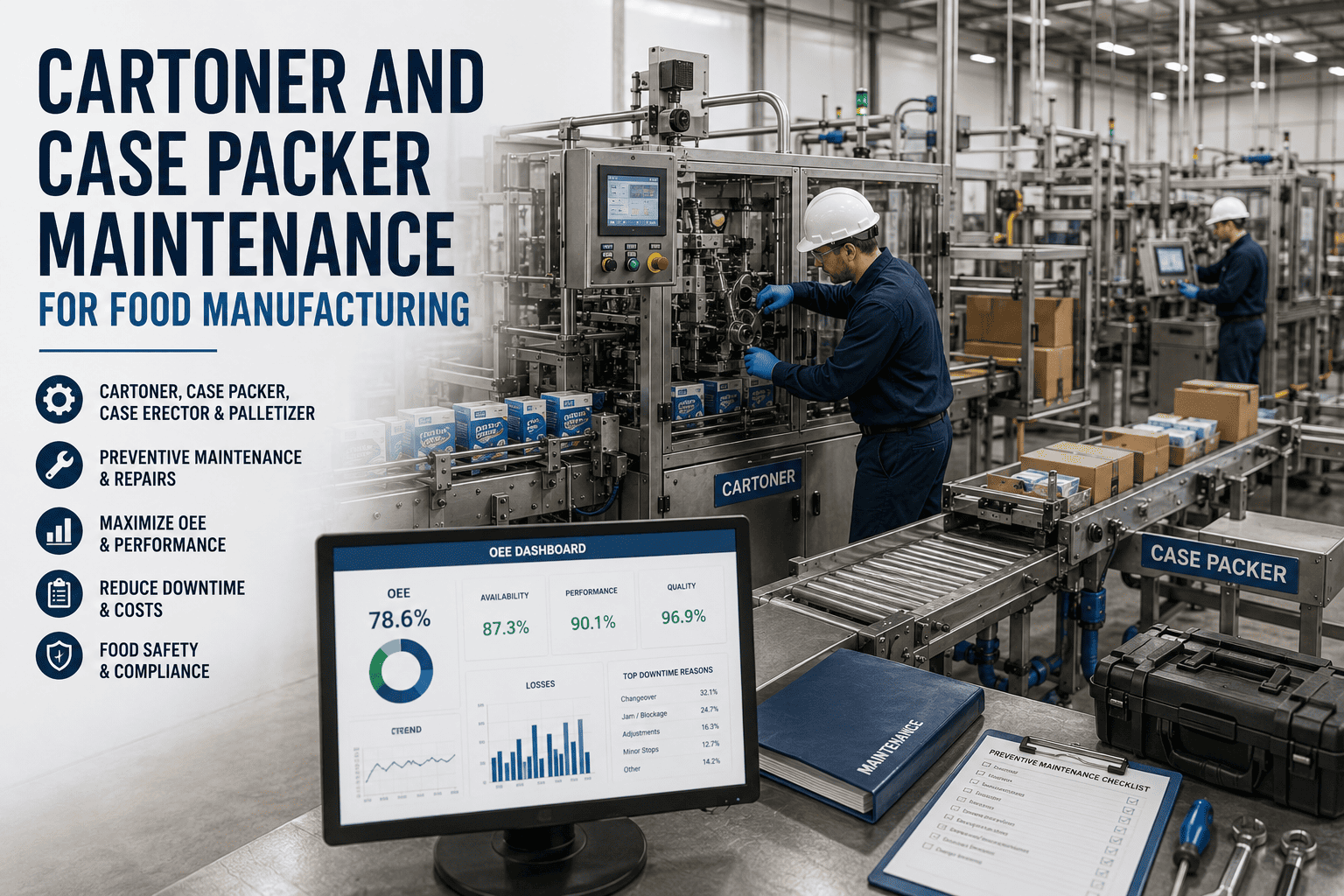
Packaging line maintenance in food manufacturing is the discipline that separates facilities running at peak throughput from those hemorrhaging hours to unplanned downtime and costly changeovers. For packaging engineers managing form-fill-seal machines, case packers, labelers, shrink wrappers, and palletizers simultaneously, the challenge is not whether to maintain — it is how to build a systematic PM program that reduces changeover time, prevents catastrophic failures, and keeps every line audit-ready. This guide delivers the actionable framework packaging engineers need to optimize every asset on the line.
Why Packaging Line Maintenance Directly Drives Food Manufacturing Profitability
In food manufacturing, packaging lines are the final bottleneck between production and dispatch. A single unplanned failure on a high-speed form-fill-seal machine or case packer does not just idle one asset — it backs up every upstream process, compresses changeover windows, and forces rushed sanitation that creates food safety risk. Yet most packaging engineers still manage maintenance schedules through a mix of OEM manuals, spreadsheet logs, and institutional memory that fails the moment a senior technician is unavailable. Sign up free with OxMaint and centralize every PM schedule in one platform from day one.
Effective packaging equipment PM in food plants is built on three pillars: precision scheduling aligned to machine-specific failure modes, changeover optimization using SMED methodology, and documentation that satisfies both GMP regulators and GFSI auditors. When these three pillars are managed through a unified CMMS platform, packaging engineers gain the visibility needed to cut unplanned downtime by more than half — and reduce changeover time without compromising food safety.
Form-Fill-Seal Machine Maintenance: High-Wear Components and PM Frequency
Form-fill-seal (FFS) machines are the highest-speed and highest-failure-risk assets on most food packaging lines. Vertical and horizontal FFS systems operate under continuous thermal, mechanical, and pneumatic stress — and their failure modes are almost entirely predictable when PM programs address the correct component categories at the correct intervals. Packaging engineers managing FFS maintenance must structure PM programs around four primary wear categories.
Heat Seal Bar and Jaw Maintenance
Heat seal jaws and bars are the highest-wear components on vertical FFS machines. Teflon coating degradation, jaw alignment drift, and thermocouple calibration failure are the three primary failure modes. PM schedules must include weekly Teflon inspection, monthly jaw alignment verification, and quarterly thermocouple calibration with temperature profile documentation — all linked to seal integrity test records.
Film Drive and Tracking System PM
Film drive rollers, dancer arms, and registration sensors are responsible for the majority of packaging film waste and seal registration failures on FFS lines. PM tasks must include roller surface inspection for contamination and wear, dancer arm tension calibration, and registration sensor cleaning — scheduled at intervals matched to the film type and line speed rather than calendar defaults.
Pneumatic System Maintenance and Air Quality
Pneumatic cylinders, valves, and filtration systems on FFS machines are critical for consistent jaw pressure and film advancement. Water contamination in compressed air is a leading cause of valve failure and microbial risk on food-contact packaging surfaces. PM programs must include weekly condensate drain inspection, quarterly valve seal replacement, and annual air quality verification.
PLC and HMI Maintenance for FFS Lines
PLC battery backup, HMI touchscreen calibration, and servo drive parameter verification are maintenance tasks that packaging engineers frequently defer until failure — at which point a recipe and parameter backup loss can add hours to changeover time. PM schedules must include quarterly PLC battery checks, annual servo drive parameter archiving, and HMI calibration verification.
Case Packer and Labeler PM: Reducing Changeover Failures on Secondary Packaging Lines
Case packers and labelers represent the most changeover-intensive assets on food packaging lines. Format changes, label roll transitions, and case size switches are the primary triggers for unplanned downtime — and most of that downtime is caused not by mechanical failure but by changeover steps that are inconsistently executed because PM and changeover procedures are not integrated into a single documented workflow. Book a demo to see how OxMaint brings PM and changeover work orders into one unified system.
| Machine Type | Primary Failure Mode | Critical PM Tasks | Changeover Risk Area | Recommended PM Frequency |
|---|---|---|---|---|
| Case Erector | Suction cup wear and vacuum leak | Cup replacement, vacuum gauge calibration | Flap fold misalignment on format switch | Weekly inspection / Monthly replacement |
| Case Sealer | Tape head tension failure | Tape path cleaning, drive roller inspection | Tape head height reset on case size change | Daily wipe-down / Weekly tension check |
| Pressure-Sensitive Labeler | Peel plate wear and label registration drift | Peel plate inspection, sensor cleaning, web tracking | Label gap sensor recalibration on roll change | Per-shift sensor check / Weekly peel plate |
| Print-and-Apply Labeler | Printhead wear and ribbon tracking failure | Printhead cleaning, ribbon path inspection | Print quality verification on product changeover | Daily head clean / 500km ribbon interval |
| Shrink Wrapper | Seal bar Teflon degradation | Teflon replacement, tunnel temperature calibration | Tunnel temperature reset on film gauge change | Weekly Teflon / Quarterly temp calibration |
| Tray Former | Glue system nozzle clog | Nozzle purge, glue temperature verification | Glue volume adjustment on tray size change | Daily nozzle check / Weekly glue system flush |
Palletizer Maintenance in Food Manufacturing: PM for Robotic and Conventional Systems
Palletizer maintenance is frequently under-resourced in food plant PM programs because palletizers are viewed as end-of-line assets with lower food safety criticality than upstream packaging equipment. This misallocation creates significant throughput risk — a palletizer failure at end-of-shift blocks line clearance and creates product accumulation that forces upstream shutdowns. Packaging engineers must treat palletizer PM with the same discipline applied to primary packaging assets.
- Inspect gripper pad wear and suction integrity weekly
- Verify robot arm joint lubrication on OEM-defined intervals
- Calibrate TCP (Tool Center Point) after any collision event
- Archive robot programs and parameter sets monthly
- Inspect drive chain tension and wear on weekly walkdowns
- Lubricate all conveyor chains at manufacturer-defined intervals
- Check slip sheet feeder vacuum system for contamination
- Verify pallet entry sensors and stop gate alignment monthly
- Inspect film carriage pre-stretch rollers for wear weekly
- Verify turntable drive belt tension and tracking monthly
- Clean film cut-and-clamp mechanism at every roll change
- Calibrate film tension settings on pallet load changeovers
- Test light curtain and safety gate interlocks monthly
- Verify emergency stop circuit function at every PM event
- Document LOTO procedure compliance at each maintenance visit
- Inspect perimeter guarding integrity on a weekly basis
SMED Methodology for Food Packaging Changeover Optimization
Single-Minute Exchange of Die (SMED) is the most powerful tool packaging engineers have for reducing changeover time on food packaging lines — and its application in food manufacturing goes well beyond the automotive origins of the methodology. When SMED is applied to form-fill-seal, labeler, and case packer changeovers, the internal-to-external conversion of changeover steps can reduce total changeover time by 30 to 60 percent without compromising the sanitation and verification steps mandated by food safety regulations. Get started free and load your optimized changeover sequences as digital work order checklists in OxMaint.
Document Every Current Changeover Step with Time Stamps
SMED implementation begins with a complete video-documented baseline of every changeover step currently performed on the target line. Time-stamp each step and classify it as internal (machine must be stopped) or external (can be performed while machine is running or during sanitation). Most food packaging changeovers contain 40 to 60 percent of steps that can be reclassified as external with proper pre-staging.
Convert Internal Steps to External Where Food Safety Allows
For food packaging changeovers, external step conversion must be validated against sanitation and allergen control requirements. Film roll staging, label roll preparation, format part kitting, and parameter recipe loading are all examples of steps that can be moved external without compromising food safety — reducing the time the line must be stopped for non-sanitation reasons.
Standardize Tooling and Eliminate Adjustment Steps
Changeover time on food packaging lines is disproportionately consumed by adjustment and fine-tuning steps that should not be necessary if format parts are correctly designed and maintained. Replacing adjustable tooling with dedicated format parts, implementing visual alignment aids, and adding permanent scale markings for height and guide adjustments eliminates the trial-and-error that extends changeovers by 20 to 30 percent in most facilities.
Integrate Changeover Verification into CMMS Work Orders
The final step in food packaging SMED implementation is capturing the optimized changeover sequence as a CMMS work order checklist that technicians complete on mobile devices during the changeover. Digital completion timestamps create the documentation trail required by GMP regulators and GFSI auditors, and CMMS analytics reveal which changeover steps consistently run over target — identifying where further improvement effort should be focused.
CMMS-Driven Packaging Line Maintenance: Closing the Documentation and Visibility Gap
The operational gap between food packaging facilities that run at 85 percent OEE and those struggling below 70 percent almost never traces to differences in equipment quality or technician skill. It traces consistently to the visibility gap — the inability of packaging engineers and maintenance managers to see, in real time, which PM tasks are overdue, which assets are trending toward failure, and which changeover steps are consuming disproportionate time. A CMMS built for food manufacturing packaging lines closes that gap by connecting scheduling, execution, documentation, and analytics in a single platform. Book a demo with OxMaint to see how packaging line PM workflows operate across a live food plant environment.
Building the Packaging Line PM Schedule: A Practical Framework for Packaging Engineers
A compliant, effective packaging line maintenance schedule in food manufacturing is built from the asset level up — not from a generic template applied across all machines. Packaging engineers who build PM programs from OEM recommendations, operational failure history, and food safety risk classification consistently achieve higher PM compliance rates and lower unplanned downtime than those who adapt programs designed for other industries or facilities. The framework below provides the practical sequence for building a PM schedule that regulators accept and production teams can execute.
Inventory Every Packaging Line Asset with OEM Maintenance Data
Build the asset register for every piece of packaging equipment — FFS machines, case packers, labelers, coders, shrink wrappers, palletizers, and conveyors — with manufacturer model number, serial number, installation date, and OEM maintenance manual reference. Pull the OEM-recommended PM intervals for each machine as the baseline for your PM schedule. Document any deviations from OEM recommendations with written justification.
Classify Each Asset by Food Safety and Throughput Criticality
Assign each packaging asset a criticality rating that combines food safety impact (food-contact components, CCP-adjacent equipment) with throughput impact (single-point-of-failure machines, line-speed-limiting assets). High-criticality assets receive tighter PM intervals, additional condition monitoring, and priority scheduling — while lower-criticality assets receive standard OEM-based intervals without premium resource allocation.
Identify High-Wear Components and Set Runtime-Based Triggers
For high-speed packaging machines, calendar-based PM intervals are frequently misaligned with actual component wear rates that depend on line speed, product type, and operating hours. Identify the five to ten highest-wear components on each critical asset and set PM triggers based on production cycles, operating hours, or footage run rather than calendar dates — especially for seal jaws, printheads, and drive components.
Write Task-Level PM Procedures Integrated with Changeover Steps
For each packaging asset, write task-level PM procedures that specify the individual inspection and replacement steps, the tools required, the food-grade lubricants and materials to be used, acceptance criteria for each inspection point, and the steps that can be combined with scheduled changeover windows to minimize line stop events. Integration of PM and changeover steps is one of the highest-leverage strategies for reducing total planned downtime on packaging lines.
Load PM Schedules into CMMS and Configure Auto-Generation
Enter the validated PM schedule for every packaging asset into the CMMS with auto-generation rules that create work orders at the correct interval and assign them to qualified technicians based on the asset location and skill requirement. Configure overdue escalation thresholds that flag delayed PM tasks to supervisors and document the risk assessment process for any PM tasks deferred beyond the scheduled due date.
Review PM Effectiveness Monthly Using CMMS Failure Data
Establish a monthly PM effectiveness review that compares unplanned downtime events against the PM schedule for each packaging asset. When the same failure mode appears on a machine that received PM on schedule, the PM task list or interval is the root cause — not maintenance execution. Use CMMS failure history and MTBF trending to refine PM content and frequency on a continuous improvement cycle that reduces both downtime and unnecessary maintenance labor.
Packaging Line Maintenance KPIs Every Packaging Engineer Should Track
Packaging line maintenance performance is measurable at the asset level, and packaging engineers who establish KPI baselines before implementing PM program changes gain the ability to quantify improvement and justify maintenance investment to plant leadership. The metrics below are the leading indicators that distinguish packaging lines running at optimal OEE from those consuming disproportionate maintenance and changeover hours. Sign up free to access live KPI dashboards built for food packaging teams.
OEE combines availability, performance, and quality into one composite score. Lines below 70% have maintenance and changeover issues that a structured PM program can directly address.
Declining MTBF on a specific machine is the earliest indicator that current PM frequency is insufficient for operating conditions — before a catastrophic failure forces the issue.
Tracking changeover time by line and SKU reveals which format changes consume disproportionate time and where pre-staging or tooling standardization will deliver the highest return.
PM compliance below 90% on high-speed packaging equipment signals a scheduling conflict with production priorities — a management issue, not just a maintenance one.
Increasing film waste is almost always a leading indicator of seal jaw wear, film drive misalignment, or registration sensor degradation — each one a preventable PM finding.
Facilities spending more than 40% of packaging maintenance hours on reactive repairs demonstrate to GMP auditors that the PM program is responding to failures, not preventing them.