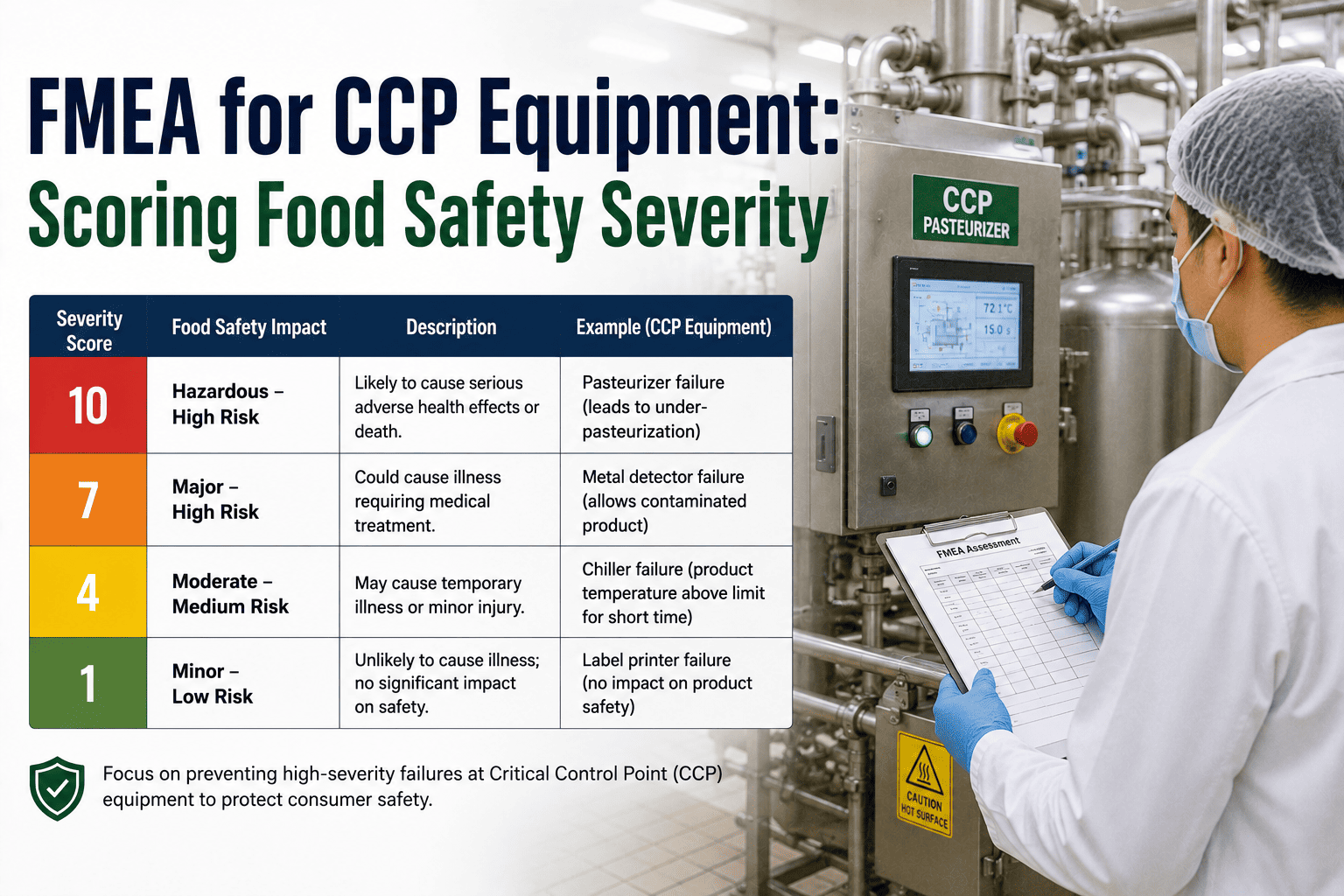
A standard FMEA scores a bearing failure by cost and downtime. On a CCP asset, the same bearing failure can mean metal fragments reaching product — and a severity score built for reliability alone will never catch that difference. Sign up to run FMEA scoring that weighs food safety severity alongside reliability risk, and keep every high-RPN action tracked to closure.
What This Guide Covers
FMEA on CCP equipment means scoring each failure mode on severity, occurrence, and detection — with food safety consequence built directly into the severity dimension — then turning the highest risk priority number items into corrective actions that stay visible in the CMMS instead of fading back into a spreadsheet after the review meeting ends.
The RPN Formula, And Why Food Safety Changes It
Severity
On CCP equipment, this must reflect food safety consequence first — contamination or a CCP miss scores at the top regardless of repair cost
Occurrence
How often this specific failure mode actually happens, drawn from real failure history, not a guess
Detection
How likely current controls are to catch the failure before it reaches product — weaker detection pushes the score higher
RPN
Severity multiplied by occurrence multiplied by detection — the number that ranks which failure modes get addressed first
Scoring Severity For A CCP Asset
| Consequence |
Severity Weight |
| Failure allows a CCP limit to be breached undetected |
Highest — treated as a potential product recall or public health event |
| Failure triggers a detectable CCP deviation |
High — product is held or diverted, but the safety net caught it |
| Failure affects quality but not food safety |
Moderate — scored on standard reliability and cost criteria |
| Failure has no product-facing impact |
Low — general operational scoring applies |
Every High-RPN Item, Tracked To Closure
OxMaint keeps FMEA scores, corrective actions, and PM changes tied to the same CCP asset record, so a high-RPN finding never quietly drops off the list. Sign up for a free trial to build your FMEA into the CMMS, or book a demo to see the RPN workflow.
From RPN Score To Working Corrective Action
1
Rank Failure Modes By RPN, Not Alphabet
The highest-scoring failure modes get addressed first, regardless of how the original FMEA worksheet happened to list them
2
Assign An Owner And A Deadline To Each Action
A corrective action without an owner in the CMMS is a line item that will still be open a year later
3
Convert High-Severity Items Into PM Tasks
The detection controls FMEA identifies become scheduled inspections or condition checks, not one-time fixes
4
Re-Score After The Fix, Not Just Before
A verified corrective action should lower the RPN in the record — if it doesn't, the fix didn't address the real failure mode
An FMEA That Lives Only In A Spreadsheet Isn't Active
Most FMEA studies produce a strong worksheet and then stall — the ranked failure modes never connect to a PM schedule or a tracked action. Keeping FMEA outputs inside the CMMS is what turns a one-time analysis into a program that keeps scoring, prioritizing, and closing risk on CCP equipment continuously.
Frequently Asked Questions
Q
How is FMEA on CCP equipment different from a standard reliability FMEA?
The severity score is weighted toward food safety consequence first, so a failure mode that risks a CCP breach ranks at the top even if it would score low on cost or downtime alone.
Q
What's a reasonable RPN threshold for requiring action?
There's no universal number — a plant should set its own threshold based on its scoring scale, but any failure mode with a high severity score for food safety should typically require action regardless of the total RPN.
Q
How often should FMEA on CCP equipment be revisited?
Whenever the HACCP plan changes, a process or equipment modification occurs, or new failure history suggests occurrence or detection scores need updating — not just on a fixed annual calendar.
Score Risk The Way A CCP Asset Actually Deserves
OxMaint keeps FMEA severity, occurrence, detection, and corrective actions tied to every CCP asset — so nothing high-risk fades back into a spreadsheet. Sign up for a free trial to build your FMEA program today, or book a demo to see it applied to your equipment.