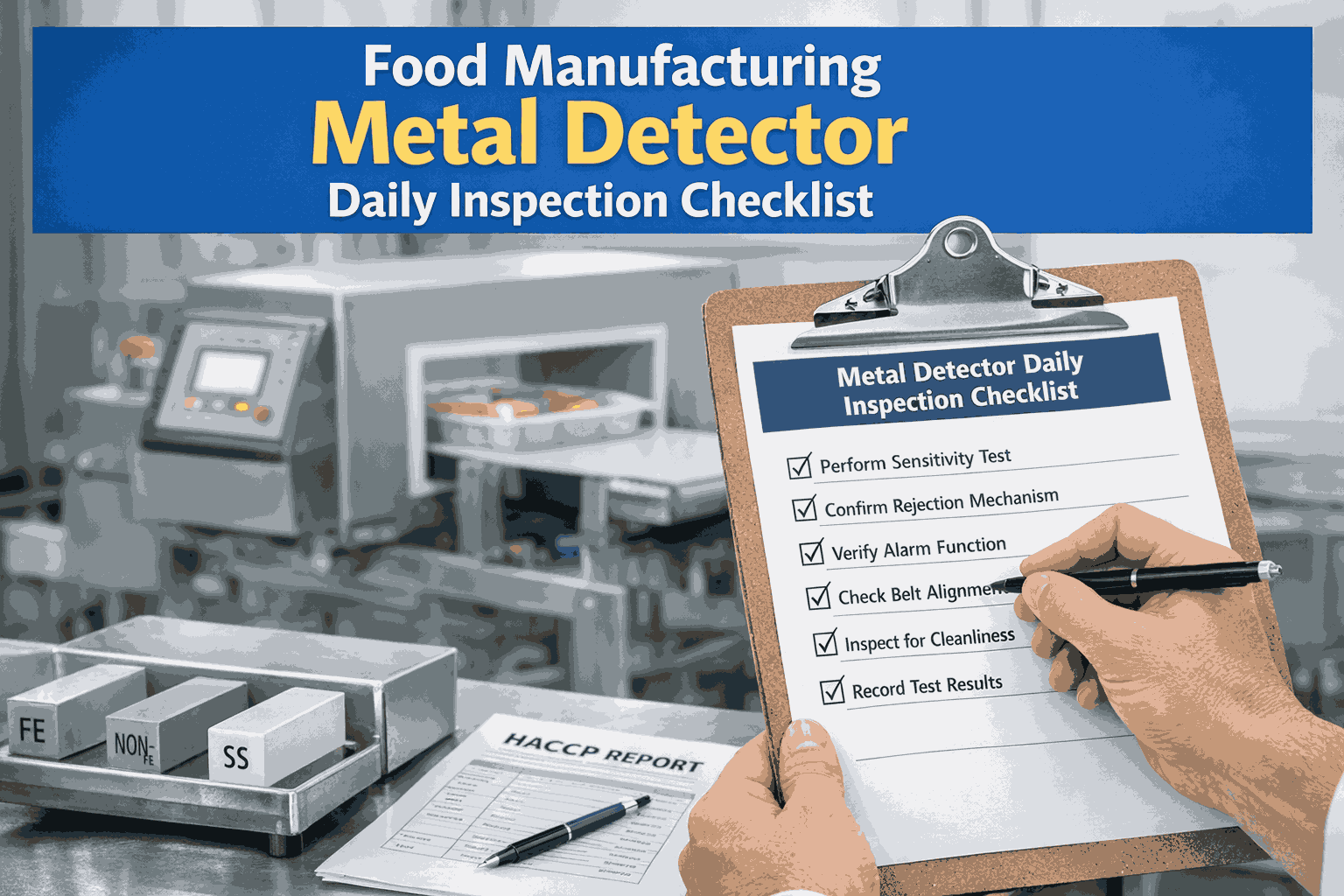
Checklist for Metal Detector and X-Ray Inspection Systems in Food Plants
By Johnson on February 23, 2026
In February 2026, a frozen meatball manufacturer in New York recalled over 9,400 pounds of product after metal fragments were found in their ready-to-eat line. The metal detector on the packaging line had been operational — but its last documented calibration test was 11 days overdue. That single gap between "working equipment" and "verified equipment" turned a routine production day into a Class I recall, triggering FDA investigation and immediate retailer de-listing. For food plants running metal detectors and X-ray inspection systems, the equipment itself is only half the equation. The other half is a documented, repeatable inspection routine that proves your systems are catching what they're supposed to catch, every shift, every day. Sign up for OxMaint to digitize your inspection checklists and never miss a verification window again.
2025 Recall Alert: Foreign material was the #1 cause of USDA food recalls in 2025 — responsible for 13 out of 42 total recalls, affecting over 71 million pounds of product. Metal, glass, plastic, and wood contamination surpassed even bacterial hazards as the leading recall trigger.
13
Foreign Material Recalls (USDA 2025)
71M+
Pounds of Product Recalled
90%
Were Class I — Serious Health Risk
11.6%
Of All FDA Recalls: Foreign Objects
Why Metal Detectors and X-Ray Systems Need Systematic Inspection
Metal detectors and X-ray inspection systems are your last line of defense before contaminated product leaves the building. They sit at Critical Control Points in your HACCP plan, and auditors from BRC, SQF, FSMA, and retailer programs all expect documented proof that these systems are calibrated, tested, and functioning within specification — not just installed and powered on. When a system drifts out of calibration or a reject mechanism fails silently, contaminated product passes through undetected. The result is a recall that costs an average of $10 million in direct expenses, not counting brand damage and lost retail partnerships. Book a demo to see how OxMaint automates inspection scheduling for detection equipment.
What Goes Wrong Without Systematic Inspections
Each failure compounds into the next — creating a chain reaction from missed check to product recall
01
Calibration Drift
Sensitivity degrades from vibration, temperature changes, or electrical interference — undetected without routine testing
02
False Accept / False Reject
Contaminated products pass through, or good product gets rejected — both cost money and compromise safety
03
Audit Failure or Recall
Inspector flags missing test logs, or contaminated product reaches market — triggering corrective actions or full recall
Metal Detector vs. X-Ray: What Each System Catches
Both technologies are critical — but they detect different contaminants under different conditions. Understanding these differences determines what your inspection checklist must cover for each system type.
Contaminant / Factor
Metal Detector
X-Ray System
Ferrous metals (iron, steel)
Excellent
Excellent
Non-ferrous (aluminum, copper)
Good
Excellent
Stainless steel (304, 316)
Challenging
Good
Glass, bone, stone, dense plastic
Not Detectable
Good
Wet / salty / high-mineral products
Product Effect Risk
Unaffected
Foil or metalized packaging
Causes Interference
No Issue
Maintenance cost over lifespan
Lower
Higher (consumables)
Environmental sensitivity
EMI, vibration, power
Temperature, cooling
Key takeaway: Many facilities need both systems at different points in production. Your inspection checklist must account for the unique maintenance requirements of each technology — a single generic checklist won't cover both.
Complete Inspection Checklist: Metal Detectors & X-Ray Systems
This checklist covers every verification point that HACCP auditors, BRC assessors, and SQF certifiers expect to see documented. Each section maps to specific compliance requirements. Sign up for OxMaint to turn this into an automated, recurring digital checklist with photo capture and timestamped completion records.
Section 1
Pre-Shift Visual & Safety Inspection
Every Shift — Before Production Starts
Section 2
Calibration & Sensitivity Verification
Every Shift + After Product Changeover
Section 3
Operational Performance Monitoring
During Production — Continuous
Section 4
Environmental & Electrical Conditions
Weekly + After Any Facility Changes
Section 5
Documentation & Compliance Records
Every Test Event — Mandatory for All Audits
Turn this checklist into an automated digital workflow. OxMaint schedules every inspection, sends reminders, captures photo evidence, and logs timestamped completion records — so you're audit-ready 365 days a year, not just the week before an inspector arrives.
Different checks require different frequencies. This schedule aligns with industry best practices and auditor expectations for HACCP critical control point equipment. Set these as recurring tasks in OxMaint and they'll auto-generate with reminders and escalation rules.
Every Shift
Visual safety inspection
Test piece validation (all metal types)
X-ray calibration standard test
Reject mechanism function test
Reject bin check & lockout
Weekly
False reject rate trend analysis
Conveyor belt wear inspection
EMI & environmental interference scan
X-ray image quality review
Monthly
Full calibration verification & documentation
Electrical connection & wiring inspection
X-ray cooling system service
Software & firmware update check
Annually
Radiation safety inspection (X-ray)
Full HACCP / CCP program review
Operator retraining & recertification
Equipment replacement assessment
What Auditors Actually Flag: Top Inspection Failures
These are the most common non-conformances auditors cite when reviewing metal detector and X-ray inspection programs. Every item on the checklist above is designed to prevent these exact findings.
01
Test piece verification gaps
Calibration tests run with only one metal type instead of all three (ferrous, non-ferrous, stainless). Auditors check that every test covers the full contaminant range.
02
Missing reject mechanism proof
Sensitivity was verified, but no record shows the reject system actually removed the product from the line. Detection without rejection equals zero protection.
03
Undocumented product changeovers
Different products have different detection characteristics. Switching from dry cereal to a high-moisture sauce without recalibration — and documenting it — is a critical gap.
04
No corrective action trail
A failed test was recorded, but the follow-up action — recalibration, line stoppage, product hold — was never documented. Auditors need to see the complete response chain.
05
Overdue scheduled maintenance
PM schedule exists on paper, but actual completion dates are weeks behind. This is the exact gap that triggered the meatball recall referenced above — equipment was running, maintenance was late.
How OxMaint Digitizes This Entire Checklist
Paper checklists get lost, timestamps get questioned, and corrective actions fall through the cracks. OxMaint replaces all of that with a digital system purpose-built for food plant compliance. Book a demo to see these features configured for your specific production lines.
Recurring Digital Checklists
Assign this checklist to specific equipment, operators, and shifts. It auto-generates at your defined frequency with push notifications — no one has to remember to pull a clipboard off the wall.
Auto-ScheduleShift-Based
Photo Evidence with Metadata
Technicians capture before/after photos directly inside the checklist. Every image embeds timestamp, GPS location, and operator ID automatically — evidence that auditors accept without question.
TimestampedGPS Tagged
Fail-Triggered Work Orders
When a checklist item fails — such as a test piece not triggering rejection — OxMaint automatically creates a corrective action work order assigned to maintenance, with full context from the failed check.
Auto-EscalationHACCP Linked
One-Click Audit Reports
Generate compliance-ready documentation packages filtered by equipment, date range, or regulatory standard. Hand your BRC, SQF, or FDA auditor a complete report in minutes instead of spending days reconstructing records.
PDF ExportAudit-Ready
"Our metal detector test logs used to be a binder that no one could find during audits. After switching to OxMaint, our SQF auditor spent ten minutes reviewing two years of inspection data — filterable by equipment, shift, and operator. She told us it was the cleanest CCP documentation she'd reviewed that month."
— QA Manager, Frozen Foods Processor, Midwest US
Frequently Asked Questions
How often should metal detector test pieces be run through the system?
Industry best practice and most GFSI-benchmarked standards require testing at the start of every production shift, after every product changeover, and at the end of each shift. Some high-risk operations test every hour. OxMaint lets you set custom intervals per equipment and product type.
What test pieces do we need for proper calibration verification?
For metal detectors, you need certified test samples in three categories: ferrous (iron/steel), non-ferrous (aluminum/copper), and stainless steel (typically 316 grade). For X-ray systems, calibration standards should include ceramic, glass, bone, and metal samples embedded in food-safe carrier material. Sizes depend on your HACCP plan critical limits.
Can one inspection checklist cover both metal detectors and X-ray systems?
The visual, safety, and documentation sections overlap significantly. However, calibration procedures differ — metal detectors use magnetic field test pieces while X-ray systems use density-based standards. OxMaint allows you to create a shared base template with equipment-specific sections that appear only when relevant.
What should we do when a test piece fails to trigger detection?
Immediately stop the production line and quarantine all product that passed through the system since the last successful test. Recalibrate the detector, re-run the test, and document the root cause. All quarantined product must be re-inspected before release. Sign up for OxMaint to automate this corrective action workflow with auto-generated hold orders.
How long must we keep inspection records for compliance?
FSMA requires records for at least two years. BRC and SQF may require longer retention depending on the clause. Most food safety professionals recommend keeping records indefinitely for trend analysis and legal protection. OxMaint stores unlimited records with no additional cost. Book a demo to see the record retention system.
Your Inspection Systems Are Only as Good as Your Inspection Process
Metal detectors and X-ray systems protect your products — but only when they're properly calibrated, tested, and documented every single shift. OxMaint turns this checklist into an automated digital workflow that runs itself, captures audit-ready evidence, and escalates failures before contaminated product leaves your facility.