FSMA 204 asks food companies to know where a lot came from, what happened to it and where it went, and to prove it quickly when the FDA asks. The rule sets out specific data to keep at specific moments in a food's journey, and many plants discover their production records are patchy once they look closely. This guide explains the key data elements, the critical tracking events and the records that quietly make or break a trace, with a maintenance management platform supporting the equipment side of the story.
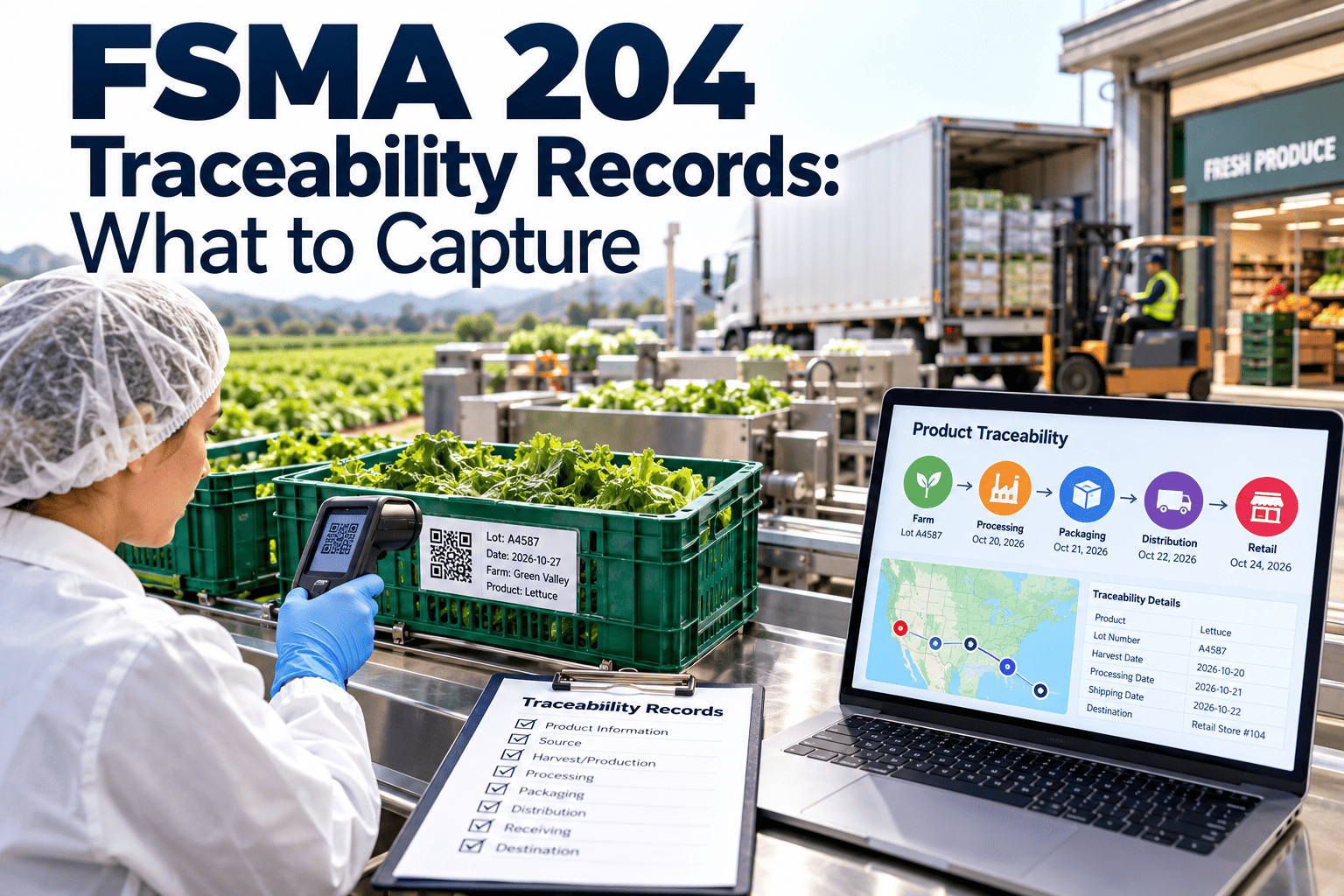
FSMA 204 Traceability Records: What to Capture
Understand the events that trigger a record, the data each record needs and the supporting plant records that let you answer a trace request within the required time.
The rule in plain terms
The Food Traceability Rule is part of the Food Safety Modernization Act and sits in the US federal regulations at 21 CFR Part 1, Subpart S. It adds recordkeeping for foods on the Food Traceability List, so outbreaks can be traced faster and recalls can be narrower.
Dates and deadlines
The original compliance date of January 20, 2026 has been extended. Current FDA information points to July 20, 2028, with the requirements themselves unchanged. Customers may still ask for earlier readiness, so check your contracts.
Four terms to know
- FTL: the Food Traceability List of foods covered by the rule.
- CTE: a critical tracking event, such as receiving or shipping.
- KDE: a key data element recorded for each event.
- TLC: the traceability lot code that links records together.
Who needs to keep these records
Covered
Businesses that manufacture, process, pack or hold foods on the Food Traceability List, including cheese, fresh produce categories, shell eggs, certain seafood and ready to eat deli salads.
Possibly exempt
The rule contains exemptions, for example for some small operations and certain foods that receive a qualifying kill step. Confirm applicability against the regulation, not a summary.
Indirectly affected
Suppliers and customers of covered foods are often asked for data by trading partners, even if the rule does not bind them directly.
Critical tracking events and what each record needs
The data you keep depends on which event is happening. The table summarises the main events for a manufacturer and the type of information expected. Treat it as a planning aid and verify the exact list in the regulation.
| Event | When it applies | Core data to capture |
|---|---|---|
| Receiving | A covered food arrives at your facility from another party. | Traceability lot code, product description, quantity and unit, receiving date, location of receipt, immediate previous source, source of the lot code and a reference document. |
| Transformation | You manufacture, process or change the food or its packaging in a way that creates a new product. | New lot code, product description, quantity and unit, date, location, reference document and the link back to the input lot codes used. |
| Shipping | A covered food leaves your facility to another party. | Lot code, product description, quantity and unit, ship date, ship from and ship to locations, source of the lot code and a reference document. |
| Initial packing and cooling | Relevant to certain raw agricultural commodities and seafood at the start of the chain. | Event specific details such as location, date, lot code assignment and product description. |
| Harvesting | Farm level event for covered produce and similar foods. | Farm location, harvest date and lot code information for the supplier. |
Designing a traceability lot code that survives a recall
The traceability lot code is the thread that ties every record together. A weak scheme creates duplicates, ambiguity and long manual searches when time matters most.
Qualities of a workable code
- Unique within your business, so two lots never share a code
- Assigned at the right moment, such as when a new lot is created by transformation
- Printed or labelled so it follows the product through packing and shipping
- Linked in records to the input lots and the shipping documents
- Readable by the people who must key it in under pressure
Common design choices
- Many plants combine site, line, date and sequence in one code.
- Avoid reusing a code after a recall or rework.
- Decide in advance how a re-lotted or blended product is coded.
Connect plant records to the lots they touched
Oxmaint keeps equipment, sanitation, inspection and corrective records organised by asset so they are ready when a trace needs more than a lot code.
How a lot code travels through your plant
Inbound lot arrives
The supplier lot code is recorded at receiving with date, quantity and source. Without it, the trace stops at your dock.
Lots are staged and used
Production records show which inbound lots went into which batch, on which line and shift.
New lot code is assigned
Transformation creates a new traceability lot code that links back to every input lot.
Finished lot ships
Shipping records connect the new lot code to customers, dates and reference documents.
Every handoff is a place where a code can be lost, mistyped or never recorded. The goal is an unbroken chain from inbound lot to shipped lot.
- One lot code format per site
- Codes captured at the point of work
- Links between input and output lots stored together
An illustrative record trail for one finished lot
The table below is an invented example to show how records connect. Your own codes, systems and documents will differ.
| Step | Record | Example content | Links to |
|---|---|---|---|
| 1. Receiving | Goods in record | Supplier lot code, quantity, date received, dock and purchase order | Supplier shipping document |
| 2. Staging | Material issue record | Which inbound lots were released to which production order | Receiving record |
| 3. Production | Batch record | Line, shift, start and finish times, new lot code, output quantity | Material issue record |
| 4. Plant status | Equipment and sanitation records | Line clean down, calibration status and any repairs during the run | Line and date |
| 5. Shipping | Dispatch record | Lot code, quantity, ship date, customer location and reference document | Batch record |
Where production records usually fall short
Sharing traceability data with suppliers and customers
What you need from suppliers
- The lot code on every delivery, on the label and on the document.
- The source location for the lot code.
- Agreed format and timing for sending the data.
- A named contact for trace requests.
What customers will ask of you
- The new lot code on every shipment and shipping document.
- Ship from and ship to location details.
- Evidence you can run a trace within the expected time.
- Updates when a recall or withdrawal is under way.
The twenty four hour test
When the FDA requests records during an outbreak or recall investigation, the rule expects you to provide the relevant information within 24 hours or an agreed reasonable time. It also expects an electronic sortable spreadsheet of the relevant records.
Run a mock trace to see where you stand
- Pick a finished lot that shipped last month
- Trace it back to every input lot and supplier
- Trace it forward to every customer that received it
- Time the exercise and note every missing or unclear record
- Repeat until the result is routine
Also keep ready
- A written traceability plan describing procedures, lot code assignment and a contact person.
- A list of covered foods you handle.
- A description of how records are stored and retrieved.
Where maintenance and equipment records fit
FSMA 204 is mainly about lot and movement data, which usually lives in ERP, warehouse and production systems. Maintenance records matter because a real investigation asks more than where a lot went. It asks what the lot touched.
Which line and machine
Asset records let you identify the equipment on a line and review its status for the production window.
Repairs near the lot
Work order history shows breakdowns, repairs and any foreign material controls around those dates.
Calibration status
Instrument records show whether temperature and weight measurements were from calibrated devices.
Sanitation and clean down
Linked cleaning and release steps support the claim that equipment was fit for production.
Preventive maintenance
Completion history shows the equipment was maintained to schedule, supporting audit and customer reviews.
Corrective actions
Issues found during a trace exercise can be raised, tracked and closed with evidence.
What Oxmaint does and does not do here
Not its role
- Replacing your ERP, warehouse or lot control system.
- Generating the FDA sortable spreadsheet on its own.
- Assigning supplier or customer lot codes.
Where it helps
- Holding asset, work order, inspection and calibration records by machine.
- Scheduling the preventive tasks that keep equipment records complete.
- Raising and closing corrective actions from mock trace findings.
- Giving quality and maintenance one searchable record set.
A readiness checklist by team
Quality and food safety
- Confirm which products are on the list
- Write and approve the traceability plan
- Schedule recurring mock traces
- Review gaps with trading partners
Production and warehouse
- Capture lot codes at receipt and use
- Record rework and carryover
- Standardise lot code formats
- Keep shipping documents with lot codes
Maintenance and engineering
- Keep an accurate asset register by line
- Close work orders with detail and dates
- Track calibration and verification
- Document temporary repairs and clean down
IT and data owners
- Map where each record type is stored
- Enable sortable exports
- Control access and retention
- Test retrieval under time pressure
Storing, retrieving and retaining the records
Decide where each record lives
List every record type and name its system or folder, owner and format so nothing is orphaned.
Make it searchable
Index records by lot code, product, date and location so a single search can start a trace.
Export in a usable form
Test that relevant data can be sorted and filtered in a spreadsheet without manual retyping.
Retain for the required period
The rule sets a retention period for records. Confirm it and apply it consistently across systems.
Retrieval speed is a design requirement, not an afterthought. Practise it before an investigator does.
- Name an owner for each record type
- Test retrieval quarterly
- Keep a trace log of each exercise
Mistakes to avoid when preparing
Waiting for the deadline
Supplier data, systems and training take time. Customers may also require compliance sooner than the regulatory date.
Treating it as a paperwork exercise
The records are only useful if they are captured at the point of work and can be retrieved quickly.
Assuming one system covers everything
Lot, equipment, sanitation and shipping data often sit in different tools. Plan how they connect.
Skipping the mock trace
A paper plan that has never been tested usually fails its first real request.
Quick wins for the first thirty days
Week one
List the foods you handle, check them against the Food Traceability List and name one person to lead the work.
Week two
Walk one product from dock to dispatch and mark every point where a lot code is or is not recorded.
Week three
Fix the easiest gaps first, such as label formats, missing fields on batch sheets and unclear rework entries.
Week four
Run a timed mock trace, record the result honestly and set a date for the next one.
Frequently asked questions
What is the FSMA 204 compliance date?
The FDA has moved the compliance date from January 20, 2026 to July 20, 2028. Always confirm the current date on the FDA website.
What are key data elements?
They are the specific pieces of information recorded for each critical tracking event, such as the lot code, quantity, product description, dates and locations.
Does a CMMS replace traceability software?
No. A CMMS manages equipment and maintenance records that support a trace. You can book a demo to see how those records connect to your plant.
How fast must records be provided?
The rule expects records within 24 hours of an FDA request or another reasonable agreed time, in an electronic sortable format.
Where should we start?
Confirm which of your foods are covered, run a mock trace on one lot and fix the biggest gaps first. Then extend to other products and suppliers.
Make every lot easy to trace and defend
Pair your lot and shipping records with organised equipment, calibration and corrective action history. Start with one product line and prove you can answer a trace quickly.