IoT sensors in food manufacturing are no longer a competitive advantage — they are a baseline operational requirement. Plant engineers managing temperature-sensitive production lines, humidity-controlled storage environments, and complex processing equipment now rely on industrial-grade sensor networks to maintain food safety compliance, prevent equipment failures, and deliver measurable yield improvements. Whether you're evaluating your first sensor deployment or scaling an existing food plant IoT monitoring program, this guide covers everything from sensor selection and placement to CMMS integration and intelligent alert management. Sign up for OxMaint to connect your food plant sensor network directly to a compliance-ready maintenance platform.
Automate Food Plant Monitoring with IoT + CMMS
OxMaint integrates with your IoT sensor network to automate work orders, track equipment health, and maintain food safety documentation — all in one platform built for plant engineers.
Why IoT Sensors Are Critical for Food Manufacturing
Food manufacturing operates under a uniquely unforgiving compliance and safety framework. FDA Food Safety Modernization Act (FSMA) requirements, HACCP critical control point monitoring, and Global Food Safety Initiative (GFSI) benchmark standards all demand continuous, documented environmental and process monitoring that manual inspection cycles cannot reliably deliver. IoT sensor networks bridge the gap between regulatory obligation and operational reality by providing continuous data streams, automated alerting, and tamper-resistant audit logs that satisfy regulatory auditors and food safety certifiers alike.
The business case extends beyond compliance. Equipment failures in food processing plants — compressor failures in cold storage, conveyor drive overloads, heat exchanger fouling — routinely cause production losses that exceed annual sensor infrastructure costs within a single incident. IoT equipment health monitoring enables condition-based maintenance strategies that reduce unplanned downtime, extend equipment service life, and shift maintenance activities to planned windows that minimize production impact. Sign up free to see how OxMaint connects equipment health data to automated maintenance workflows.
Temperature Monitoring in Food Processing: Sensor Selection and Placement
Temperature sensors form the foundation of any food plant IoT monitoring program because thermal excursions represent the primary mechanism through which microbial contamination events occur. Selecting the correct sensor technology for each application is essential — food manufacturing environments encompass temperature ranges from deep-freeze storage at -40°F to high-temperature pasteurization processes exceeding 200°F, and no single sensor technology performs optimally across this entire range.
RTD (PT100/PT1000) Sensors
Best for: HACCP critical control points — pasteurization tubes, retort systems, cooking validation.
Accuracy: ±0.1°C with excellent long-term stability. Higher cost justified where temperature error has direct food safety implications.
Thermocouple Sensors
Best for: High-temperature zones — baking ovens, fryers, steam sterilization.
Range: -200°C to 1260°C (Type K). Fast response and low cost enable dense deployment across large arrays.
NTC Thermistor Sensors
Best for: Cold storage, blast chillers, walk-in coolers — the 0°C to 70°C range.
Low cost enables wide deployment wherever continuous HACCP and FSMA temperature documentation is required.
Non-Contact IR Sensors
Best for: Conveyor profiling, seal temperature checks, CIP surface validation — no product contact needed.
Food-grade IP69K-rated units withstand high-pressure washdown in processing environments.
Humidity Monitoring in Food Manufacturing Environments
Humidity monitoring in food manufacturing addresses two distinct risk categories: product quality degradation through moisture absorption or condensation, and microbial proliferation in production environments where elevated relative humidity creates conditions favorable to mold growth, biofilm formation, and pathogen survival. Food plant IoT humidity monitoring programs must account for both risks through sensor placement strategies that cover product storage zones, active production areas, packaging operations, and building envelope interfaces where condensation risk is highest. Book a demo to see how OxMaint logs environmental data automatically for GFSI and FSMA audits.
Dry Ingredient Storage Monitoring
Flour, sugar, spice, and powdered ingredient storage requires sustained relative humidity below 60% to prevent caking, clumping, and mold growth that renders ingredients unusable. Capacitive humidity sensors with ±2% RH accuracy provide the continuous monitoring needed to trigger HVAC adjustments before threshold exceedances damage inventory. Sensor placement at multiple elevations accounts for stratification patterns in large storage spaces.
High-Care Production Zones
Ready-to-eat product manufacturing areas, fresh-cut produce processing lines, and post-lethality product handling zones require active humidity control to suppress airborne pathogen proliferation. These high-care production environments typically target 50-65% RH with continuous monitoring and automated HVAC integration that maintains conditions within validated parameters documented in food safety plans under FSMA Preventive Controls rules.
Packaging and Labeling Areas
Packaging material performance — seal integrity, label adhesion, carton structural strength — degrades in high-humidity environments. IoT humidity sensors integrated with packaging line operations provide real-time environmental data that helps plant engineers correlate packaging failure rates with environmental conditions, enabling root-cause analysis and preventive action documentation required by customer quality assurance programs.
Cold Storage and Freezer Facilities
Condensation management in blast freezers, pull-down coolers, and long-term frozen storage facilities requires continuous dew point monitoring alongside temperature tracking. Humidity sensors rated for operation at -40°C enable detection of defrost cycle anomalies, door seal failures, and refrigeration system performance degradation that causes frost accumulation on evaporator coils — a leading cause of energy efficiency loss and food quality deterioration in cold chain operations.
IoT Equipment Health Monitoring for Food Processing Machinery
Equipment health monitoring represents the highest-ROI application of IoT sensors in food manufacturing because the cost of unplanned equipment failures — lost production, product waste, emergency maintenance premiums, and potential food safety incidents — dwarfs the investment in predictive monitoring infrastructure. Plant engineers managing food processing equipment portfolios that include conveyors, mixers, pumps, compressors, heat exchangers, and filling lines can deploy condition monitoring sensor arrays that deliver early warning of developing failures before they cause production-impacting breakdowns.
| Sensor Type | Target Equipment | Failure Mode Detected | Alert Threshold Example |
|---|---|---|---|
| Vibration (Accelerometer) | Motors, pumps, compressors, conveyors | Bearing wear, imbalance, misalignment, looseness | >0.5 in/s RMS velocity alarm |
| Current Monitoring (CT) | All electric motor-driven equipment | Overload, phase loss, bearing degradation | >110% FLA sustained trigger |
| Pressure Sensors | Pumps, hydraulic systems, CIP circuits | Valve failure, blockage, seal leakage | ±15% deviation from baseline |
| Flow Rate Sensors | Product pipelines, CIP systems, cooling water | Fouling, pump wear, valve malfunction | <90% of rated flow rate |
| Ultrasonic Thickness | Pressure vessels, heat exchangers, piping | Corrosion, erosion, wall thinning | <80% of original wall thickness |
| Oil Condition Sensors | Gearboxes, hydraulic systems | Contamination, water ingress, degradation | Dielectric constant shift >10% |
Vibration Sensors: The Core of Food Plant Predictive Maintenance
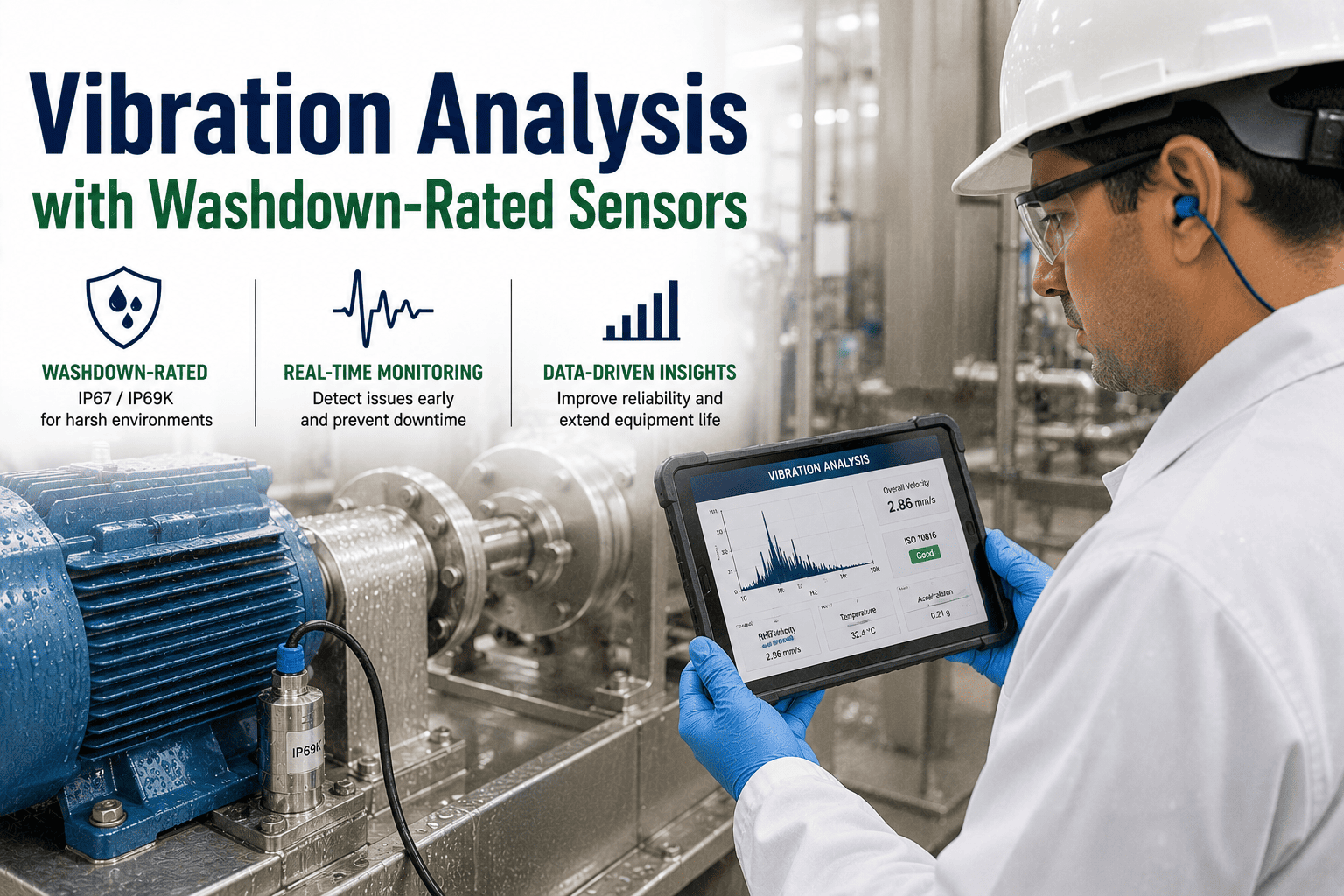
Vibration analysis is the single most effective predictive maintenance technology for rotating equipment — and food processing plants contain hundreds of rotating machines that are candidates for continuous vibration monitoring. Industrial IoT vibration sensors using MEMS accelerometer technology now deliver laboratory-grade vibration data at costs that enable broad deployment across motor-pump sets, conveyor drive units, mixer gearboxes, and compressor trains that would previously have been monitored only through periodic manual route-based data collection.
Effective vibration monitoring programs in food manufacturing environments must account for IP69K washdown resistance requirements, hygienic design standards that prevent bacterial harborage in sensor mounting hardware, and wireless communication reliability in RF-dense processing plant environments with heavy metal shielding from equipment enclosures and building structure. LoRaWAN and industrial Wi-Fi mesh network architectures both see successful deployment in food plant IoT sensor networks, with protocol selection driven by existing infrastructure, facility size, and real-time data latency requirements. Get started free and connect your vibration sensor alerts directly to OxMaint work orders.
Connect Your Sensor Network to a Compliance-Ready CMMS
OxMaint integrates IoT sensor alerts with automated work order generation, equipment health dashboards, and food safety documentation — giving plant engineers a single platform for monitoring and maintenance management.
Pressure and Flow Monitoring in Food Processing Lines
Pressure and flow rate monitoring deliver both food safety and equipment protection value in liquid food processing applications. Continuous pressure monitoring across homogenizers, pasteurizers, CIP systems, and product transfer pumps provides real-time indication of process performance that links directly to HACCP critical control point management. A pressure drop across a heat exchanger that exceeds validated parameters signals either fouling that will compromise pasteurization lethality or gasket failure that creates a potential contamination pathway — both conditions demanding immediate corrective action.
Electromagnetic flow meters, Coriolis mass flow meters, and ultrasonic clamp-on flow sensors each offer specific advantages in food processing applications. Electromagnetic meters excel in conductive liquid applications including dairy, juice, and liquid egg processing, providing sanitary designs compatible with CIP cleaning and COP procedures. Coriolis meters provide mass flow and density measurement simultaneously, enabling direct process control and product changeover verification. Ultrasonic clamp-on sensors allow non-invasive monitoring of existing pipelines without process interruption, particularly valuable for retrofit IoT deployments in operating food plants.
CMMS Integration for IoT Sensor Data: Closing the Loop from Alert to Work Order
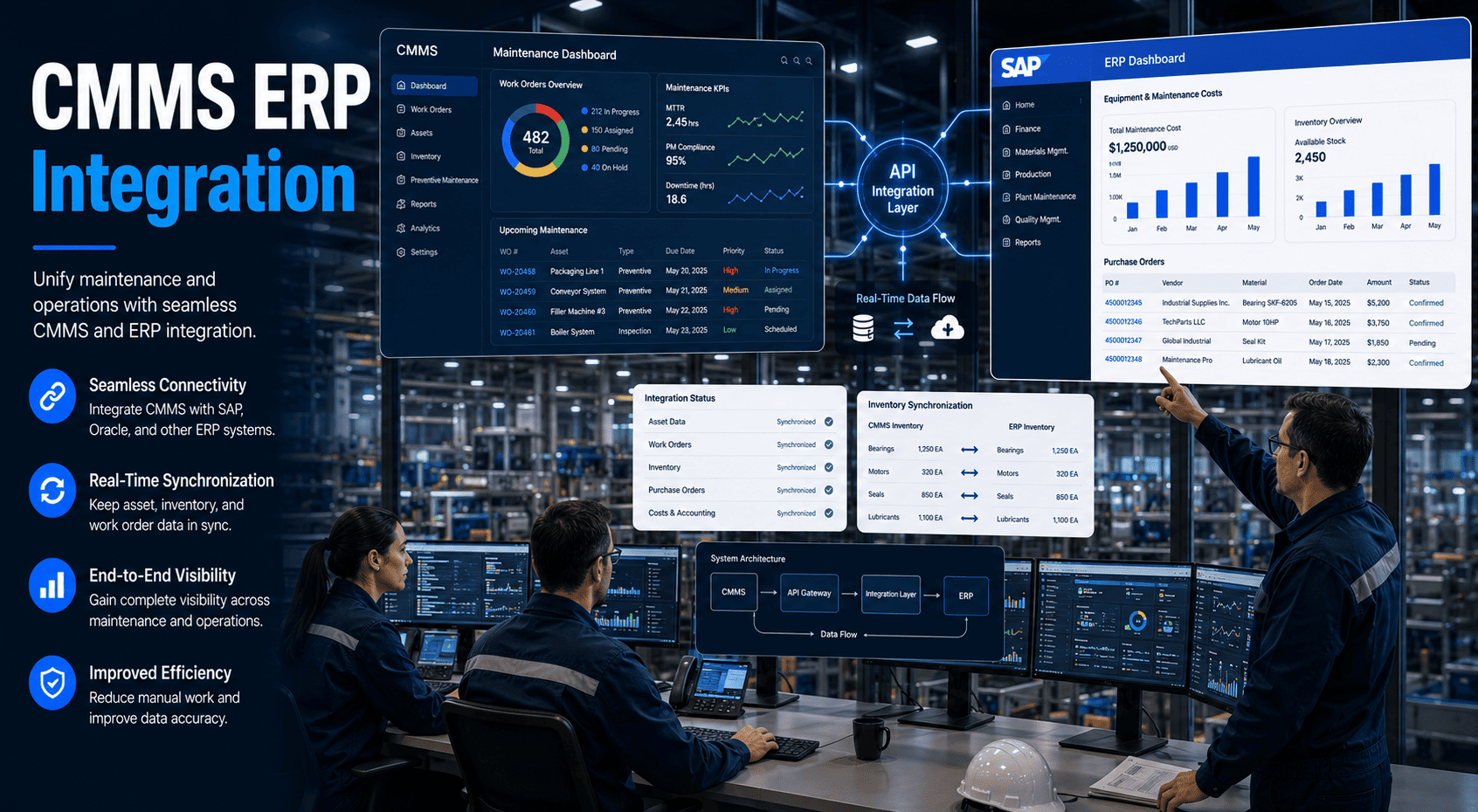
The operational value of a food plant IoT monitoring program is fully realized only when sensor data flows seamlessly into a maintenance management workflow that converts alerts into documented corrective actions. Raw sensor data displayed on monitoring dashboards without structured response workflows creates alert fatigue, inconsistent response, and compliance documentation gaps that undermine both food safety and regulatory audit readiness. CMMS integration transforms sensor alerts from passive notifications into active maintenance triggers with assigned technicians, documented response actions, and closed-loop verification records. Book a demo to see OxMaint's IoT-to-work-order workflow live.
Automated Work Order Generation
Sensor threshold breaches — temperature alarms, vibration spikes, pressure deviations — instantly generate CMMS work orders with pre-filled equipment details and response procedures. No manual transcription, no delays.
Equipment Health Score Dashboards
Aggregated vibration, temperature, current, and pressure data feeds health scoring algorithms giving plant engineers an at-a-glance condition indicator for every monitored asset — weeks before alarms trigger.
Food Safety Compliance Documentation
Sensor logs create tamper-resistant, timestamped records satisfying FSMA, SQF, and customer audit requirements. Automated reports eliminate manual compilation before every regulatory inspection.
Predictive Maintenance Scheduling
ML models on historical sensor streams predict failure timelines with enough lead time to pre-stage parts and schedule downtime — converting reactive breakdowns into planned reliability interventions.
Alert Management Strategy: Avoiding Sensor Alarm Fatigue in Food Plants
One of the most common failures in food plant IoT deployments is poorly configured alert management that generates excessive nuisance alarms, causing operations and maintenance teams to disable or ignore sensor notifications — exactly defeating the purpose of the monitoring investment. Effective alert management for food manufacturing IoT networks requires a tiered alarm architecture that distinguishes between critical food safety alarms demanding immediate response, equipment condition warnings requiring scheduled attention, and informational notifications supporting trend analysis without requiring action. Sign up free to explore OxMaint's tiered alert and escalation management tools.
Alert threshold configuration must be grounded in validated process parameters from food safety plans and equipment manufacturer specifications rather than arbitrary default values from sensor manufacturer documentation. Critical control point temperature alarms must be set below HACCP critical limits with sufficient buffer to allow corrective action before product safety is compromised. Equipment vibration alarms should use ISO 10816 severity zones calibrated to the specific equipment class and mounting configuration, not generic one-size-fits-all thresholds that generate false alarms on inherently high-vibration equipment types.
Wireless Sensor Network Architecture for Food Manufacturing Facilities
Selecting the right wireless communication protocol for a food plant IoT sensor network requires balancing data transmission requirements, facility RF environment characteristics, power availability, and long-term scalability needs. Food manufacturing buildings present unique wireless challenges including dense metal equipment layouts that attenuate RF signals, high-pressure washdown environments that stress enclosure sealing, and temperature extremes in freezer and oven areas that exceed the operating range of consumer-grade wireless hardware.
LoRaWAN
Best for: Large facilities with battery-powered sensors and moderate data frequency needs.
Up to 10-year battery life on simple temperature sensors. One gateway typically covers an entire mid-size food plant.
Industrial Wi-Fi (IEEE 802.11)
Best for: High-bandwidth applications — vibration waveform transmission, plants with existing Wi-Fi infrastructure.
Industrial access points with IP67 ratings support washdown zones. Higher power draw requires wired power at sensor points.
Cellular (LTE-M / NB-IoT)
Best for: Outdoor cold storage, satellite buildings, multi-site programs needing consistent connectivity.
Eliminates site-specific network dependency. LTE-M supports faster reporting than NB-IoT for rapidly changing parameters.
Wired Industrial Ethernet
Best for: HACCP CCP monitoring and process control where communication reliability is non-negotiable.
Stainless-conduit-routed CAT6 to IP69K transmitters delivers deterministic, interference-free data with no wireless vulnerabilities.
Building Your Food Plant IoT Monitoring Roadmap
A phased IoT deployment roadmap allows food manufacturing plants to build sensor network capability systematically while delivering measurable ROI at each phase rather than requiring large upfront capital commitments before any operational benefits are realized. The following deployment sequence reflects the risk and return priorities of food plant operations.
Food Safety Critical Control Point Monitoring
Deploy temperature and process parameter sensors on HACCP-identified critical control points first. This phase delivers immediate regulatory compliance value through automated CCP monitoring records while building the sensor network infrastructure and CMMS integration that subsequent phases will expand upon. Pasteurization holding tubes, cold storage facilities, and blast chiller systems are typical Phase 1 priorities.
High-Value Equipment Condition Monitoring
Instrument the highest-criticality processing equipment — equipment whose failure would immediately halt production — with vibration, current, and temperature monitoring. Identify the ten to twenty assets whose unplanned failure generates the greatest production and quality impact, and prioritize these for Phase 2 sensor deployment. CMMS integration for automated work order generation should be fully operational before Phase 2 deploys.
Environmental Monitoring Network Expansion
Extend temperature and humidity monitoring across all production zones, storage areas, and packaging environments not covered in Phase 1. This phase delivers comprehensive environmental documentation for GFSI certification programs, customer food safety audits, and internal quality management programs. Condensation risk points, HVAC supply and return air monitoring, and building envelope sensors complete the environmental monitoring picture.
Broad Equipment Fleet and Utility Monitoring
Expand condition monitoring to the broader equipment fleet including ancillary conveyors, utility systems, compressed air networks, and building mechanical systems. Energy monitoring sensors integrated with the IoT network provide sustainability reporting data alongside equipment health information. Machine learning models applied to the full sensor dataset deliver facility-wide predictive maintenance capability that continuously improves as historical failure pattern data accumulates. Book a demo with OxMaint to see how your Phase 4 data flows into a fully integrated maintenance platform.
Frequently Asked Questions
What IoT sensors are most important for food safety compliance?
Temperature sensors are the most critical IoT monitoring technology for food safety compliance because thermal control is the primary mechanism for controlling pathogen growth and lethality in food manufacturing. HACCP-identified critical control points including pasteurization systems, cold storage facilities, and cooking processes must be continuously monitored with temperature sensors that log data at regulatory-required intervals. Pressure sensors on pasteurization systems and flow sensors on CIP circuits provide additional food safety critical control point monitoring capability.
How do vibration sensors detect equipment problems before failure?
Vibration sensors continuously measure the mechanical movement of rotating equipment components. As bearings wear, gears develop defects, or rotating components become imbalanced, the vibration signature changes in characteristic ways that trained algorithms and experienced analysts can correlate to specific failure modes. Bearing outer race defects produce vibration frequencies at predictable multiples of shaft speed that appear in frequency domain analysis weeks before the bearing fails catastrophically. This early warning enables planned replacement during scheduled maintenance windows rather than emergency breakdown repairs.
How does IoT CMMS integration work for food manufacturing maintenance?
IoT CMMS integration connects sensor monitoring platforms to computerized maintenance management systems through API connections that translate sensor alert events into maintenance work orders. When a sensor exceeds a configured threshold — a refrigeration unit temperature rising above setpoint, a motor vibration increasing beyond alarm levels, or a pressure reading deviating from baseline — the integration automatically creates a work order in the CMMS with the equipment identification, alarm data, and response procedure. Technicians receive mobile notifications and complete the work order with documented corrective actions, creating the closed-loop compliance record that regulatory auditors require.
What wireless protocol should food manufacturers use for IoT sensors?
Protocol selection depends on facility characteristics and application requirements. LoRaWAN is ideal for battery-powered sensors across large facilities where long range, low power consumption, and simple gateway infrastructure are priorities. Industrial Wi-Fi suits high-bandwidth applications like vibration waveform transmission in facilities with existing enterprise wireless networks. Wired Ethernet remains the most reliable choice for HACCP critical control point sensors where communication reliability is non-negotiable. Many food plants implement hybrid architectures using wired connections for CCP monitoring and wireless protocols for broader environmental and equipment condition monitoring.
How do food manufacturers prevent alert fatigue in IoT monitoring programs?
Preventing alert fatigue requires tiered alarm architecture, properly calibrated thresholds, and structured alert response workflows. Critical food safety alarms must be reserved for genuine CCP deviations requiring immediate human response. Equipment condition warnings can be routed to CMMS work order queues for scheduled response without generating urgent notifications. Alarm thresholds should be validated against historical process data to eliminate nuisance alarms triggered by normal process variation. Regular alarm rationalization reviews — quarterly at minimum — should identify and disable or reconfigure chronic nuisance alarms that undermine the credibility of the monitoring program.