Food Processing Conveyor and Material Handling Hygiene Checklist
By Josh Turley on May 6, 2026
A snack food plant in Tennessee received a customer complaint about black rubber particles in a finished product lot. Three weeks of investigation traced the contamination to a deteriorating conveyor belt that had passed visual inspection every day for six months — because the inspection checklist only asked whether the belt was running, not whether it was shedding. The product recall cost $1.8M. The replacement belt cost $12,000. The gap was not equipment quality — it was a maintenance checklist that asked the wrong questions. Start a free trial to digitize your food conveyor PM program in Oxmaint, or book a demo to see hygienic conveyor maintenance tracking for your plant.
ChecklistFood ProcessingConveyor Hygiene
Food Processing Conveyor and Material Handling Hygiene Checklist
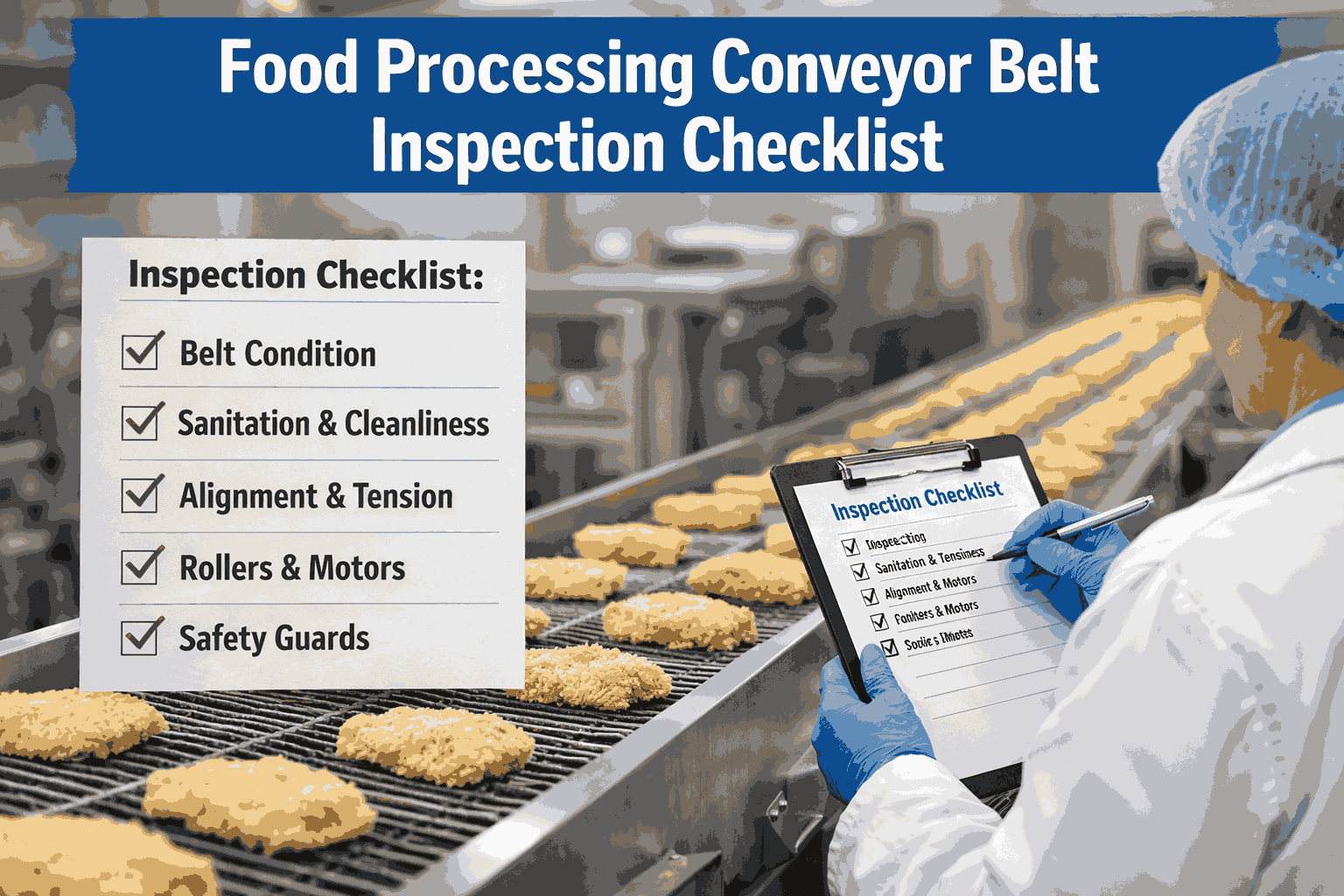
Complete food conveyor hygiene checklist covering sanitary belt inspections, cleaning verification, food-grade lubrication, hygienic design checks, and material handling compliance for food processing plants.
21%Of foreign body contamination complaints originate from conveyor systems (BRCGS data)
$1.8MAverage cost of a foreign body product recall in food manufacturing (Stericycle Recall Index)
60%Of microbiological contamination events in food plants linked to equipment cleaning failures
3xMore frequent belt replacement when food-grade lubrication schedules are not maintained
Overview
What Is Food Conveyor Hygiene Maintenance?
Food processing conveyors are product contact surfaces under food safety law in every major regulatory framework — FDA 21 CFR Part 110/117, EU Food Hygiene Regulation 852/2004, FSSC 22000, SQF Code, and BRCGS Food Safety Standard all classify conveyor belts and frames as Critical Control Points or prerequisite program elements requiring documented cleaning, inspection, and maintenance.
Conveyor hygiene maintenance covers three distinct disciplines: mechanical PM (belt tension, tracking, bearing condition, drive alignment), cleaning and sanitation verification (pre-operational checks, post-CIP swab results, cleaning frequency records), and hygienic design compliance (no horizontal surfaces, no dead zones, appropriate materials for the product zone).
Visual inspection for cuts, abrasion, fraying, color change, embedded debris, and surface hardening. Belt surfaces are product contact — any deterioration is a foreign body or microbiological risk, not just a mechanical issue.
02
Cleaning Verification
Pre-operational visual check and ATP bioluminescence test on belt surface and frame joints. Post-CIP inspection for chemical residues and rinse completeness. Cleaning records signed by operator and QA.
03
Food-Grade Lubrication
H1-rated lubricant confirmed on all bearings, chains, and drive components in product zones. Non-food-grade lubricant applied to product-zone components is an immediate non-conformance in SQF and BRCGS audits.
04
Belt Tracking and Tension
Misaligned belts cause edge wear, belt debris, and product contact with frame components. Tension checks prevent slippage that creates friction heat — a microbiological growth risk in high-care environments.
05
Bearing and Drive Checks
Bearing temperature by contact thermometer, audible noise, and vibration check. Failed bearings shed metal fragments and grease. Drive chain lubrication verified with food-grade lubricant — documented per application.
06
Hygienic Design Compliance
Frame horizontal surfaces eliminated or sloped. No open hollow sections. All fasteners closed-ended or fully accessible for cleaning. Inspection points documented for each conveyor line in the hygiene risk assessment.
07
Scraper and Guide Condition
Belt scrapers prevent product build-up that becomes biofilm. Guide rails prevent product contact with frame and structure. Both components inspected for wear, correct adjustment, and cleaning access on defined schedule.
08
Transfer Point Integrity
Transfer plates, product deflectors, and crossover guides are high-risk accumulation points. Inspected for product build-up, correct positioning, material suitability, and cleaning access after every production run.
21% of foreign body contamination complaints in food plants come from conveyor systems — and most originate from maintenance gaps, not equipment quality.
Pain Points
Where Conveyor Hygiene Programs Fail
Belt-Only Inspections
Operators check whether the belt is running — not whether the belt surface is deteriorating. Frame weld points, transfer plates, and guide rail underside accumulate contamination between scheduled deep cleans with no visible warning.
Wrong Lubricant in Product Zone
Maintenance technicians use whatever lubricant is available — often general-purpose grease. In product zones, non-H1 lubricants are an automatic major non-conformance in BRCGS, SQF, and FSSC audits.
No Pre-Op Verification
Production starts after cleaning without systematic pre-operational verification. HACCP and SQF both require pre-op checks before product contact. Gap discovered during audit, not during production.
Untracked Belt Lifecycle
No record of belt installation date, replacement history, or condition score. Belts replaced on visible failure — after contamination risk has existed for weeks. No data for lifecycle cost or replacement budget planning.
Shadow Zone Biofilm
Transfer plates, scraper underside, and return belt zone are cleaning shadow zones. Standard cleaning schedules miss these areas — positive environmental swabs trace back to conveyor components nobody monitored.
No Mechanical PM Record
Bearing failure, belt misalignment, and drive chain stretch create contamination risk — metal particles, belt debris, lubricant migration. Without PM records, root cause investigation has no baseline to work from.
Every conveyor line registered with belt type, material, installation date, product zone status, and lubrication type. QR code on each drive for instant mobile work order access by technicians on the floor.
Shift Pre-Op Checklists
Digital pre-operational verification checklist completed on mobile before each production run. Belt surface, transfer points, scrapers, guides, and frame joints all included. Operator cannot mark "clear for production" without completing all items.
Lubricant Control
Lubrication tasks specify H1-rated lubricant by product name and quantity. Technicians confirm lubricant type used in work order. Non-food-grade lubricant application in product zones generates automatic corrective action.
Cleaning Verification Records
Post-clean verification linked to conveyor asset. ATP swab results, visual inspection sign-off, and chemical residue check all captured in Oxmaint. Auditors see complete cleaning history per conveyor line — no paper logs.
Belt Lifecycle Tracking
Belt condition score tracked at each inspection. Replacement threshold triggers automatic work order. Full belt replacement history per conveyor — data for lifecycle budget forecasting and supplier evaluation.
Environmental Swab Integration
Positive environmental swab results linked to nearby conveyor assets. Corrective action work order generated automatically. Root cause trends visible across multiple positive results — shadow zones identified and cleaned.
Plants using digital conveyor hygiene programs in Oxmaint reduce audit non-conformances from conveyor-related findings by an average of 70% within the first year.
Comparison
Reactive vs. Planned Conveyor Hygiene Management
Area
Reactive / Paper-Based
Planned with Oxmaint
Belt inspection
Running check only — no surface assessment
Condition score per inspection — trend visible
Pre-op verification
Verbal confirmation — no record
Digital checklist — signed, timestamped, photo
Lubrication control
Whatever is available — type unrecorded
H1 lubricant specified and confirmed per task
Cleaning verification
Visual only, no ATP, no record
ATP results linked to conveyor asset record
Belt lifecycle
Replaced on failure — no history
Condition tracked — replacement before failure
Audit preparation
Paper logs — incomplete and scattered
One-click export by conveyor line or date range
Positive swab response
Manual investigation — days of effort
Auto work order — linked asset and cleaning history
ROI
What Structured Conveyor Hygiene Delivers
70%
Fewer conveyor audit non-conformances
Plants using Oxmaint digital hygiene programs vs. paper-based inspection
3x
Longer belt life
Correct tension, tracking, and food-grade lubrication extend belt replacement intervals by 2–3x
$1.8M
Average recall cost avoided
Per foreign body event in food manufacturing — belts are the number one source in many categories
60%
Fewer positive environmental swabs
From systematic shadow zone cleaning linked to conveyor PM schedules
What lubricants are approved for use on food conveyor systems in product zones?
NSF H1-rated lubricants are approved for incidental food contact in product zones. H1 lubricants must be on the NSF International H1 register and applied in minimum quantities. Non-H1 lubricants — including general-purpose greases — are not permitted in product zones and constitute a major non-conformance under BRCGS, SQF, and FSSC 22000 standards. All lubricant applications in product zones should be documented with lubricant name, NSF registration number, and quantity applied.
How often should food conveyor belts be replaced?
Belt replacement frequency depends on belt type, product, and operating conditions — not a fixed interval. Food safety standards require replacement when surface condition presents a contamination risk: cuts, embedded debris, surface hardening, color change, or porosity. A condition-score-based replacement trigger (e.g., replace at score 3/5) is more defensible than calendar-based replacement. Tracking belt condition at each inspection provides the data to set a facility-specific trigger and justify replacements to management based on food safety risk, not just cost.
What is the pre-operational check requirement for food processing conveyors?
HACCP plans and GFSI standards (SQF, BRCGS, FSSC 22000) require documented pre-operational verification before product contact after any cleaning event. This includes visual inspection of product contact surfaces, verification that all equipment is correctly assembled, and confirmation that no non-food-safe materials (tools, cleaning chemicals, foreign objects) are present. Pre-op checks must be signed off by a designated responsible person — not just completed verbally. ATP testing as part of pre-op is best practice in high-care environments.
Can Oxmaint manage conveyor hygiene across multiple production lines?
Yes. Each conveyor is registered as an individual asset in Oxmaint with its own PM schedule, cleaning verification record, lubricant type, and condition history. Production managers see all conveyor pre-op statuses in one dashboard — which lines are cleared for production and which have outstanding items. QA receives ATP result alerts in real time. Corporate quality teams can view hygiene compliance rates across multiple sites from a single view.
Trusted by Food Plants in 40+ Countries
Stop Chasing Positive Swabs Back to Conveyor Shadow Zones
Every foreign body complaint and every positive environmental swab that traces back to a conveyor is a preventable failure — preventable with the right checklist, the right schedule, and the right documentation system.
Digital pre-op checklists — signed, timestamped, auditable
H1 lubricant control enforced in every work order
Belt lifecycle tracked — condition-based replacement, not failure-based
See measurable results in the first 30 days — used by food operations teams managing 500+ conveyor assets.