A winery's inventory isn't just product — it's time. A barrel of premium Cabernet Sauvignon aging in a climate-controlled cave represents three to five years of growing, harvesting, fermenting, and waiting. When the HVAC system in that barrel room fails during a summer heat wave, or when a humidity controller drifts unnoticed for six weeks, the damage is measured in vintages lost — not just dollars spent on repair. Industry data shows that temperature excursions above 70°F during barrel aging can accelerate oxidation and spoilage to the point where the vintage is unsaleable as a premium product. For a winery with $25 million in barrel inventory, a single climate failure event can write off a million-dollar vintage before anyone realizes the equipment was trending in the wrong direction. This case study details how a premium winery implemented Oxmaint CMMS to protect their barrel room inventory, modernize their equipment maintenance program, and achieve the operational reliability their inventory values demanded. Start a free trial and see how Oxmaint manages climate-sensitive asset maintenance, or book a demo to walk through a winery equipment setup with our team.
Case Study · Wine Production · Climate-Controlled Maintenance
How a Winery Protects $25M in Vintage Inventory with CMMS
Premium wine production demands climate precision that most maintenance programs aren't built to deliver. See how one winery built an equipment reliability system that protects barrel room conditions, tracks bottling line performance, and gives ownership the operational data their investment deserves.
$25M
Premium barrel inventory protected by climate-controlled maintenance program
55-65°F
Critical temperature range for premium barrel aging — zero tolerance for excursion
60-70%
Humidity range required to prevent excessive wine evaporation in barrel storage
Zero
Undetected climate excursions in barrel rooms since Oxmaint IoT integration
The Winery Profile
Premium Production, Aging Infrastructure, and the Climate Control Problem
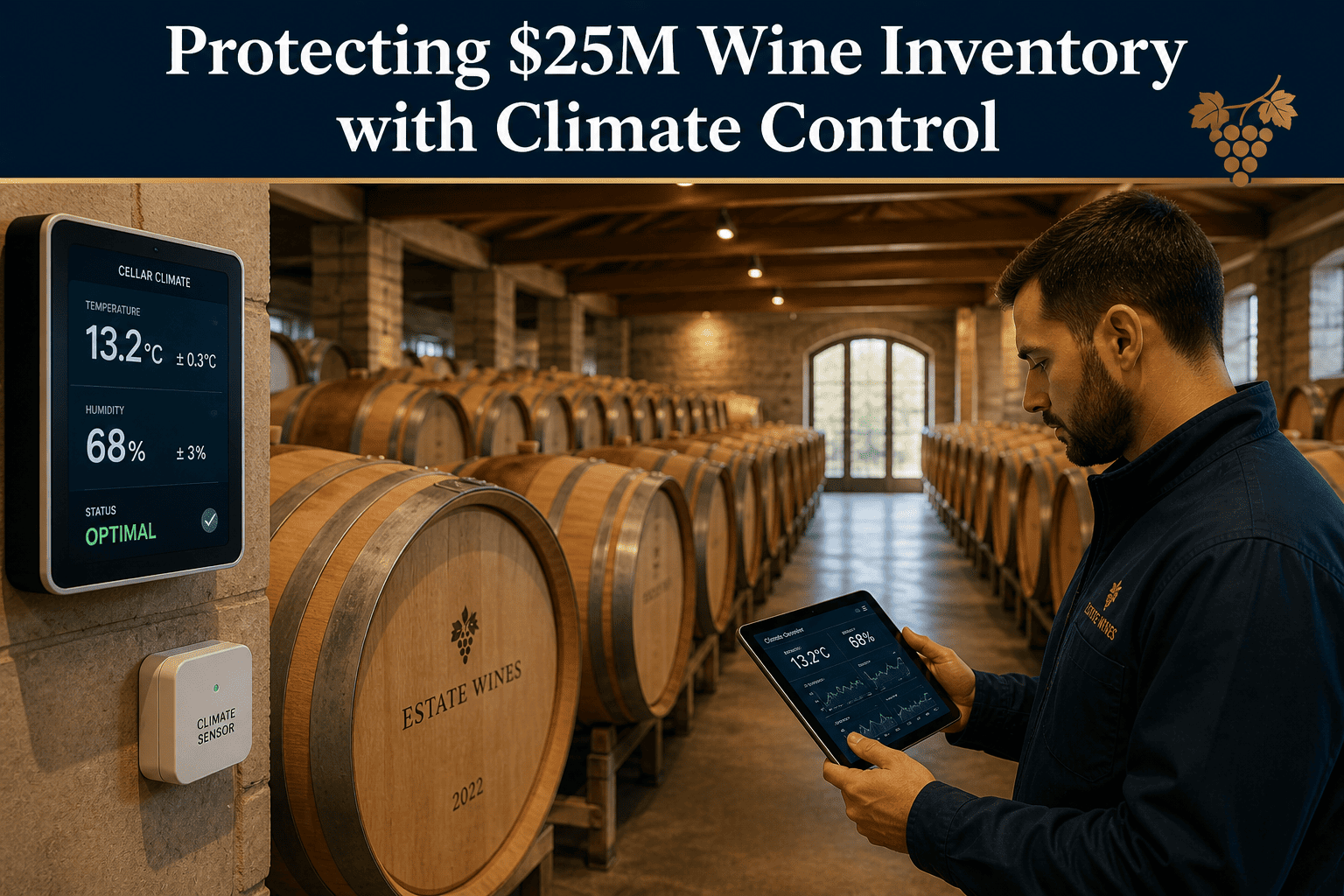
This estate winery produces approximately 25,000 cases annually across five varietals, with a significant portion of production aged 18-36 months in French and American oak barrels in two underground barrel caves and one above-ground barrel room. Total barrel inventory value at any given time exceeds $25 million — a figure that represents not just product cost but irreplaceable vintage years.
The winery's maintenance program had been managed by a single facilities manager using paper work orders and a printed PM schedule taped to the equipment room wall. Climate control for the barrel caves relied on three aging HVAC units — none of which had a documented maintenance history older than three years, and none of which was connected to any monitoring system that would alert the team to performance degradation before a failure event.
A near-miss incident during a summer heat wave — where a condenser unit in Barrel Cave B ran in an alarmed state for 28 hours before anyone noticed — was the event that drove the ownership group to mandate a proper asset management system. The cave temperature reached 68°F before the unit was repaired. The vintage was ultimately fine, but the margin was uncomfortably thin. Start a free trial and build your barrel room monitoring setup in Oxmaint, or book a demo to see how wineries are managing climate-sensitive maintenance.
Critical Equipment Requiring Managed Maintenance
Barrel cave HVAC units — climate control for 55-65°F temperature range, year-round
Humidity control systems — maintaining 60-70% RH to prevent excessive angel's share evaporation
Refrigeration systems — jacketed fermentation tanks, cold stabilization equipment
Bottling line — filler, corker, capsule applicator, labeler, and case packer
Crush pad equipment — destemmer/crusher, presses, and must pumps — seasonal intensity
Wastewater treatment — crush season discharge volumes require treatment system reliability
Risk Landscape
The Four Maintenance Failures That Threaten Premium Wine Quality
01
Climate Control Failure During Barrel Aging
Barrel cave temperature above 70°F for extended periods accelerates oxidation reactions and can cause premature aging or spoilage in sensitive varietals. Humidity below 55% increases evaporative loss ("angel's share") beyond the acceptable 2-3% annual rate — each percentage point of excess loss represents direct inventory value destroyed. A barrel room HVAC failure isn't a maintenance event. It's an inventory risk event.
02
Bottling Line Downtime During Peak Production Windows
A premium winery's bottling schedule is constrained by market release dates, allocated wine club shipments, and trade placement deadlines that cannot slip without commercial consequence. An unplanned filler or corker failure during a committed bottling run doesn't just cost repair time — it can cost a wine club shipment window or a critical distributor commitment. Preventive maintenance on bottling equipment is not optional when the production calendar has zero slack.
03
Crush Season Equipment Failures With No Backup
Harvest is a 4-6 week window that cannot be extended. A destemmer or press failure during peak crush — when fruit is arriving from multiple vineyard blocks on a weather-driven schedule — can result in fruit that is held too long, ferments in the field, or must be processed at a competitor facility at premium contract rates. Preventive maintenance on crush pad equipment before harvest is the only viable risk management strategy.
04
No Documented Asset History for Ownership Reporting
Many premium wineries operate under investor or family ownership groups that expect operational discipline commensurate with the asset values at stake. When an ownership group asks how often the barrel cave HVAC is serviced, what the maintenance history is on the bottling line, or what the condition of the refrigeration system is — and the answer is a paper binder or "we don't really track that" — it signals a governance gap that sophisticated owners find unacceptable.
The Oxmaint Solution
How Oxmaint Manages Climate and Equipment Reliability for This Winery
01
Barrel Room Climate Monitoring Integration
IoT temperature and humidity sensors in both barrel caves and the above-ground barrel room connected to Oxmaint. Real-time alerts when any zone exceeds set-point — with automatic work order generation for the on-call facilities manager, before the drift becomes a damage event.
02
HVAC PM Schedule for Climate-Critical Assets
Barrel cave HVAC units on quarterly preventive maintenance schedules in Oxmaint — condenser cleaning, refrigerant charge verification, belt inspection, and filter replacement. Each PM generates a work order and records completion, building the documented maintenance history the ownership group requires.
03
Bottling Line Preventive Maintenance
Each bottling line component — filler valves, corker jaws, labeler drive belt, case packer sensors — registered as individual assets with PM schedules tied to production cycles. Maintenance runs before each bottling campaign, not after a failure stops the line during a committed run.
04
Pre-Harvest Crush Equipment Readiness
A comprehensive pre-harvest PM checklist in Oxmaint triggers 6 weeks before the projected crush start date. Destemmer bearings, press membrane condition, must pump seals, and all crush pad electrical systems checked and documented before the first fruit arrives at the crush pad.
05
Owner-Level Reporting Dashboard
Portfolio-level reports showing barrel room climate compliance, equipment PM completion rates, and open corrective actions exportable for ownership group review. Investors and family ownership see the operational data behind the assets they've funded — without having to request it each quarter.
06
Corrective Action Documentation for Excursion Events
When a climate event occurs, Oxmaint documents the excursion parameters, the corrective action taken, and the barrel lots in the affected zone during the event period — giving the winemaker and ownership the full record needed to make informed vintage disposition decisions.
Before vs. After
Paper-Based Winery Maintenance vs. Oxmaint Asset Management
| Operational Area |
Before Oxmaint |
With Oxmaint |
| Barrel room climate monitoring |
Manual checks — 28-hour excursion went undetected |
Real-time IoT monitoring — alert within minutes of drift |
| HVAC maintenance history |
Paper records — incomplete, lost over time |
Full digital history per unit — accessible to ownership |
| Bottling line reliability |
Run to failure — unplanned stoppages during committed runs |
Pre-campaign PM — zero unplanned stoppages in 2 vintages |
| Pre-harvest crush readiness |
Informal checklist — failures discovered during harvest |
Structured 6-week pre-harvest PM program, fully documented |
| Ownership reporting capability |
No operational data available for ownership review |
Quarterly reports showing PM compliance and climate data |
| Excursion event documentation |
Verbal recollection — no formal record of affected lots |
Full corrective action record with affected lot documentation |
The assets in your barrel room deserve the same operational discipline as the viticulture that produced them. Start a free trial and build your winery's equipment registry and climate monitoring setup in Oxmaint, or book a demo to see the full winery asset management workflow.
$25M
Barrel inventory under active climate protection
Real-time monitoring with automated work order generation on excursion
Zero
Undetected climate excursions post-implementation
Down from one 28-hour undetected event that nearly cost a vintage
2
Consecutive vintages with zero bottling line downtime
Pre-campaign PM eliminated unplanned stoppages during committed production runs
6 wks
Pre-harvest crush readiness window
Structured PM program ensures crush equipment ready before first fruit arrives
FAQ
Frequently Asked Questions
What temperature and humidity monitoring sensors work with Oxmaint for barrel caves?
Oxmaint integrates with IoT sensors using standard industrial protocols including MQTT, Modbus, and REST API. For barrel cave environments, common sensor hardware includes wireless temperature and humidity sensors from manufacturers like Monnit, Onset HOBO, and Sensirion — all of which can be integrated with Oxmaint via their respective cloud APIs or direct protocol connections. The key requirement is that the sensor can push data to an endpoint on a defined interval (typically every 5-15 minutes for barrel cave monitoring). Oxmaint then evaluates each reading against the configured set-point thresholds and generates work orders or alerts when readings fall outside the acceptable range. For underground barrel caves with limited wireless connectivity, Oxmaint's team can advise on sensor hardware that supports mesh networking or LoRaWAN connectivity suitable for below-grade installations.
How should a winery structure its PM schedule around seasonal production intensity?
Winery maintenance scheduling in Oxmaint is built around the production calendar, not a fixed 52-week grid. The most effective structure uses three scheduling layers: year-round climate equipment (barrel cave HVAC, humidity control, refrigeration) on fixed-frequency schedules regardless of season; bottling line equipment on production-cycle triggers, with a pre-campaign PM completed before each committed bottling run; and crush pad equipment on a seasonal pre-harvest program that triggers 4-6 weeks before the projected harvest start date. This means crush equipment receives intensive PM attention in August when harvest may start in September, and receives minimal maintenance scheduling during the January-March barrel work season when it's not in operation. Oxmaint's scheduling system supports all three layers simultaneously, with production-linked triggers for bottling equipment and calendar-based triggers for harvest prep.
Can Oxmaint generate the maintenance reporting that investor or family ownership groups typically require?
Yes. Oxmaint's reporting module generates portfolio-level and property-level reports that show PM completion rates by equipment category, open corrective actions with priority and age, climate compliance data for barrel rooms (percentage of time within set-point range, number of excursion events and duration), and maintenance cost tracking by asset or equipment category. These reports can be scheduled for automatic generation on a monthly or quarterly cadence and exported in PDF or spreadsheet format for ownership group distribution. For family-owned wineries with estate investors, or for wineries that are part of a larger hospitality or real estate portfolio, Oxmaint's multi-property hierarchy allows the parent entity to view operational data across all assets from a single dashboard — the same data structure that supports $500M commercial real estate portfolios also works for a three-property wine estate.
What should be included in a pre-harvest crush equipment readiness checklist in Oxmaint?
A comprehensive pre-harvest crush equipment readiness checklist in Oxmaint should cover the following for each piece of equipment: destemmer/crusher — bearing inspection and lubrication, shaft alignment check, screen and paddle condition, drive belt tension and wear; bladder press — membrane condition and inflation test, end plate seal inspection, drain channel cleaning, rotation drive function test; must and wine pumps — seal condition, impeller inspection, pressure test, hose and fitting integrity; receiving hopper — structural inspection, vibrator function, drain condition; fermentation tank instrumentation — temperature probe calibration, valve function, pump-over equipment readiness; crush pad drains and wastewater system — drain capacity, screen condition, first flush valve function before crush season discharge volumes begin. Oxmaint's checklist templates allow you to add photo evidence requirements for any field — particularly useful for membrane press condition documentation, which is often disputed when post-harvest claims arise about harvest equipment performance.
Winery Asset Management — Powered by Oxmaint
$25M in Barrel Inventory Deserves More Than a Paper Work Order System
Oxmaint gives wineries real-time climate monitoring for barrel rooms, preventive maintenance scheduling for bottling lines and crush equipment, owner-grade reporting for investor and family ownership groups, and the documented maintenance history your operation needs to run at the quality level your wines demand.