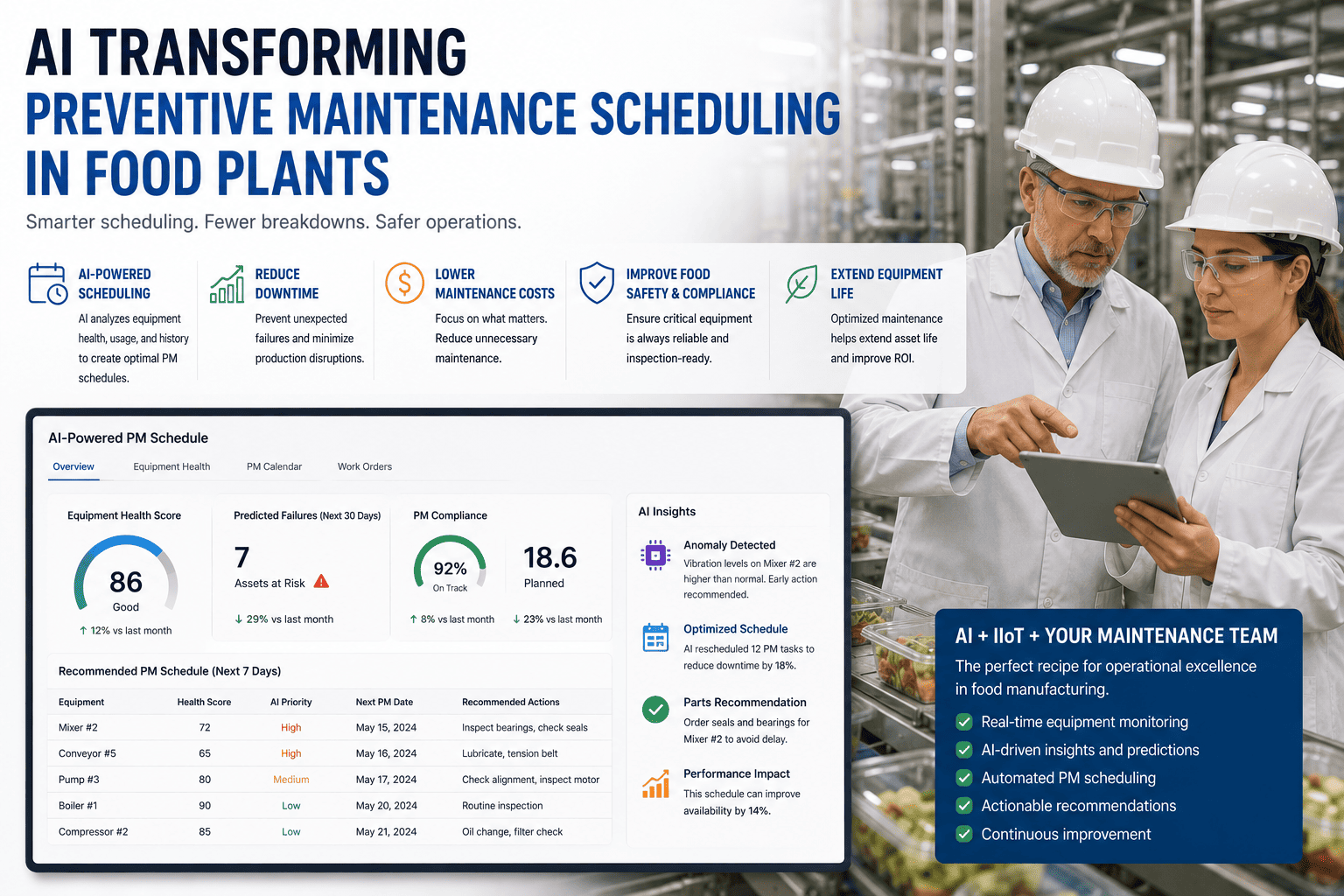
A meat processing facility in Nebraska ran their preventive maintenance program the same way for eight years: maintenance technicians received a printed list of PMs due that week and completed what they could between breakdowns. The result was predictable. PM completion rates hovered around 62%, emergency repairs consumed 40% of maintenance labor, and equipment reliability steadily declined. When a critical packaging line went down during their busiest production week, costing $340,000 in lost product and overtime, the maintenance manager finally secured approval for a scheduling overhaul. Within six months of implementing a structured PM scheduling template that coordinated maintenance windows with production schedules, their PM completion rate reached 94%, emergency repairs dropped to 18% of labor hours, and the packaging line that triggered the change ran 847 consecutive days without unplanned downtime.
Preventive maintenance scheduling in food processing is not simply about listing tasks and due dates. It requires coordinating maintenance activities with production schedules that cannot be interrupted, sanitation windows that create maintenance opportunities, regulatory requirements that mandate specific frequencies, and resource constraints that limit how much work can actually be completed. Effective PM scheduling transforms maintenance from a reactive firefighting operation into a strategic function that protects production capacity, food safety compliance, and equipment reliability.
Sign up to implement structured PM scheduling or book a demo to see how automated scheduling coordinates maintenance with production for maximum completion rates.
PM Scheduling Framework
Preventive Maintenance Scheduling Framework for Food Processing Plants
Coordinate PM activities with production schedules, sanitation windows, and resource availability to maximize completion rates and equipment reliability.
PM Completion Rate with Structured Scheduling
Reduction in Emergency Repairs
Of Plants Under-Resource PM Programs
3.4x
ROI
Return on PM Program Investment
Why PM Scheduling Fails in Food Processing Environments
Food processing plants face scheduling challenges that generic PM programs fail to address. Production schedules are driven by customer orders, seasonal demand, and perishable raw materials that cannot wait for equipment availability. Sanitation requirements create mandatory downtime windows that should enable maintenance but often go unutilized due to poor coordination. Regulatory requirements mandate maintenance frequencies that must be met regardless of production pressure. And the consequences of equipment failure extend beyond downtime to include food safety risks, product loss, and potential recalls.
Despite these pressures, many food plants approach PM scheduling with methods borrowed from other industries or rely on CMMS auto-scheduling features without adapting to their operational reality. The result is PM schedules that conflict with production, incomplete work packages that extend task duration, and chronic deferrals that erode equipment reliability while creating audit exposure.
78%
of food processing plants report their PM programs are under-resourced relative to equipment needs. But resource constraints are often symptoms of scheduling inefficiency rather than actual capacity shortages. Plants that optimize scheduling typically find 25-40% more productive capacity in existing maintenance teams.
Common scheduling failures in food processing include: scheduling PMs during peak production without coordination, failing to batch related tasks for efficiency, ignoring sanitation window opportunities, over-scheduling based on manufacturer recommendations rather than actual equipment condition, and not accounting for parts lead times in scheduling decisions. Each failure mode reduces PM completion rates and drives the reactive maintenance burden that consumes resources needed for preventive work.
Sign up for Oxmaint to implement PM scheduling that works with your production reality rather than against it.
Building Your PM Scheduling Framework
An effective PM scheduling framework integrates equipment maintenance requirements with operational constraints to create executable schedules. This framework consists of interconnected elements that must work together.
Not all equipment deserves equal PM attention. Classify equipment based on production impact, food safety role, and failure consequences to allocate maintenance resources appropriately.
Critical A
CCP equipment, single-point-of-failure production assets, equipment where failure creates food safety risk
Maximum PM rigor, predictive monitoring, zero tolerance for deferrals, documented compliance
Critical B
High-production-impact equipment with limited redundancy, utilities supporting critical operations
Full PM program, condition monitoring where cost-effective, limited deferral flexibility
Essential C
Equipment supporting production with redundancy or workarounds available, non-CCP quality equipment
Standard PM program, deferrals acceptable with documented justification
Support D
Non-production equipment, easily replaceable items, equipment with minimal failure impact
Run-to-failure acceptable for some items, basic PM where cost-justified
Identify all available maintenance windows by analyzing production schedules, sanitation cycles, and planned downtime. Most food plants have more maintenance opportunity than they utilize.
Sanitation Windows
Daily or shift sanitation creates 1-4 hour windows. Weekly deep sanitation may provide 4-12 hours. Coordinate maintenance to occur during sanitation rather than after.
Changeover Windows
Product changeovers create equipment access time. Quick PM tasks can be completed during changeover without extending downtime.
Production Gaps
Scheduled production gaps, weekend downtime, or seasonal slow periods provide extended maintenance windows for major PM activities.
Running Maintenance
Some PMs can be performed while equipment operates: inspections, lubrication of external points, monitoring activities, peripheral equipment service.
Optimize individual PM tasks for efficiency, then batch related tasks to minimize equipment access events and maximize productive time during maintenance windows.
Task Duration Analysis
Measure actual task duration including setup, execution, and cleanup. Update estimates based on real data rather than manufacturer specifications.
Work Package Completeness
Include all required tools, parts, procedures, and safety requirements in work packages. Incomplete packages cause delays and return trips.
Route Optimization
Sequence tasks to minimize travel between equipment locations. Group tasks by area when multiple PMs are scheduled in the same window.
Multi-Craft Coordination
When PMs require multiple crafts (mechanical, electrical, instrumentation), schedule simultaneously rather than sequentially to reduce total downtime.
Match PM workload to available resources including labor hours, skills, and parts availability. Scheduling more work than can be completed guarantees deferrals and erodes program credibility.
Available Labor Hours
Calculate realistic available hours after accounting for emergency response allocation (typically 20-30%), meetings, training, and non-maintenance activities.
Skill Requirements
Match task skill requirements to available technicians. Scheduling electrical PMs when no electrician is available guarantees deferral.
Parts Availability
Verify required parts are in stock before scheduling. Integrate MRO inventory with PM scheduling to prevent parts-related deferrals.
Tool and Equipment Access
Account for shared tools, specialized equipment, and contractor availability when scheduling tasks that require these resources.
Automate Your PM Scheduling
Oxmaint automatically schedules PMs based on equipment criticality, production calendars, and resource availability. Stop fighting scheduling conflicts and start completing more preventive maintenance.
Scheduling Coordination with Production
PM scheduling that ignores production reality is destined for chronic deferrals. Effective scheduling requires collaboration between maintenance and production to identify realistic maintenance windows and protect them from encroachment.
Weekly Scheduling Meeting
Hold a brief weekly meeting between maintenance planning and production scheduling to review the coming week's PM schedule against the production plan. Identify conflicts early and adjust either schedule while flexibility remains.
Review production schedule for the coming week
Identify maintenance windows within production plan
Confirm equipment availability for scheduled PMs
Adjust PM schedule to align with windows
Document any deferrals and rescheduled dates
Production Calendar Integration
Integrate production calendars into the CMMS so PM scheduling automatically considers production constraints. Block scheduling during known high-production periods and prioritize scheduling during planned downtime.
Import production schedule into CMMS
Define equipment-production dependencies
Configure scheduling rules respecting production
Automate window identification
Alert when conflicts are detected
Sanitation Window Utilization
Sanitation creates equipment downtime that should be leveraged for maintenance. Coordinate with sanitation teams to perform maintenance during sanitation rather than after, capturing time that would otherwise be lost.
Map sanitation schedules by equipment area
Identify PM tasks executable during sanitation
Coordinate timing with sanitation supervisor
Sequence maintenance to not delay sanitation completion
Track window utilization as scheduling metric
Shutdown Planning
Planned shutdowns, whether daily, weekly, or seasonal, provide the most valuable maintenance windows. Plan PM activities for shutdowns well in advance to maximize utilization of this limited time.
Identify all planned shutdown periods annually
Allocate shutdown time between PM and projects
Schedule long-duration PMs during longer shutdowns
Plan parts and contractor needs in advance
Protect shutdown maintenance time from production creep
Stop Deferring. Start Completing.
Oxmaint scheduling tools coordinate PM activities with production calendars, track parts availability, and balance workload to ensure scheduled work can actually be completed. See the difference structured scheduling makes.
Managing PM Deferrals
Even with optimized scheduling, some PM deferrals are inevitable. The goal is not zero deferrals but controlled deferrals with documented justification, defined limits, and catch-up plans.
Valid Deferral Reasons
Production emergency requiring equipment operation
Parts required not available (with procurement in progress)
Specialist resource unavailable (with reschedule date)
Condition monitoring indicates PM not yet needed
Equipment already shut down for other repair
Invalid Deferral Reasons
"Too busy" without specific conflict identified
Chronic over-scheduling of PM workload
Production preference without actual necessity
Parts not ordered despite known need
"Equipment seems fine" without supporting data
Deferral Limits by Criticality
Critical A
No deferral without plant manager approval. Maximum 48 hours with documented risk assessment.
Critical B
Maintenance manager approval required. Maximum 7 days with reschedule date confirmed.
Essential C
Supervisor approval. Maximum 14 days with documented reason.
Support D
Planner can defer with reason documented. Maximum 30 days.
Deferral Documentation Requirements
Original due date and new scheduled date
Specific reason for deferral
Name and role of person approving deferral
Risk assessment for Critical A/B equipment
Any interim measures taken to manage risk
Implementing Your PM Scheduling Framework
Transitioning from ad-hoc PM scheduling to a structured framework requires systematic implementation to ensure adoption and deliver results.
01
Audit Current State
Measure current PM completion rates, deferral patterns, and emergency work ratio. Identify the biggest gaps between scheduled and completed work. This baseline reveals where scheduling improvements will have the greatest impact.
02
Classify Equipment Criticality
Apply the A/B/C/D criticality framework to all equipment in the PM program. Focus initial scheduling improvements on Critical A and B equipment where PM completion has the highest impact on reliability and food safety.
03
Map Maintenance Windows
Work with production to identify all available maintenance windows: sanitation periods, changeovers, production gaps, and shutdowns. Build a calendar of maintenance opportunities that scheduling can leverage.
04
Right-Size PM Workload
Compare total PM workload to available maintenance capacity. If workload exceeds capacity, optimize frequencies, eliminate non-value-added tasks, or make the case for additional resources. Do not schedule more work than can be completed.
05
Establish Coordination Processes
Implement weekly scheduling meetings with production. Integrate production calendars into CMMS. Define escalation paths for conflicts. Create the collaborative processes that make scheduling work.
06
Track and Improve Continuously
Monitor PM completion rates, deferral patterns, and outcome metrics weekly. Investigate systemic deferral causes and address root issues. Celebrate improvements and share success stories to reinforce new practices.
Frequently Asked Questions: PM Scheduling
How do we balance PM scheduling with production demands that constantly change?
Build flexibility into your scheduling framework by defining acceptable scheduling windows for each PM based on criticality. Critical A equipment may have only 24-48 hour windows while Support D equipment may have 2-week windows. Use rolling weekly scheduling meetings to adjust within these windows based on actual production needs. The goal is not rigid adherence to original dates but reliable completion within acceptable ranges.
What PM completion rate should we target?
Target 95%+ completion within flexibility windows and 85%+ on-time completion by original due date. For Critical A food safety equipment, target 100% completion with zero deferrals. These targets are achievable with proper scheduling but require realistic workload planning. Starting with lower targets and improving incrementally is better than setting unachievable goals that undermine program credibility.
How do we get production to respect maintenance windows?
Production cooperation requires demonstrating value and involving production in scheduling decisions. Share data showing how PM prevents the breakdowns that disrupt production schedules. Include production in criticality assessment so they understand PM priorities. Hold them accountable for equipment failures that result from deferred maintenance. When production sees PM as protecting their schedules rather than disrupting them, cooperation improves.
Sign up for Oxmaint to provide visibility that helps production understand maintenance needs.
Should we use calendar-based or meter-based PM scheduling?
Use the trigger type that best correlates with equipment wear for each asset. Equipment that runs continuously at steady load often works well with calendar-based scheduling. Equipment with variable utilization benefits from meter-based scheduling that adjusts frequency to actual use. High-criticality equipment may warrant condition-based scheduling using monitoring data. Most plants use a mix, with calendar-based for simplicity on most equipment and meter/condition-based for high-criticality or variable-use assets.
How do we handle PM scheduling during seasonal production peaks?
Plan ahead by completing discretionary PMs before peak season begins and deferring appropriate work until after peak ends. During peak, focus PM resources on critical equipment that cannot be deferred. Consider extending shifts or temporary resources for essential PM work. Document the seasonal scheduling approach so it becomes a planned part of the annual maintenance calendar rather than a crisis response each year.
Schedule Smarter. Complete More. Prevent Failures.
Oxmaint PM scheduling tools coordinate maintenance with production calendars, balance workload to available resources, and track completion to ensure your preventive maintenance program delivers the reliability and compliance results food processing demands.