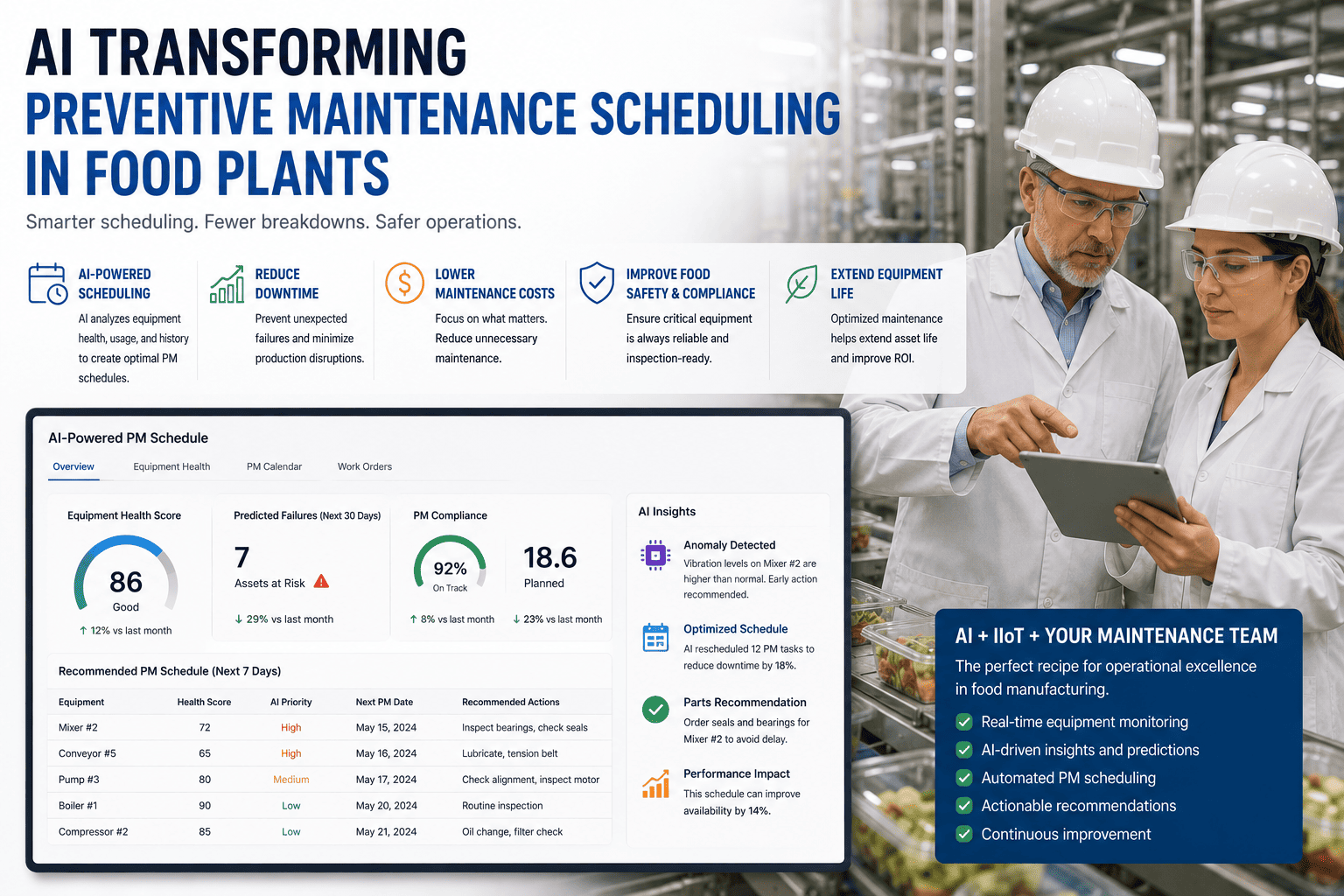
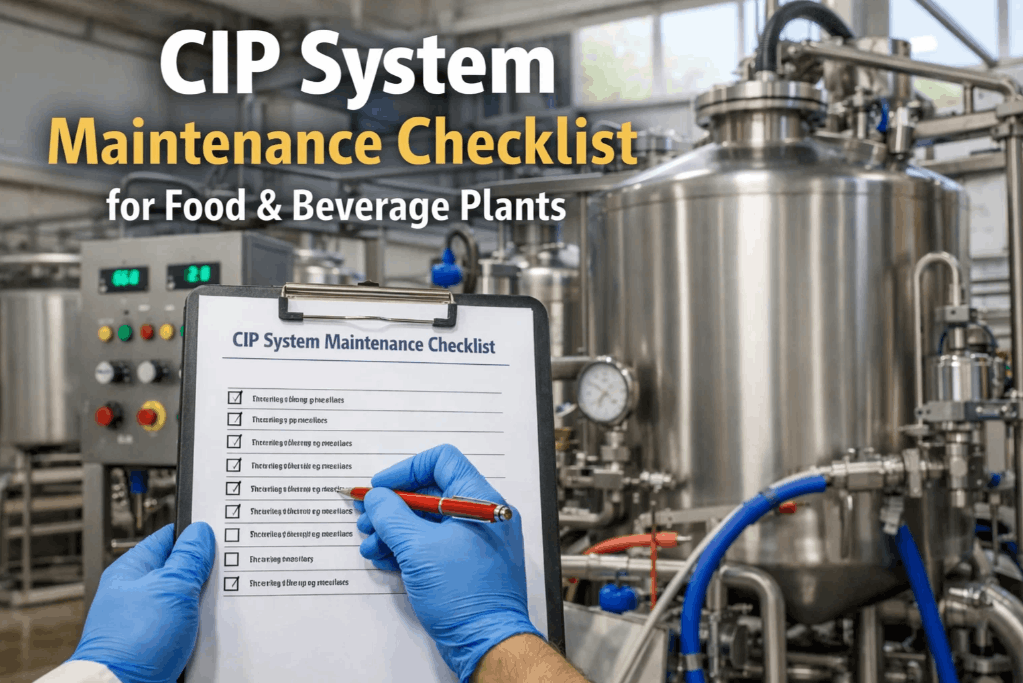
Food and beverage manufacturing operates under pressures that few other industries can match — razor-thin margins, strict regulatory oversight, perishable raw materials, and zero tolerance for contamination or unplanned downtime. In this environment, reactive maintenance is not just inefficient; it is a direct threat to product safety, brand reputation, and profitability. Computerized Maintenance Management System (CMMS) software gives food and beverage plants the operational intelligence to shift from firefighting to precision maintenance — reducing costs, ensuring compliance, and keeping production lines running at peak performance. Platforms like OxMaint are purpose-built to help food manufacturing teams manage assets, automate workflows, and stay audit-ready across every line and facility.
See How OxMaint Transforms Food Plant Maintenance
OxMaint CMMS gives food and beverage operations teams the tools to automate preventive maintenance, track every asset, and maintain full compliance documentation — all from a single platform designed for the demands of food manufacturing.
Why CMMS Software Is Critical for Food and Beverage Plants
The food and beverage sector faces a unique convergence of operational challenges: equipment that must meet sanitary design standards, maintenance records that regulators can demand at any moment, production schedules that leave minimal time for planned maintenance windows, and supply chains sensitive to even minor disruptions. Legacy paper-based maintenance systems and disconnected spreadsheets cannot provide the visibility or speed that modern food plants require. CMMS software addresses this gap by centralizing asset data, automating work order management, and providing real-time operational intelligence that enables proactive decision-making at every level of the organization. Explore OxMaint to see how a modern CMMS fits into your food plant operations.
Top 15 Benefits of CMMS Software for Food and Beverage Plants
Significant Reduction in Unplanned Downtime
Unplanned equipment failures are among the most costly events in food production. A single conveyor breakdown or filling machine failure can halt an entire production line, waste raw materials, and delay customer shipments. CMMS software enables systematic preventive maintenance scheduling — triggering work orders based on runtime hours, calendar intervals, or sensor thresholds — so maintenance teams address equipment wear before it becomes a failure. Plants that deploy CMMS consistently report 20 to 30 percent reductions in unplanned downtime within the first year of implementation.
Automated Preventive Maintenance Scheduling
Manually tracking hundreds of assets across a food facility — ovens, mixers, pasteurizers, packaging lines, refrigeration units, CIP systems — and maintaining a reliable preventive maintenance calendar is operationally impossible without automation. CMMS software auto-generates work orders on the schedules established by maintenance engineers, assigns them to qualified technicians, and escalates tasks that approach their due date without completion. This ensures that no piece of critical equipment falls through the cracks of a busy production schedule.
Food Safety and Regulatory Compliance Support
Food safety regulations — including FSMA, HACCP, SQF, BRC, and ISO 22000 — require manufacturers to demonstrate that equipment is properly maintained, calibrated, and sanitized on documented schedules. CMMS software creates an unbroken digital audit trail for every maintenance activity, calibration event, and sanitation procedure. When an FDA inspector or third-party auditor requests maintenance records, a CMMS-equipped plant can produce complete, timestamped documentation within minutes rather than hours spent searching paper files. Schedule a demo to see how OxMaint handles compliance documentation end to end.
Improved Overall Equipment Effectiveness (OEE)
OEE is the gold standard metric for manufacturing productivity, measuring the intersection of availability, performance, and quality. Each component of OEE is directly influenced by maintenance quality. CMMS software improves availability by reducing unplanned failures, improves performance by ensuring equipment operates within its designed parameters, and improves quality by preventing the subtle mechanical degradation that causes product defects. Plants using structured CMMS programs regularly achieve OEE improvements of five to fifteen percentage points — a significant commercial impact in high-volume food manufacturing.
Streamlined Work Order Management
Without a CMMS, work orders may be communicated verbally, written on whiteboards, or tracked in spreadsheets that quickly become outdated. CMMS software creates a structured work order lifecycle — from initiation and assignment through execution, parts consumption, and closure — with complete documentation at each stage. Maintenance supervisors gain real-time visibility into open work orders, technician workloads, and task completion rates. This visibility enables better resource allocation and helps identify recurring failure patterns that signal the need for root-cause investigation.
Optimized Spare Parts Inventory Management
Spare parts management is a persistent pain point in food manufacturing. Overstocking ties up capital and creates storage challenges; understocking means that a missing bearing or seal extends a breakdown into a prolonged production stoppage. CMMS software links parts consumption data to work orders, generates reorder alerts when stock falls below minimum thresholds, and provides usage history that enables data-driven stocking decisions. Over time, CMMS-driven inventory optimization reduces parts carrying costs by 15 to 25 percent while improving parts availability when failures do occur.
Enhanced Calibration and Sanitation Tracking
Temperature sensors, pressure gauges, flow meters, and weighing systems in food plants must be calibrated on defined intervals and documented per regulatory requirements. Sanitation procedures for food-contact equipment must be executed on strict schedules and verified. CMMS software manages both calibration and sanitation workflows with the same precision applied to mechanical maintenance — scheduling tasks, issuing reminders, capturing results, and flagging overdue activities before they create compliance gaps.
Reduced Maintenance Costs and Higher ROI
The financial case for CMMS investment in food manufacturing is well-documented. By shifting labor hours from reactive breakdown repairs to planned preventive maintenance, plants spend less on emergency parts procurement (which typically carries a 20 to 40 percent premium), overtime labor, and expedited production catch-up. Combined with inventory optimization and extended asset life, CMMS implementations in food and beverage typically deliver full return on investment within 12 to 18 months, with ongoing annual savings that grow as the system captures more operational history.
Extended Asset Lifespan and Capital Efficiency
Food processing equipment represents substantial capital investment. Filling lines, retort systems, heat exchangers, and packaging machinery carry six- and seven-figure replacement costs. Equipment that receives consistent preventive maintenance, proper lubrication, timely component replacement, and documented operating history regularly exceeds its design life — deferring capital expenditure and maximizing the return on existing assets. CMMS software is the infrastructure that makes consistent, documented asset care operationally achievable at scale.
Faster Root Cause Analysis and Failure Elimination
Recurring equipment failures that appear random often have systematic root causes — contamination, misalignment, incorrect lubrication intervals, or operator errors — that are only visible when maintenance history is analyzed longitudinally. CMMS software aggregates work order history, failure codes, parts consumption, and technician notes into a searchable database that makes failure pattern analysis straightforward. Maintenance engineers can identify which assets are generating disproportionate repair costs and direct root-cause investigations where they will have the greatest operational impact.
Mobile Accessibility for Field Technicians
Food plant maintenance technicians spend their working hours on the production floor, not at a desk. Modern CMMS platforms provide mobile applications that allow technicians to receive work orders, access asset manuals and maintenance procedures, record completed tasks, log parts used, and capture photos of equipment conditions — all from a smartphone or tablet at the point of work. Mobile CMMS eliminates the documentation lag that leads to incomplete records and ensures that every maintenance activity is captured accurately in real time.
Improved Technician Productivity and Accountability
When maintenance activities are systematically planned, clearly assigned, and tracked through completion, technician productivity improves substantially. CMMS data provides maintenance managers with objective metrics on work order completion rates, response times, and task durations — enabling fair performance assessment and identifying training needs. For technicians, structured work orders with step-by-step procedures and access to digital manuals reduce time spent troubleshooting and eliminate uncertainty about task requirements.
Support for Predictive Maintenance Programs
CMMS software provides the data foundation that predictive maintenance technologies require. Vibration sensors, thermographic cameras, and oil analysis programs generate condition data that must be integrated with maintenance history to generate actionable predictions. A CMMS platform that ingests sensor data alongside work order history allows maintenance teams to move beyond time-based preventive schedules toward condition-based interventions — performing maintenance only when equipment condition data indicates it is needed, and avoiding unnecessary downtime from over-maintenance.
Better Cross-Shift Communication and Knowledge Retention
In food plants that operate 24 hours across multiple shifts, maintenance knowledge transfer between shifts is a persistent challenge. Equipment problems identified by the night shift may not be effectively communicated to the day shift, leading to repeated failures and inconsistent responses. CMMS software creates a centralized, real-time record of open issues, in-progress work, and asset condition notes that all shifts can access. When experienced technicians retire, their documented work history and troubleshooting notes remain in the system — preserving institutional knowledge that would otherwise walk out the door.
Data-Driven Maintenance Strategy and Continuous Improvement
The most transformative long-term benefit of CMMS software is the operational intelligence it generates. Maintenance KPI dashboards — tracking mean time between failures, mean time to repair, preventive maintenance compliance, cost per work order, and OEE trends — give maintenance managers and plant directors the data needed to make evidence-based decisions about staffing, capital investment, and maintenance strategy evolution. Food plants that use CMMS data to drive continuous improvement consistently outperform their peers on uptime, compliance, and cost metrics over a multi-year horizon.
CMMS Impact Comparison: Food Plant Operations
| Operational Area | Without CMMS | With CMMS | Measured Impact |
|---|---|---|---|
| Unplanned Downtime | Reactive, unpredictable | Proactively minimized | 20–30% reduction |
| Compliance Audit Prep | Hours of manual search | Digital records in minutes | 10× faster response |
| Spare Parts Costs | Overstocked or stockouts | Data-driven stocking | 15–25% cost savings |
| PM Task Completion | Missed or inconsistent | Automated scheduling | Compliance rate 85%+ |
| Maintenance Labor | Reactive breakdown repairs | Planned, efficient workflows | 30% productivity gain |
| Asset Lifespan | Premature replacement | Documented care, extended life | Deferred capex |
| Food Safety Risk | Documentation gaps | Full audit trail | Significantly reduced |
Key Features to Look for in a Food and Beverage CMMS
Not all CMMS platforms are equally suited to the demands of food and beverage manufacturing. When evaluating solutions, plant operations and maintenance leaders should prioritize platforms that offer role-based mobile access for floor technicians, configurable preventive maintenance triggers based on runtime and calendar schedules, built-in calibration and sanitation workflow management, and compliance documentation exports formatted for regulatory submissions. Integration capability with ERP systems, SCADA platforms, and IoT sensor networks is increasingly important as food plants expand their digital infrastructure. Ease of implementation and technician adoption should also weigh heavily — the best CMMS is one that your team will actually use consistently. Explore OxMaint to see how these capabilities are delivered for food and beverage teams.
Built for Regulated Environments
The right food plant CMMS must generate documentation that satisfies FDA, FSMA, SQF, and BRC auditors without manual reformatting. Look for platforms with pre-configured compliance templates, digital signature capture, and tamper-evident record-keeping that meets 21 CFR Part 11 requirements for electronic records.
Grows with Your Operations
Food and beverage companies often operate multiple facilities across different geographies. A CMMS that scales from a single plant to an enterprise-wide deployment — with centralized reporting and site-level operational autonomy — delivers compounding value as your organization grows and as management demands cross-facility benchmarking.
Implementing CMMS in a Food Manufacturing Environment
Successful CMMS implementation in a food plant requires more than software deployment. The foundation is a complete, accurate asset register — every piece of equipment catalogued with its make, model, installation date, maintenance history, and criticality rating. Without a reliable asset register, the CMMS cannot generate accurate maintenance schedules or meaningful performance reports. Most food plants find that the asset audit required for CMMS implementation itself surfaces valuable insights about the true condition of their equipment portfolio.
Change management is equally important. Maintenance technicians accustomed to verbal work assignments and paper records need structured training and a clear explanation of how CMMS changes their daily workflow — and how it benefits them. The fastest path to CMMS adoption is demonstrating early wins: the first time a CMMS-driven preventive maintenance task prevents a failure that would previously have halted production, the value proposition becomes self-evident to the entire maintenance team.
The Strategic Case for CMMS Investment in Food and Beverage
The competitive landscape in food and beverage manufacturing continues to intensify. Consumer expectations for product quality and safety have never been higher. Regulatory scrutiny continues to increase. Labor markets are tightening, making it more important than ever to maximize the productivity of existing maintenance teams. In this environment, CMMS software is no longer a discretionary investment — it is operational infrastructure as essential as the production equipment itself.
Plants that implement CMMS systematically — with proper asset data, structured PM programs, and disciplined work order management — consistently outperform their competitors on uptime, compliance, cost, and quality metrics. The 15 benefits outlined in this article represent not just operational improvements but a compounding strategic advantage that grows over time as the CMMS accumulates operational history and enables increasingly sophisticated maintenance decision-making. Ready to take the next step? Schedule a demo with the OxMaint team today.
Ready to Transform Your Food Plant Maintenance Program?
OxMaint CMMS is purpose-built for the operational demands of food and beverage manufacturing — from preventive maintenance automation and spare parts management to calibration tracking and full compliance documentation. Join the teams delivering higher OEE, lower costs, and audit-ready operations.
Frequently Asked Questions
What is CMMS software and how does it benefit food and beverage plants?
CMMS (Computerized Maintenance Management System) software centralizes maintenance operations — scheduling preventive tasks, managing work orders, tracking spare parts, and generating compliance documentation. For food and beverage plants, the primary benefits include reduced unplanned downtime, improved food safety compliance, lower maintenance costs, and better OEE performance.
How does CMMS support food safety regulatory compliance?
CMMS software creates a digital audit trail for every maintenance, calibration, and sanitation activity — with timestamps, technician signatures, and photographic evidence. This documentation satisfies the record-keeping requirements of FSMA, HACCP, SQF, BRC, and ISO 22000 audits and enables plants to respond to regulatory requests quickly and completely.
What is the typical ROI of CMMS implementation in food manufacturing?
Food and beverage plants that implement CMMS systematically typically achieve full return on investment within 12 to 18 months. Ongoing annual savings come from reduced breakdown repair costs, optimized spare parts inventory, extended asset life, and improved maintenance labor productivity — with documented savings commonly reaching tens of thousands to hundreds of thousands of dollars annually depending on plant scale.
Can CMMS software integrate with existing plant systems?
Modern CMMS platforms are designed to integrate with ERP systems, SCADA networks, IoT sensor platforms, and laboratory information management systems. These integrations enable automated work order triggering from sensor alerts, synchronized spare parts data with procurement systems, and consolidated operational reporting across production and maintenance functions.
How long does CMMS implementation take for a food manufacturing facility?
Implementation timelines vary by facility complexity and the completeness of existing asset data. A single food plant with an organized asset registry can typically complete CMMS implementation and initial training within four to eight weeks. Multi-site enterprise deployments may take three to six months, with phased rollouts allowing each facility to refine its setup before full deployment.
Is CMMS software suitable for small and mid-sized food manufacturers?
Yes. Cloud-based CMMS platforms have made enterprise-grade maintenance management accessible to small and mid-sized food manufacturers without large upfront infrastructure investments. Subscription-based pricing models allow smaller plants to start with core functionality and scale capabilities as their needs grow — making CMMS a viable investment for operations of all sizes.