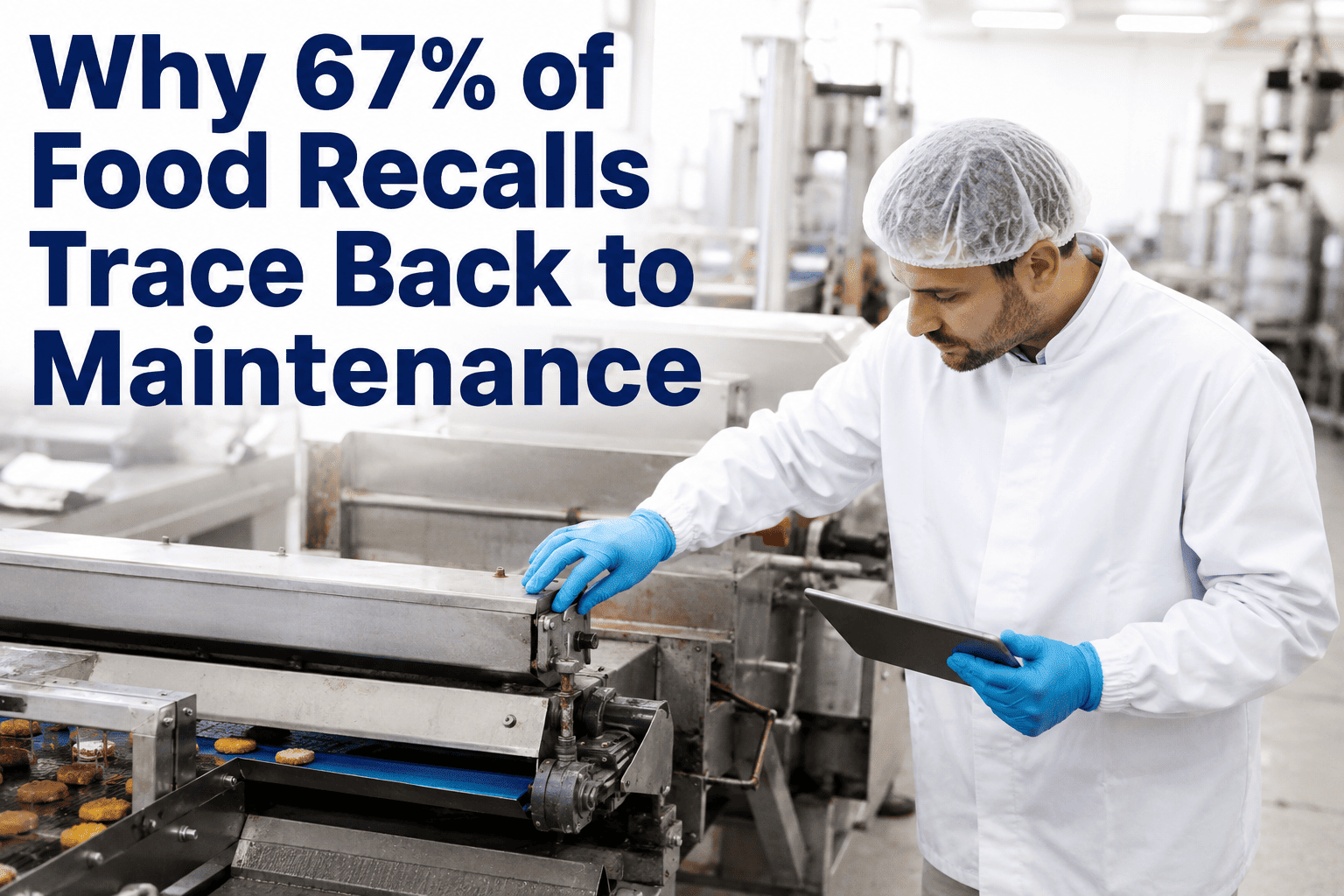
Unplanned equipment failure costs food and beverage manufacturers an average of $532,000 per hour of downtime — and in high-throughput production environments, that number climbs higher every minute the line sits idle. The good news: facilities that implement CMMS-driven preventive maintenance automation consistently report 35–45% reductions in unplanned stoppages within 12 months. This page covers exactly how that happens, and what it means for your bottom line. Want to see it in action? Start a free 30-day trial or book a demo with the Oxmaint team today.
Reduce Food Plant Downtime by 40% With CMMS Automation
How modern maintenance platforms are turning reactive food facilities into high-reliability production operations — with real numbers, real workflows, and zero guesswork.
Why Food Plants Bleed Money on Downtime
Most food facilities fix equipment after it fails. That model worked when production schedules were loose. Today, with SKU proliferation and thin margins, every unplanned stop triggers a cascade — missed SLAs, product waste, overtime labor, and quality holds.
Maintenance teams manage dozens of critical assets — fillers, sealers, CIP systems, conveyors, refrigeration — without a single unified view of equipment health, last service date, or failure history. Decisions get made from memory and paper logs.
Equipment failure in food production isn't just an operations problem — it's a compliance event. A failed CIP cycle, a broken seal on a filler, or unplanned refrigeration downtime can trigger FDA investigation, product recall, and brand damage worth millions.
When a critical component fails at 2am, technicians discover there's no spare on-site. Emergency procurement adds 6–24 hours to an already costly stoppage. Over-stocking the wrong parts ties up capital. Neither extreme is sustainable.
Where Downtime Actually Comes From in Food Plants
Industry data from food and beverage manufacturing facilities consistently identifies these as the primary contributors to unplanned production stops. Understanding the distribution tells you exactly where automation delivers the fastest ROI. Ready to map your own facility's downtime sources? Start a free trial and run an asset health audit in under a week.
Source: Food Processing Industry Maintenance Benchmark Report | Percentage of facilities reporting as primary downtime cause
The Real Cost Difference
The math is brutal and unavoidable. Food manufacturers still running reactive maintenance pay a premium on every repair, every hour, every year. Here's what the comparison looks like across the key operational metrics that matter to plant managers and VPs of Operations.
The 6-Layer Downtime Prevention Framework
Oxmaint attacks food plant downtime at every layer — from asset registry to production-triggered PM scheduling to IoT-connected condition monitoring. Here's how each layer works and what it eliminates. Book a demo to see the full platform configured for your facility type.
Every piece of food production equipment — fillers, sealers, conveyors, CIP systems, refrigeration — lives in a single asset hierarchy. Each asset carries a live condition score, maintenance history, and failure risk indicator. No more managing equipment from spreadsheets or memory.
Food plants don't run on fixed calendars — they run on units, cycles, and line hours. Oxmaint triggers preventive maintenance tasks based on production data, not just time intervals. A filler that runs 3 shifts gets serviced appropriately. A line that ran 40% capacity last month gets adjusted automatically.
Every work order captures who did what, which parts were used, how long the job took, and what the outcome was. Patterns emerge fast: recurring failures on a specific filler, a technician missing steps on a CIP protocol, a vendor part that fails prematurely. That intelligence drives smarter decisions.
Oxmaint links critical spare parts directly to asset records. Min/max stock levels trigger automatic replenishment. When a work order is created for a critical asset, the system confirms part availability before the technician walks to the line — eliminating the 6-hour stoppage that starts with "we don't have that seal in stock."
Pre-shift inspections, CIP verification, sanitation checks, and changeover sign-offs are captured digitally with electronic signatures and timestamps. Failed inspection items automatically generate corrective work orders. Every record is audit-ready for FDA, BRC, SQF, and FSMA inspections without manual compilation.
For facilities with IoT or SCADA integration, Oxmaint ingests real-time production and equipment data to surface OEE at the individual line level. Availability, Performance, and Quality tracked per shift, per line, per site. When OEE drops below threshold, a PM work order fires automatically — before the line goes down.
What Food Manufacturers Achieve After CMMS Automation
Why Maintenance Compliance Is Now a Food Safety Issue
FSMA, FDA 21 CFR, BRC Global Standard, and SQF all explicitly require documented evidence of equipment maintenance and inspection — and regulators are scrutinizing maintenance records more than ever. A facility that reacts to failures rather than preventing them generates incomplete documentation trails, inconsistent CIP records, and uninvestigated equipment events.
That's a compliance vulnerability, not just an operations problem. Oxmaint creates the audit trail automatically: every PM task completed, every inspection result captured, every corrective action linked to the originating finding — with electronic signatures and immutable timestamps. Start a free trial and see what an audit-ready maintenance programme looks like, or book a demo to walk through GMP compliance workflows.
Food Plant Managers Ask These
Your Food Plant. Your Equipment. Zero Downtime Surprises.
Oxmaint gives food and beverage manufacturers the tools to prevent failures before they happen — with production-triggered PM scheduling, live asset condition tracking, digital GMP inspections, and portfolio-level OEE reporting. No implementation fees. No long onboarding. Up and running in days, not months.