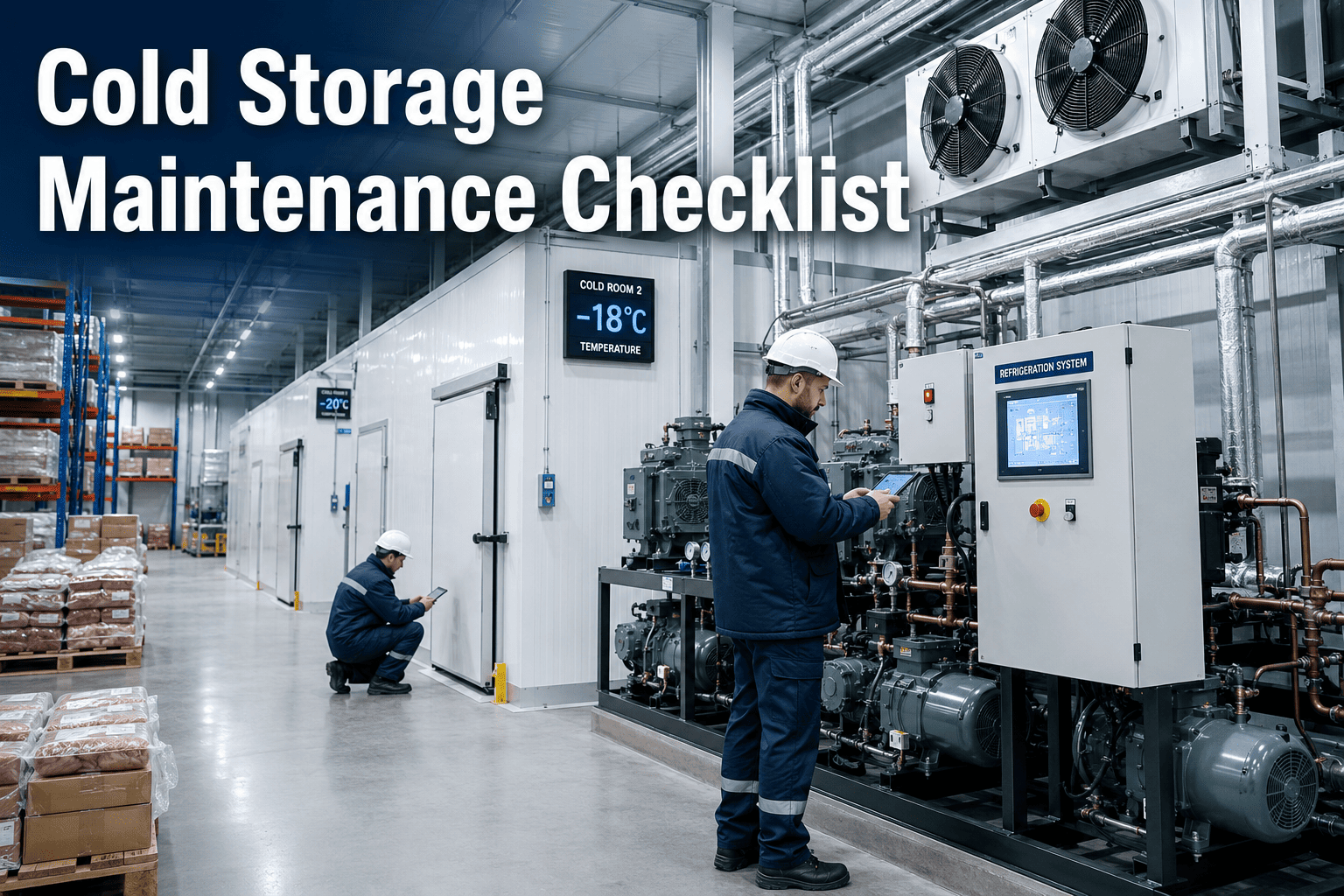
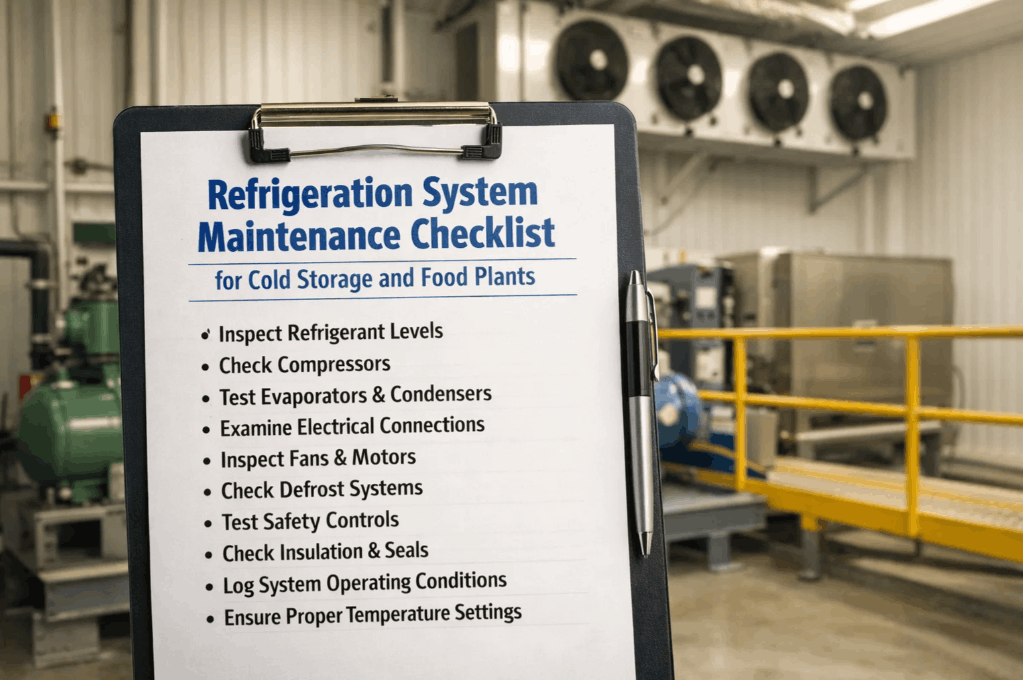
A refrigeration compressor doesn't fail without warning. It vibrates slightly differently. It draws more current. Its discharge temperature creeps up by two degrees. In a food plant, every one of those signals is a window — a chance to intervene before a temperature excursion turns one mechanical issue into a product loss, a compliance breach, and a regulatory investigation. Most facilities miss that window entirely. Here's how to stop missing it.
Why This Matters Now
Cold Storage Is Your Highest-Risk, Highest-Cost Asset. Most Plants Treat It Like a Utility.
One Failure, Three Simultaneous Crises
When a refrigeration compressor fails in a food plant, you are not dealing with a maintenance event — you are dealing with three simultaneous crises. A production stoppage. A food safety temperature excursion. And a compliance gap that will show up on your next FDA inspection. The mechanical failure and the regulatory failure happen at exactly the same moment.
The $46 Billion Market That Cannot Afford Downtime
The U.S. cold storage market was valued at $46.47 billion in 2025 and is growing at 12.3% annually through 2032. Food and beverage accounts for over 77% of all cold storage usage. With perishable product on the line around the clock, unplanned downtime is not a maintenance metric — it is a business continuity emergency.
FSMA Compliance Is Now Data-Driven
A time-based maintenance log tells an FDA inspector you performed a task. Real-time sensor data with timestamped temperature records proves your asset was healthy and your cold chain was intact. Under FSMA, that distinction is the difference between a clean record and a Form 483 observation — and in 2026, regulators are asking for the data.
The 5 Failure Modes That Cause 90% of Temperature Excursions
These are not edge cases. Every cold storage facility in food manufacturing faces each of these failure patterns. Understanding how they develop — and how early detection changes the outcome — is the foundation of effective prevention.
01
Compressor Degradation and Overload
The compressor is the heart of every refrigeration system. When condenser coils accumulate dust and grease in food plant environments, heat rejection drops, head pressure rises, and the compressor works progressively harder. A 20% reduction in condenser airflow can increase energy consumption by 30% and accelerate compressor failure. Emergency compressor repairs run $25,000–$75,000 per incident. A catastrophic failure with product loss easily exceeds $200,000.
Early warning signals
Rising discharge temperature
Elevated amp draw
Increased vibration signature
Head pressure trending up
02
Evaporator Coil Ice Buildup and Defrost Failure
When defrost cycles fail to fully clear frost from evaporator coils, each subsequent cycle adds more ice. Airflow decreases progressively and room temperature rises — often just 1–2°F per day initially. By the time alarms trigger, the coil may be a solid block of ice requiring hours of manual defrost. Product is already compromised. The failure develops over days or weeks while appearing normal to time-based inspection.
Early warning signals
Gradual temp rise pattern
Longer cooling cycles
Reduced airflow at evaporator
Defrost duration anomalies
03
Evaporator Fan Motor Failure
Fan motors are the most common single-point failure in cold storage systems. When a fan motor fails, air circulation stops in that zone. Without even airflow, temperature stratification creates hot pockets across the cold room — some areas may remain within spec while others are already at dangerous temperatures. Standard temperature sensors placed at a single point will miss zonal excursions entirely until product is already affected.
Early warning signals
Current draw drop on motor
Vibration change at fan unit
Zonal temperature variation
Unusual noise patterns
04
Temperature Sensor Drift and Alarm System Failure
A temperature sensor that has drifted by 3°F does not alarm — it simply tells the system everything is fine while the room is actually out of range. This is arguably the most dangerous failure mode because the monitoring system designed to catch problems is itself the problem. Alarm communication failures via cellular or WiFi further compound the risk: the equipment failure may be minor, but delayed detection turns it into a major product loss event.
Early warning signals
Sensor calibration drift
Communication latency increase
Alarm test failures
Battery backup degradation
05
Door Seal Degradation and Infiltration Load
Worn door gaskets and damaged strip curtains create a constant warm air infiltration load that forces refrigeration systems to work continuously at elevated capacity. This accelerates compressor wear, increases energy costs by 15–30%, and creates condensation and ice accumulation at doorways. The failure develops over months and never trips a single alarm — it simply degrades overall system health until a component fails under the accumulated strain.
Early warning signals
Higher energy consumption trend
Compressor run time increasing
Ice at door perimeters
Humidity excursions near entries
The Detection Gap: Reactive vs. Predictive
The Difference Between Finding a Problem and Preventing One
How Most Plants Operate Today
Day 1–14
Compressor begins working harder. Energy consumption rises quietly. No alarm. No alert. No action.
Day 15–20
Performance degrades further. Technician notices room is "running warm" during a manual walkthrough.
Day 21
Temperature alarm triggers. Product is already at risk. Emergency service call placed. Parts ordered. 48-hour wait begins.
Day 23
Compressor repaired. $35,000–$75,000 in emergency repair costs. Product batch written off. FDA notification likely required.
VS
With Oxmaint Predictive Monitoring
Day 1–3
AI detects anomaly in compressor vibration and amp draw. Alert sent to maintenance team immediately.
Day 4
Condenser coils inspected and cleaned. Root cause identified and resolved during scheduled maintenance window.
Day 5
System returns to baseline performance. Work order automatically logged with sensor data for compliance documentation.
Outcome
Zero temperature excursion. Zero product loss. Zero emergency repair cost. Full compliance record maintained automatically.
What to Monitor and When
The Cold Storage Monitoring Matrix: Every Critical Asset and Its Key Parameters
| Equipment | Parameters to Monitor | Failure Without Monitoring | Alert Lead Time |
|---|---|---|---|
| Refrigeration Compressor | Vibration, amp draw, discharge temp, suction/discharge pressure, oil level | Total cooling loss, $75K–$200K+ incident cost | 2–4 weeks |
| Evaporator Fan Motors | Current draw, vibration signature, RPM consistency, noise frequency | Zonal temperature excursion, product spoilage before alarm | 1–2 weeks |
| Condenser Unit | Head pressure, discharge temperature, coil surface temp, fan operation | Compressor overload, 30% energy increase, early wear | 1–3 weeks |
| Temperature Sensors | Calibration drift, multi-point zone coverage, response time consistency | Silent excursion — system shows "normal" while product is at risk | Continuous |
| Defrost System | Defrost cycle duration, coil temperature after defrost, drain flow rate | Progressive ice buildup, airflow reduction, delayed failure | 3–7 days |
| Door Seals and Gaskets | Energy consumption trend, compressor run time, humidity near entries | 15–30% energy waste, accelerated compressor wear over time | Trend-based |
The Prevention Framework
4 Layers of Cold Storage Protection — and Why You Need All of Them
1
Continuous Sensor Monitoring
IoT sensors on all critical components — compressors, fan motors, condensers, and temperature zones — capturing data continuously, not just during inspections. Real anomalies surface between scheduled checks.
2
AI Pattern Recognition
Machine learning models establish normal operating baselines for your specific equipment and load patterns. Deviations from those baselines trigger alerts — not just threshold breaches, but trending anomalies that precede failure by weeks.
3
Automated Work Order Generation
When a predictive alert is triggered, a work order is automatically created with the asset details, sensor data, recommended action, required parts, and technician routing. No manual translation. No delay between detection and response.
4
Compliance Documentation
Every sensor reading, alert, inspection, and corrective action is timestamped and stored. Under FSMA, your temperature compliance record is built automatically — audit-ready at any moment, not assembled the night before an inspection.
The Real Cost of Waiting
What a Single Cold Storage Failure Actually Costs — Line by Line
Emergency Compressor Failure — Fully Loaded Cost
Emergency service call and overtime labor
$3,000 – $8,000
Parts (compressor, valves, refrigerant recharge)
$15,000 – $45,000
Product loss from temperature excursion
$20,000 – $120,000
Production downtime (per-hour revenue loss)
$5,000 – $25,000
Regulatory documentation and compliance response
$2,000 – $10,000
Total incident cost
$45,000 – $208,000+
Predictive Maintenance Intervention Cost
Condenser cleaning and inspection
$200 – $600
Planned compressor service
$800 – $2,500
Fan motor replacement (planned)
$150 – $400
Door gasket replacement
$100 – $300
Typical savings per avoided incident
$40,000 – $205,000
A single avoided compressor failure covers a full year of predictive maintenance software costs — often several times over. The ROI calculation is not complicated. The decision to act is what separates high-performing plants from reactive ones.
Energy and Compliance
Beyond Failure Prevention: Two More Reasons Predictive Maintenance Pays
Energy Savings
Cold Storage Is Your Largest Energy Consumer. Maintenance Directly Controls the Bill.
Cold storage accounts for 40–60% of total facility electricity in most food plants. Every 1°F increase in condensing temperature raises energy consumption by 2–3%. Dirty condenser coils, failing fan motors, and worn door seals compound these losses continuously. Maintenance-driven energy optimization — cleaning coils on condition rather than schedule, catching fan motor inefficiencies early, sealing infiltration points — routinely delivers 20–35% reductions in cold storage energy costs. At scale, that is $40,000–$100,000 in annual utility savings for a mid-size facility.
20–35%
Energy reduction from condition-based coil maintenance
15–30%
Energy saved by maintaining door seals and air barriers
Regulatory Compliance
FSMA and HACCP Compliance Is Now a Data Problem, Not a Paperwork Problem.
Under FSMA's Preventive Controls for Human Food rule, food manufacturers must demonstrate that Critical Control Points — including cold storage temperatures — are actively monitored and that corrective actions are documented. A binder of manual temperature logs no longer satisfies inspectors who are increasingly asking for continuous data. Real-time monitoring with automated logging creates an unbroken, timestamped compliance record. Every temperature reading. Every alert. Every corrective action. All available instantly — not assembled under pressure during an inspection.
24/7
Automated temperature logging with zero manual intervention
100%
Audit-ready documentation available on demand
See How Oxmaint Monitors Your Cold Storage in Real Time
Sensor installation in under 4 hours. First predictive alerts within days. No disruption to operations.
Implementation: Getting Started
From Reactive to Predictive in 30 Days: The Cold Storage Monitoring Roadmap
Week 1
Asset Criticality Assessment
Rank every cold storage asset by failure impact — product value at risk, regulatory exposure, and downtime cost per hour. Your compressors and evaporator fan motors are almost always the top priority. This step prevents the most common implementation mistake: installing sensors on the wrong equipment.
Week 2
Sensor Deployment on Priority Assets
Deploy IP69K-rated wireless sensors — designed for washdown environments — on your top-priority assets. Vibration, temperature, current draw, and pressure sensors install in hours without production disruption. Connect data streams to the Oxmaint AI engine via existing network or cellular gateway.
Weeks 3–4
Baseline Establishment and Alert Calibration
AI models learn the normal operating signature of your specific equipment across all shifts and seasonal conditions. Alert thresholds are calibrated with your maintenance team to minimize false positives while maintaining maximum early-warning lead time. First meaningful predictive alerts typically surface within 2–3 weeks.
Month 2+
Full Coverage and Continuous Improvement
Expand coverage to all cold storage assets based on validated findings from your pilot. Track MTBF, MTTR, energy consumption, and compliance record quality on a monthly dashboard. AI models retrain continuously on your actual failure history, improving prediction accuracy over time.
We went from firefighting daily equipment failures to having full visibility over our refrigeration systems. The platform flagged a compressor anomaly three weeks before it would have failed completely. That single early detection saved us the cost of the entire annual subscription — on the first month.
89%
Reduction in unplanned cold storage downtime at Oxmaint deployments
42%
Average maintenance cost reduction across food plant implementations
7.3 mo
Average payback period on full Oxmaint implementation
Cold Storage Protection Starts Here
Stop Reacting to Cold Storage Failures. Start Predicting Them.
Oxmaint's predictive maintenance platform is built for food manufacturing — with washdown-safe sensors, FSMA-ready compliance logging, and AI that learns your specific equipment and operating conditions. Your next compressor failure is not inevitable. It is preventable — if you can see it coming.
Sensor installation in under 4 hours
First predictive alerts within days
Cancel anytime