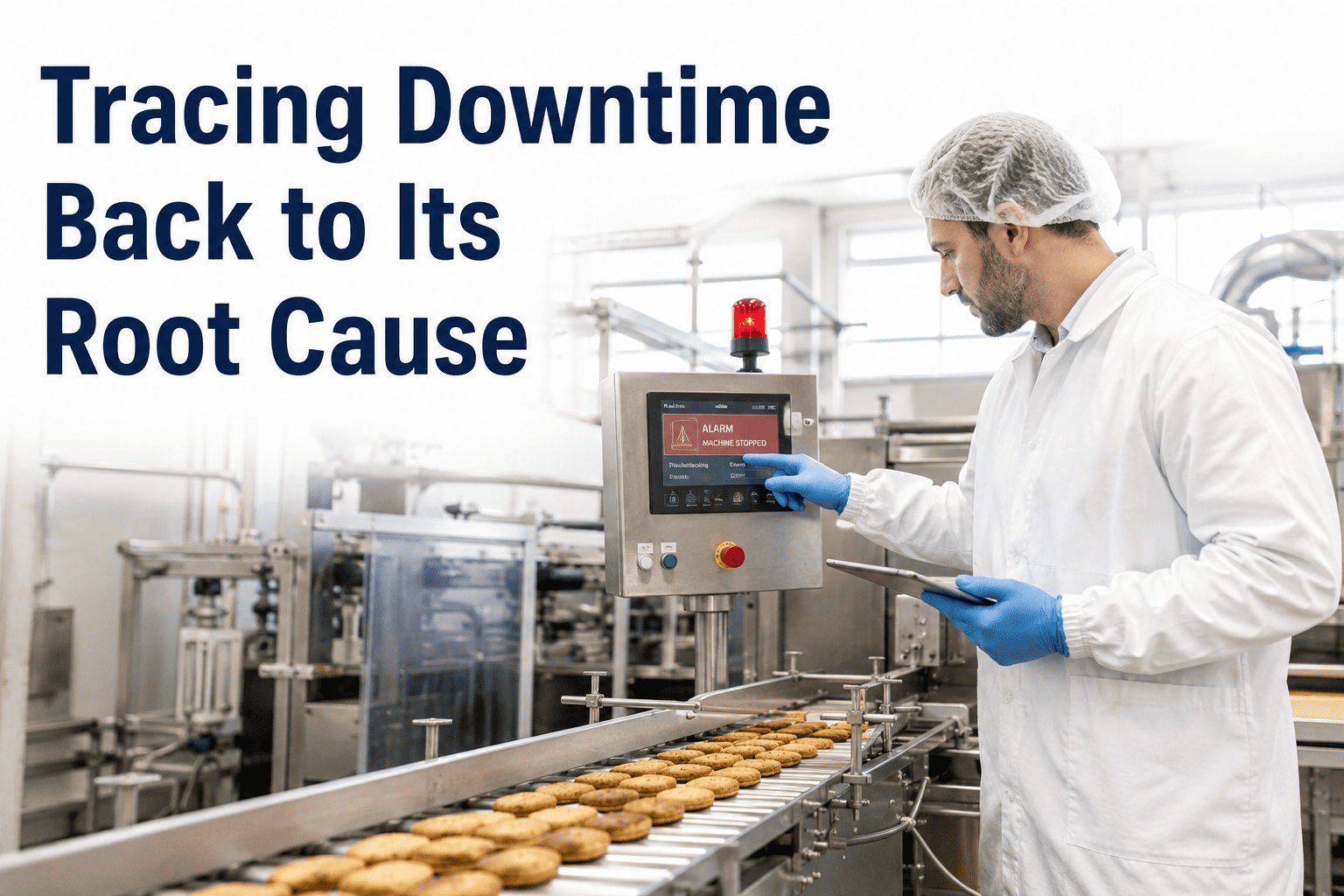
Unplanned equipment downtime is the single most expensive operational failure in food manufacturing — and it is almost entirely preventable. Plant and operations managers across the food and beverage industry are now turning to Computerized Maintenance Management Systems (CMMS) as the strategic engine behind equipment reliability programs that consistently deliver 40% reductions in unplanned downtime. This guide breaks down exactly how food manufacturers are using CMMS-driven root cause analysis, preventive maintenance optimization, predictive alerts, and intelligent spare parts strategies to reclaim lost production hours, protect margins, and build sustainable uptime.
Cut Unplanned Downtime by 40% — Starting Today
OxMaint gives food plant managers real-time equipment monitoring, automated PM scheduling, and predictive failure alerts — all in one CMMS built for food manufacturing reliability.
Why Unplanned Downtime Costs Food Manufacturers More Than Any Other Loss
In food production, an unplanned equipment failure does not simply pause output — it triggers a cascade of compounding losses. A filling line that stops unexpectedly during a production run initiates product holds, forces maintenance into reactive firefighting mode, disrupts downstream scheduling, and can compromise HACCP compliance if a critical control point is breached mid-process. Industry data consistently shows that unplanned downtime in food manufacturing costs between $5,000 and $25,000 per hour when labor, waste, schedule recovery, and regulatory risk are fully accounted for.
The gap between reactive maintenance and a proactive CMMS-driven reliability program is precisely where that cost lives. Food manufacturers still relying on paper-based PM checklists, manual work order systems, or tribal maintenance knowledge are structurally exposed to downtime that more data-mature competitors have already eliminated. The question is no longer whether to implement a CMMS for food production downtime reduction — it is how to deploy it for maximum reliability impact. Sign up free and see how OxMaint maps your facility's downtime profile from day one.
The Four CMMS Strategies Driving 40% Downtime Reduction in Food Plants
Root Cause Analysis via CMMS Work Orders
Reactive plants repeat the same failures because no one analyzes the pattern. CMMS links every downtime event to a structured work order — failure mode, component, diagnosis, and repair time — so recurring failures become visible and fixable before they happen again.
- Every breakdown tied to a specific failure mode
- Pareto analysis reveals top repeat failures
- Turns 6 reactive repairs into 1 preventive fix
PM Optimization: Condition-Based Intervals
OEM-default PM schedules are built for average plants — not yours. CMMS uses actual run-time data and MTBF history to set intervals that reflect your real operating conditions, eliminating both over-maintenance waste and under-maintenance failures.
- PM triggered by usage hours, not just the calendar
- MTBF analysis flags under-protected assets
- 25–35% reduction in PM labor and failure rates
Predictive Alerts: Catch Failures Early
IoT sensors connected to your CMMS monitor vibration, temperature, and motor current in real time. When readings drift from baseline, automated alerts fire — giving your team days or weeks to schedule a repair before the line goes down.
- Covers packaging, filling, conveyors, and CIP systems
- Alerts replace emergency calls with planned repairs
- Protects both uptime and food safety compliance
Spare Parts Pre-Staging: No More Wait Time
A 45-minute repair becomes a 6-hour outage when the right part isn't on the shelf. CMMS tracks parts consumption against failure history and sets minimum stock levels for high-criticality components — so the parts you need most are always staged and ready.
- Stock levels driven by actual consumption data
- Flags food-grade compliance for product-zone parts
- Eliminates emergency procurement scrambles
CMMS Downtime Reduction Benchmarks: Food Manufacturing Performance Data
Food manufacturers implementing structured CMMS-driven reliability programs consistently outperform industry averages across every equipment reliability metric. The performance data below reflects outcomes from food production environments that have transitioned from reactive-only maintenance to integrated CMMS programs combining PM optimization, predictive alerts, and root cause analysis.
| Reliability Metric | Reactive Maintenance Baseline | CMMS-Driven Performance | Improvement Range |
|---|---|---|---|
| Unplanned Downtime Rate | 18% – 24% of planned time | 8% – 14% of planned time | 35% – 50% reduction |
| Mean Time Between Failures (MTBF) | 320 – 480 hours | 520 – 780 hours | 50% – 65% increase |
| Mean Time to Repair (MTTR) | 3.8 – 6.2 hours | 1.4 – 2.8 hours | 45% – 60% reduction |
| PM Compliance Rate | 55% – 68% | 88% – 96% | 30% – 40% improvement |
| Reactive vs. Planned Maintenance Ratio | 70% reactive / 30% planned | 25% reactive / 75% planned | Ratio inversion |
| Spare Parts Emergency Procurement Events | 8 – 14 per month | 2 – 4 per month | 70% – 80% reduction |
| Overall Equipment Effectiveness (OEE) | 55% – 65% | 70% – 82% | 12% – 18% gain |
These figures are not theoretical projections — they represent the operational reality of food manufacturers who have made the transition from reactive maintenance to CMMS-enabled reliability programs. The 40% unplanned downtime reduction headline consistently holds across facility sizes, equipment types, and product categories, because the underlying mechanisms — better PM intervals, faster root cause identification, parts availability, and predictive detection — are universal to all food production environments. Book a demo to see how these benchmarks apply to your specific lines.
Food Safety Integration: Why CMMS Downtime Reduction Must Include Compliance
Operations managers pursuing CMMS-driven downtime reduction in food manufacturing cannot treat equipment reliability and food safety compliance as separate programs. The decisions that drive unplanned downtime and the decisions that affect HACCP compliance are deeply entangled — and a CMMS platform that manages them in isolation creates blind spots that expose the facility to regulatory risk precisely when production pressure is highest. Get started free with OxMaint to unify both programs in a single platform.
CCP Monitoring Linked to Maintenance Records
A cook temperature excursion or metal detector failure gets auto-linked to the equipment's maintenance record — revealing whether a maintenance gap caused it and fixing both the compliance deviation and the root condition at once.
- CCP deviations tied to work order history
- One corrective action covers compliance + reliability
Sanitation Work Orders as Availability Loss Events
Sanitation overruns are a hidden OEE killer. CMMS tracks actual vs. planned cleaning time, exposing where delays happen so you can reduce them — without cutting corners on allergen or CIP compliance.
- Actual vs. planned sanitation time tracked per run
- Overruns surfaced and actioned systematically
Audit-Ready Maintenance Documentation
SQF, BRC, and FSSC 22000 audits demand calibration logs, PM completion records, and corrective action evidence. CMMS generates all of it automatically — no manual scramble before every audit.
- Full maintenance history available on demand
- Audit prep time cut from days to minutes
How to Build a CMMS-Driven Downtime Reduction Roadmap for Your Food Plant
Audit Your Current Downtime Data Quality
Before deploying any CMMS strategy, establish the accuracy of your existing downtime records. Most food plants discover that 30–50% of downtime events are either unrecorded or miscategorized. Automated capture is the prerequisite — without complete data, root cause analysis and PM optimization produce misleading outputs. Spend the first 3–4 weeks of any CMMS program ensuring that all downtime events, including minor stops under 5 minutes, are captured with failure mode, asset ID, and duration.
Identify Your Top Five Downtime-Generating Assets
Pareto analysis of your downtime data will almost always reveal that 20% of your equipment assets generate 80% of your unplanned downtime hours. These are your priority targets for root cause analysis, PM interval optimization, and predictive monitoring investment. Spreading reliability improvement effort evenly across all assets is the most common mistake food plant managers make when launching a CMMS program — concentration on the high-impact assets first produces results fast enough to sustain organizational commitment to the program.
Recalibrate PM Schedules Using Actual MTBF Data
Pull the failure history for each of your top five downtime assets from your CMMS and calculate actual MTBF by failure mode. Compare that to your current PM interval for each failure mode. Where the PM interval is longer than MTBF, you have structural under-maintenance driving predictable failures. Where PM interval is dramatically shorter than MTBF, you have over-maintenance consuming labor and parts unnecessarily. Calibrate intervals to actual data and implement usage-triggered triggers where runtime meters or production cycle counts are available.
Stage Critical Spare Parts Based on CMMS Consumption History
Use your CMMS parts consumption data to identify the top 15–20 components consumed in repair events on your priority assets. For each component, calculate the lead time from your current supplier and the average consumption rate. Set minimum stock levels that ensure no repair event waits on parts. Where supplier lead times are long, evaluate secondary sourcing or consignment stocking arrangements. Review stocking levels quarterly as MTBF improves and consumption patterns shift.
Expand Predictive Monitoring to All Critical Assets
Once your CMMS root cause and PM optimization work has stabilized your highest-impact assets, expand predictive monitoring coverage. Prioritize assets where failure impact is highest — bottleneck equipment, assets with long MTTR due to complexity, and assets where failure creates food safety risk. Build predictive alert thresholds from normal operating baselines established during stable periods. Review alert performance quarterly and adjust thresholds to minimize false positives while maintaining genuine early-warning sensitivity.
Choosing the Right CMMS for Food Manufacturing Downtime Reduction
Not all CMMS platforms are built to handle the operational complexity of food manufacturing reliability management. The requirements of a food plant — allergen sanitation tracking, HACCP corrective action integration, GFSI audit documentation, and multi-shift production scheduling — demand a platform that goes beyond generic work order management. When evaluating CMMS options for food production downtime reduction, operations managers should assess five critical capability areas. Book a demo to see how OxMaint addresses every one of them.
Real-Time OEE Integration
The CMMS must capture downtime events automatically and link them to OEE availability calculations in real time. Manual data entry creates gaps and delays that undermine root cause analysis accuracy.
Food Safety Event Linkage
CCP deviations, allergen verification records, and sanitation completion documentation must link to maintenance work orders — creating a unified compliance and reliability record for every equipment event.
IoT and Sensor Integration
Predictive maintenance capability requires native integration with vibration sensors, temperature monitors, and motor current monitoring. Evaluate both current integrations and the platform's API openness for future sensor expansion.
Mobile Technician Workflow
Maintenance teams in food plants work across large facility footprints in environments hostile to desktop access. Mobile-first CMMS workflows that enable technicians to open, execute, and close work orders from the equipment they are servicing are essential for data completeness.
Multi-Line and Multi-Shift Reporting
Food plants operating multiple production lines across multiple shifts need CMMS reporting that segments downtime data by line, shift, and product — enabling targeted improvement that accounts for the shift-specific and product-specific variation that drives much of the unexplained downtime in complex operations.
See How OxMaint Delivers 40% Downtime Reduction in Food Plants
From real-time OEE tracking and predictive alerts to HACCP-linked corrective actions and spare parts optimization — OxMaint is the CMMS purpose-built for food manufacturing reliability. Book a 30-minute demo and see your facility's downtime profile transformed.
Frequently Asked Questions: CMMS and Unplanned Downtime in Food Manufacturing
How does a CMMS reduce unplanned downtime in food manufacturing?
A CMMS reduces unplanned downtime through four interconnected mechanisms: root cause analysis that eliminates recurring failures, PM interval optimization calibrated to actual run-time data, predictive alerts that catch equipment degradation before failure, and spare parts pre-staging that eliminates repair wait time. Together these strategies shift maintenance activity from reactive firefighting to planned, proactive reliability management — typically delivering 35–50% reductions in unplanned downtime within 12 months.
What is the ROI of implementing a CMMS for food plant downtime reduction?
ROI from CMMS implementation in food manufacturing typically reaches payback within 6–14 months, driven by three value streams: recovered production capacity from reduced downtime (typically $5,000–$25,000 per prevented downtime hour), reduced emergency maintenance labor and expedited parts costs, and lower quality losses from equipment-related defects. Facilities operating multiple high-speed lines with above-average downtime rates see the fastest payback periods.
What CMMS data is most valuable for root cause analysis in food plants?
The highest-value data for food plant root cause analysis combines failure mode classification (the specific component and mechanism of failure), time-to-failure from the last PM completion, the maintenance history of the affected asset, and the production context at failure (product SKU, line speed, shift). When these four data fields are captured consistently across all downtime events, Pareto analysis of failure patterns becomes statistically reliable enough to drive targeted preventive action.
How long does it take to see downtime reduction results from a CMMS program?
Food manufacturers typically see measurable downtime reduction within 60–90 days of full CMMS deployment — primarily from improved PM compliance and spare parts availability improvements. Root cause-driven MTBF improvements usually become visible at 4–6 months as recurrence patterns break. Full program maturity, where predictive monitoring is generating consistent early interventions, typically develops at 9–18 months post-implementation.
Can CMMS predictive alerts integrate with existing food production equipment?
Yes. Modern CMMS platforms support integration with a wide range of IoT sensors and equipment communication protocols including OPC-UA, MQTT, and direct API connections to equipment PLCs. For older equipment without native communication capability, standalone vibration sensors, temperature loggers, and current monitoring devices can be retrofitted at low cost and connected to the CMMS via wireless gateway. Full sensor integration is not required to begin benefiting from CMMS-driven reliability — PM optimization and root cause analysis deliver significant downtime reduction without any sensor investment.
How does CMMS downtime tracking support GFSI audit compliance?
CMMS platforms that serve as the system of record for all maintenance activity automatically generate the documentation required by GFSI certification schemes — PM completion records with technician sign-off, calibration history with as-found and as-left readings, corrective action logs with root cause and closure evidence, and equipment history reports by asset ID. This documentation is available on-demand rather than requiring manual compilation before audits, significantly reducing quality team burden and improving audit readiness posture year-round.