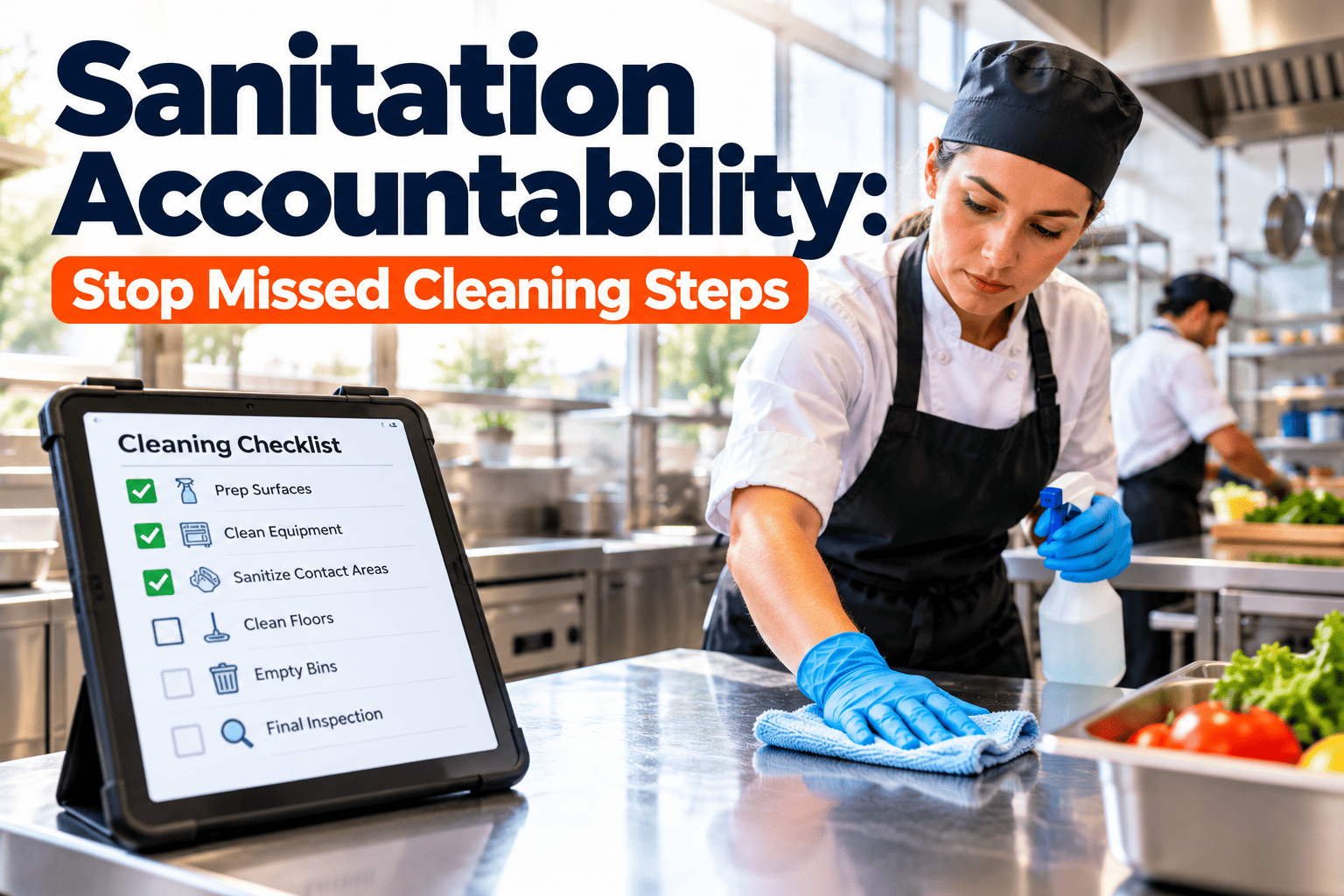
Most sanitation failures are not caused by a lack of chemicals or effort. They happen because one step in a long cleaning sequence was skipped, rushed or done out of order, and nobody could tell until a swab failed or an auditor asked. When cleaning is recorded on a paper sheet with a tick and initials, accountability is thin: a tick proves that someone marked the box, not that the step was done well. This guide shows how digital task lists, photo evidence and supervisor sign-off can close that gap, supported by maintenance management software.
Sanitation accountability: stop missed cleaning steps
Use step-by-step digital task lists, photo proof and supervisor sign-off to make every cleaning step visible, so skipped steps and repeat sanitation failures stop recurring.
Seven ways a cleaning step quietly disappears
Missed steps usually follow a pattern. Naming the pattern is the first step to designing controls against it.
Time pressure
The changeover window is short, so the crew shortens the sequence and skips the slowest steps.
Unclear instructions
The procedure is long, outdated or written for another machine, so people rely on habit.
Tick-and-flick sign-off
Boxes are ticked at the end of the shift for all tasks at once, whether or not each one was done.
Hard-to-reach areas
Dead legs, underside of conveyors, seals and guards are awkward, so they are cleaned less often.
Handover gaps
One crew starts the clean, another finishes it, and nobody owns the whole sequence.
Missing tools or chemicals
A brush, a nozzle or a chemical is not available, so the step is replaced with something less effective.
No consequence or feedback
Missed steps are never noticed or discussed, so the shortcut becomes the normal way of working.
From a tick on paper to evidence of the task
Accountability means each step has an owner, a time, a result and a reviewer. Compare the two approaches side by side.
- One tick for a block of cleaning tasks
- Completed at the end of the shift, often from memory
- No evidence of the condition of the equipment
- Supervisor review is occasional and after the fact
- Repeat failures are found by searching old sheets
- Each step is its own task with a named owner
- Time and user are recorded when the step is completed
- Photo or note is attached for the critical steps
- Supervisor sign-off is required before the line is released
- Skipped, late and failed steps are visible in reports
What a good sanitation task list contains
The task list is the backbone of accountability. If it is vague or too long, people will find ways around it.
| Element | Why it matters | Good practice |
|---|---|---|
| One action per step | Combined steps hide which part was missed | Write short, specific steps, such as remove guard, brush hopper, rinse, inspect |
| Correct order | Out-of-order cleaning can spread soil or waste chemical | Lock the sequence so later steps open only after earlier ones are done |
| Chemical, concentration and contact time | Wrong chemical or time defeats the clean | Show the details on the step, and record checks of strength where required |
| Tools and parts | Wrong or missing tools lead to substitutions | List required tools and color-coded items for each area |
| Critical steps flagged | Not every step carries equal risk | Mark steps that need photo proof or second-person verification |
| Owner and time | Shared ownership means no ownership | Assign each task to a named role or person, with a due time |
Use photos where they add real assurance
A photo turns an opinion into evidence. Because photos take time, reserve them for steps where the risk and the chance of error are highest.
- Underside of conveyors and hard-to-reach frames
- Disassembled parts laid out for cleaning
- Allergen changeover clean-down points
- Drains, sumps and floor junctions
- Slicer, filler and nozzle internals
- Take the photo after cleaning, in the same position each time
- Include the equipment name or tag in the frame where possible
- Rely on system time and user, not on manual notes
- Keep a reference photo of what clean looks like
- Review photos during sign-off, not only store them
Follow your plant's rules for cameras and devices in production areas, and agree with employees how photos are used.
Make every sanitation step visible and owned
Build step-by-step cleaning task lists with photo proof and supervisor sign-off in Oxmaint, and see skipped steps while there is still time to fix them.
Try a task list for one line first
Match the level of sign-off to the risk of the area
Not every task needs the same scrutiny. A tiered approach protects critical areas without overloading supervisors.
Decide in advance what happens when a step is late or skipped
Accountability is only real when the response is clear. Write down who is told, how quickly and what authority they have.
| Situation | Immediate response | Escalate to |
|---|---|---|
| Step not started by the due time | Reminder to the owner and the supervisor | Production lead if the start-up time is at risk |
| Step skipped without a reason | Return the task for completion and record the reason | Quality, to decide whether the area can be released |
| Critical step lacks proof | Re-do or re-verify before release | Quality manager if repeated |
| Verification fails after cleaning | Re-clean, retest and record each result | Maintenance, if equipment condition may be the cause |
| Same failure repeats in a month | Open a corrective action | Plant management through the regular review |
Break the cycle of repeat sanitation failures
If the same area fails again and again, retraining alone is rarely the answer. Follow the loop below to find the real driver.
Spot the repeat
Report failures by area, equipment and shift, and flag anything that appears more than once.
Find the cause
Review the task, the tools, the time available, the instruction and the condition of the equipment.
Fix the system
Change the step, repair the surface, add time or update the instruction, not only the person.
Check the fix
Review the next several cleans for that area and confirm the failures have stopped.
Some missed steps are really maintenance problems
People skip steps that are impossible, unsafe or ineffective. Equipment condition is a frequent cause.
- Guards and covers that are hard to remove because of stripped fasteners or damaged hinges.
- Scratched, pitted or cracked surfaces that hold soil and cannot be cleaned to standard.
- Worn gaskets and seals that trap product and moisture.
- Poor drainage or sloped surfaces that leave standing water.
- Hoses, nozzles and spray balls that are blocked or damaged and no longer reach the surface.
- Lack of access points for inspection or cleaning, which needs a design fix or a modification.
When the cleaning team reports one of these issues, it should become a tracked repair with an owner and a date, so the cleaning step is possible again.
Accountability without blame
If people fear punishment for reporting a missed step, they will hide it. A fair culture asks what in the system allowed the miss.
- Only investigating when a swab fails
- Blaming the last person who cleaned
- Rewarding speed over thoroughness
- Never giving feedback on completed lists
- Reviewing results with the crew each week
- Recognizing good catches and honest reports
- Giving enough time for the whole sequence
- Fixing tools, access and instructions quickly
Close the gap when one crew hands a clean to another
Partly finished cleans are a common place for steps to vanish. Make the handover explicit and visible.
Show the status
The outgoing crew leaves the task list open, with finished and unfinished steps clearly marked.
Note the exceptions
Missing tools, damaged parts, blocked drains and anything unusual are written against the task.
Confirm the owner
The incoming supervisor accepts the remaining steps and names who will complete them.
Finish and verify
The final sign-off covers the whole sequence, not only the last part.
Train for understanding, not only for compliance
People follow steps more reliably when they know what each one prevents. Combine short practical training with the task list itself.
- Explain the hazard behind key steps, such as why dismantling matters for allergen control or why contact time matters for sanitizer.
- Train on the same device and task list that people will use at the line, not on a classroom example.
- Pair new cleaners with an experienced person for several cleans, and check their first completed lists.
- Refresh training when an instruction, chemical, tool or piece of equipment changes.
- Keep training records, and link them to the roles who can complete or sign off each task.
A short weekly meeting that keeps accountability alive
Data only changes behavior when people discuss it. A fifteen-minute review with sanitation, quality, production and maintenance is enough for most plants.
| Agenda item | Question to ask | Output |
|---|---|---|
| Late and skipped steps | Which steps, where and why? | Cause noted, owner assigned |
| Failed verifications | Which areas failed and did retests pass? | Corrective actions opened or updated |
| Repeat problem areas | What keeps coming back, and what has not been fixed? | System fix agreed, such as a repair or instruction change |
| Cleanability repairs | Which maintenance jobs are blocking proper cleaning? | Priorities and dates set with maintenance |
| Good catches | What did the crew find that prevented a problem? | Recognition and shared learning |
Pitfalls when introducing digital sanitation records
- Copying a long paper form onto a screen without simplifying the steps.
- Requiring photos for everything, so people take quick, useless pictures.
- Letting one login be shared across a crew, which removes individual attribution.
- Skipping supervisor review because the task list looks complete.
- Launching on every line at once instead of proving the routine on one.
Who is accountable for what
Accountability fails when everyone assumes someone else owns the outcome. Write the roles down and show them on the task list.
Measure accountability, not just completion
How Oxmaint supports sanitation accountability
Oxmaint is maintenance management software. Its scheduling, checklist and work order features suit the recurring, evidence-based tasks around sanitation.
- Recurring cleaning and inspection tasks with owners, due times and instructions attached to the equipment.
- Mobile checklists with notes and photo attachments, completed at the line.
- Supervisor review through completed task records, so sign-off is tied to real results.
- Corrective work orders for damaged surfaces, seals, guards and drains that make cleaning difficult.
- Asset history that shows equipment linked to repeated sanitation issues.
- Reports on late, skipped and returned tasks by area, line and shift.
Sanitation accountability: common questions
Do we need photos for every step?
No. Use photo proof for critical and error-prone steps, and rely on timestamped completion with sign-off for routine tasks.
How do we stop tick-and-flick sign-off?
Break the clean into individual tasks completed in order, with system time and user recorded. Late bulk completion then becomes visible to supervisors.
Who should sign off a sanitation task?
Someone independent of the cleaner for critical areas, such as a supervisor or quality technician. Review levels should reflect the risk of each area.
Can this work on a small team?
Yes. Start with one line and a short task list. You can sign up and build it in an afternoon.
How do we see it working in practice?
A short walkthrough shows task lists, sign-off and reports with your own steps. Schedule a demo to see it.
Give every cleaning step an owner and a record
Move from ticks on paper to task lists, photo proof and sign-off, and stop missed cleaning steps from turning into repeat sanitation failures.
Bring your current cleaning checklist to the demo