Spare Parts Inventory Management for FMCG | CMMS Guide
By Jack Edwards on April 24, 2026
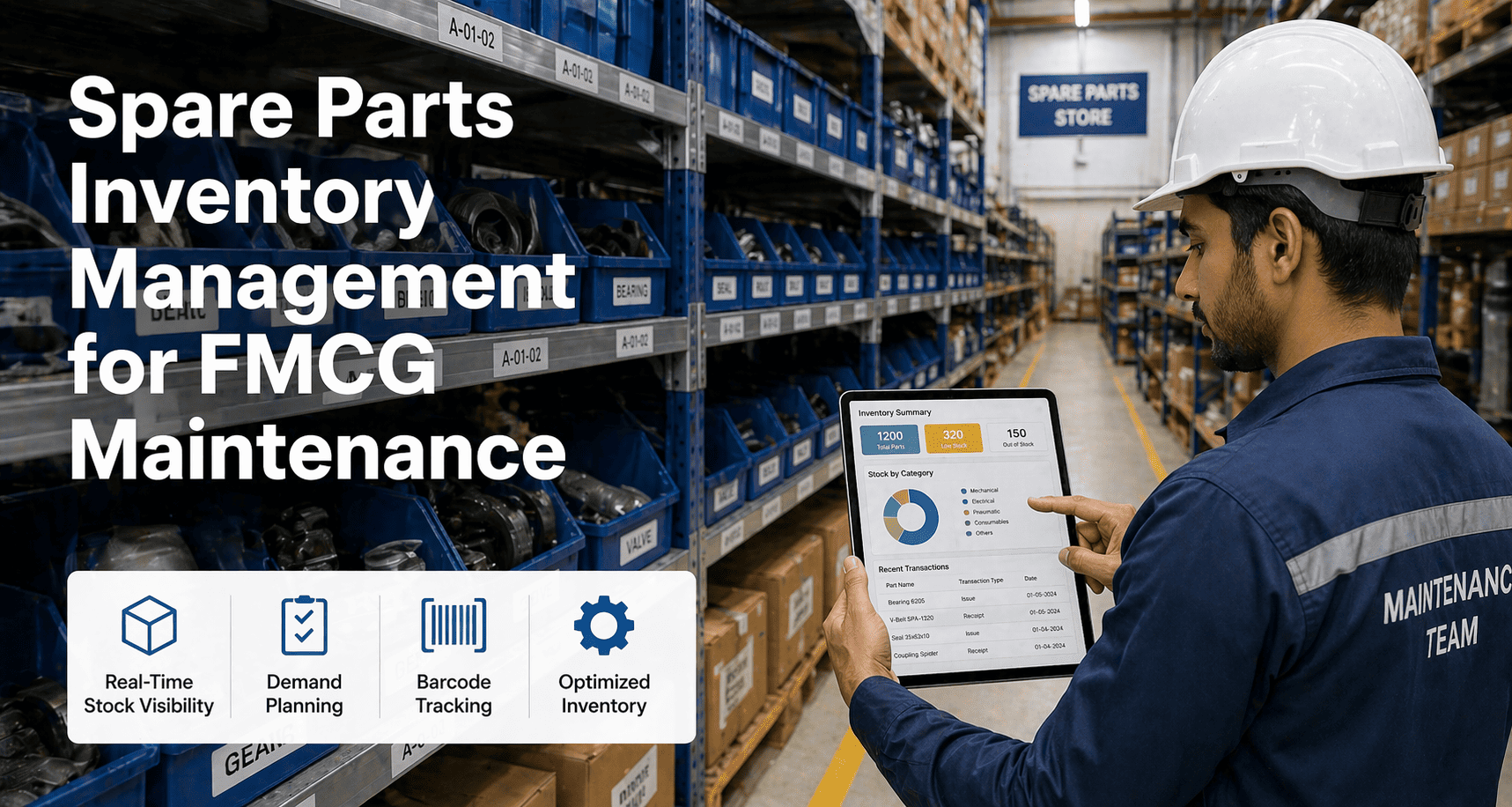
In most FMCG plants, spare parts management is an afterthought — bins of unlabelled components, spreadsheets that nobody trusts, and technicians making emergency procurement calls at 2 a.m. because a critical seal is out of stock. The cost of this approach is not the parts themselves. The cost is the production line that sits idle for four hours while someone drives to an industrial supplier. FMCG plants operating with mature spare parts management — demand forecasting, ABC classification, and automated reordering — reduce parts-related downtime by up to 40% and cut MRO inventory carrying costs by 20–35%. If your storeroom is still run on gut feel and tribal knowledge, start a free trial with Oxmaint and take control of your FMCG spare parts inventory today — or book a demo to see how leading food manufacturers are managing MRO with precision.
Spare Parts & MRO — FMCG Maintenance
Smart Spare Parts Management for FMCG Production Plants
Stop stockouts and stop overstocking. Oxmaint gives FMCG maintenance teams a live parts inventory linked directly to work orders, PM schedules, and automated reorder triggers — so the right part is always in stock when you need it.
Oxmaint auto-classifies every SKU based on usage frequency and criticality
$85K–$420K
Average excess MRO inventory per FMCG plant — capital locked in slow-moving and obsolete parts
40%
Reduction in parts-related downtime achieved by plants with structured spare parts management
23%
Of spare parts stock in average FMCG plant is slow-moving or obsolete, tying up working capital
4.8x
Emergency procurement premium over planned purchasing — the real cost of poor spare parts visibility
Why FMCG Spare Parts Management Fails Without a CMMS
FMCG production relies on hundreds of distinct equipment types — filling machines, labellers, conveyors, compressors, blending systems, CIP pumps, packaging lines. Each has a unique bill of materials and a unique criticality profile. Managing this across multiple lines and multiple shifts from spreadsheets and memory means critical parts run out during breakdowns, obsolete stock silently occupies shelf space for years, and nobody knows which vendor has the best lead time for a bearings order. Without a CMMS linking your parts store to your asset records, you are managing risk blindly. Oxmaint connects every spare part to the equipment it belongs to — so when a work order raises a requirement, the system checks stock, reserves the part, and triggers a reorder if minimum stock is breached. Start your free trial to import your existing parts list into Oxmaint today.
8 Core Spare Parts Management Capabilities in Oxmaint
Real-Time Stock Levels
Live inventory counts updated every time a part is issued, returned, or received. No manual stock counts between audits.
Automated Reorder Triggers
Set minimum stock levels per SKU. Oxmaint auto-generates purchase requests when stock falls below threshold — no manual monitoring needed.
Asset-to-Parts Linkage
Every spare part is linked to the equipment it serves. Technicians see the exact BOM when viewing an asset — no searching by part number.
Usage & Demand Forecasting
Oxmaint tracks parts consumption per asset and per PM type, building demand patterns that reduce over-ordering and prevent stockouts on high-consumption items.
Multi-Vendor Management
Store preferred vendors, lead times, and pricing per SKU. Compare vendor performance and cost per order over time — visibility that reduces emergency procurement reliance.
Work Order Parts Reservation
When a technician creates a work order, they reserve the parts needed. Stock is held against that job — preventing two teams competing for the same last bearing on a Friday night.
Inventory Audit Trail
Every stock movement — issue, return, write-off, receipt — is logged with timestamp and user ID. Complete audit trail for internal review and external compliance.
Slow-Moving & Obsolete Detection
Oxmaint flags parts that have not moved in 12+ months and matches them against current equipment lists — helping you recover working capital from dead stock annually.
The Four Biggest Spare Parts Problems in FMCG Plants
Stockouts During Critical Breakdowns
A filling line is down and the seal kit is out of stock. Emergency procurement takes 6–8 hours. Production loss: $80K–$250K per line per shift depending on product value.
Excess Stock Hiding in Plain Sight
Overordering to avoid stockouts creates $85K–$420K of idle inventory in a typical mid-size FMCG plant. 23% of parts haven't moved in over a year. That is working capital earning nothing.
No Linkage Between Parts and Equipment
Technicians know from experience what parts a machine takes. When they leave, that knowledge leaves too. There is no documented bill of materials, no systematic reorder point, no institutional memory.
Spreadsheets That Are Always Out of Date
The spreadsheet says 4 in stock. The shelf shows 0. Someone took them last Tuesday and didn't update the sheet. Every FMCG maintenance team has this problem. A CMMS eliminates it.
Reactive Parts Buying vs Oxmaint-Managed Inventory
Criteria
Reactive / Spreadsheet Model
Oxmaint Managed Inventory
Stock visibility
Manual counts, always lagged
Real-time, updated per transaction
Reorder trigger
When someone notices it is empty
Auto-triggered at minimum stock level
Parts-to-asset linkage
Tribal knowledge only
Full BOM per equipment asset tag
Emergency procurement rate
15–30% of all orders
Reduced to under 5% with forecasting
Obsolete stock detection
Annual physical count — if at all
Automatic flagging after 12 months no movement
Vendor comparison
Same vendor used every time by habit
Lead time and cost tracked per vendor per SKU
Parts reservation for WOs
Not possible — first-come, first-served
Parts reserved against open work orders
Turn Your Storeroom From a Cost Centre Into a Reliability Asset
Oxmaint links your parts inventory directly to your equipment, your work orders, and your PM schedule. The right part is in stock when you need it — and nothing sits on the shelf for years unchecked.
The Financial Impact of Fixing Spare Parts Management
35%
Reduction in MRO inventory value when ABC classification and reorder rules are applied
40%
Less parts-related production downtime when min/max levels are enforced automatically
60%
Fewer emergency purchase orders in plants that switch from reactive to demand-driven MRO management
$120K
Average working capital recovered per plant in Year 1 by identifying and liquidating obsolete spare stock
Frequently Asked Questions
How does Oxmaint link spare parts to specific equipment in a food plant?
Each asset in Oxmaint has an associated bill of materials — a list of spare parts that can be linked to that piece of equipment. When a technician opens a work order for a specific machine, the system shows all parts associated with that asset and their current stock levels. Parts can be reserved directly from the work order, which updates the live inventory count immediately. Plants can build their equipment BOMs by importing from existing spreadsheets or entering manually, and Oxmaint supports multi-level BOMs for complex assemblies. Start your free trial to build your first equipment BOM in Oxmaint.
Can Oxmaint generate automatic purchase orders when spare parts run low?
Oxmaint generates automated purchase requests when stock levels fall below the minimum threshold set for each SKU. The purchase request includes the part number, current stock, reorder quantity, preferred vendor, and estimated cost. This request is routed for approval through the configured workflow — maintenance manager or procurement team — and once approved, becomes a tracked purchase order in the system. The entire cycle from stockout alert to goods received is managed within Oxmaint, eliminating the gap between the maintenance storeroom and procurement. Book a demo to see the automated reorder workflow in action.
How does Oxmaint help identify obsolete spare parts in FMCG plants?
Oxmaint tracks every stock movement — issue, return, receipt, write-off. Parts that have shown zero movement for a configurable period (typically 12 months) are automatically flagged in the slow-moving and obsolete report. The system also cross-references the part against current active equipment — if the equipment the part was purchased for has been decommissioned, the part is flagged immediately. Maintenance managers can then take action: return to vendor, liquidate, or reclassify. Most FMCG plants run this report quarterly and recover $80K–$200K of dead stock in the first year.
Does Oxmaint work with multiple supplier accounts and vendor catalogues?
Yes — Oxmaint supports multiple vendor profiles per SKU. Each part can have one or more approved vendors with associated lead times, unit costs, and minimum order quantities stored in the system. When a purchase request is generated, the buyer sees all approved vendors and their pricing, making like-for-like comparison straightforward. Vendor performance — on-time delivery, cost accuracy — is tracked over time, building a data-driven basis for annual vendor reviews. This is particularly valuable in FMCG where parts for packaging machines often come from specialised OEM suppliers with long lead times that need to be planned against. Try Oxmaint free and set up your first vendor catalogue today.
Spare Parts Management — FMCG
The Right Part. In Stock. Every Time. That Is What Oxmaint Delivers.
Connect your spare parts store to your equipment, your work orders, and your PM schedule. Eliminate stockout-caused downtime and recover working capital from excess inventory — all from one CMMS built for FMCG production environments.