A 2-degree temperature deviation in a cold fill zone can render an entire production batch unsafe for consumption — and most food plants do not detect the deviation until product sampling reveals the damage hours later. HVAC and environmental control failures are responsible for 23% of all food safety incidents in temperature-sensitive production environments, and the average cost of a temperature-related product hold exceeds $125,000 before accounting for disposal, retesting, and customer notification. The solution is not more thermometers. It is maintenance-driven environmental monitoring integrated into your CMMS — so the moment an HVAC system degrades, your maintenance team is responding to a work order, not discovering the problem during a post-production quality review. Start a free trial with Oxmaint and connect HVAC maintenance schedules to environmental performance data — or book a demo to see how condition-based HVAC maintenance prevents temperature excursion events.
HVAC Maintenance · Temperature Mapping · Humidity Control · Contamination Prevention · GMP Zones
The Air Inside Your Plant
Is a Production Input.
Maintain It Like One.
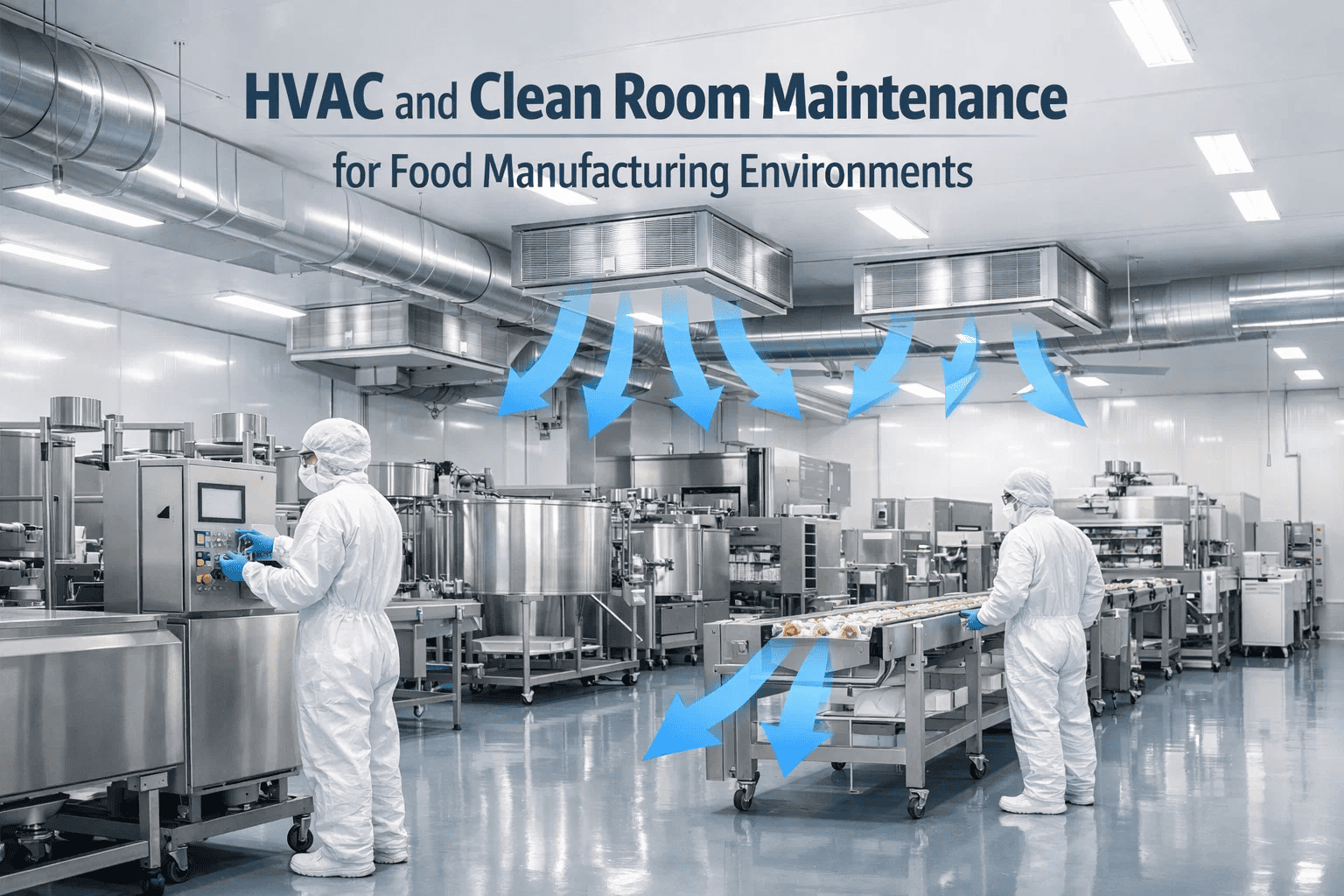
HVAC systems in food production facilities are not comfort systems — they are food safety infrastructure. Temperature, humidity, particulate filtration, and positive pressure differentials directly control product safety, shelf life, and regulatory compliance. When the HVAC system in a production zone degrades, the consequence is not discomfort — it is contamination risk, batch rejection, and audit non-conformance. This guide covers the maintenance strategies, monitoring approaches, and CMMS integration patterns that keep food production environments within specification.
Oxmaint tracks HVAC assets alongside production equipment — with PM schedules tied to environmental performance data, condition-based triggers, and audit-ready inspection documentation for every air handling unit, chiller, and filtration system.
23%
Of Food Safety Incidents
Linked to HVAC and environmental control failures in temperature-sensitive food production environments
$125K
Average Product Hold Cost
Per temperature excursion event — including product disposal, retesting costs, and downstream supply chain disruption
35%
Energy Savings Potential
Well-maintained HVAC systems in food plants consume 25-35% less energy than degraded systems operating outside optimal parameters
40%
Of HVAC Failures Preventable
At least 40% of food plant HVAC failures are caused by missed preventive maintenance — filter changes, coil cleaning, refrigerant checks
Environmental Parameters
The Four Critical Environmental Controls in Food Production Zones
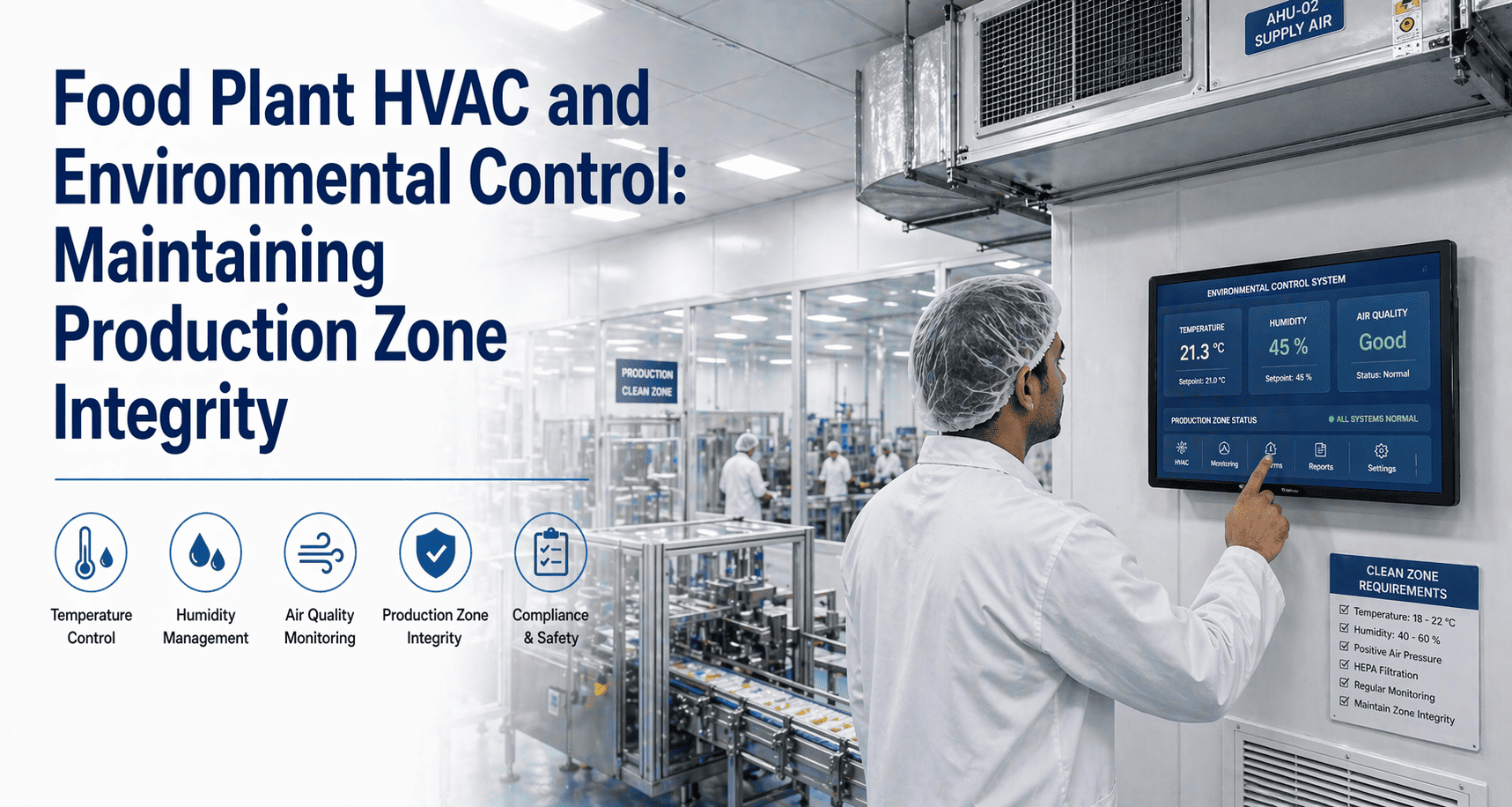
Food production environments must maintain precise control over four environmental parameters simultaneously. When any single parameter drifts outside specification, product safety, quality, and shelf life are all compromised. Each parameter is controlled by specific HVAC equipment that requires its own maintenance program — and all four must be tracked together because they interact continuously. A humidity spike caused by a failed dehumidifier coil simultaneously affects temperature control, air quality, and microbial growth risk. Understanding these interactions is what separates a food plant HVAC program from a commercial building HVAC program. Want to see how Oxmaint tracks all four parameters against HVAC asset performance? Start a free trial and build your environmental control maintenance program.
Temperature Control
Cold Fill Zones2-8 C / 36-46 F
Ambient Processing18-22 C / 64-72 F
Tolerance+/- 1-2 degrees
Temperature is the primary food safety parameter. A 3-degree excursion in a ready-to-eat processing zone can shift microbial growth rates by orders of magnitude. HVAC maintenance directly controls temperature stability.
Humidity Management
RTE Processing40-55% RH
Dry GoodsBelow 45% RH
Cold Storage85-95% RH
Humidity above specification promotes mold growth, condensation drip, and Listeria harborage. Humidity below specification accelerates product dehydration and weight loss. Dehumidifier coil maintenance is the most common failure point.
Air Quality and Filtration
ProductionMERV 13-16 filtration
High-CareHEPA filtration
Change FreqPer differential pressure
Air filtration prevents airborne particulates, microorganisms, and allergens from entering production zones. Filter degradation increases contamination risk and energy consumption simultaneously. Differential pressure monitoring triggers filter replacement.
Pressure Differentials
High-Care to Low-Care+10-15 Pa positive
Production to Warehouse+5-10 Pa positive
MonitoringContinuous with alarms
Positive pressure in clean zones prevents unfiltered air from entering from lower-classification areas. Door operation, exhaust fan failures, and AHU damper issues all compromise pressure cascades — and auditors check differential pressure logs.
HVAC Asset Inventory
Critical HVAC Equipment That Requires Structured PM Programs
Food plant HVAC is not a single system — it is a network of interconnected equipment that must be maintained both individually and as a system. Each component has its own failure modes, inspection frequencies, and compliance documentation requirements. A CMMS that manages these assets with the same rigor as production equipment is not optional in a food manufacturing environment. Book a demo to see a fully configured HVAC asset registry in Oxmaint.
Cooling
Air Handling Units
Fan motors, cooling coils, heating coils, dampers, and control actuators. PM includes belt tension, bearing lubrication, coil cleaning, drain pan inspection, and VFD performance verification. Quarterly deep clean mandatory in food environments.
Refrigeration
Chiller and Compressor Systems
Compressor motor health, refrigerant charge, condenser performance, evaporator condition, and oil analysis. Refrigerant leak detection is both an environmental compliance and food safety requirement. Annual comprehensive inspection minimum.
Humidity
Dehumidification Systems
Desiccant wheel condition, regeneration heater performance, and condensate drainage. Failed dehumidifiers create condensation on cold surfaces — the primary Listeria harborage risk in ready-to-eat food facilities.
Filtration
HEPA and MERV Filter Banks
Differential pressure monitoring, integrity testing, and scheduled replacement. HEPA filters in high-care zones require annual integrity testing. MERV filters replaced based on pressure drop data, not arbitrary calendar intervals.
Ventilation
Exhaust and Make-Up Air Systems
Exhaust hood performance, make-up air balance, damper calibration, and ductwork integrity. Imbalanced exhaust creates negative pressure events that pull unfiltered air into production zones through doors and openings.
Controls
BMS/BAS and Sensors
Temperature sensors, humidity sensors, pressure transducers, and BMS controller calibration. Sensor drift is invisible without calibration — your zone reads 4 C when actual temperature is 7 C. Semi-annual calibration is minimum standard.
Failure Consequences
What Goes Wrong When Food Plant HVAC Maintenance Fails
HVAC failures in food plants are not comfort inconveniences — they are food safety events with quantifiable financial consequences. Each failure mode below has been documented in actual food plant incidents and audit findings. The common thread: every one of them was preventable with structured PM execution and CMMS-driven condition monitoring. Start a free trial and set up condition-based HVAC maintenance triggers before the next failure costs you a production batch.
Temperature Excursion Events
A failed compressor or degraded cooling coil allows zone temperature to rise above critical limits. In cold fill operations, a 3-degree excursion turns a safe product into a microbial growth medium. Average cost per event: $125K including product disposal, retesting, and line sanitization.
Condensation and Listeria Risk
Dehumidifier failure allows humidity to rise above 55% RH in cold environments — creating condensation on walls, ceilings, and equipment surfaces. Condensation is the primary environmental vector for Listeria monocytogenes in ready-to-eat facilities. A single positive Listeria finding can shut down a production zone for days.
Filter Bypass Contamination
Overloaded filters that are not replaced based on differential pressure data can develop seal failures, bypass leaks, or structural collapse — allowing unfiltered air containing particulates, allergens, and microorganisms directly into production zones. 14% of airborne contamination events trace to filter maintenance failures.
Pressure Cascade Failures
Loss of positive pressure in high-care zones allows contaminated air from adjacent lower-classification areas to flow into clean production spaces. Common causes: exhaust fan failures, AHU damper malfunction, and unsealed penetrations. Auditors check pressure differential logs — gaps are findings.
Maintenance Approach
Calendar-Based vs. Condition-Based HVAC Maintenance
| HVAC Maintenance Area |
Calendar-Based Approach |
Oxmaint Condition-Based Approach |
| Filter Replacement |
Every 90 days regardless of actual condition — wastes usable filters or misses clogged ones |
Based on differential pressure data — replaced when needed, not when scheduled |
| Coil Cleaning |
Quarterly — some coils clean, others severely fouled between cycles |
Triggered by approach temperature deviation — cleaned when performance degrades |
| Refrigerant Monitoring |
Annual check — slow leaks undetected for months, capacity gradually lost |
Continuous subcooling and superheat monitoring — leak indicators flagged in real time |
| Sensor Calibration |
Annual calibration — 6 months of drifted readings drive wrong control responses |
Cross-reference validation against portable instruments during inspections |
| Failure Detection |
Discovered when zone temperature alarm fires — product already at risk |
Detected from performance trend degradation — repaired before zone impact |
| Energy Efficiency |
No visibility into energy vs. performance relationship — waste unknown |
Energy consumption tracked against output — degradation triggers investigation |
Oxmaint Solution
How Oxmaint Manages Food Plant HVAC as Critical Production Infrastructure
Oxmaint treats HVAC equipment with the same operational rigor as production line equipment — because in food manufacturing, they are equally critical to product safety and compliance. Every air handling unit, chiller, dehumidifier, and filter bank carries its own asset record, PM schedule, condition score, and compliance documentation trail. Start a free trial and register your HVAC fleet as critical food safety assets.
Asset Registry
Complete HVAC Asset Inventory
Every AHU, chiller, compressor, filter bank, and sensor registered with installation data, manufacturer specifications, zone assignment, and a full maintenance history trail. The asset hierarchy links HVAC equipment to the production zones they serve.
Condition Triggers
Performance-Based PM Scheduling
PM triggers based on actual condition data: filter differential pressure, approach temperature deviation, energy consumption anomalies, and sensor calibration drift. Repairs happen when the data says they are needed — not on an arbitrary calendar.
Zone Mapping
Environmental Zone-to-Asset Linkage
Each production zone is linked to the HVAC equipment that controls its environment. When a zone temperature alarm fires, Oxmaint immediately identifies which AHU, chiller, or damper serves that zone — eliminating diagnostic delay in critical situations.
Digital Inspections
HVAC Inspection Checklists
Structured digital checklists for each HVAC equipment type — with mandatory fields for temperature readings, pressure measurements, and condition assessments. Technician photos and digital signatures create defensible compliance documentation.
Energy Tracking
HVAC Energy Performance Monitoring
Track energy consumption against cooling or heating output. When an AHU's energy consumption rises 15% without a corresponding increase in load, the system flags it for investigation — catching coil fouling, refrigerant loss, and motor degradation early.
Compliance Reports
Audit-Ready Environmental Documentation
Generate GMP-compliant reports showing HVAC inspection history, filter change records, calibration certificates, and temperature mapping results. When the auditor asks for environmental control documentation, the answer takes seconds, not hours.
Financial Impact
ROI of Structured HVAC Maintenance in Food Production
35%
Energy Cost Reduction
Properly maintained HVAC systems — clean coils, correct refrigerant charge, calibrated controls — consume 25-35% less energy than degraded systems running the same zones
$125K
Cost Per Prevented Excursion
Every temperature excursion event prevented through proactive HVAC maintenance avoids $125K+ in product holds, disposal, retesting, and supply chain disruption
40%
Fewer HVAC Failures
Condition-based HVAC maintenance reduces unplanned failures by 40% — keeping production zones within specification continuously instead of recovering from deviations
100%
Audit Documentation Compliance
Digital HVAC inspection records with mandatory data fields and timestamps eliminate the environmental monitoring documentation gaps that auditors flag as non-conformances
Expert FAQ
Food Plant HVAC and Environmental Control — Common Questions
How often should food plant HVAC systems be inspected?
Inspection frequency depends on the zone classification and the HVAC component. Air handling units serving high-care production zones should receive monthly comprehensive inspections covering coil condition, drain pan cleanliness, belt tension, and fan performance. Filters should be inspected weekly visually and replaced based on differential pressure readings — not arbitrary calendar intervals. Chiller and refrigeration systems require monthly performance checks (pressures, temperatures, energy draw) and annual comprehensive inspections. Sensor calibration should be verified semi-annually at minimum. Oxmaint manages all these overlapping frequencies through automated PM scheduling.
Start a free trial and configure your HVAC PM schedules today.
What is temperature mapping and how does it relate to HVAC maintenance?
Temperature mapping is the process of documenting temperature distribution across a production zone using multiple sensors placed at different locations and heights. It reveals hot spots, cold spots, and areas where HVAC performance is insufficient. Temperature mapping should be performed at initial HVAC installation, after any significant HVAC modification, and annually for GMP compliance. Results directly inform HVAC maintenance priorities — zones with poor temperature uniformity may need additional air distribution, coil upgrades, or damper adjustments.
Book a demo to see how Oxmaint documents temperature mapping results linked to HVAC asset records.
How does condensation control relate to Listeria prevention in food plants?
Condensation is the single most significant environmental vector for Listeria monocytogenes in food processing facilities. When warm, humid air contacts cold surfaces — walls, ceilings, equipment — condensation forms and creates the persistent moisture that Listeria requires to establish harborage sites. Dehumidifier maintenance is directly linked to Listeria prevention: a failed dehumidifier coil can raise zone humidity from 45% to 65% within hours, creating condensation across an entire production area. CMMS-tracked dehumidifier PM with humidity-triggered condition alerts is the maintenance-side defense against this contamination pathway.
Start free and set up humidity-based maintenance triggers.
Should HVAC maintenance be managed in the same CMMS as production equipment?
Absolutely — and it is a mistake to separate them. HVAC equipment directly impacts production capability: a chiller failure shuts down a cold fill line just as effectively as a filler breakdown. Managing HVAC in a separate system creates artificial silos — the maintenance manager sees production equipment health but not the environmental systems that production depends on. Oxmaint places HVAC assets in the same asset hierarchy, same PM scheduling engine, same work order system, and same KPI dashboard as production equipment. When the maintenance manager views plant health, they see everything.
Book a demo to see the unified asset management approach.
HVAC Maintenance · Environmental Control · Temperature Monitoring · Free to Start
Your Production Environment Is Only as Safe as Your HVAC Maintenance Program
Oxmaint tracks every HVAC asset serving your production zones — with condition-based PM triggers, energy performance monitoring, and audit-ready inspection documentation. The air your product breathes is maintained with the same operational rigor as the equipment that processes it. No more temperature surprises. No more condensation events. No more audit findings on environmental control documentation.