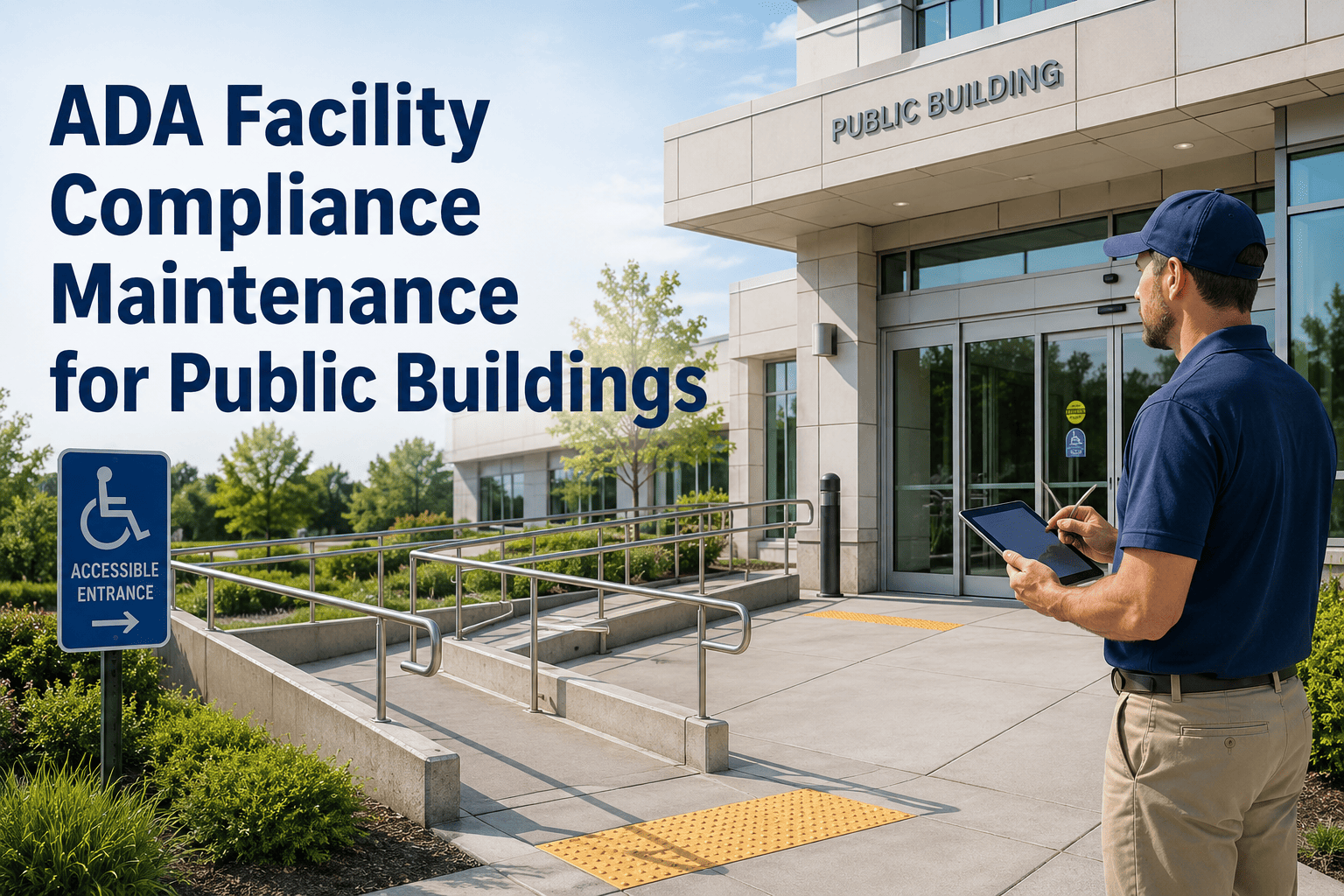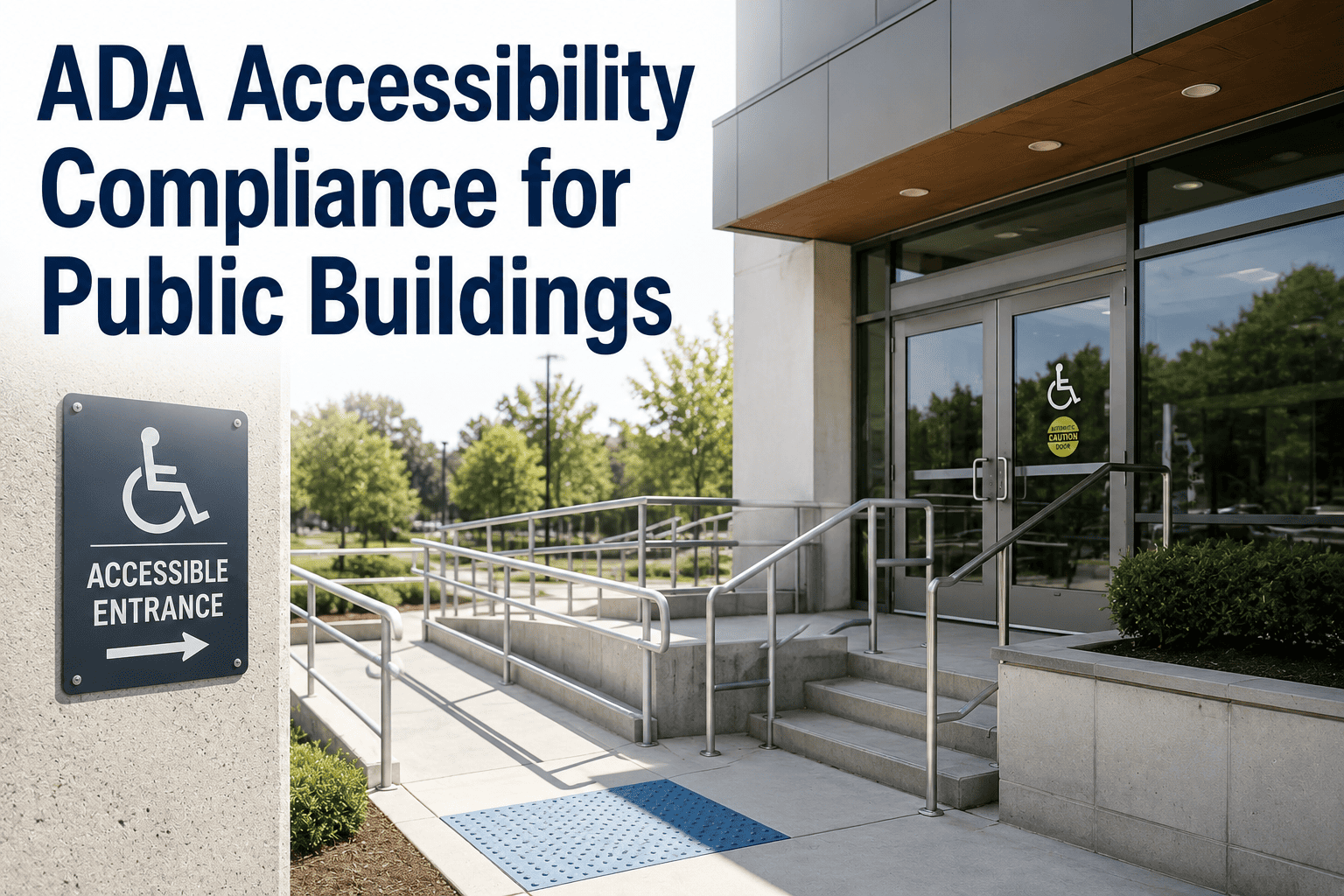
Title II of the Americans with Disabilities Act makes accessibility non-negotiable for every state and local government facility, yet a striking share of public buildings still fall short on measurable elements like door pressure, route slope, and tactile signage. Federal data shows thousands of ADA complaints are filed against public entities each year, with single-claim settlements routinely exceeding $20,000 in remediation costs before legal fees are even tallied. The path to defensible compliance runs through a documented self-evaluation, a written transition plan, and disciplined maintenance of the barriers identified. Start Free Trial to turn that obligation into an auditable, fundable program rather than a reactive scramble.
Is your public building portfolio ready for the next accessibility audit?
Title II obligates every state and local government facility to be programmatically and physically accessible. Most agencies discover gaps only after a complaint is filed — when remediation costs 3–5x more than proactive barrier removal and exposes the entity to federal investigation.
Public buildings face the highest accessibility exposure in the U.S.
Roughly 61 million adults in the United States live with a disability, and federal law grants each of them standing to file an ADA complaint against any public entity that denies program access. The numbers below quantify why agencies treat ADA not as a one-time project but as an ongoing operational discipline.
The 12 barriers cited most often in public facility audits
DOJ settlement agreements consistently surface the same dozen deficiencies. Most are inexpensive to fix individually — a door closure adjustment costs under $150 — but become litigation evidence when ignored across a portfolio.
Parking & Passenger Loading
- Missing or faded access aisle striping
- Van-accessible spaces below 1 per 6 required ratio
- Signage not mounted 60 in AFF minimum
Accessible Route
- Slope exceeds 1:20 on approach walks
- Curb ramps without detectable warnings
- Path width below 36 in continuous clearance
Entrance & Doors
- Door opening force above 5 lb interior
- Thresholds exceeding 0.5 in without bevel
- Hardware requiring tight grasping or twisting
Restrooms
- Grab bars missing or mounted outside range
- Clear floor space under 60 in diameter turning
- Lavatory rims above 34 in AFF
Signage & Wayfinding
- Restroom signs lacking Grade 2 Braille
- Permanent room signs not wall-mounted
- Contrast ratio below 70 percent
Assembly & Program Access
- Wheelchair seating below required dispersion
- Service counters above 36 in transaction height
- Assistive listening systems absent in 50+ seat rooms
The math behind deferred barrier removal
When an agency waits for a complaint before addressing a known barrier, the same fix carries settlement overhead, legal fees, and expedited-construction premiums. The formula below isolates the true delta between planned and reactive remediation.
| Scenario | Barrier Count | Planned Cost | Reactive Cost | Cost Delta |
|---|---|---|---|---|
| Single facility, parking + entry | 6 | $3,800 | $24,500 | $20,700 |
| Mid-size courthouse, restrooms | 14 | $9,200 | $58,000 | $48,800 |
| 10-site library system, signage + routes | 80 | $31,000 | $205,000 | $174,000 |
| County portfolio, full audit scope | 240 | $86,000 | $612,000 | $526,000 |
A 6-month path from self-evaluation to defensible program
The DOJ expects public entities to complete a self-evaluation, adopt a transition plan, and demonstrate measurable progress. Compressing this into a structured 6-month cycle keeps the work funded, documented, and audit-ready.
Self-Evaluation
Inventory every facility, program, and service. Document existing barriers against the 2010 ADA Standards and note which programs are delivered in inaccessible locations.
Barrier Prioritization
Rank barriers by program-access impact, remediation cost, and complaint risk. High-traffic entrances and restrooms typically outrank back-of-house items by a 4:1 exposure ratio.
Transition Plan Draft
Publish a written plan specifying each barrier, the corrective action, responsible party, and target completion date. Title II requires the plan be available for public inspection.
Funding & Procurement
Bundle remediation into capital cycles. Group similar scope (door hardware, signage, striping) to secure volume pricing and avoid per-mobilization overhead above 18 percent.
Remediation Execution
Complete barrier removal in priority order. Photograph before-and-after conditions and attach measurements to each work order for audit defensibility.
Verification & Re-Certification
Re-survey corrected elements, close out the transition plan, and schedule the next annual self-evaluation. Maintain barrier logs for a minimum 3-year retention window.
What a defensible ADA program actually contains
A passing audit is not a binder — it is a live system. These four pillars keep accessibility funded, documented, and defensible across every budget cycle.
Documented Self-Evaluation
A facility-by-facility record of every ADA element surveyed, the measurement taken, the standard cited, and the barrier status. Updated annually, not once per decade.
Live Transition Plan
A written, publicly available schedule naming each barrier, the corrective action, the responsible official, and the completion date — tracked to closure, not filed and forgotten.
Funded Maintenance Cycle
Annual line-item budget for accessibility remediation, sized from the open barrier log. Prevents barriers from re-emerging after weathering, renovation, or tenant churn.
Audit-Ready Evidence
Before-and-after photos, calibrated measurements, work orders, and inspector credentials attached to every closed barrier — producible within 48 hours of a DOJ inquiry.
Stop reacting to ADA complaints. Start managing accessibility.
Turn your self-evaluation into a live, funded, defensible program before the next complaint arrives.
ADA compliance for public buildings: the questions that matter
Does ADA Title II apply to buildings constructed before 1992?
Yes. Title II covers every program, service, and activity of a public entity regardless of facility age. Pre-1992 buildings must achieve program accessibility — meaning the service itself must be accessible, even if that requires structural barrier removal or relocation to an accessible site. A self-evaluation is the legally required first step for these facilities.
What is the difference between a self-evaluation and a transition plan?
A self-evaluation assesses current policies, programs, and physical barriers against ADA standards. A transition plan is the written, public document that specifies which structural barriers will be removed, by whom, and on what timeline. Public entities with 50 or more employees are required to maintain both. You can operationalize both inside a single system — Start Free Trial to see the workflow.
How often should a public building be re-surveyed for ADA compliance?
Industry best practice and most consent decrees call for annual re-survey of high-traffic elements (entries, restrooms, parking) and a full facility re-evaluation every three years. Renovations, tenant changes, and weathering can introduce new barriers at any time, so the program must be continuous rather than cyclical.
Who can perform an ADA self-evaluation for a public entity?
Internal staff may conduct the self-evaluation, but defensible surveys are typically performed or reviewed by a CASp (Certified Access Specialist) or an ADA consultant with documented training on the 2010 Standards. The inspector's credentials, calibration records for measuring tools, and methodology should be attached to every finding.
What happens if a public entity ignores an ADA complaint?
The DOJ can initiate a compliance review, negotiate a settlement agreement, or refer the matter for litigation. Outcomes routinely include mandatory barrier removal on an expedited timeline, monetary compensation to complainants, civil penalties, and multi-year monitoring. Proactive documentation of a transition plan is the strongest defense against escalated enforcement. To build that defense on a timeline, Book a Demo with our team.
Build a defensible ADA program in weeks, not years
Self-evaluation, transition planning, barrier tracking, and audit evidence — in one platform built for public facility portfolios.
Free 14-day trial · No credit card