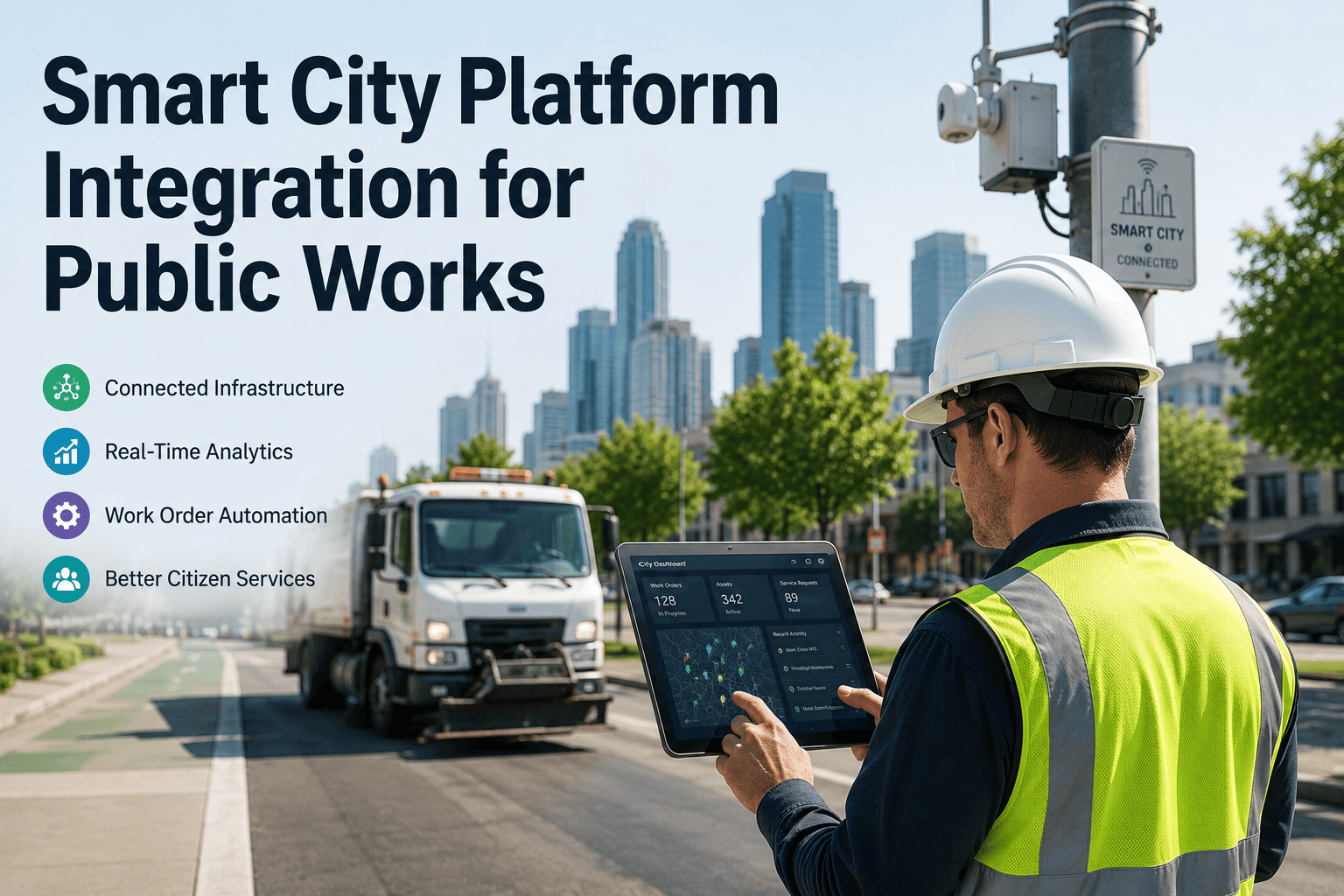
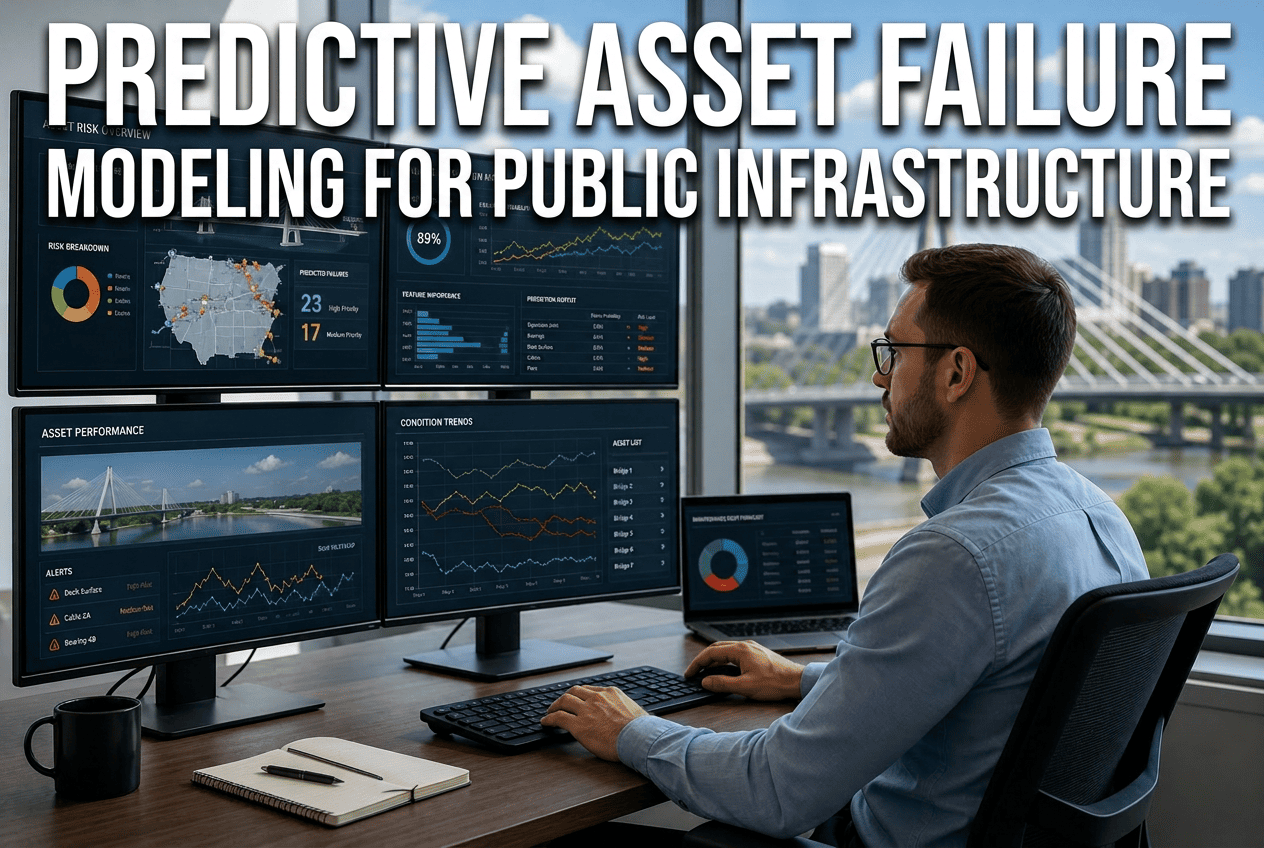
When a city engineer asks "What is the remaining useful life of the Main Street bridge?" and the answer depends on a paper inspection form from three years ago, the liability gap is glaring. Public works departments manage millions in infrastructure, yet many rely on fragmented data, subjective manual inspections, and reactive "break-fix" cycles. The resulting deferred maintenance backlog is not just a financial risk—it is a public safety hazard. The solution lies in AI-Driven Asset Management. By integrating automated data collection (drones, IoT, LiDAR) with predictive lifecycle modeling, municipalities can transition from subjective guesswork to objective, data-backed capital planning. Talk to our team about deploying AI to predict infrastructure failures before they happen.
Smart City Operations Guide
AI-Driven Asset Management for Public Works
Modernize asset management with AI-powered inspection data, lifecycle modeling, and predictive planning for roads, utilities, and facilities.
30%
Reduction in maintenance costs via predictive planning
10x
Faster inspection analysis using computer vision
$4:1
ROI on preventative vs. reactive repairs
24/7
Real-time asset condition monitoring capability
Why Legacy Asset Management Fails Municipalities
Municipalities relying on spreadsheets and manual clipboards to manage critical infrastructure are operating in a blind spot. Legacy methods are labor-intensive, subjective, and data-poor. A pothole survey conducted manually is often outdated by the time the data is digitized. Without real-time insights, departments allocate budgets based on complaints rather than condition, leading to inefficient spending and accelerated asset deterioration. AI transforms this model by treating infrastructure data as a live, strategic asset. Start Free Trial.
The Six Failure Modes of Analog Asset Management
Data Silos
74%
Information is trapped in disparate systems (GIS, Excel, paper), making holistic capital planning impossible.
Subjective Scoring
Varied
Manual inspections vary by inspector. One person's "Grade B" road is another's "Grade C," skewing budget models.
Reactive Firefighting
60%
Budget is consumed by emergency repairs, leaving zero funds for preventative interventions that extend asset life.
Planning Blindness
Risk
Capital Improvement Plans (CIP) are built on historical guesses rather than predictive deterioration modeling.
Labor Shortages
High
Not enough staff to physically inspect every asset annually, leading to compliance gaps and overlooked failures.
Regulatory Fines
$$$
Inability to prove compliance (SSO events, water quality) due to poor record-keeping and lack of monitoring.
The AI Data Lifecycle: From Sensor to Strategy
A successful AI-driven program follows a structured data lifecycle. It moves from automated capture to predictive action. By leveraging Computer Vision (CV) and Machine Learning (ML), public works departments can process thousands of data points—pavement cracks, sign reflectivity, pump vibrations—into actionable work orders without human manual entry.
The Intelligent Asset Model
Automated workflow for predictive maintenance
Drones, vehicle-mounted cameras, IoT sensors, and SCADA feeds collect raw condition data automatically.
Continuous
›
Computer vision identifies defects (cracks, corrosion) and assigns objective PCI/condition scores.
Real-Time
›
Machine learning algorithms model deterioration curves to predict when an asset will fail.
Modeling
›
AI recommends the optimal intervention strategy (seal vs. overlay) to maximize ROI.
Planning
›
Work orders are auto-generated and dispatched to crews via mobile apps with precise locations.
Action
›
Post-work sensors verify the repair quality and update the asset's lifecycle model.
Audit
›
Aggregated data informs long-term bonding, budget requests, and council reporting.
Strategic
Automate Your Inspections
Oxmaint integrates with modern sensor networks to ingest asset data, calculate risk scores, and trigger preventative work orders automatically—removing the guesswork from public works management.
AI Applications by Infrastructure Class
A "smart city" approach applies specific AI models to different asset classes. Pavement requires visual surface analysis, while water systems require hydraulic pressure monitoring. Effective platforms unify these distinct data streams into a single "Command Center" view, allowing directors to see the health of the entire city at a glance. Book a Demo.
Core Asset Intelligence Tracks
Focus: Pavement & Rights-of-Way
Auto-Crack Detection
Sign Reflectivity
Pothole Mapping
PCI Modeling
LiDAR Grading
Outcome: Objective PCI scoring across 100% of road network annually.
Focus: Utilities (Water/Sewer/Storm)
Acoustic Leak Detect
Flow Anomalies
Pump Vibration
Pipe Risk Scoring
Inflow/Infiltration
Outcome: Pre-emptive repair of mains before catastrophic breaks.
Focus: Heavy Equipment & Transit
Predictive Engine Maint
Fuel Optimization
Route AI
Parts Forecasting
EV Battery Health
Outcome: Zero unplanned downtime for critical emergency vehicles.
Focus: Vertical Infrastructure
HVAC Energy AI
Occupancy Sensors
Roof Thermal Scans
Smart Lighting
Cleaning Robotics
Outcome: 20-30% reduction in municipal energy consumption.
Before & After: The Impact of Predictive Modeling
Moving from a "Worst-First" repair strategy to an "Optimized Lifecycle" strategy yields massive financial returns. By catching defects early (preservation) rather than late (rehabilitation), municipalities stretch their tax dollars further. Documented AI analysis also provides the objective evidence needed to win competitive infrastructure grants.
Build a Future-Ready City
Oxmaint provides the digital backbone for your smart city strategy—ingesting sensor data, visualizing risk maps, and ensuring that every dollar spent delivers maximum value to the community.
AI Outputs & Deliverables
For an asset management system to be valuable, it must produce actionable intelligence, not just raw data. Modern AI platforms generate specific deliverables that engineering and finance teams use daily. These outputs validate budget requests and defend decisions to the City Council, ensuring that infrastructure investments are transparent and defensible. Start Free Trial.
Digital Intelligence Outputs
01
Risk Heatmaps
GIS-based failure probability
Criticality vs. Condition
Zone-based risk analysis
02
Deterioration Curves
Predictive lifespan modeling
"Do Nothing" cost scenarios
Intervention impact analysis
03
Automated Work Orders
Condition-triggered dispatch
GPS-tagged defect location
Material requirement lists
04
Budget Optimization
Multi-year CapEx scenarios
ROI calculation per project
Funding gap visualization
05
Compliance Reporting
GASB 34 reporting
EPA/State audit trails
Performance benchmarking
06
Project Prioritization
AI-ranked project lists
Equity/Justice40 analysis
Co-location opportunities
Expert Perspective: The Shift to Predictive
"
The biggest mistake municipalities make is treating asset management as a software purchase rather than a philosophy change. It's not just about digitizing paper forms; it's about changing how we make decisions. When we deployed AI for our road assessments, we found that our manual surveys were off by 40%. We were repaving roads that still had life and neglecting others that were about to fail. With AI, we stopped guessing. We now direct our budget to the exact treatment needed at the exact right time. We effectively 'found' $2 million in our budget just by eliminating waste.
— Public Works Director, Smart City Pilot Program
40%
Improvement in assessment accuracy
$2M
Budget efficiency realized in Year 1
100%
Defensible data for council meetings
Municipalities that succeed in maintaining high-quality services despite budget constraints share a common trait: they view data as their most valuable utility. By building an AI-driven asset management program supported by digital tools, you ensure continuity of operations, preserve infrastructure value, and create a safer community for everyone. Start building your smart city backbone with the tools necessary for predictive success.
Empower Your Infrastructure Decisions
Oxmaint's asset management platform tracks condition data, predicts failures, and automates maintenance workflows, helping you build a resilient, efficient, and data-driven public works department.
Frequently Asked Questions
Is AI asset management expensive to implement?
While there is an initial investment in software and data collection (e.g., a van scan or drone survey), the ROI is often realized within 12-18 months. The cost of a single catastrophic failure (like a main break washing out a road) often exceeds the cost of the entire software suite. Furthermore, AI helps municipalities avoid "over-maintaining" assets that don't need it, freeing up significant budget. Many deployments are also eligible for federal infrastructure grants.
Do we need data scientists on staff to use this?
No. Modern AI Asset Management platforms like Oxmaint are designed for operational users, not data scientists. The complex algorithms happen in the background. The user interface presents simple, actionable insights—such as a map showing red (at risk) vs. green (healthy) assets, or a prioritized list of work orders. If your team can use a smartphone and read a map, they can use these tools effectively.
How accurate is AI compared to manual inspection?
AI is significantly more consistent and objective. A manual inspector might grade a road differently on a Monday morning versus a Friday afternoon, or depending on the lighting. AI algorithms apply the exact same standard to every inch of infrastructure, detecting micro-cracks or slight vibrations that human senses miss. Studies show AI pavement assessment correlates 95%+ with detailed engineering cores, compared to ~60% for visual drive-bys.
Can this integrate with our existing GIS?
Yes. Integration with GIS (like ESRI ArcGIS) is a standard requirement. The AI platform pulls asset location and attribute data from your GIS, enriches it with condition data and predictions, and then pushes updated risk scores back to your GIS map. This ensures that your GIS remains the "system of record" while the Asset Management system acts as the "system of intelligence."
How long does it take to get predictive results?
You get "condition" results immediately upon data ingestion (e.g., identifying all potholes today). "Predictive" results improve over time. A baseline model can be generated immediately using industry-standard deterioration curves. However, the model becomes hyper-accurate for your specific city after 1-2 years of historical data, as the AI learns how your specific weather, soil, and traffic usage impact your specific assets.