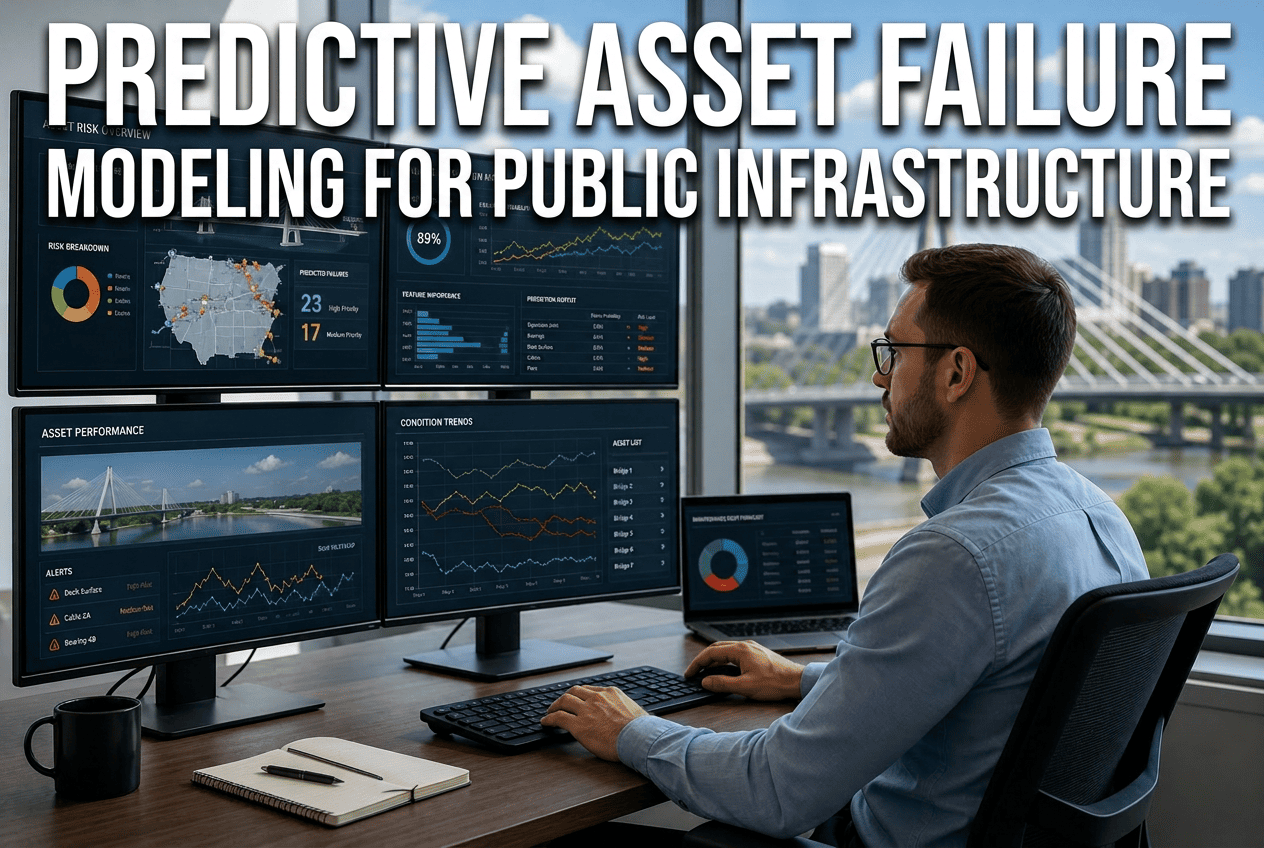
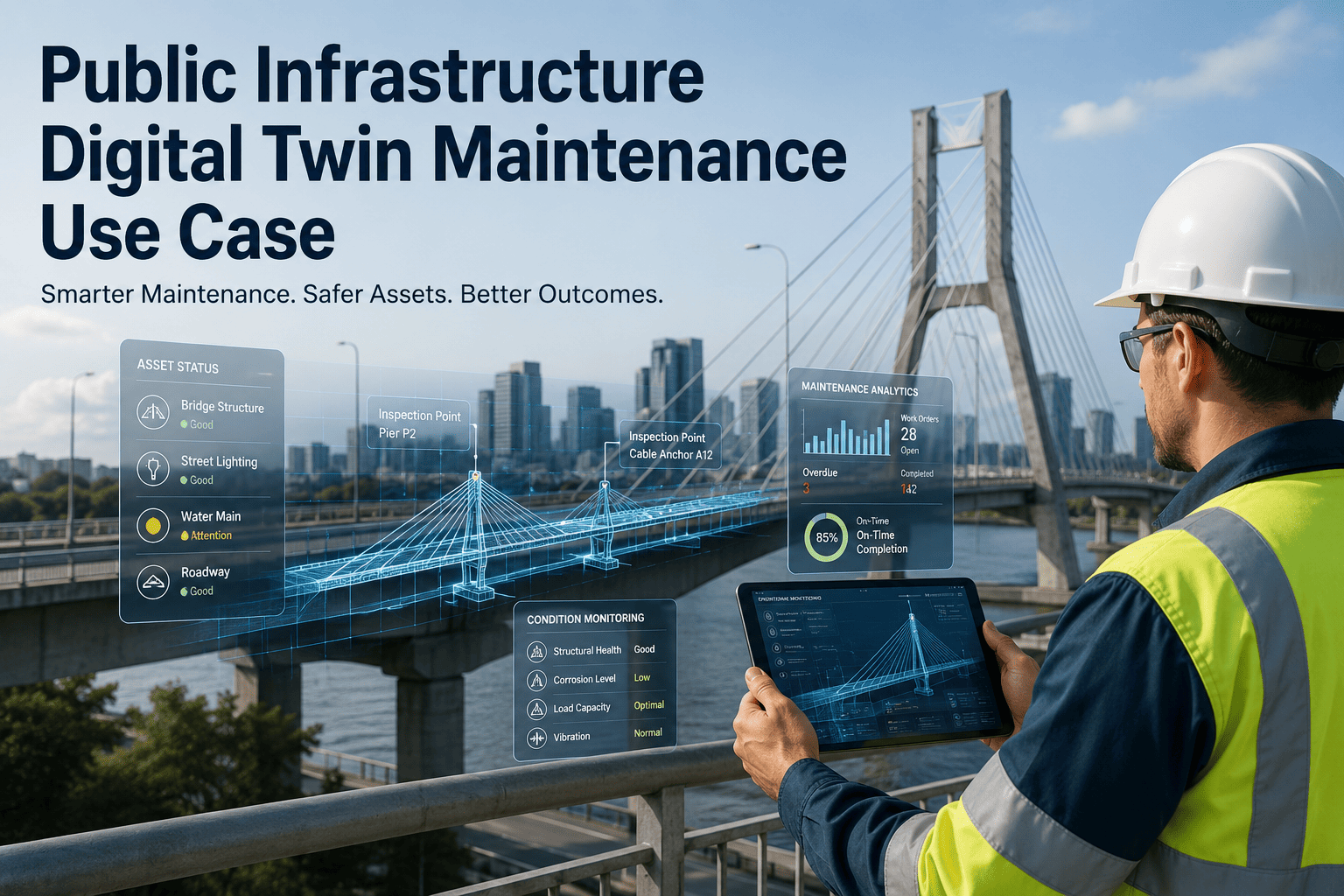
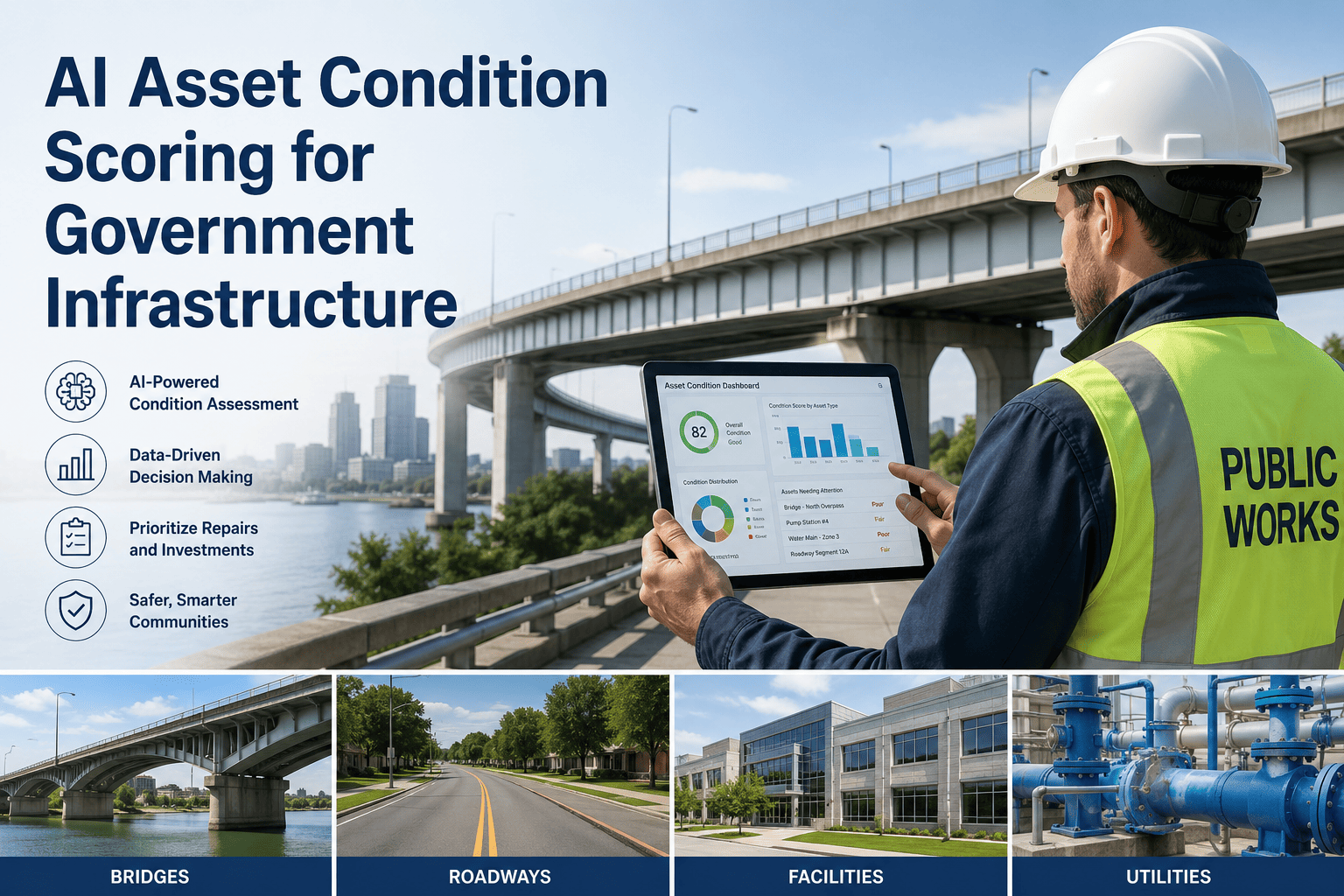
When a critical water main shows early signs of corrosion or a bridge sensor detects abnormal vibration patterns, waiting for catastrophic failure is no longer an option—it's a liability. Infrastructure breakdowns cost taxpayers billions, disrupt public services, and erode community trust. For government facility managers navigating shrinking budgets and aging assets, the question isn't whether AI predictive maintenance works—it's how fast you can deploy it to prevent the next failure before it happens.
AI predictive maintenance represents the most significant leap in government infrastructure management since the adoption of digital work orders. By combining machine learning algorithms, IoT condition monitoring sensors, and real-time failure prediction models, agencies can now detect degradation patterns weeks or months before a breakdown occurs. Forward-thinking departments are already replacing reactive "fix-it-when-it-breaks" approaches with intelligent CMMS platforms that learn from every asset, every reading, and every repair—transforming maintenance from a cost center into a strategic defense system.
This guide provides actionable strategies for government infrastructure teams to implement AI-driven predictive maintenance programs that deliver measurable ROI and operational resilience. Agencies ready to future-proof their infrastructure can start their AI predictive maintenance journey today.
Government infrastructure operates in a high-stakes, zero-tolerance environment. A failed HVAC system in a federal courthouse isn't just uncomfortable—it can halt proceedings. A water treatment pump failure affects thousands of residents. Traditional time-based maintenance either replaces parts too early (wasting budget) or too late (causing failures). AI predictive maintenance eliminates this guesswork by analyzing real-time sensor data, historical failure patterns, and environmental variables to predict exactly when an asset will need attention.
50%
Reduction in unplanned downtime with AI-driven failure prediction
$2.5M+
Average annual savings per agency from preventing catastrophic failures
8x
Earlier fault detection compared to traditional inspection methods
30%
Extension of asset lifespan through optimized maintenance scheduling
Government facilities manage a vast portfolio of infrastructure assets—each with unique failure modes and consequences. Deploying AI condition monitoring on these high-impact systems delivers the greatest return on investment and risk reduction.
Priority Assets for AI Predictive Workflows
HVAC & Climate Systems
Failure Impact:Critical
AI Monitors:Vibration, temperature, refrigerant levels
Typical Gain:40% fewer emergency HVAC calls
Water & Wastewater Pumps
Failure Impact:Severe
AI Monitors:Flow rate, pressure, motor current
Typical Gain:Zero unplanned pump outages
Electrical Distribution
Failure Impact:Critical
AI Monitors:Thermal imaging, load patterns, arc detection
Typical Gain:Prevent electrical fires & outages
Structural & Bridge Systems
Failure Impact:Catastrophic
AI Monitors:Strain gauges, corrosion sensors, tilt
Typical Gain:Early crack & fatigue detection
Most government agencies still operate at a reactive or basic preventive level. AI predictive maintenance represents the next evolution—where machine learning models analyze thousands of data points to forecast failures with precision that human inspection alone cannot achieve. Understanding where your agency sits on this spectrum is the first step toward transformation.
| Approach |
Failure Prevention |
Cost Efficiency |
Asset Lifespan |
Decision Quality |
| Reactive (Run-to-Fail) |
None |
Highest Cost |
Shortest |
Guesswork |
| Preventive (Time-Based) |
Moderate |
Over-Maintenance |
Average |
Calendar-Driven |
| AI Predictive (ML-Driven) |
Excellent |
Optimized |
Maximized |
Data-Driven |
Quick-Win AI Predictive Maintenance Strategies
1
IoT Sensor Deployment on Critical Assets
Install vibration, temperature, and pressure sensors on your top 20 highest-risk assets. Feed real-time data into AI models that learn normal operating baselines and flag anomalies automatically.
Result: Early detection of 85% of failure modes
2
Machine Learning Work Order Analysis
Use AI to analyze historical work orders and identify recurring failure patterns across your asset fleet, uncovering hidden correlations between environmental conditions and breakdowns.
Result: Predict failures 3-6 weeks in advance
3
Automated Health Scoring Dashboards
Assign each infrastructure asset an AI-calculated health score (0-100) based on sensor data, age, maintenance history, and usage patterns. Prioritize repairs by risk, not just schedule.
Result: 60% better resource allocation
4
Condition-Based Maintenance Triggers
Replace fixed-schedule PM tasks with condition-based triggers. AI automatically generates work orders only when sensor data indicates an asset is trending toward failure thresholds.
Result: 35% reduction in unnecessary maintenance tasks
Ready to Deploy AI Predictive Maintenance?
Oxmaint CMMS integrates AI-powered condition monitoring, machine learning analytics, and predictive workflows purpose-built for government infrastructure operations.
Join government agencies preventing infrastructure failures nationwide
AI predictive maintenance is only as powerful as the data feeding it. Government agencies need a structured approach to deploying IoT sensors, integrating legacy systems, and ensuring data quality. The right sensor-to-CMMS pipeline transforms raw readings into actionable intelligence that maintenance teams can trust and act on.
Core AI Predictive Maintenance Capabilities
✓
Real-Time Condition Monitoring
Continuous IoT sensor feeds monitor vibration, temperature, humidity, and pressure—detecting micro-changes invisible to manual inspections
✓
Machine Learning Failure Models
ML algorithms trained on historical failure data and real-time inputs predict remaining useful life (RUL) for every monitored asset
✓
Anomaly Detection Alerts
AI identifies deviations from normal operating patterns and automatically escalates high-risk anomalies to maintenance supervisors
✓
Predictive Analytics Dashboard
Visual dashboards display asset health scores, failure probability timelines, and recommended actions for leadership decision-making
Deploying AI predictive maintenance across government infrastructure requires a phased approach that builds confidence, validates models, and scales proven results—without disrupting ongoing operations or exceeding budget constraints.
90-Day AI Predictive Maintenance Roadmap
Days 1-30
Data Foundation & Pilot
→ Audit top 20 critical assets and install IoT sensors (vibration, temp, pressure)
→ Import 2+ years of historical work orders into the AI engine for model training
→ Establish baseline health scores for each pilot asset
Milestone: AI models generating first failure predictions
Days 31-60
Model Validation & Expansion
→ Validate AI predictions against actual asset performance and technician feedback
→ Expand sensor coverage to 50+ assets across multiple facilities
→ Train maintenance teams on AI-generated work orders and health dashboards
Milestone: Prediction accuracy exceeding 85% on pilot assets
Days 61-90
Full-Scale Deployment
→ Roll out AI predictive workflows across all facilities and satellite offices
→ Generate executive-level infrastructure health reports for leadership
→ Integrate AI insights with capital planning and budget forecasting systems
Milestone: Agency-wide predictive maintenance fully operational
Infrastructure Directors need clear, data-driven KPIs to justify AI investments and demonstrate tangible risk reduction to oversight committees and budget authorities.
Prediction
Failure Prediction Accuracy
Target: > 90%
Measures how reliably the ML model identifies impending failures before they occur
Reliability
Mean Time Between Failures (MTBF)
Target: 40% Increase
Tracks improvement in asset reliability since AI deployment
Efficiency
Unplanned Downtime Reduction
Target: 50% Decrease
Demonstrates operational continuity gains from predictive interventions
Financial
Maintenance Cost per Asset
Target: 25% Reduction
Validates ROI by comparing pre- and post-AI maintenance expenditures
Government agencies deploying AI predictive maintenance report transformative improvements across reliability, cost savings, and infrastructure resilience:
50%
Fewer Unplanned Failures
Through ML-driven early detection
$2.5M
Annual Cost Avoidance
Per agency from prevented breakdowns
30%
Longer Asset Lifespan
Optimized repair timing extends usable life
90%+
Prediction Accuracy
After 90 days of model training
See How Oxmaint Powers AI Predictive Maintenance
Schedule a personalized demo showing exactly how machine learning models, IoT sensor integration, and predictive analytics dashboards prevent infrastructure failures for your facilities.
Trusted by public works and infrastructure departments nationwide
The era of reactive infrastructure maintenance—waiting for bridges to crack, pumps to seize, or electrical systems to fail—is ending. AI predictive maintenance powered by machine learning and real-time condition monitoring gives government agencies the ability to see failures coming weeks or months in advance, intervene at the optimal moment, and allocate limited budgets with surgical precision.
The agencies making this transition in 2026 are reporting documented outcomes: 50% fewer unplanned failures, 30% longer asset lifespans, and millions in avoided emergency repair costs. These aren't theoretical projections—they're measurable results from infrastructure teams that deployed AI-driven CMMS platforms and committed to data-driven decision making.
Your aging infrastructure won't maintain itself. Your failure risks won't decrease without intelligent intervention. But the AI tools to address these challenges are proven, affordable, and available today. For a personalized assessment of your agency's predictive maintenance potential, request an AI infrastructure maintenance consultation from specialists who understand federal and municipal operations.
How does AI predictive maintenance actually predict failures?
AI predictive maintenance uses machine learning algorithms trained on historical failure data combined with real-time IoT sensor inputs (vibration, temperature, pressure, current draw). The models learn what "normal" looks like for each asset and detect subtle deviations that indicate degradation—often weeks before a human inspector could spot the issue. As the system processes more data, its accuracy continuously improves.
What kind of sensors are needed for government infrastructure?
The most common sensors for government infrastructure include vibration sensors (for rotating equipment like pumps and motors), temperature sensors (for electrical panels and HVAC), pressure transducers (for water systems), and corrosion sensors (for bridges and structural elements). Oxmaint supports integration with all major IoT sensor platforms and can recommend the right sensor mix for your specific asset portfolio.
How long does it take for AI models to become accurate?
Most agencies see useful predictions within 30-60 days when historical work order data is available for model training. Accuracy typically exceeds 85% within the first 90 days and continues improving as more real-time sensor data is collected. Agencies with 2+ years of digital maintenance records can accelerate this timeline significantly.
Can AI predictive maintenance work with legacy infrastructure?
Yes. Retrofit IoT sensors can be installed on virtually any existing asset—regardless of age—without modifying the equipment. Wireless sensors with battery lives of 5+ years make deployment on legacy infrastructure fast and non-invasive. The AI doesn't require the asset to be "smart"—it makes the maintenance process smart by analyzing external sensor data.
Is the AI platform secure enough for government data?
Yes. Oxmaint's AI predictive maintenance platform features enterprise-grade security including role-based access control (RBAC), end-to-end data encryption (AES-256), SOC 2 compliance, and single sign-on (SSO) integration. All sensor data and asset records are stored in secure cloud environments with full audit trails for regulatory compliance.