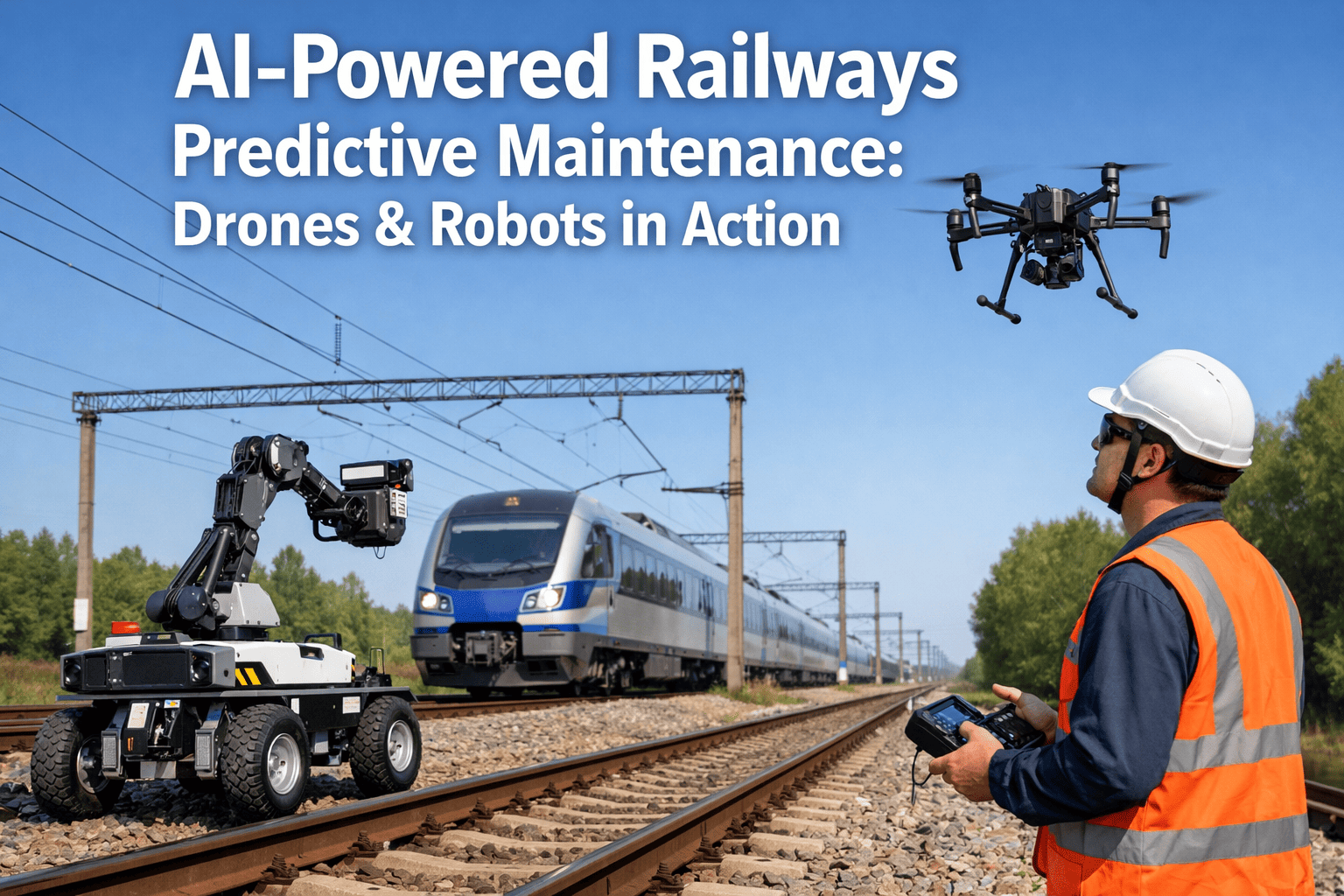
Railway infrastructure failures do not happen without warning — they build through micro-cracks, material fatigue, and deferred inspections until a track fault, bridge defect, or signal failure disrupts an entire network. AI-powered predictive maintenance, drone inspection programmes, and robotic monitoring systems are changing how rail operators find and fix problems before they become service disruptions. OxMaint gives railway maintenance teams the platform to manage all of it — from AI-generated alerts to work order tracking and compliance documentation. Start free or book a demo to see how.
Bring AI, Drone, and Robot Inspection Data Into One Railway Maintenance Platform
OxMaint centralises predictive alerts, inspection work orders, asset lifecycle data, and compliance documentation for rail infrastructure teams operating at any scale.
The Challenge
Why Traditional Railway Inspection Is No Longer Sufficient
Manual track walking, calendar-based inspection cycles, and paper-based defect logging cannot keep pace with the infrastructure demands of modern rail networks. Inspectors miss hairline cracks. Bridges are assessed on fixed schedules regardless of load or weather stress. Tunnels go uninspected for months between crew visits. The result is a maintenance programme that reacts to failures rather than preventing them — at a cost measured in service cancellations, emergency repairs, and regulatory penalties. Book a demo to see how OxMaint manages the transition to predictive rail maintenance.
of railway infrastructure failures are detectable 2–6 weeks in advance with AI-based monitoring systems
Enabling planned repair over emergency response in the majority of cases
more track coverage achievable per inspection shift using drones versus manual walking inspection
With higher defect detection accuracy on surface-level anomalies
reduction in unplanned maintenance costs in rail networks running structured predictive programmes
Industry benchmark across heavy rail, metro, and light rail operators
Technology Overview
AI, Drones, and Robots in Railway Predictive Maintenance
AI-Based Track Monitoring
Machine learning models analyse vibration sensors, rail stress gauges, and geometry measurement data to detect developing faults — rail corrugation, gauge widening, ballast deterioration — before they cross safety thresholds. Alerts are generated automatically and fed into OxMaint as prioritised work orders.
Drone Infrastructure Inspection
Autonomous drones equipped with thermal imaging, LiDAR, and HD cameras inspect track corridors, bridges, tunnels, and overhead line equipment at speeds and coverage levels impossible for walking crews. Defect images and GPS coordinates are ingested directly into OxMaint for work order generation and asset record updates.
Robotic Track and Weld Inspection
Rail-mounted robotic platforms perform ultrasonic testing of rails and welds, detecting internal defects invisible to visual inspection. Robots operate during overnight possession windows, covering far more track than manual UT teams. Results are logged per asset in OxMaint with defect classification and severity rating.
Embedded Sensor Networks
Strain gauges, accelerometers, and acoustic emission sensors embedded in bridges, tunnels, and critical track sections provide continuous structural health monitoring. OxMaint ingests sensor streams and triggers inspection work orders when readings breach configured thresholds — days before a structural issue becomes a safety event.
Predictive Diagnostics for Rolling Stock
Onboard diagnostics systems monitor wheel wear, bearing condition, brake performance, and traction equipment health in real time. Predictive models calculate remaining useful life for each component and generate OxMaint work orders for depot maintenance — eliminating unplanned failures on the line.
OxMaint as the Central Work Order Hub
Every alert from AI systems, drone inspection reports, robot surveys, and sensor networks converges in OxMaint. Work orders are created, assigned, tracked, and closed in one platform — giving maintenance managers a single operational view across all inspection technologies and asset types.
Connect Your AI and Drone Systems to a Single Maintenance Platform
OxMaint acts as the operational hub for all predictive maintenance data sources — turning AI alerts and drone findings into assigned, tracked, and documented repair work orders.
How It Works
OxMaint Railway Predictive Maintenance Workflow
Data Ingestion From AI, Drone, Robot, and Sensor Systems
OxMaint connects to existing monitoring infrastructure via API — AI track monitoring platforms, drone fleet management systems, robotic inspection outputs, and embedded sensor networks. Defect data flows into OxMaint automatically with asset ID, GPS location, defect classification, and severity score.
Automated Work Order Generation and Priority Assignment
Each defect or predictive alert automatically generates a work order in OxMaint. Priority is assigned based on defect severity, asset criticality, and track possession availability. Safety-critical defects escalate immediately to maintenance control with push notification to the responsible engineer.
Possession-Aware Repair Scheduling
OxMaint schedules repair work orders against track possession windows — ensuring maintenance interventions are planned for available engineering hours without disrupting service. Teams receive daily work packs on the OxMaint mobile app with all asset details, defect history, and required materials pre-loaded.
Compliance Documentation and Asset Record Update
Every completed repair is logged with technician sign-off, before/after photos, and materials used. The asset record is updated automatically. Compliance reports for the safety regulator, infrastructure manager, or operator are generated from OxMaint in minutes — not assembled manually before every audit.
Compliance Coverage
Regional Railway Standards OxMaint Supports
| Region | Key Railway Standards | OxMaint Documentation Support |
|---|---|---|
| USA | FRA Track Safety Standards (49 CFR Part 213), FTA safety oversight, APTA maintenance standards | FRA-aligned inspection records, defect log with severity classification, corrective action trails |
| Canada | Transport Canada Railway Safety Act, TC E-1 track geometry standards, PIPEDA data requirements | PIPEDA-compliant data storage, TC-aligned inspection documentation, exportable audit packages |
| United Kingdom | Network Rail standards (NR/SP/TRK series), RSSB Group Standards, ORR safety regulations, UK GDPR | NR/SP-aligned inspection templates, RSSB corrective action records, GDPR-compliant audit trail |
| Australia | ONRSR railway safety requirements, ARTC track standards, AS 4292 railway safety management, state rail authority regulations | ONRSR safety case documentation, ARTC-aligned PM records, state authority audit exports |
| Germany | EBO (Railway Construction and Operating Regulations), DB Netz technical standards, DSGVO, EU CSM regulations | EBO-compliant inspection logs, EU CSM risk assessment documentation, DSGVO-compliant data architecture |
| Saudi Arabia | SAR (Saudi Railways Organisation) standards, PDPL data compliance, SASO infrastructure codes, Vision 2030 transport mandates | PDPL-aligned data handling, SAR-structured maintenance records, Vision 2030 reporting documentation |
Competitive Analysis
OxMaint vs. Other Platforms for Railway Predictive Maintenance
| Capability | OxMaint | MaintainX | UpKeep | Fiix | Limble | IBM Maximo | Hippo CMMS |
|---|---|---|---|---|---|---|---|
| AI/sensor alert to work order automation | Yes | Partial | Partial | Partial | No | Yes | No |
| Drone inspection data ingestion | Yes | No | No | Limited | No | Yes | No |
| Railway-specific PM templates | Yes | No | No | No | No | Partial | No |
| Possession-aware scheduling | Yes | No | No | No | No | Partial | No |
| Multi-region compliance documentation | Yes | Partial | Partial | Partial | No | Yes | No |
| Free tier available | Yes | Limited | Limited | No | Limited | No | Limited |
| Implementation time | 1–2 weeks | 2–4 weeks | 2–4 weeks | 4–8 weeks | 2–4 weeks | 3–6 months | 2–4 weeks |
Implementation Roadmap
Deploying OxMaint for Railway Predictive Maintenance
Asset Register and Integration Setup
All track sections, bridges, tunnels, and rolling stock assets catalogued in OxMaint. API connections configured to existing AI monitoring, drone fleet, and sensor platforms. Team access provisioned across maintenance control, field engineers, and depot staff.
Work Order Automation and Alert Thresholds
Automated work order generation configured for each connected data source. Alert thresholds set per asset type and defect class. Possession calendar integrated for repair scheduling. Field teams trained on OxMaint mobile for inspection capture and work order execution.
First Inspection Cycle and Compliance Baseline
First drone and AI-assisted inspection cycle completed with all findings captured in OxMaint. PM compliance baseline established. First regulatory documentation package generated. Maintenance control reviews dashboard showing open defects, work order aging, and asset health trends.
Continuous Optimisation and Reporting
OxMaint analytics identify repeat defect patterns and highest-risk asset sections. Alert thresholds refined based on first cycle data. Quarterly compliance reports generated automatically for the safety regulator, infrastructure manager, and operations leadership.
Client Results
Outcomes From Rail Operators Using OxMaint
Reduction in unplanned track possession events
Regional rail operator, 340km network, 14 months post OxMaint deployment with AI monitoring integration
Increase in defect detection rate per inspection shift
Metro operator, drone inspection programme managed through OxMaint work order platform
Regulatory audit report compilation time
Down from 3+ days of manual record gathering — heavy rail infrastructure manager
| Maintenance Area | Traditional Approach | With OxMaint and Predictive Technology | Impact |
|---|---|---|---|
| Track Defect Detection | Manual walking inspection on fixed cycle | AI and robot ultrasonic continuous monitoring | Defects caught weeks earlier, planned repair |
| Bridge and Tunnel Inspection | Visual inspection every 1–3 years | Drone survey quarterly, sensor alerts continuous | Structural issues caught before safety threshold breach |
| Rolling Stock Maintenance | Mileage-based scheduled depot visits | Condition-based PM triggered by onboard diagnostics | 35–50% reduction in on-line failures |
| Compliance Documentation | Manual compilation before each audit | Auto-generated from OxMaint records | Audit preparation time from days to hours |
| Repair Scheduling | Ad hoc possession requests, reactive resourcing | Possession-aware planning from OxMaint scheduler | Higher engineering hour utilisation, fewer overruns |
Railway Safety Starts With Defects You Find Before They Fail
OxMaint connects AI monitoring, drone inspection, and robotic survey data to a maintenance platform that ensures every finding becomes a tracked, documented, and resolved work order.
FAQ
Frequently Asked Questions


