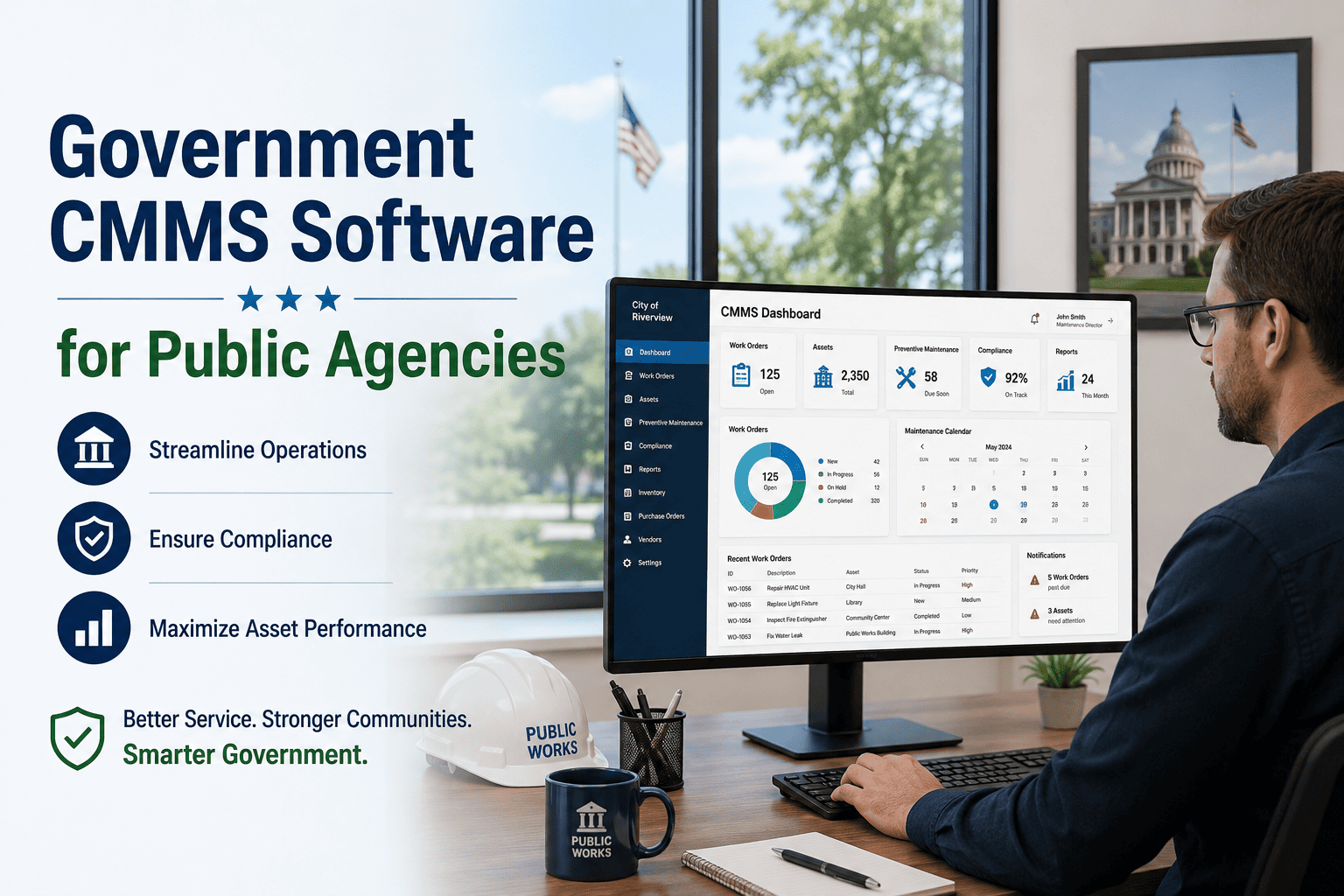
Municipal CMMS approvals are moving faster in 2026 than any prior year — and the reason is not a technology trend. It is a convergence of three fiscal realities that councils can no longer defer: deferred maintenance backlogs that have become headline budget crises, federal infrastructure grant requirements that demand documented asset condition data cities do not have, and a workforce demographic where 65% of municipalities face skilled labour shortages that only productivity-enhancing technology can address. Public works directors who spent years making the case for CMMS software are now fielding council questions about why deployment is not faster. Start a free trial on OxMaint or book a demo to see the council-ready business case framework that public works directors are using to secure fast-track budget approvals in 2026.
Why City Councils Are Fast-Tracking CMMS Approvals in 2026
The three fiscal drivers forcing council-level urgency, the FCI evidence that makes the budget case unanswerable, and the capital justification framework that public works directors are using to get CMMS approved in a single budget cycle.
The Three Converging Drivers Forcing Council Urgency in 2026
For years, CMMS appeared on municipal capital wish lists — desirable, defensible, but rarely urgent enough to displace visible capital projects in a constrained budget. In 2026, three simultaneous pressures have changed the calculation for most councils.
The average US municipality now carries a deferred maintenance backlog equal to 2.2× its annual maintenance operating budget — and the backlog is growing faster than the operational budget that addresses it. Councils are seeing water main failures, structural failures, and HVAC collapses in public buildings that were predictable from asset condition data that simply was not being collected. The conversation has shifted from "can we afford CMMS" to "can we afford the cost of not having it."
The Bipartisan Infrastructure Law, EPA SRF programmes, FEMA BRIC grants, and FHWA surface transportation funding increasingly require documented asset condition assessments, maintenance histories, and Facility Condition Indexes that paper-based and spreadsheet-based programmes cannot produce on demand. Cities without structured asset documentation are being screened out at pre-application stage — before a single federal dollar is at stake in the review. The CMMS is now the price of admission to federal infrastructure funding, not just a management tool.
65% of US municipalities face skilled maintenance labour shortages — Governing Institute 2025 research. The average public works department has 15% fewer field staff than it did in 2010. Councils that previously deferred CMMS because they had "enough people to manage manually" are now realising that fewer people managing more infrastructure can only work with technology that eliminates the administrative waste — paper work orders, manual PM tracking, phone-based dispatch — consuming 30–40% of technician productive time in manual systems.
The FCI Argument — The Single Number That Makes the Budget Case Unanswerable
The Facility Condition Index (FCI) is the financial argument that cuts through council scepticism. FCI = deferred maintenance cost / current replacement value. A building or infrastructure asset with FCI above 0.10 (10%) is in "poor" condition — the National Infrastructure Institute standard. Above 0.30, replacement is almost always more cost-effective than continued deferred maintenance.
The Council-Level Business Case — What the Resolution Needs to Show
A CMMS budget request that is approved by council in a single cycle contains four elements. Missing any one of them extends the approval timeline by one to two budget cycles.
Document actual emergency repair spend vs planned maintenance spend in the last 24 months — pulled from work order records or contractor invoices. Show the reactive-to-planned ratio and the specific events (pump failure, HVAC collapse, water main break) that drove the highest emergency costs. Real events with real dollar amounts are more persuasive to councils than industry averages.
Calculate FCI on 10–15 highest-value city assets — major buildings, water infrastructure, fleet categories. Present the current FCI score alongside the projected FCI at three years of continued deferred maintenance. The visual of assets crossing from "fair" to "poor" to "critical" condition on the council's own infrastructure is the most powerful single element of the business case.
Identify 2–3 specific federal grants the city has applied for or is eligible for that require documented asset condition data — BIL, FEMA BRIC, EPA SRF. Show the documented evidence requirement from the grant NOFO and what the city currently can and cannot produce. Councils respond to "we left $X in federal grants unrealised because we could not produce the documentation" far more than abstract efficiency arguments.
Model the CMMS cost against the three primary savings streams — emergency repair reduction, overtime reduction, and deferred backlog prevention — using the city's own budget line items. Show breakeven at 12–18 months. A $150,000 CMMS investment that prevents one $340,000 emergency infrastructure failure pays back before the second budget cycle. Most cities can identify a recent emergency event that alone exceeded the CMMS cost.
2026 Fast-Track Approval — What Is Different This Year
| Approval Factor | 2022–2024 Environment | 2026 Environment |
|---|---|---|
| Federal grant pressure | BIL just passed — documentation requirements not yet fully enforced | Grant reviews actively screening for asset documentation — cities without CMMS data losing competitive scoring |
| Deferred maintenance visibility | Backlog acknowledged but not quantified at council level | FCI scores and backlog dollar values appearing in annual budget presentations and bond rating reviews |
| Labour market | Staff shortages emerging — manual tracking still feasible | 65% of municipalities report shortages — productivity tools are now operational necessity, not luxury |
| Council familiarity with CMMS | Explanation of what CMMS does consumed most of the presentation | Many council members have seen CMMS in private sector roles — business case is now ROI, not education |
| Budget risk framing | "CMMS saves money" — abstract and long-dated | "Without CMMS we will lose X federal grants and face Y in emergency capital costs" — concrete and immediate |
Frequently Asked Questions
Council Approval in 2026 Comes to Cities With Evidence — Not Estimates
OxMaint gives public works directors the FCI framework, savings model, and grant eligibility documentation needed to build a council business case that approves in a single budget cycle — not after two years of committee review.