When a mid-Atlantic state government agency managing 240 buildings across 18 counties decided to replace its fragmented maintenance tracking system, the priority was not features — it was speed. The agency had already passed two Joint Commission-equivalent state audit cycles using paper work orders and separate spreadsheet-based asset registers for each facility. A third audit with the same documentation gaps would trigger a state comptroller review. The agency needed a unified CMMS deployed across every building within a single fiscal quarter. Oxmaint went live across all 240 buildings in 14 weeks — with a fully structured asset hierarchy, role-based access for 340 staff members, and a single unified work order intake system replacing 18 separate email inboxes. Book a demo to see how Oxmaint deploys across multi-building government portfolios.
Case Study · State Government · CMMS Deployment
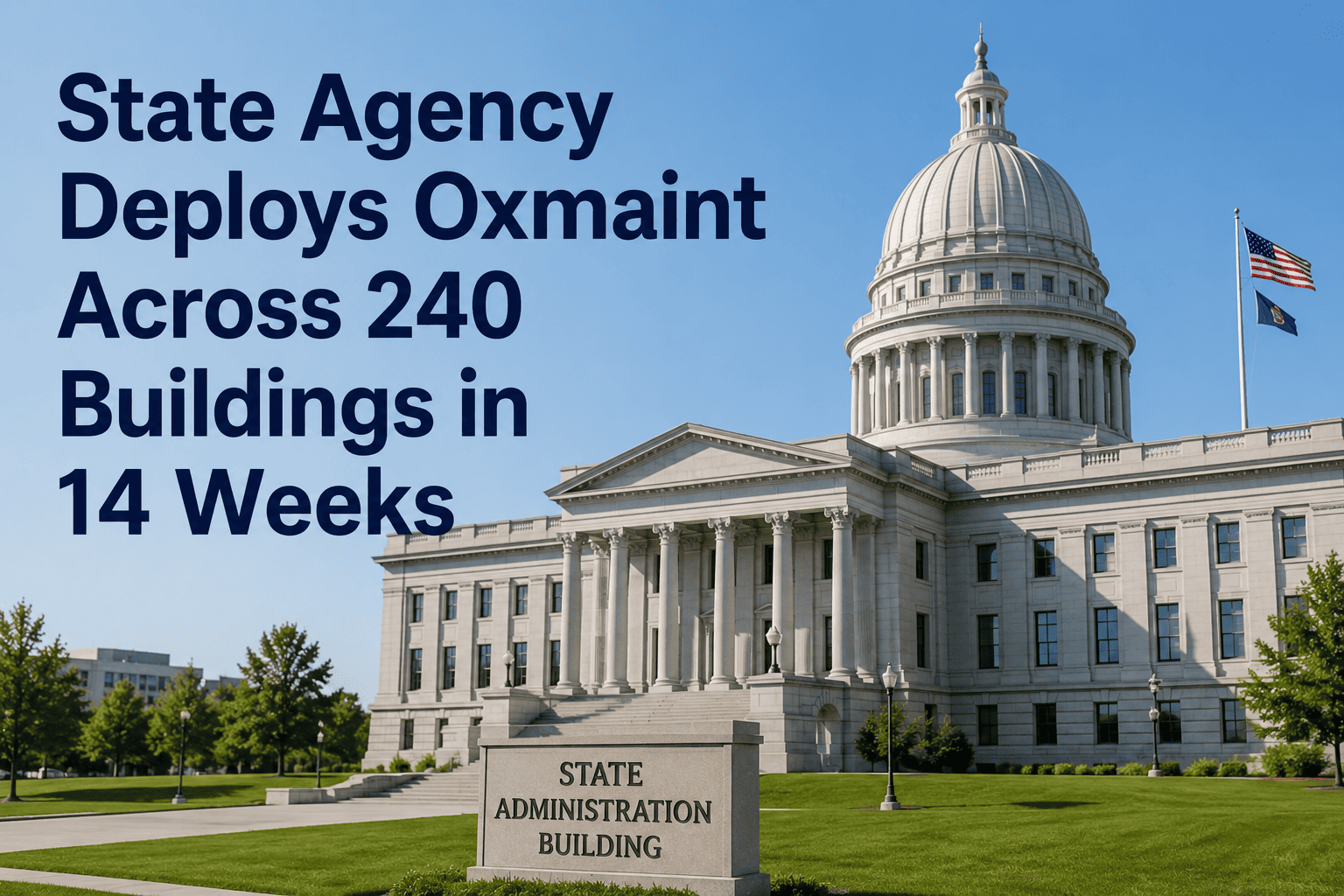
State Agency Deploys Oxmaint Across 240 Buildings in 14 Weeks
How a mid-Atlantic state government agency replaced 18 fragmented work order inboxes with a single unified CMMS — on time, under budget, and audit-ready before the fiscal year ended.
240
Buildings live on Oxmaint
14 wks
Full deployment timeline
340
Staff members onboarded
18
Email inboxes replaced by one system
0
Audit findings on maintenance documentation post-deployment
The Situation Before Oxmaint
The agency's maintenance operation had grown organically over 12 years into a system of local workarounds — each facility manager handling work requests in whatever way worked for their county office. The result was an organization that was doing maintenance, but could not prove it.
18
Separate work request inboxes
Each county office managed requests via a shared email address. No central visibility, no priority triage, no response time tracking.
0
Buildings with structured PM schedules
Preventive maintenance was calendar-reminder based. No work order generation, no completion tracking, no PM compliance rate calculable.
6 wks
Time to assemble audit documentation
Each state audit required manually compiling paper inspection logs, email threads, and spreadsheets across 18 county offices — a 6-week process consuming 3 FTE.
$0
Per-asset maintenance cost visibility
All maintenance spend tracked as a department line item. No ability to show cost per building, per system, or per asset — a requirement for capital replacement planning.
The 14-Week Deployment — Phase by Phase
Oxmaint's government deployment team built a phased rollout plan that prioritized getting the highest-risk buildings live first while training county-level administrators in parallel. The full 14-week timeline was completed within the agency's Q4 fiscal window.
Oxmaint's implementation team conducted structured data collection sessions with each county facility manager to capture building square footage, primary systems (HVAC, electrical, plumbing, elevators), and critical asset lists.
A three-tier asset hierarchy was designed: Agency → County → Building → System → Asset. This structure allowed both facility-level and portfolio-level reporting from day one.
Output: Complete asset hierarchy for 240 buildings · 8,400 individual assets registered
340 user accounts provisioned across four role types: Agency Director (portfolio view), County Facility Manager (county-level work order management), Building Technician (mobile work order completion), and Read-Only Auditor (compliance report access).
Access controls configured so each county manager sees only their county's assets and work orders, while agency directors see the full portfolio. Auditors access compliance reports without the ability to modify asset or work order records.
Output: 340 users live · 4 role types configured · County data isolation verified
Standard PM schedule templates deployed for six asset classes common across all 240 buildings: HVAC systems, fire suppression, electrical panels, elevators, plumbing, and exterior envelope. Each template included state regulatory compliance tasks specific to the agency's audit framework.
Unified work order intake configured: a single request portal replaced all 18 county email inboxes. Requests automatically route to the correct county facility manager based on building ID selected by the requester.
Output: 6 PM template types deployed · Unified intake live for all 240 buildings · Automatic county routing active
County facility managers completed 4-hour administrator training sessions delivered remotely in groups of 10–15. Building technicians completed 90-minute mobile app training via recorded modules with live Q&A sessions per county group.
Pilot operation ran for 3 weeks with all 240 buildings processing real work orders in Oxmaint while email inboxes remained open as a parallel backup. Transition issues identified and resolved before full cutover.
Output: 340 staff trained · Pilot operation completed · Zero critical issues identified at cutover
Email inboxes decommissioned. All 240 buildings operating exclusively through Oxmaint for work order intake, PM tracking, and asset management.
Audit readiness review conducted with agency compliance team — PM compliance reports, asset inventory export, and work order history reports verified against state audit documentation requirements. All documentation checks passed.
Output: Full cutover complete · Audit documentation verified · Agency officially CMMS-operational
Deploy Oxmaint Across Your Government Portfolio
Oxmaint's government deployment team has implemented multi-building rollouts for state agencies, county governments, and municipal authorities — with structured timelines and audit-ready outputs from day one.
Results — Six Months Post-Deployment
| Metric |
Before Oxmaint |
6 Months Post-Deployment |
Change |
| PM compliance rate (portfolio-wide) |
Not measurable (no system) |
87% |
Established from zero |
| Work order acknowledgment time |
24–72 hours (email dependent) |
Under 4 hours |
−83% avg |
| Audit documentation preparation time |
6 weeks (3 FTE manual effort) |
Under 4 hours (system-generated) |
−98% time reduction |
| Buildings with active PM schedules |
0 of 240 |
240 of 240 |
100% coverage |
| Emergency vs planned work order ratio |
68% emergency / 32% planned |
31% emergency / 69% planned |
Reactive work halved |
| State audit documentation findings |
7 findings (prior audit) |
0 findings |
Zero deficiencies |
Expert Review
RB
"The 14-week timeline was the requirement — not a goal. We had a hard audit date and a fiscal year deadline that could not move. What made Oxmaint work for us was that their implementation team understood government procurement constraints and audit documentation requirements from the first meeting. They weren't trying to sell us features. They were solving the specific problem: how do we get 240 buildings documented, structured, and audit-ready in one quarter? The answer was a phased rollout with clear handoffs and a pilot period that caught every edge case before we went fully live."
Deputy Director of Facilities, State Government Agency
Name withheld per agency communication policy · Mid-Atlantic state government · 22-year facilities career · 240-building portfolio
Frequently Asked Questions
How did Oxmaint handle the asset data migration when each county had different record formats?
Oxmaint provided a standardized asset data collection template that county facility managers completed during weeks 1–2 of the deployment. Where existing electronic records existed, Oxmaint's team converted them to the template format. Where records were paper-only, data entry was completed during facilitated sessions. The structured collection process took an average of 6 hours per county — significantly faster than the 3–5 day estimate the agency had budgeted. All 8,400 assets were registered with consistent data fields before any PM schedules were configured.
Book a demo to see the government asset migration process.
What happens to historical maintenance records from before Oxmaint was deployed?
Historical paper records were not migrated into Oxmaint — migration of 12 years of paper records was neither practical nor required for audit purposes. Instead, Oxmaint's implementation team configured a "legacy record note" field on each asset where the date and location of physical legacy records was logged, ensuring auditors know where to find pre-CMMS documentation. From deployment date forward, all maintenance activity is fully captured in Oxmaint. State auditors accepted this approach during the first post-deployment audit cycle with zero findings on documentation completeness.
How does role-based access work for a state agency where some staff need portfolio visibility and others need county-only access?
Oxmaint's role-based access model allows administrators to define exactly which buildings, counties, or portfolio-wide views each user can access. Agency directors see dashboards aggregating all 240 buildings with drill-down capability. County managers see only their county's assets and work orders. Field technicians see only the buildings they are assigned to. Read-only audit roles can access compliance reports without the ability to modify records. This structure can be reconfigured at any time as staff roles change — and it was the same access model used in this deployment.
Configure your access hierarchy in Oxmaint free trial.
Government Portfolio Deployment
240 Buildings. 14 Weeks. Zero Audit Findings. Your Agency Is Next.
Oxmaint's government implementation team delivers structured CMMS rollouts for state agencies, county governments, and municipal authorities — with audit-ready documentation from day one of go-live.