When a municipal water utility serving 340,000 residents integrated its SCADA alarm system with OxMaint's CMMS work order platform, the results arrived faster than any internal projection had suggested: emergency repairs dropped 64% within twelve months, preventive maintenance compliance climbed from 41% to 89%, and the average response time to critical pump and treatment plant alarms fell from 4.2 hours to 47 minutes. The utility had not added staff, changed its asset base, or rebuilt its SCADA infrastructure. It had simply connected the two systems that were generating data and work — and eliminated the gap between an alarm firing and a technician receiving a prioritised, asset-linked work order. OxMaint's SCADA-to-CMMS integration is now the operational backbone for the utility's maintenance team across four water treatment plants, 28 pump stations, and 1,400 kilometres of distribution network.
Case Study · Municipal Water Utility · SCADA-CMMS Integration
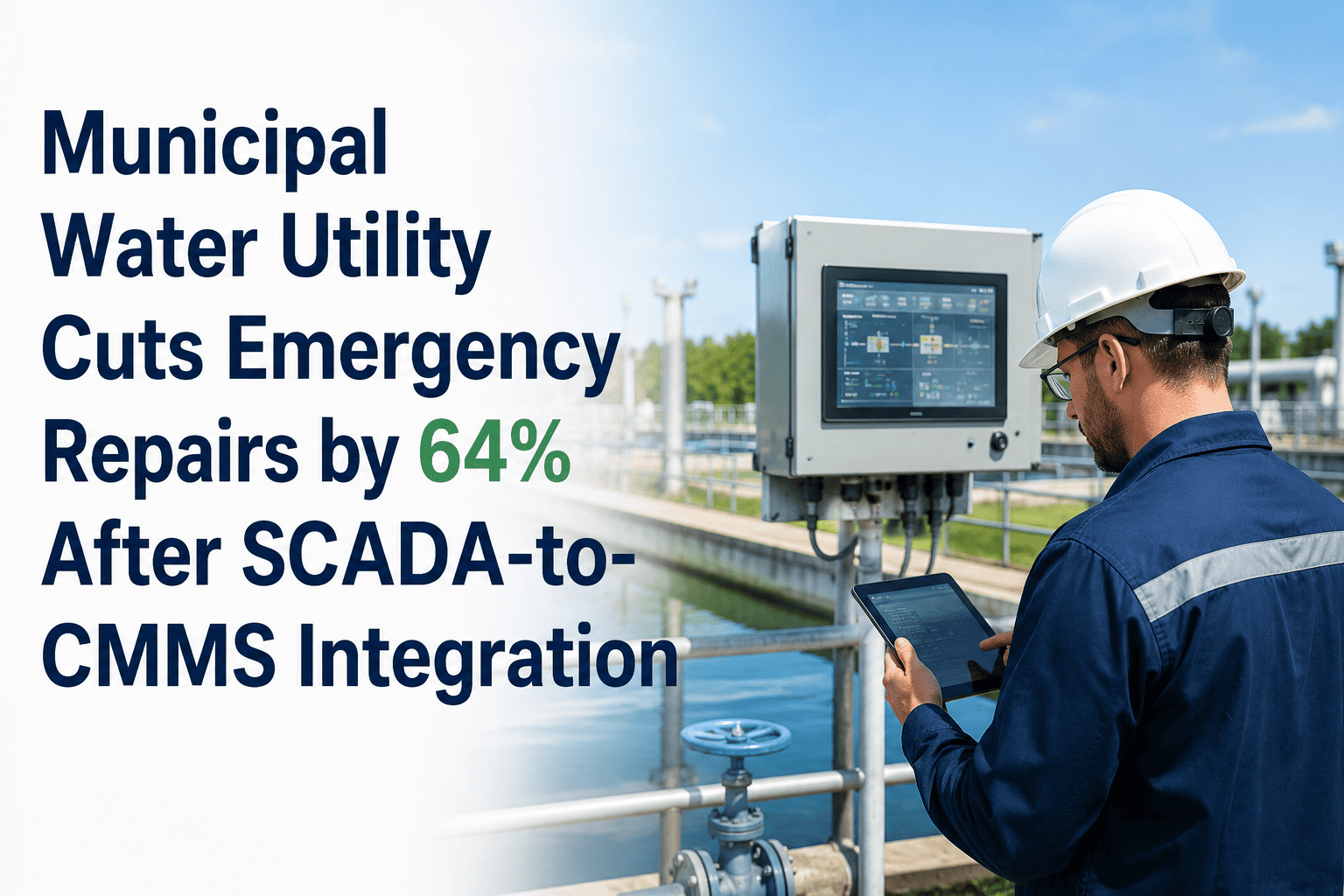
Municipal Water Utility Cuts Emergency Repairs by 64% After SCADA-to-CMMS Integration
SCADA Alarm Routing · Auto Work Orders · PM Compliance Tracking · Pump Station Monitoring · Regulatory Audit Trail
Live SCADA Feed → OxMaint Work Orders
PS-14 Pump 2 High Vibration → WO #4421 · P1
2 min ago
WTP-2 Chlorine Dosing Deviation → WO #4419
14 min ago
PS-07 Monthly PM Completed · Tech: K. Osei
1 hr ago
Reservoir Level Low → Auto WO #4418 · P2
2 hr ago
64%
Reduction in emergency repair events in Year 1 after SCADA alarms routed to OxMaint work orders
41→89%
PM compliance improvement — from 41% (paper-based) to 89% (OxMaint digital) within 12 months
47 min
Average critical alarm response time post-integration — down from 4.2 hours pre-OxMaint
$1.9M
Estimated annual cost avoidance from emergency repair reduction and PM compliance improvement
The Challenge — What the Utility Faced Before Integration
01
SCADA and CMMS Were Disconnected Silos
SCADA alarms fired at the control room. A controller would call a supervisor. The supervisor would call a technician. The technician would attend — sometimes hours later — with no prior knowledge of the asset's service history, recent fault pattern, or current PM status. The work was done, verbally reported, and eventually entered into a separate spreadsheet-based maintenance log. The two systems never communicated.
02
41% PM Compliance on Safety-Critical Assets
Across 28 pump stations, four treatment plants, and 200+ maintainable assets, only 41% of scheduled PM tasks were completed on time. The cause was not technician capacity — it was the absence of a digital scheduling system that assigned, tracked, and escalated overdue tasks automatically. Paper PM cards were easily missed; no one knew which tasks were overdue until something failed.
03
No Audit Trail for Regulatory Reporting
The utility's regulatory obligations — drinking water quality assurance, EPA maintenance records, and asset inspection documentation — required comprehensive maintenance records that the paper-based system could not reliably produce. Audit preparation required weeks of manual compilation; records were incomplete, inconsistent, and occasionally lost.
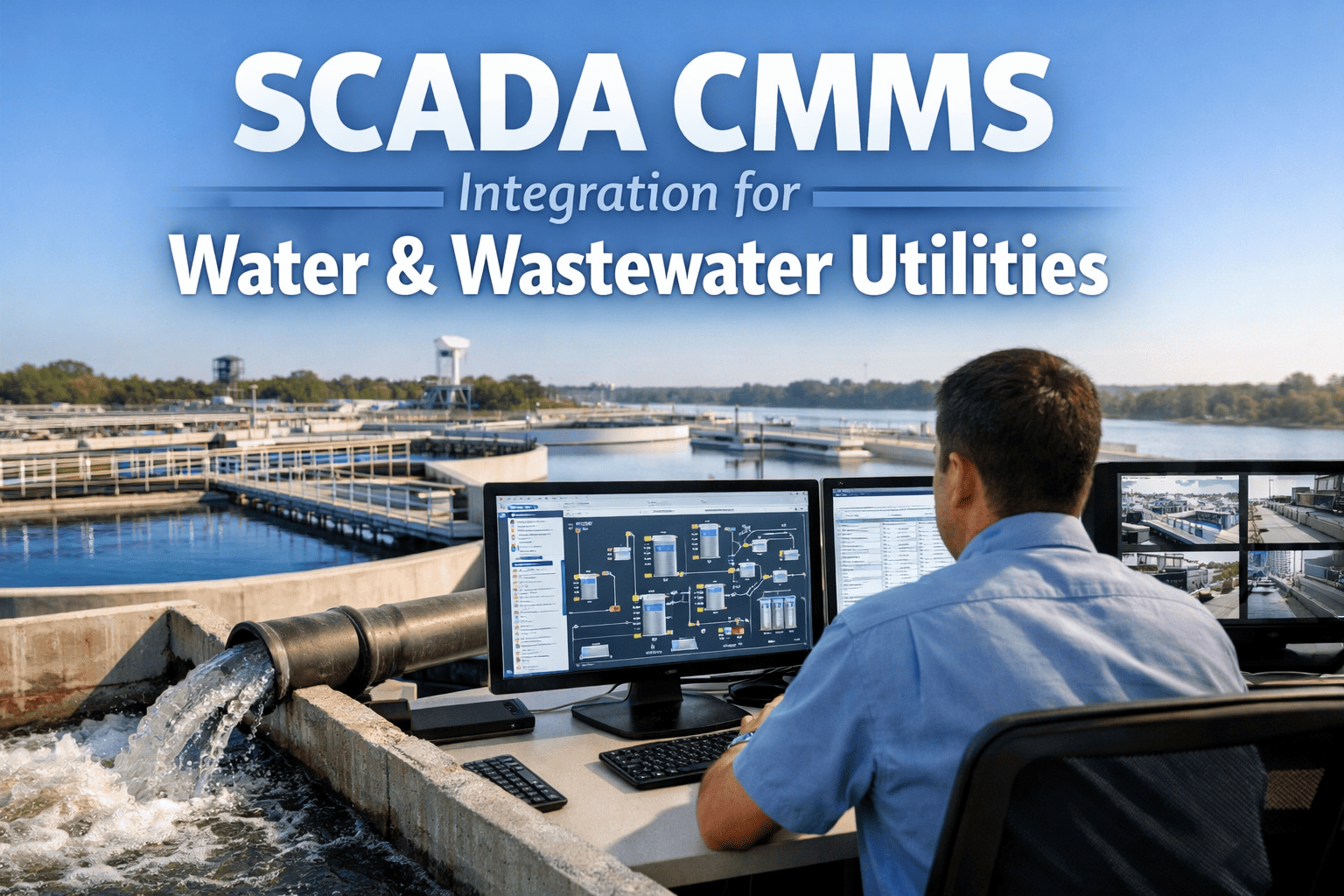
The OxMaint Integration Architecture
SCADA Layer
Wonderware / OSIsoft PI Alarm Export
SCADA alarms exported via OPC-UA and REST API. 847 alarm points mapped across 4 treatment plants and 28 pump stations. Each alarm point linked to an OxMaint asset record.
→
Classification Layer
OxMaint Alarm Rule Engine
847 alarm points classified into P1 (immediate), P2 (same day), P3 (scheduled), and nuisance (filtered). Rules configured per asset type — pump, dosing system, chlorination, reservoir, valve.
→
Work Order Layer
Auto Work Order Creation
P1 and P2 alarms auto-create work orders in OxMaint — pre-populated with asset history, last PM date, current open faults, and OEM troubleshooting notes. Pushed to technician mobile app.
→
Closure Layer
Mobile Closeout + Audit Record
Technician closes work order in field — fault cause, resolution, parts used, photos, and readings. Full SCADA alarm-to-closure record stored per asset for regulatory reporting.
Before vs After — Key Performance Metrics
| KPI |
Before OxMaint |
After OxMaint |
Change |
| Emergency repair events / year |
214 |
77 |
-64% |
| PM compliance rate (all assets) |
41% |
89% |
+48 percentage points |
| Critical alarm response time |
4.2 hours avg |
47 minutes avg |
-81% |
| Work orders with audit-ready records |
23% |
100% |
Full compliance achieved |
| Regulatory audit preparation time |
3–4 weeks manual |
2 hours (report export) |
95% time reduction |
| Emergency repair cost / year |
$2.96M |
$1.07M |
$1.89M saved |
| Pump MTBF (primary stations) |
8.4 months |
19.2 months |
+129% increase |
Performance Improvement — Visual Comparison
Critical Alarm Response Time
Connect Your SCADA Alarms to Work Orders. Cut Emergency Repairs. Improve Compliance.
OxMaint integrates with Wonderware, OSIsoft PI, GE iFIX, Ignition, and all major SCADA platforms via OPC-UA and REST API — turning alarm data into structured, assigned, auditable maintenance work orders from day one.
"
The utility had a SCADA system that was generating excellent data and a maintenance team that was doing their best work — but the two were operating in isolation from each other. Operators knew about pump faults that maintenance teams only heard about hours later through informal phone calls. PM tasks were overdue on safety-critical assets because there was no digital system tracking them and no automatic escalation when they were missed. The OxMaint integration did not require replacing anything — it required connecting what already existed. The 64% reduction in emergency repairs is not primarily a technology result; it is the result of maintenance teams receiving the right information at the right time with enough context to act on it preventively rather than reactively. The regulatory audit improvement — from weeks of manual work to a two-hour report export — was the outcome that most surprised the utility's senior management, because it transformed compliance from a cost centre into a demonstration of operational competence that significantly strengthened the utility's regulatory relationships.
Douglas Ferreira, PE, CWEM
Principal Water Infrastructure Asset Manager · Municipal Water Authority Consultancy · 26 Years Water Treatment Plant Operations, SCADA Systems, and Asset Management · Professional Engineer (Civil/Water) · Chartered Water and Environmental Manager · Specialist in SCADA-CMMS integration, water utility PM programme design, and regulatory compliance management for municipal and regional water supply authorities serving 100,000–1,000,000 residents
Frequently Asked Questions
Which SCADA platforms does OxMaint integrate with for water utility deployments?
OxMaint integrates with SCADA platforms via OPC-UA, OPC-DA, REST API, and MQTT — covering the primary protocols used by AVEVA (Wonderware) InTouch and System Platform, OSIsoft PI, GE iFIX and Proficy, Schneider Electric EcoStruxure, Ignition by Inductive Automation, and most other major water utility SCADA platforms. For utilities running older SCADA systems without modern API capability, OxMaint supports flat-file alarm export integration with a defined polling interval, which typically requires no changes to the existing SCADA infrastructure. Integration configuration for a standard water utility deployment — mapping alarm points to asset records and configuring work order creation rules — typically takes 3–5 days with OxMaint's implementation team.
Start a free trial and assess SCADA integration options for your utility.
How does OxMaint support EPA and drinking water regulatory compliance documentation?
OxMaint's compliance module maintains a full maintenance record per asset — including every PM completed, every alarm-triggered work order, every inspection reading, and every corrective action — with timestamps, technician identification, and attached evidence such as photos, test results, and calibration records. For water utilities, OxMaint supports configuration of regulatory compliance records including EPA sanitary survey response documentation, AWWA condition assessment records, and state-specific drinking water system inspection requirements. All compliance records are exportable as structured PDF reports or CSV data files suitable for submission to regulatory bodies, insurance auditors, and water authority board reporting. The two-hour audit preparation result achieved by this utility — compared to their previous three-to-four week manual process — is typical for OxMaint deployments with complete asset records and PM compliance above 85%.
Book a demo to see OxMaint's regulatory compliance reporting for water utilities.
How does OxMaint handle SCADA alarm routing for remote pump stations with intermittent connectivity?
OxMaint's architecture handles remote pump station connectivity in two modes. For stations with reliable cellular or fixed-line connectivity, SCADA alarm data is transmitted in real time and work orders are created and dispatched to technicians' mobile devices within seconds of the alarm event. For stations with intermittent connectivity — common in rural water utilities — OxMaint operates in a store-and-forward mode: SCADA alarm data is logged locally and batched for transmission when connectivity is available, and technicians' mobile devices operate in offline-first mode, receiving work orders when in range and syncing completions when connectivity resumes. In both modes, the full alarm-to-work-order audit trail is preserved with accurate timestamps from the point of alarm origination, not the point of data transmission.
Explore OxMaint's offline-first mobile capability with a free trial.
OxMaint · Municipal Water Utility · SCADA-CMMS Integration
SCADA Alarms That Become Work Orders. PM Compliance That Becomes Regulatory Confidence.
OxMaint connects water utility SCADA systems to structured maintenance workflows — turning alarm data into assigned, auditable work orders and PM schedules into verified compliance records for every asset in your network.