Civic buildings — city halls, courthouses, municipal offices — are the most public-facing assets in any government portfolio, and the public reads their condition as a direct reflection of government competence. A scuffed council chamber, an out-of-service elevator on judgment day, or a leaking roof above the county clerk's vault erodes trust faster than any press release can rebuild it. Yet most municipal maintenance programs run on paper logs, tribal knowledge, and reactive calls that cost 3–5× more per work order than a planned approach. Building a CMMS-driven facility maintenance program for civic buildings reclaims that spend, protects historic fabric, and keeps ADA and security obligations provably audit-ready. You can stand one up today with a Start Free Trial, or schedule a walkthrough tailored to your facility.
Is your courthouse maintenance program provably audit-ready — or just reacting to the next complaint?
Most city halls and courthouses run on paper logs and memory. A CMMS-driven civic maintenance program shifts you from reactive calls to planned, defensible, ADA-compliant upkeep — and trims 18–30% off annual facility spend in the first 18 months.
The real cost of deferred upkeep in public buildings
A single deferred roof repair on a 1920s courthouse typically compounds into $4.20 of consequential damage for every $1 of the original fix — ceiling tile, electrical, records storage, and court-day closures included. The numbers below are the baseline most civic facilities are running against.
A 180-asset courthouse portfolio, before and after CMMS
Consider a mid-sized county complex: one 110-year-old courthouse, a city hall annex, and a shared records annex — 180 maintained assets, 9 tradespeople, and a $42K/yr reactive maintenance budget that always overspent. Here is what shifted in the first 12 months on a CMMS-driven program.
A CMMS moves the reactive ratio from ~47% toward 18–22%, which alone typically removes 25–35% of consequential damage liability in year one.
| Metric (180-asset civic portfolio) | Before CMMS (paper/logbook) | After 12 months on CMMS | Delta |
|---|---|---|---|
| Reactive work-order ratio | 49% | 21% | −28 pts |
| Average work-order cycle time | 6.4 days | 2.3 days | −64% |
| Annual maintenance spend | $48,200 | $37,600 | −22% |
| Consequential damage claims (roof, HVAC leaks) | $14,800 | $3,200 | −78% |
| PM compliance (scheduled vs. completed) | ~40% (untracked) | 93% | +53 pts |
| Audit-ready documentation retrieval time | 3–5 days (file room) | < 90 seconds | ~99% faster |
Core PM streams every city hall and courthouse should standardize
A defensible civic maintenance program is built on six recurring PM streams, each tied to a cadence and an audit artifact. Below is the baseline library — adapt frequencies to asset age, occupancy, and climate.
High-traffic public-facing inspection
Council chambers, clerk counters, restrooms, and lobby entrances get a 15-minute walkdown: ADA door operators, panic hardware, lighting, flooring trip hazards, and signage legibility. Citizens notice these first; document every pass.
Life-safety and security system check
Test mag-locks, duress alarms, metal-detector power, fire panel signals, and emergency lighting. Pull the last 30 days of access-control events and reconcile anomalies. Most courthouse security failures are maintenance gaps, not policy gaps.
HVAC, IAQ, and historic envelope
Filter swaps, coil cleaning, belt tension, and IAQ logging in records rooms and courtrooms. For historic structures, pair this with a masonry, flashing, and gutter inspection — water is the #1 enemy of 19th- and early-20th-century civic fabric.
Elevator, ADA, and accessibility audit
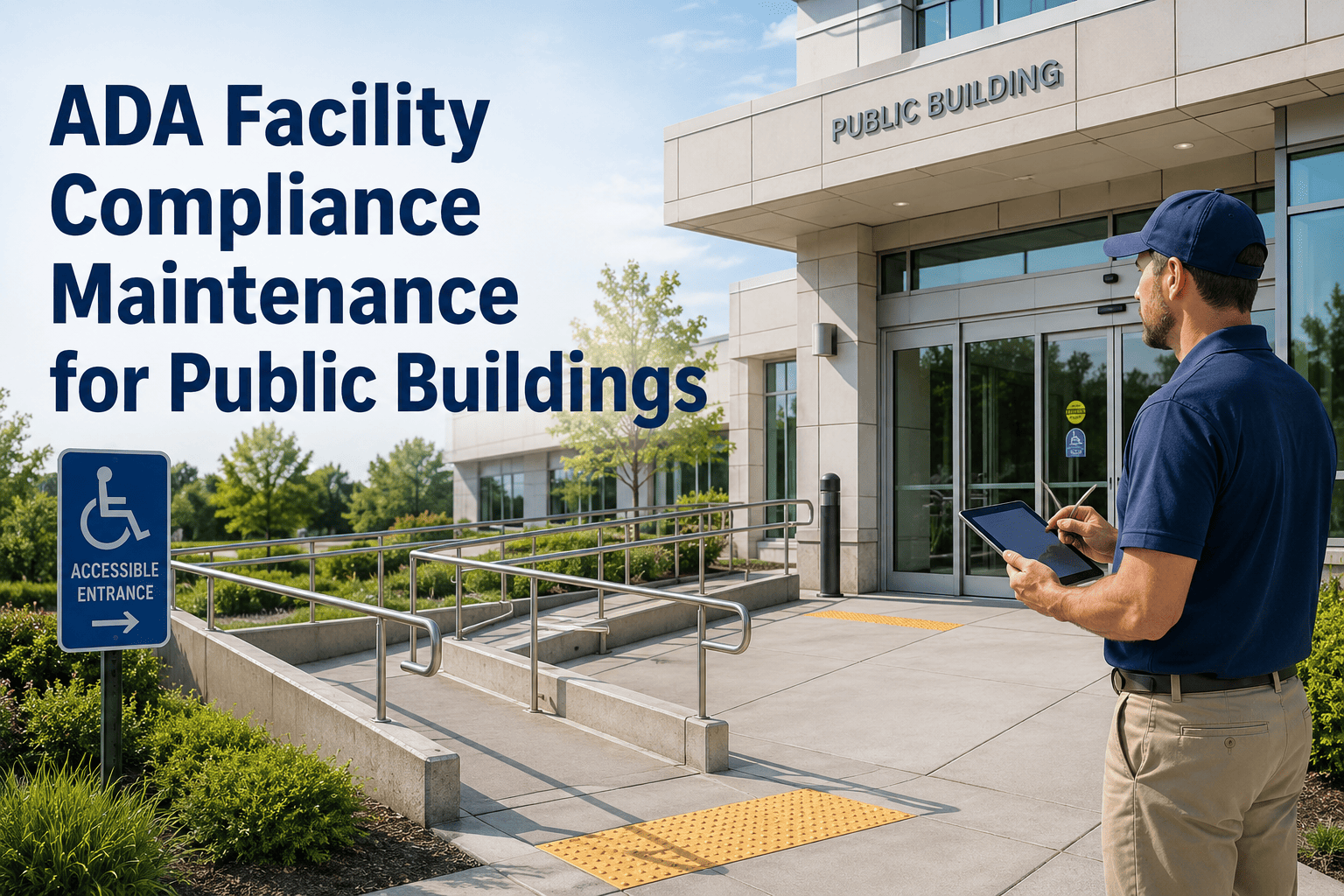
Elevator cert, door-clearance measurements, ramp slopes, grab-bar torque, and accessible-restroom fixture heights. ADA complaints are fast-moving and expensive; a documented semi-annual audit is your strongest defense.
Roof, envelope, and historic asset condition
Full roof walkdown, parapet and flashing review, window seal check, and a photograph-backed condition assessment of any designated historic interior elements. Feed findings directly into the capital plan.
Capital planning and deferment backlog review
Roll up every asset condition score into a 5-year capital forecast. Rank projects by risk-of-failure × consequence, not by squeaky-wheel politics. This is the document that wins budget season.
From paper logbooks to a defensible civic CMMS program
A civic facility maintenance program is not a software purchase — it is a 12-month operating change. Here is the cadence that consistently delivers payback inside the first budget cycle.
Asset register and criticality
Inventory every maintained asset across city hall, courthouse, and annexes. Assign a criticality score (1–5) based on life-safety impact, public-facing visibility, and replacement lead time. Most counties find 8–15% of assets they didn't know they owned.
PM library build-out
Convert tribal knowledge into templated PM checklists with cadences. Tag every PM with its regulatory driver — ADA, NFPA, state elevator code, local historic commission — so each completed task generates a defensible audit artifact.
Mobile work orders go live
Tradespeople close work orders from the field with photos. Reactive ratio typically drops 10–15 points in this window simply because problems are logged at the source instead of forgotten on a clipboard.
Vendor and security integration
Link to access-control and fire-alarm systems for automated event-triggered work orders. Onboard preferred vendors with scoped SLAs. Most security-driven maintenance gaps close inside this quarter.
Capital plan and first audit cycle
Generate the first CMMS-backed 5-year capital forecast and run it through one full audit cycle. By month 12, most civic programs hit 90%+ PM compliance and a sub-25% reactive ratio — the two numbers that win the next budget round.
What civic facility teams say after the first year
"We cut our reactive work orders from 51% to 19% in ten months. The courthouse metal-detector downtime that used to back up the morning docket hasn't happened once since we automated the quarterly security PM."
"Our last ADA audit took a morning instead of three days pulling paper. Every door clearance, ramp slope, and grab-bar torque record was already in the system, dated and photographed. That alone justified the switch."
Stop closing civic work orders on paper. Start building a defensible program.
Stand up a CMMS-driven facility maintenance program for your city hall and courthouse in under two weeks — with the PM library, ADA audit trails, and capital forecasting already built in.
Civic facility maintenance, answered
How is courthouse maintenance different from ordinary commercial facility maintenance?
Courthouses combine three pressures most commercial buildings don't: mandatory public access (so ADA and life-safety compliance is non-negotiable and heavily scrutinized), scheduled high-occupancy days tied to the court docket (which means maintenance windows are narrow and predictable), and often a historic-building designation that restricts what you can touch and how. A civic CMMS lets you schedule PMs around docket days, attach regulatory citations to each task, and document historic-fabric decisions for the record.
Can a CMMS help us pass ADA and accessibility audits?
Yes — that's one of the fastest paybacks. Every completed accessibility PM (door clearance, ramp slope, grab-bar torque, accessible-restroom fixture height, panic-hardware function) is stored with a date, a photo, and the technician's signature. When a complaint or audit arrives, you retrieve the full record in under 90 seconds instead of digging through a file room. You can see this in action — Book a Demo and we'll walk through a real ADA audit trail.
What about historic preservation requirements on older city halls and courthouses?
A CMMS doesn't override your state historic preservation office or the Secretary of the Interior's standards — but it makes compliance dramatically easier. Tag historic assets separately, attach treatment protocols to their PM templates, and require photo documentation before and after any work. This creates a condition history that protects you during reviews and helps prioritize scarce preservation dollars toward the assets at highest risk of irreversible loss.
How long does implementation take for a typical municipal portfolio?
A single city hall or courthouse usually goes live in 4–6 weeks; a multi-building civic portfolio in 8–12 weeks. The longest step is almost always building the asset register, not configuring the software. Most teams see the first measurable reactive-ratio drop by month three and reach 90%+ PM compliance by month nine to twelve.
Is there a way to try it before committing budget?
Yes. You can spin up a full civic facility workspace on a 14-day trial — import a sample asset list, build a PM library, and close real work orders with your team before any procurement conversation. Start at app.oxmaint.ai, or book a guided demo and we'll tailor the walkthrough to your courthouse or city hall portfolio.
Give your civic buildings the maintenance program they deserve.
Join the municipal and county facility teams using OxMaint to cut reactive work orders, pass audits cleanly, and protect the public buildings their communities rely on.
Free 14-day trial · No credit card