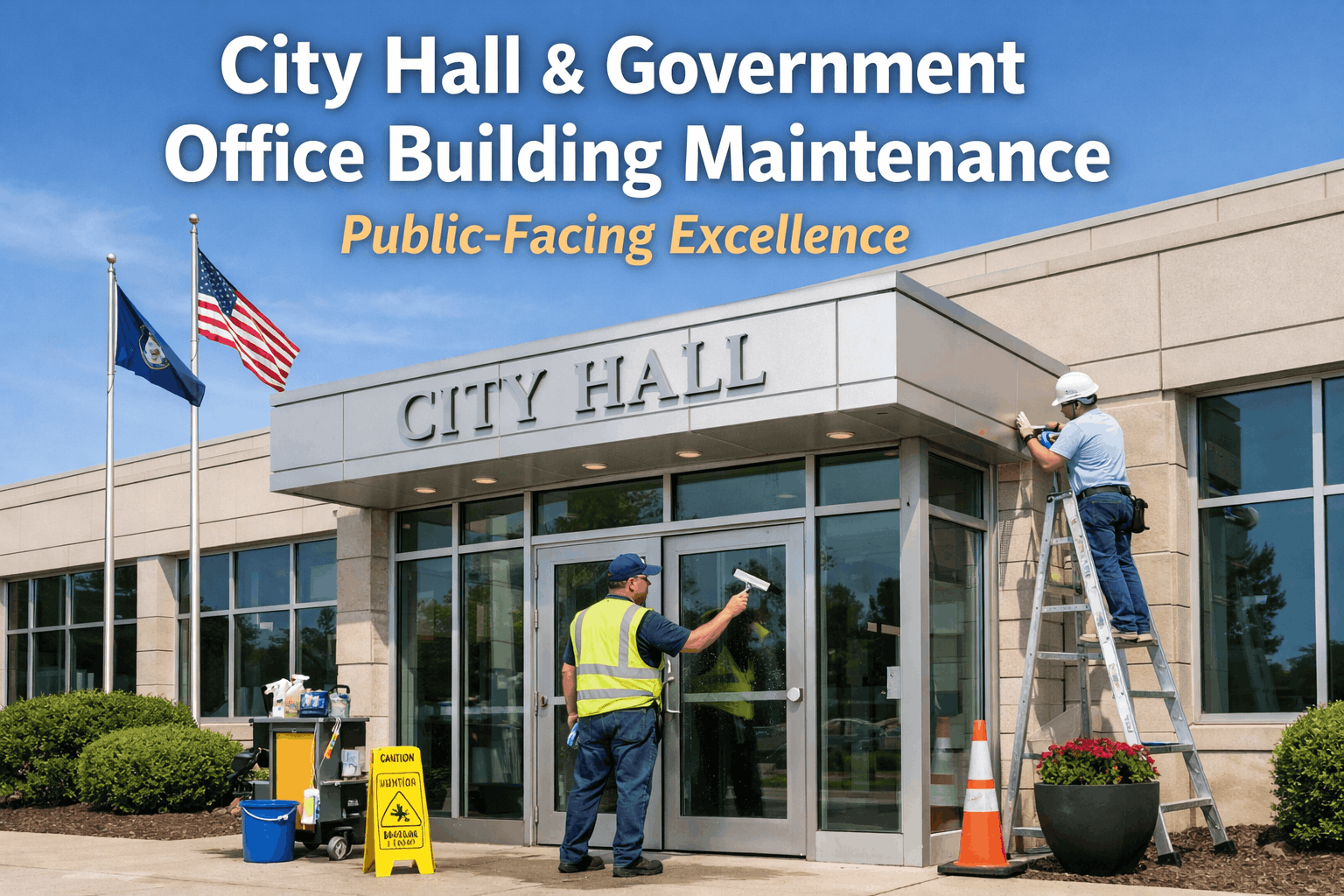
City Hall and Government Office Building Maintenance: Public-Facing Excellence
By Taylor on February 26, 2026
Behind every government building that citizens enter — to pay taxes, renew licenses, attend council meetings, or seek public services — lies a complex web of mechanical, electrical, and safety systems that must function flawlessly during every business hour. Yet most municipal building maintenance programs operate on the same reactive model they have used for decades: fix it when it breaks, call the contractor when the elevator stalls, and hope the boiler survives another winter. A stuck elevator trapping three elderly citizens between floors during a permit office visit generates a local news segment that no city manager wants to explain. A failed HVAC system turning a packed council chamber into a 92°F hearing room during August budget deliberations undermines public confidence in the very government asking for tax dollars. A malfunctioning ADA automatic door forcing a wheelchair user to wait for someone to open it manually violates federal law and erodes the public trust that government buildings are supposed to represent. These are not hypothetical scenarios — they happen in municipal buildings across America every week. Talk to our team about building a maintenance program that ensures your government facilities reflect the excellence your citizens deserve.
Government Facility Excellence 2026
City Hall & Government Office Building Maintenance: Public-Facing Excellence
Systematic CMMS-driven maintenance of HVAC, elevators, security systems, ADA compliance, and public spaces ensures that every government building is safe, accessible, energy-efficient, and welcoming — every day citizens walk through the door.
Why Government Building Maintenance Demands a Higher Standard
Government buildings are not ordinary commercial properties. They serve as the physical embodiment of public trust — the place where citizens interact with their government in person. A courthouse with a broken elevator forces mobility-impaired jurors to miss service. A city hall with a failing HVAC system sends employees home and cancels public hearings. A permit office with flickering lights and stained ceiling tiles communicates neglect before a single word is spoken. Unlike private-sector facilities, government buildings face the additional burden of public scrutiny, ADA federal mandates, historic preservation requirements, tight budget cycles, and council-approved spending constraints that make proactive maintenance not just operationally smart but politically essential.
Common Government Building Maintenance Challenges
01
Aging HVAC Systems
Boilers, chillers, and air handlers in 40-60 year old buildings running past design life. Failures during occupied hours force building closures and emergency contractor costs.
02
Elevator Entrapments
Elevator breakdowns in multi-story government buildings strand citizens and staff. ADA requires functional elevator access — every hour of downtime is a compliance violation.
03
Security System Gaps
Access control panels, surveillance cameras, metal detectors, and panic buttons require continuous maintenance. A failed camera during a security incident creates legal liability.
04
ADA Non-Compliance
Automatic door openers, ramp surfaces, accessible restroom fixtures, and signage require ongoing maintenance. Non-compliance exposes municipalities to federal lawsuits and DOJ action.
05
Public Space Deterioration
Lobbies, restrooms, parking structures, and exterior facades visible to every visitor. Deferred cosmetic and structural maintenance erodes public confidence in government competence.
The Smart Government Building Maintenance Stack
A modern government building maintenance architecture layers capabilities: Asset Inventory catalogs every system across every building; Preventive Scheduling automates inspections and servicing; Compliance Tracking documents code adherence for auditors; Work Order Management routes repairs by trade and priority; and Analytics provide building condition data for capital planning. This stack transforms reactive custodial response into proactive facility excellence.
Government Building Maintenance Architecture
From building system inventory to capital improvement planning: a unified maintenance pipeline
1
Complete Asset Inventory
Catalog every HVAC unit, elevator, generator, fire panel, ADA feature, roof section, plumbing riser, and electrical panel across all government buildings with age, condition, and warranty data.
Foundation
2
Automated PM Scheduling
Configure recurring preventive maintenance for every building system — HVAC filter cycles, elevator inspections, fire alarm tests, generator load runs, roof assessments — with auto-generated work orders.
Prevention
3
Compliance & Code Tracking
Document every fire marshal inspection, ADA assessment, elevator certification, backflow test, and generator compliance run with timestamped records exportable for state auditors and federal reviewers.
Accountability
4
Trade-Routed Work Orders
Staff and department heads submit requests via mobile portal. CMMS auto-routes to correct trade — HVAC, electrical, plumbing, elevator, security, custodial — with priority levels and SLA tracking.
Execution
5
Building Condition Analytics
Dashboard reports showing maintenance costs by building, system age vs. failure rates, reactive vs. preventive ratios, and deferred maintenance backlog — the data foundation for capital improvement budget requests.
Intelligence
Your Buildings Represent Your Government
Oxmaint connects every HVAC unit, elevator, fire panel, and ADA feature across all your government buildings into one maintenance platform. Automate inspections, track compliance, route work orders, and give your city manager the building condition data they need for capital planning.
Reactive vs. Proactive: The Case for Preventive Maintenance
There is often tension between the reactive model that most government maintenance departments default to and the proactive model that prevents the headline-generating failures. Reactive maintenance feels cheaper in the short term because it requires no planning — but it costs 3-5x more per repair, causes unplanned building closures, and creates the compliance gaps that auditors and attorneys exploit. Proactive maintenance requires upfront investment in scheduling and CMMS tools — but it extends equipment life, prevents citizen-facing disruptions, and builds the documented maintenance history that protects the municipality legally.
Maintenance Strategy Comparison
Proactive (CMMS-Driven)
HVAC: Scheduled filter/coil/belt cycles
Elevators: Monthly PM + annual certification
Fire Safety: Code-required test calendar
Budget: Predictable, documented, defensible
vs
Reactive (Break-Fix)
HVAC: Emergency calls when unit fails
Elevators: Repair only after entrapment
Fire Safety: Discovered during marshal visit
Budget: Unpredictable, crisis-driven, questioned
Expert Perspective: Why Public Buildings Demand More
I have managed government buildings for twenty-two years across three municipalities, and the single greatest lesson is this: every maintenance dollar you defer today becomes three dollars of emergency repair next year and ten dollars of capital replacement in five years. But the real cost isn't financial — it's the erosion of public trust. When a citizen walks into a city hall with a broken escalator, water-stained ceiling tiles, and a restroom with a broken lock, they don't see a maintenance backlog. They see a government that cannot manage basic building operations, and they question every other claim that government makes about competence. A CMMS doesn't just prevent equipment failures — it prevents the perception of failure that is equally damaging to public institutions.
— Director of Facilities, U.S. County Government
3-5x
Reactive repair costs vs. planned PM
24/7
Security & fire systems require continuous uptime
ADA
Federal compliance — no exceptions, no extensions
Government facility directors who invest in CMMS-driven preventive maintenance are not just protecting building systems — they are protecting the institution itself. Every scheduled HVAC filter change, every completed elevator inspection, every documented fire alarm test builds a record of diligence that shields the municipality from litigation, satisfies auditors, impresses council members reviewing capital budgets, and most importantly, ensures that every citizen who enters a government building finds a facility that is safe, accessible, comfortable, and worthy of the public trust it represents. Start Free Trial and build a maintenance program that reflects the excellence your community expects.
Every Government Building Should Work as Well as the People Inside It
Oxmaint brings together HVAC scheduling, elevator tracking, fire safety compliance, ADA feature management, security system maintenance, and building condition analytics into one CMMS platform built for government facilities. Track every asset, automate every PM, document every inspection — across every building in your portfolio.
What building systems should a government facility CMMS track?
A comprehensive government building CMMS should track every system that affects occupant safety, comfort, regulatory compliance, and building longevity. This includes HVAC systems (boilers, chillers, air handlers, rooftop units, VAV boxes, thermostats, BAS controls), elevators and escalators (cab equipment, door operators, safety devices, annual certifications), fire and life safety (alarm panels, sprinkler systems, extinguishers, emergency lighting, fire doors, kitchen hood suppression), electrical systems (panels, generators, UPS systems, lighting, surge protection), plumbing (domestic water, backflow preventers, water heaters, sanitary and storm drainage), security systems (access control, surveillance cameras, metal detectors, panic buttons, intercom systems), ADA features (automatic door openers, accessible restroom fixtures, ramp surfaces, signage, assistive listening systems), and building envelope (roofing, windows, exterior walls, parking structures). Oxmaint catalogs every asset with age, location, warranty, and maintenance history. Start your free trial to begin building your asset registry.
How does Oxmaint handle elevator maintenance tracking and compliance?
Elevator maintenance in government buildings is both a safety imperative and a regulatory requirement. Oxmaint tracks elevator service contracts with vendor performance monitoring, schedules monthly preventive maintenance tasks (door operator adjustment, leveling accuracy, safety device testing, cab lighting and ventilation checks), logs every service visit with technician notes and completion photos, manages annual state inspection certification timelines with advance alerts, and documents every entrapment incident with response time data. For multi-building portfolios, the dashboard shows elevator uptime percentage, PM compliance rate, and vendor response times across every building — giving facility directors the data to hold elevator contractors accountable to their SLA commitments.
What fire safety inspections are required for government buildings?
Government buildings must comply with NFPA 101 Life Safety Code and local fire marshal requirements, which typically include: fire alarm panel testing monthly with annual sensitivity testing, sprinkler system quarterly visual and annual flow/trip tests, fire extinguisher monthly visual inspection with annual certification and 6-year maintenance, emergency and exit lighting monthly 30-second test with annual 90-minute battery discharge test, fire door closer and latching verification quarterly, kitchen hood suppression system semi-annual inspection, and a comprehensive fire marshal walk-through annually. Oxmaint automates every one of these schedules, generates work orders with specific test procedures, and maintains the timestamped compliance records that fire marshals require — eliminating the scramble to assemble documentation before an inspection visit.
How can CMMS help with ADA compliance in government buildings?
ADA compliance in government buildings is a federal mandate under Title II — there are no exceptions and no grace periods. Oxmaint helps maintain compliance by tracking every ADA feature as a discrete asset: automatic door openers (motor condition, activation button function, opening force measurement), accessible restroom fixtures (grab bar mounting integrity, accessible stall hardware, sink height verification), ramp and walkway surfaces (slip resistance, edge detection, drainage condition), elevators (braille signage, audible floor indicators, cab dimensions), assistive listening systems in council chambers and courtrooms, and accessible parking striping and signage condition. When any ADA feature is reported as non-functional, the CMMS escalates it to emergency priority — because unlike a cosmetic repair, an ADA failure exposes the municipality to immediate legal liability.
What is the ROI of preventive maintenance for government buildings?
The ROI of government building preventive maintenance operates on three levels. Direct cost savings: proactive HVAC maintenance extends equipment life 25-40% and reduces energy consumption 15-30%; scheduled elevator PM reduces entrapment incidents by 60-80%; planned repairs cost 3-5x less than emergency calls. Avoided liability: documented ADA maintenance protects against federal lawsuits (average ADA settlement: $50,000-$300,000); documented fire safety compliance prevents marshal-ordered closures. Political and institutional value: building condition data justifies capital improvement requests to council; visible facility quality reinforces public confidence in government competence. For a municipality managing 5-10 major government buildings, the annual avoided-cost value of a comprehensive PM program typically exceeds $500,000-$2M. Book a demo to calculate projected savings for your building portfolio.