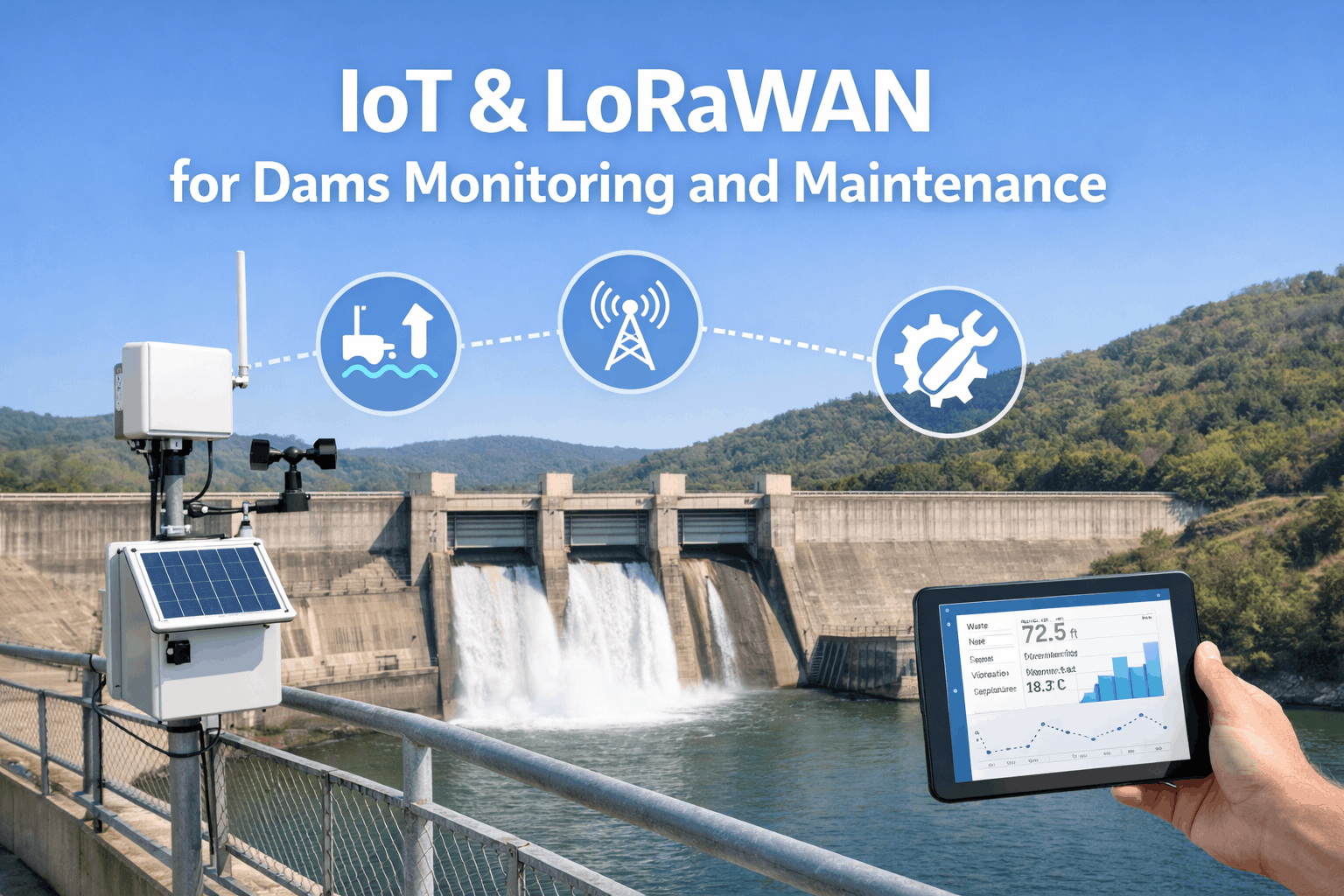
Dam failures do not announce themselves on inspection day. Seepage pathways develop during rainstorm events. Foundation pore pressures build during rapid reservoir filling. Embankment settlement occurs under specific loading combinations. Structural cracking initiates under thermal cycling at night — between field visits, between quarterly readings, between annual reviews.If your dam program still runs on scheduled site visits and manual logbooks, start a free OxMaint trial to see what continuous monitoring looks like in practice — or book a demo and we will walk through your specific dam type and sensor configuration.
50%
of embankment dam failures worldwide caused by internal erosion and piping — detectable by continuous piezometer monitoring
30%
of stored dam water lost annually to seepage globally — continuous monitoring enables early-stage detection and intervention
1/min
AI-enabled sensors auto-switch from hourly to per-minute measurement when anomalous conditions are detected
The 5 Parameters That Define Dam Safety — Monitored Continuously
Every dam safety program tracks the same core parameters. The difference between a manual program and a continuous monitoring program is not what is measured — it is when. An anomaly that develops on a Tuesday is visible to a continuous system on Tuesday. In a manual program, it waits until the next scheduled visit.
01
Pore Pressure Piezometers
The primary internal loading parameter for embankment dam stability. Elevated or rapidly rising pore pressure in upstream embankment, foundation, or abutment zones indicates developing seepage pathways or drainage system failure — the earliest quantitative warning of internal erosion.
AI alert triggers when hourly pore pressure rise exceeds threshold, or when readings deviate more than 2 standard deviations from expected values for current reservoir level and precipitation history.
02
Seepage Flow and Turbidity Seepage meters, turbidity sensors
The most direct evidence of internal erosion. An increase in seepage flow relative to historical levels for the current reservoir stage — or the appearance of turbidity indicating transport of fine material — are among the highest-consequence alarm conditions in any dam monitoring program.
Turbidity alert is zero-tolerance: any non-background turbidity in seepage triggers immediate notification regardless of flow rate. Seepage flow deviation from the predicted flow-stage regression triggers alert at defined confidence interval.
03
Structural Movement Inclinometers, tiltmeters, settlement gauges
Deformation of the dam body, foundation, and abutments indicates overstress, internal erosion, or foundation instability. Continuous structural movement monitoring detects millimeter-scale changes that accumulate between manual readings without triggering any alert in a non-continuous program.
Rate-of-change alert activates when deformation velocity exceeds defined threshold. Absolute displacement alert triggers when cumulative movement since baseline exceeds design tolerance.
04
Reservoir Level Ultrasonic level sensors, visual camera reference
The primary load parameter that normalizes every other instrument reading. Without accurate, continuous reservoir level data, piezometer readings, seepage flow comparisons, and structural displacement references cannot be correctly interpreted. Redundant level measurement with two independent sensors is the minimum for safety-critical monitoring.
Rate-of-rise alert correlated with inflow forecast triggers Emergency Action Plan review. Sudden unexplained level drop alert may indicate a developing piping breach pathway.
05
Seismic Activity Accelerometers, seismometers
Seismic monitoring serves two functions: detection of earthquake events that may have caused structural damage requiring immediate post-event inspection, and long-term monitoring of microseismic activity that may indicate developing internal instability before visible surface evidence appears.
Post-seismic event protocol activates automatically when ground acceleration exceeds threshold — triggering inspections, piezometer review, and accelerated monitoring frequency for the defined post-event window.
Managing all five parameters across a dam portfolio requires a platform that connects sensor data, correlates readings across instruments simultaneously, and maintains a complete audit trail for regulatory reporting. OxMaint centralizes this — sensor data, inspection records, maintenance work orders, and compliance documentation in one place. Book a demo to see how multi-parameter correlation works for your dam type.
Where Manual Programs Fail — And What Continuous Monitoring Catches
Seepage developing during a storm event
Detected at next scheduled visit — days or weeks later
Alert within minutes of flow deviation from stage-regression model
Pore pressure spike during rapid reservoir filling
Missed entirely if filling occurs between readings
Rate-of-change alert triggers during the event — not after
Structural cracking under thermal cycling overnight
Not detected until visual observation during site visit
Strain gauge deviation triggers alert before crack propagates
Turbidity appearing in seepage output
Dependent on technician observation — may be missed entirely
Zero-tolerance alert — any turbidity triggers immediate notification
Post-seismic structural assessment requirement
Manual decision to mobilize team after receiving event notification
Automatic post-seismic inspection protocol activates at defined threshold
How AI Turns Sensor Data Into Actionable Alerts
Raw sensor data from a single instrument is meaningful. Multi-parameter correlation across all instruments simultaneously is what converts monitoring into genuine early warning. AI analysis relates piezometer, settlement, seepage, and reservoir data in real time — detecting combinations of readings that individually appear within normal range but together indicate developing distress.
Statistical baseline modeling
Rolling 30-day statistical window establishes the expected reading for each instrument given current reservoir level and precipitation history. Alerts trigger on deviation from expected — not just absolute threshold breach.
Multi-parameter correlation
AI relates piezometer, settlement, seepage, and reservoir readings simultaneously. A pore pressure reading within tolerance combined with an unusual seepage turbidity reading triggers correlation alert — patterns neither instrument would produce alone.
Adaptive measurement frequency
Sensors operate at hourly intervals under normal conditions, automatically switching to per-minute precision measurement when anomalous readings are detected — maximizing data resolution exactly when it matters most.
Continuous Dam Monitoring — OxMaint
Every Sensor Reading. Every Alert. Every Compliance Record — One Platform.
OxMaint connects IoT sensor data to a full dam safety management program — real-time dashboards, multi-parameter alert logic, maintenance work order generation, and regulatory compliance documentation. Built for dam safety engineers, not IT teams.
Frequently Asked Questions
What sensors are required for continuous dam safety monitoring?
The core sensor set for continuous dam monitoring includes piezometers (pore pressure), seepage flow meters and turbidity sensors, inclinometers and settlement gauges (structural movement), and redundant reservoir level sensors. Larger programs add fiber-optic strain gauges, automatic total stations for surface deformation tracking, and seismometers for post-event protocols. OxMaint integrates with all major sensor platforms and data logger systems — existing instrumentation does not need to be replaced to connect to the platform.
How does AI improve on traditional threshold-based dam monitoring alerts?
Traditional threshold alerts trigger when a reading exceeds a fixed value — regardless of context. AI-based monitoring establishes a statistical baseline for each instrument that accounts for current reservoir level, precipitation history, and seasonal variation. An alert triggers when a reading deviates from its expected value for current conditions — which is far more sensitive to developing anomalies than a fixed threshold, and generates far fewer false alarms. Multi-parameter correlation further improves this by detecting combinations of readings that individually appear normal but together indicate developing distress.
Does OxMaint replace manual dam inspections, or complement them?
OxMaint complements manual inspections — it does not replace them. Continuous IoT monitoring captures the conditions that develop between field visits and cannot be detected by periodic inspection alone. Manual inspections remain essential for visual assessment, physical instrument calibration, and observations that sensors cannot make. OxMaint manages both — scheduling manual inspection rounds, capturing inspection results digitally, and storing them alongside continuous sensor data in a unified dam safety record that is always audit-ready.
IoT and AI Dam Safety — OxMaint
Stop Relying on Inspection Schedules for Real-Time Conditions.
24/7
continuous monitoring
5 parameters
correlated by AI simultaneously
Zero gaps
between inspection visits
OxMaint connects your dam's IoT sensors to a full safety management platform — real-time multi-parameter correlation, automated alert escalation, maintenance work order generation, and compliance documentation.
Start your free trial today, or
book a demo for a configuration walkthrough specific to your dam portfolio.