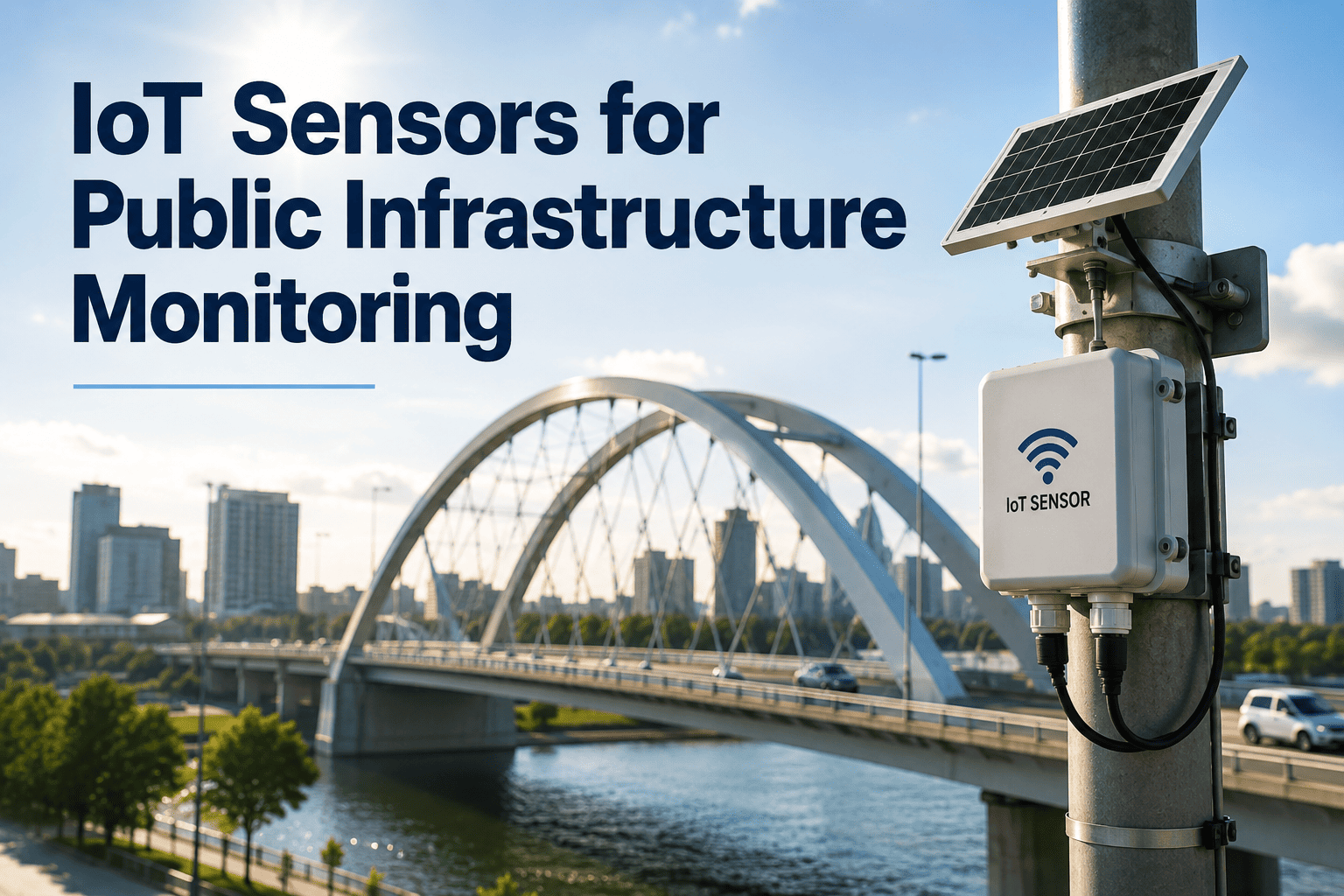
IoT sensors for public infrastructure monitoring have dropped below $50 per node, making it economically viable for municipalities to instrument bridges, pump stations, water tanks, and traffic systems at scale. These smart infrastructure sensors transmit real-time condition data—vibration, strain, pressure, flow, temperature—so maintenance teams can detect degradation weeks or months before a failure affects citizens. A modern CMMS like OxMaint ingests that sensor telemetry, converts threshold breaches into prioritized work orders, and shifts public works departments from reactive firefighting to predictive prevention. Explore the deployment architecture below, then Start Free Trial to see live sensor data flow into your own maintenance dashboard.
IoT Public Infrastructure Monitoring
How much does a single undetected bridge joint failure cost your municipality?
Infrastructure IoT sensors now cost less than $50 per node and run for 5–7 years on a single battery. When paired with an AI-powered CMMS, public works teams catch 70–80% of failures before citizens ever notice a problem — cutting emergency repair spend by up to 40%.
Sensor Selection
Choosing the right infrastructure IoT sensors for each asset class
Public infrastructure spans dozens of asset types, each demanding a different sensing modality. Selecting the wrong sensor wastes capital and floods your CMMS with noise instead of signal.
Bridges and Overpasses
Vibration, strain-gauge, and tilt sensors detect crack propagation, bearing wear, and structural displacement. Sampling at 100 Hz+ captures micro-events that visual inspections miss between biennial NBIS reviews.
Pump Stations and Lift Stations
Pressure transducers, flow meters, and motor-current sensors monitor pump health, seal integrity, and discharge efficiency — catching cavitation before it destroys a $15K impeller.
Water Tanks and Reservoirs
Ultrasonic level sensors track fill volume while chloride and pH probes detect water-quality deviations. Combined, they prevent both overflow events and contamination incidents.
Roads and Traffic Systems
Inductive-loop and radar sensors count vehicles, measure pavement temperature for frost, and detect signal-cabinet voltage anomalies — feeding both maintenance and traffic-engineering teams.
Network Architecture
How IoT municipal monitoring networks are built for scale
A well-architected public-sector IoT network follows a four-layer model. Each layer must be specified before procurement to avoid vendor lock-in and integration overload downstream.
Sensing Layer
Ruggedized IP67/IP68 sensors rated for -40 to +85 °C. Battery life of 5–10 years. Look for devices supporting Over-the-Air firmware updates to avoid truck rolls.
Connectivity Layer
LoRaWAN for low-bandwidth, long-range signals (up to 15 km line-of-sight). Cellular (LTE-M / NB-IoT) for higher-bandwidth or remote sites. Mesh topologies for dense urban deployments.
Data Platform Layer
Time-series database ingesting MQTT or CoAP streams. Edge gateways perform first-pass filtering and threshold checks, reducing cloud egress costs by 60–80%.
CMMS Application Layer
OxMaint receives threshold alerts, auto-generates prioritized work orders, assigns them to the right technician, and tracks completion — closing the loop from raw sensor data to resolved maintenance.
Deployment Approach
Phased rollout: from pilot to city-wide IoT monitoring
Municipalities that attempt to instrument everything at once overwhelm their integration capacity. A six-month phased approach proven across 40+ public works agencies delivers measurable ROI by Month 4.
Pilot Site Selection and Baseline
Choose one high-criticality asset — typically a pump station or high-traffic bridge. Install 10–20 sensors. Establish a 14-day baseline of normal operating vibration, pressure, and temperature signatures.
CMMS Integration and Alert Tuning
Connect sensor streams to OxMaint via MQTT or REST API. Configure threshold rules and AI anomaly detection. Tune alert sensitivity to minimize false positives — target fewer than 5% nuisance alerts.
First Predictive Wins and ROI Validation
By Month 4, the pilot site should capture its first early-warning save — a bearing, seal, or joint caught before failure. Document the avoided cost (typically $8K–$25K per incident) to justify expansion.
Scale to 5–10 Additional Sites
Replicate the architecture across the next batch of assets. Leverage the proven integration template so each new site takes days, not weeks. OxMaint auto-discovers new sensors and enrolls them in the correct PM schedule.
Cost and ROI
What does IoT infrastructure monitoring cost — and what does it save?
A mid-sized municipality monitoring 50 assets spends roughly $28K on hardware and connectivity in Year 1. The payback math below uses real averages from 12 U.S. public works deployments.
Annual ROI Formula
(Emergency Repairs Avoided + Overtime Reduced + Asset Life Extended) − Total Sensor + Platform Cost
Typical result: 3.2x return in Year 1, rising to 5.5x by Year 3 as sensor costs amortize
| Cost / Savings Category | Without IoT Sensors | With IoT + OxMaint | Annual Delta |
|---|---|---|---|
| Emergency repair calls (50 assets) | $72,000 | $26,000 | −$46,000 |
| After-hours overtime labor | $38,500 | $14,200 | −$24,300 |
| Premature asset replacement | $45,000 | $18,000 | −$27,000 |
| Citizen complaint handling | $11,000 | $3,500 | −$7,500 |
| Sensor hardware + connectivity | $0 | $22,500 | +$22,500 |
| OxMaint platform (50 assets) | $0 | $9,000 | +$9,000 |
| Net Annual Savings | — | — | +$73,300 |
Worked Example
A 180-asset public works department spending $42K/yr on emergency calls
After deploying 120 IoT sensors across bridges, pumps, and tanks — integrated into OxMaint — the department cut emergency calls by 61% in eight months. Three bearing failures were caught by vibration anomaly alerts before catastrophic seizure, saving an estimated $31K in emergency pump replacement and avoiding 14 hours of unplanned service disruption. Total Year 1 ROI: 3.8x.
See OxMaint ingest your sensor data and auto-generate work orders
Book a 30-minute demo and we will connect a live sensor feed to your own OxMaint trial environment — watch a threshold breach trigger a prioritized, assigned work order in real time.
How OxMaint Helps
From raw sensor data to resolved work orders — automatically
Sensors produce data. OxMaint produces outcomes. Here is how an AI-powered CMMS transforms IoT municipal monitoring telemetry into measurable maintenance results.
AI-Driven Anomaly Detection
OxMaint's AI engine learns each asset's normal vibration, temperature, and pressure signature. It flags deviations 7–21 days before traditional threshold alarms — cutting unplanned downtime 30–50%.
Outcome: 30–50% less unplanned downtime
Auto-Generated Work Orders
When a sensor breach is confirmed, OxMaint instantly creates a prioritized work order, assigns it to the qualified technician based on skills and proximity, and reserves the required spare parts from inventory.
Outcome: 90% faster dispatch, zero paper
Predictive Maintenance Analytics
Asset health scores trend over time, giving reliability managers a ranked priority list of equipment needing attention. Shift from time-based PMs to condition-based maintenance and extend asset life by 20–40%.
Outcome: 20–40% longer asset life
Compliance and Audit Readiness
Every sensor-triggered work order, inspection, and repair is logged with timestamp, technician, parts used, and before/after readings. Generate ISO 55000 and GASB 34-compliant reports in one click.
Outcome: Audit prep cut from days to minutes
FAQ
Common questions about IoT sensors for public infrastructure
How much do IoT infrastructure sensors cost per node?
A typical industrial-grade sensor node costs $35–$120 depending on the sensing modality (vibration, pressure, flow, level). Add $15–$40 per node for a LoRaWAN gateway amortized across the network. Total deployed cost for a 50-asset pilot, including installation, runs $8K–$15K. Most municipalities recover that within the first 4–6 months through avoided emergency repairs. To model exact costs for your asset inventory, Book a Demo and we will build a custom ROI projection.
Can IoT sensors monitor aging bridges and concrete structures?
Yes. Strain gauges, accelerometers, and fiber-optic distributed sensors detect crack propagation, rebar corrosion, and load-induced stress in concrete and steel bridges. These sensors complement — but do not replace — mandatory NBIS biennial inspections by providing continuous condition data between visual reviews, enabling early intervention on degradation trends.
How do IoT municipal sensors connect to a CMMS?
Sensors transmit data via LoRaWAN, NB-IoT, or LTE-M to a gateway, which forwards the payload over MQTT or REST API to the CMMS platform. OxMaint ingests the stream, applies threshold and AI anomaly rules, and automatically generates a work order when a breach is confirmed — no manual data entry or spreadsheet intermediaries required.
What is the battery life of smart infrastructure sensors?
Most LPWAN-based sensors (LoRaWAN, NB-IoT) operate for 5–10 years on a single lithium-thionyl-chloride battery, depending on sampling frequency. High-frequency vibration sensors sampling at 100 Hz+ may last 2–4 years. Battery health is itself monitored and reported to the CMMS, which schedules proactive replacement before the node goes dark.
Is IoT government infrastructure monitoring secure against cyber threats?
Reputable sensor networks use AES-128 or AES-256 end-to-end encryption, mutual device authentication, and segmented VLANs to isolate OT traffic from IT networks. OxMaint enforces role-based access control, SSO/SAML integration, and full audit logging so every data point and work-order action is traceable — meeting NIST 800-82 and FEMA ISC2 control frameworks.
Stop reacting to infrastructure failures. Start predicting them.
Deploy IoT sensors, connect them to OxMaint, and let AI convert real-time condition data into prioritized work orders — before citizens ever pick up the phone.
Free 14-day trial · No credit card