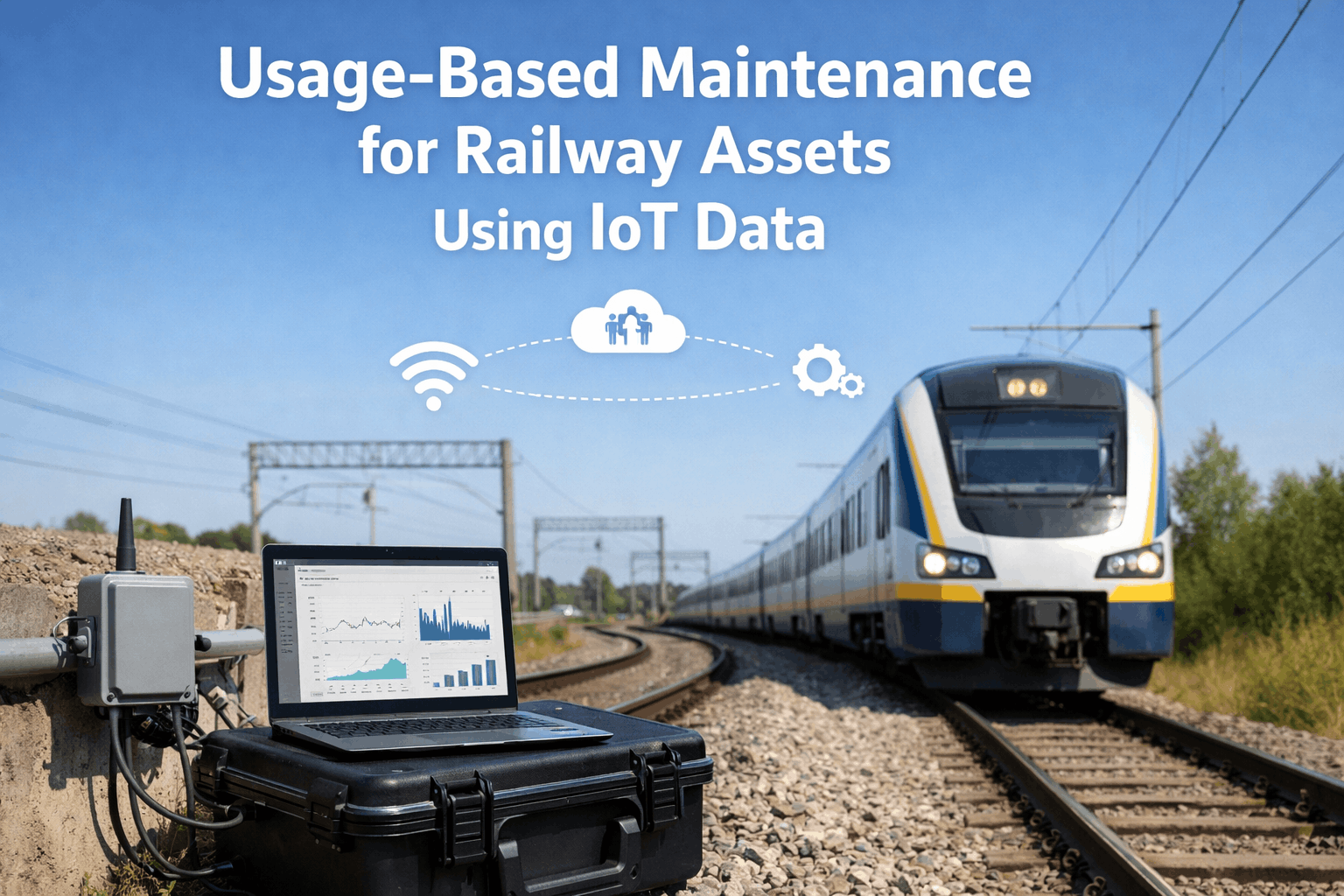
When a rail infrastructure director asks "What is the remaining useful life of the Eastside viaduct?" and the answer relies on a paper inspection report from two years ago, the liability gap is not just operational — it is a matter of public safety. Railway agencies manage billions in infrastructure — bridges, tunnels, track, signaling, electrification — yet many still depend on fragmented spreadsheets, subjective visual inspections, and reactive "break-fix" cycles. The resulting deferred maintenance backlog grows silently until it manifests as speed restrictions, unplanned closures, or structural failures. The solution is the Digital Twin: a living, data-fed virtual replica of every physical railway asset, continuously updated by IoT sensors, drone surveys, and robot inspections. When integrated with a CMMS like Oxmaint, the digital twin transforms railway maintenance from gut-feel guesswork into objective, evidence-based predictive operations. Talk to our team about deploying digital twin intelligence across your railway network.
Architecture Guide — 2026 Edition
Digital Twin for Railways Infrastructure Management
Build living virtual replicas of bridges, tunnels, track, and signals — fed by IoT sensors, drone surveys, and AI analytics. Transform maintenance from reactive to predictive with GIS-integrated risk scoring and CMMS automation.
60%
Reduction in unplanned asset failures via digital twin prediction
10×
Faster condition assessment using AI sensor fusion
$5:1
ROI on predictive vs. reactive railway maintenance spend
24/7
Real-time structural health monitoring across the network
Why Legacy Railway Asset Management Fails
Railway agencies relying on paper inspection forms, disconnected databases, and periodic visual patrols to manage safety-critical infrastructure are operating blind. Legacy methods are labor-intensive, subjective, and data-poor. A bridge inspection conducted manually is often outdated by the time the report is filed. Without real-time condition intelligence, agencies allocate budgets based on asset age or complaint volume rather than actual deterioration — leading to wasted spend on healthy assets and dangerous neglect of failing ones. The digital twin model treats infrastructure data as a live, strategic asset that continuously informs every maintenance and capital decision. Start Free Trial.
The Six Failure Modes of Analog Railway Management
Data Fragmentation
78%
Asset data scattered across GIS, Excel, paper files, and vendor portals — making holistic condition assessment impossible.
Subjective Inspections
±40%
Manual condition grades vary by inspector, weather, and fatigue. One engineer's "satisfactory" is another's "poor" — skewing renewal budgets.
Reactive Firefighting
65%
Maintenance budgets consumed by emergency speed restrictions and unplanned closures, leaving zero for proactive renewal programs.
No Deterioration Models
Risk
Capital plans built on asset age rather than actual condition curves — leading to premature replacement or dangerous late-stage failures.
Workforce Gaps
High
Experienced track engineers retiring faster than replacements. Not enough staff to inspect every structure on mandatory regulatory cycles.
Regulatory Exposure
$$$
Inability to demonstrate compliance with safety inspection mandates due to poor documentation, fragmented records, and inconsistent reporting.
The Digital Twin Architecture: From Sensor to Strategy
A railway digital twin is not a static 3D model — it is a living system that continuously ingests real-world data and produces actionable intelligence. The architecture flows from physical data capture (IoT sensors, drones, robots) through AI processing and risk modeling to automated CMMS work orders and strategic capital planning. Each layer builds on the one below, creating a self-improving feedback loop that gets smarter with every inspection cycle.
Digital Twin Architecture Layers
Seven-layer intelligence pipeline from physical reality to strategic decision
Track, bridges, tunnels, signals, switches, catenary, and embankments — the real-world infrastructure network.
Foundation
›
IoT sensors (strain, vibration, temperature), drones, track robots, LiDAR, and SCADA feeds collect live condition data.
Continuous
›
3D/BIM models enriched with real-time sensor data, inspection histories, and material properties create a virtual replica.
Virtual Layer
›
Asset health overlaid on geospatial maps — showing condition, risk, traffic density, and environmental factors by location.
Spatial
›
Machine learning algorithms calculate dynamic risk scores combining condition, criticality, traffic loading, and consequence-of-failure.
Intelligence
›
Oxmaint auto-generates prioritized work orders with asset location, defect evidence, severity rating, and recommended intervention.
Action
›
Aggregated twin data feeds multi-year renewal programs, budget scenarios, and regulatory compliance reporting.
Strategic
Build Your Railway Digital Twin Today
Oxmaint provides the CMMS backbone for your digital twin architecture — ingesting sensor data, visualizing asset risk on GIS maps, and auto-generating maintenance workflows so every decision is data-driven, not guesswork.
Digital Twin & SHM: The Three Core Capabilities
A railway digital twin delivers value through three interconnected capabilities: virtual asset modeling, GIS-integrated spatial intelligence, and dynamic risk scoring. Together they replace static inspection reports with a living, continuously updated view of network health — enabling asset managers to see the current state, predict the future state, and plan the optimal intervention for every structure on the network. Book a Demo.
Digital Twin & SHM Core Capability Tracks
Digital Twin Models — Living Virtual Replicas
3D/BIM Geometry
Sensor Data Fusion
Material Properties
Inspection History
Deterioration Curves
What-If Simulation
Create living virtual replicas of bridges, tunnels, track sections, and structures — continuously updated by IoT telemetry, drone surveys, and robot inspection data. Run "what-if" scenarios to model intervention timing and predict remaining useful life under different loading and environmental conditions.
GIS Map Overlays — Spatial Intelligence Layer
Asset Location
Condition Heatmaps
Traffic Density
Environmental Zones
Defect Clusters
Renewal Planning
Overlay digital twin health data onto geospatial maps to visualize condition, risk, and criticality across the entire route network. Identify spatial patterns — like corrosion clusters near coastal sections or track geometry degradation on high-traffic corridors — that traditional tabular reports miss entirely.
Risk Scoring & Asset Criticality Engine
Condition Score
Consequence Rating
Traffic Weighting
Redundancy Factor
Dynamic Re-scoring
Priority Ranking
Calculate dynamic risk scores for every asset by combining real-time condition data with criticality factors — traffic volume, route redundancy, consequence of failure, and regulatory classification. Scores update automatically as new sensor readings and inspection findings flow into the twin, ensuring maintenance priorities always reflect current reality.
Structural Health Monitoring — Continuous Sensing
Strain Gauges
Accelerometers
Temperature Probes
Tilt Sensors
Corrosion Probes
Acoustic Emission
Deploy IoT sensor networks on safety-critical structures to measure strain, vibration, temperature, tilt, and corrosion in real time. Continuous SHM data feeds directly into the digital twin, replacing periodic inspections with always-on condition awareness that detects deterioration the moment it begins.
Before & After: The Impact of Digital Twin Intelligence
Moving from periodic manual inspections to a continuously updated digital twin yields transformative results across every metric that matters to railway operators, finance directors, and safety regulators. The comparison below quantifies why leading rail agencies invest in digital twin architecture as the foundation of their asset management strategy.
See Your Railway Network in Real Time
Oxmaint connects digital twin intelligence with CMMS execution — turning sensor data, GIS risk maps, and AI condition scores into prioritized maintenance actions that keep your railway safe, available, and compliant.
Digital Twin Outputs & Deliverables
For a digital twin to justify investment, it must produce actionable intelligence — not just 3D visuals. Modern platforms generate specific deliverables that engineering teams, finance directors, and safety regulators use daily. These outputs validate renewal budgets, defend capital decisions, and provide the evidence base for competitive infrastructure funding applications. Start Free Trial.
Digital Twin Intelligence Outputs
01
Asset Health Dashboards
Network-wide condition overview
Asset-level drill-down detail
Real-time sensor status feeds
02
GIS Risk Heatmaps
Geospatial failure probability
Criticality vs. condition mapping
Defect cluster identification
03
Deterioration Curves
Remaining useful life projections
"Do nothing" cost scenarios
Intervention impact modeling
04
Automated Work Orders
Condition-triggered dispatch
GPS-located defect evidence
Recommended repair method
05
Capital Renewal Programs
Multi-year budget scenarios
ROI per intervention option
Funding gap visualization
06
Regulatory Compliance
Inspection mandate tracking
Safety authority audit trails
Performance benchmarking
Expert Perspective: The Digital Twin Imperative
"
We used to manage 4,000 bridges with paper inspection files and a spreadsheet prioritization matrix that no one fully trusted. When we deployed a digital twin across our most critical structures, we discovered that 12% of our "satisfactory" rated bridges actually had accelerating deterioration invisible to visual inspections. Conversely, 18% of bridges scheduled for expensive renewal still had significant remaining useful life. The twin didn't just improve safety — it redirected $8 million in capital spend to where it was actually needed. We now make every renewal decision with sensor evidence, not institutional memory.
— Chief Infrastructure Officer, National Railway Authority
$8M
Capital redirected to highest-need assets in Year 1
12%
Hidden high-risk bridges identified by sensor data
Zero
Unplanned closures on twin-monitored structures
Railway agencies that invest in digital twin architecture are not simply digitizing inspections — they are building the decision-making foundation for safe, reliable, and financially sustainable rail networks. By creating living virtual replicas of every critical structure, continuously fed by sensor intelligence and managed through a unified CMMS, they deliver the evidence-based asset stewardship that passengers, regulators, and taxpayers demand. Start building your railway digital twin with the tools that drive visibility and results.
Transform Railway Asset Intelligence with Oxmaint
Oxmaint's CMMS platform connects digital twin data, IoT sensor networks, GIS risk maps, and AI analytics into automated maintenance workflows — ensuring every railway asset gets the right intervention at the right time, backed by evidence.
Frequently Asked Questions
What exactly is a digital twin for railway infrastructure?
A railway digital twin is a living virtual replica of a physical asset — a bridge, tunnel, track section, or structure — continuously updated with real-time data from IoT sensors (strain gauges, accelerometers, temperature probes), drone surveys, robot inspections, and maintenance records. Unlike a static 3D model, the twin evolves as the physical asset ages, enabling engineers to visualize current condition, predict future deterioration, and simulate intervention scenarios without touching the physical infrastructure. When integrated with a CMMS like Oxmaint, the twin automatically triggers maintenance actions based on condition thresholds and risk scores.
How does GIS integration enhance the digital twin?
GIS (Geographic Information System) integration overlays digital twin health data onto geospatial maps, allowing asset managers to see condition, risk, and criticality across the entire route network on a single screen. This reveals spatial patterns invisible in tabular data — such as corrosion clusters near coastal track sections, geometry degradation on curves with heavy axle loads, or embankment instability along specific geological formations. Oxmaint CMMS integrates with GIS platforms to plot work orders, sensor alerts, and defect locations directly on network maps for spatial decision-making.
What is risk scoring and why does it matter for railways?
Risk scoring combines an asset's current condition with its criticality — traffic volume, route redundancy, consequence of failure, and regulatory classification — to calculate a dynamic priority rating. A bridge in "fair" condition on a low-traffic branch line has a very different risk profile than a bridge in "fair" condition on a main intercity corridor. Digital twin platforms calculate these scores automatically and update them in real time as new sensor data arrives, ensuring that maintenance budgets are always directed to the assets where failure consequences are highest — not just where deterioration is most visible.
Do we need to instrument every asset to start?
No. The most effective approach is phased deployment starting with your highest-risk, highest-consequence assets. Install IoT sensors on critical bridges, tunnels, and switch structures first. Use drone and robot inspections to build initial twin models for secondary assets. As the data foundation matures, expand monitoring progressively across the network. Oxmaint CMMS manages both instrumented and non-instrumented assets from day one, allowing you to scale sensor coverage over time without losing visibility on any asset class. A typical phased rollout covers Tier 1 critical assets in 3–6 months.
How long does it take to see ROI from a railway digital twin?
Condition intelligence is available immediately upon sensor deployment and data ingestion. Predictive deterioration models improve over 6–12 months as historical data accumulates. Most railway agencies report measurable ROI within 12–18 months — driven by avoided emergency repairs, redirected capital spend from over-maintained to under-maintained assets, reduced track possession costs, and improved regulatory compliance. A single prevented bridge speed restriction or avoided emergency closure often exceeds the entire first-year deployment cost.
Book a demo to model projected savings for your network.