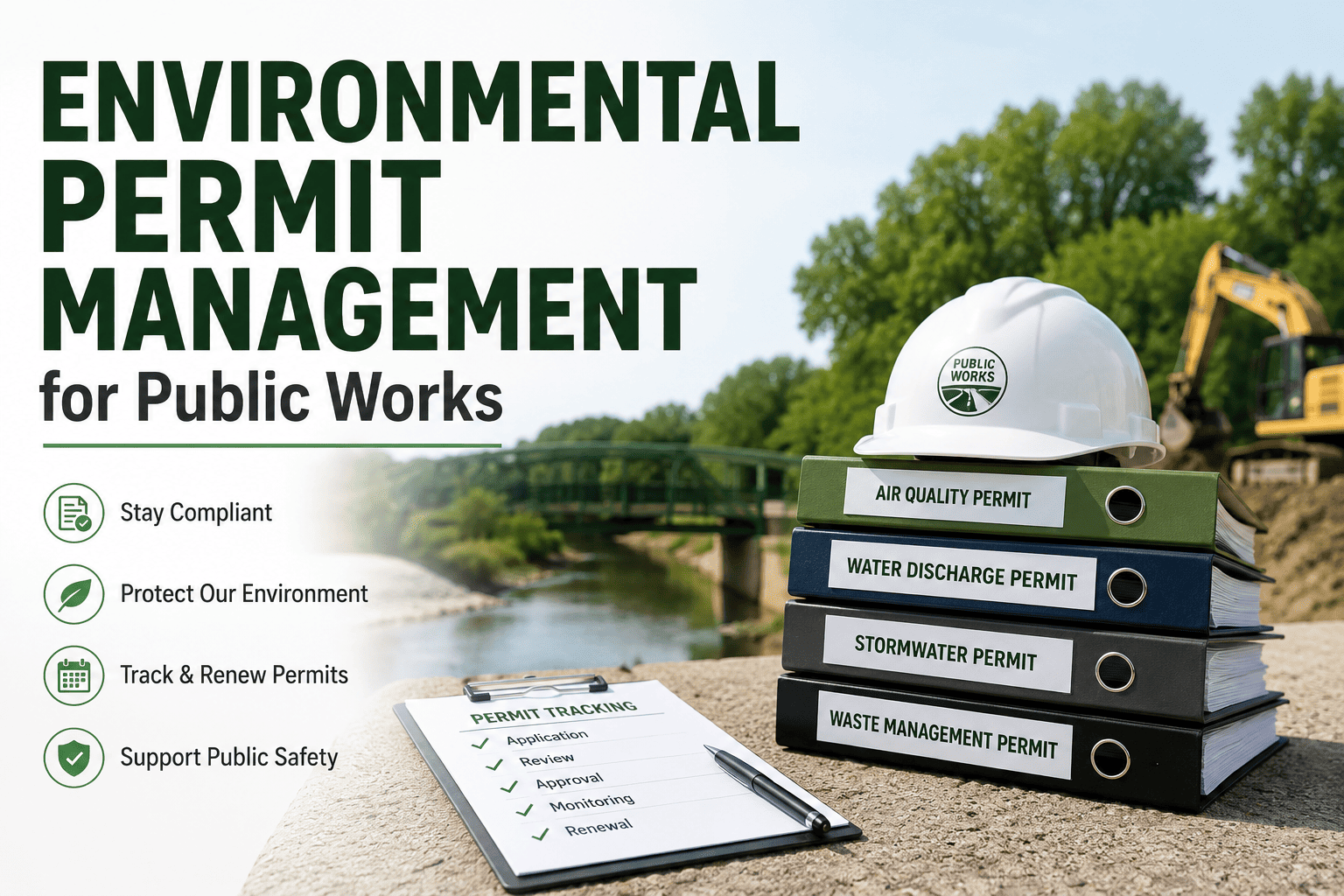
Environmental permit management for public works is the structured process of tracking every NPDES, air-quality, stormwater, wetland and hazardous-materials permit across a municipal or government portfolio so that renewals never lapse, daily compliance conditions are documented, and every inspection is audit-ready. For agencies juggling dozens — sometimes hundreds — of environmental permits, a single missed renewal can trigger EPA penalties of $37,500 per day per violation, stop-work orders on capital projects, and reputational damage that erodes public trust. The teams that stay continuously compliant do so by replacing spreadsheets and shared drives with a centralized permit registry, automated renewal pipeline, and a CMMS-driven workflow that ties each environmental condition to a work order. OxMaint brings all of these capabilities into one AI-powered platform — you can Start Free Trial today or book a personalized demo to see the full compliance workflow on your own asset data.
ENVIRONMENTAL COMPLIANCE FOR PUBLIC WORKS
How many environmental permits will expire in the next 90 days — and who is tracking them?
Most public works agencies manage 40–120 active environmental permits across stormwater, air quality, NPDES, wetlands and hazardous materials. When renewals slip through the cracks, the cost isn't just a fine — it's a stop-work order on a critical infrastructure project.
Permit lapses are the #1 cause of EPA enforcement actions against municipal agencies. The average penalty for a single NPDES violation exceeds $27,000, and multi-condition permits (stormwater + erosion control + wetland) compound the risk every day a condition goes undocumented.
OxMaint replaces spreadsheets and shared drives with a single, defensible permit registry — automated renewal alerts, condition-linked work orders, and audit-ready documentation in one platform.
A single lapsed NPDES permit on a 60-day road project can compound to $2.25M in potential exposure before the renewal is even processed.
PERMIT REGISTRY FOUNDATION
Build a central environmental permit registry for government assets
The first failure in environmental permit management isn't a missed inspection — it's not knowing the permit exists. Public works agencies typically discover 15–20% more active permits than they thought they had when they first build a centralized registry.
Permit Inventory & Classification
Catalog every NPDES, Title V air, stormwater SWPPP, Section 404 wetland, RCRA hazardous waste and underground storage tank permit — each tagged to the asset, facility or project site it governs.
Condition Mapping
Each permit carries 5–25 separate compliance conditions — sampling frequency, visual inspections, BMP maintenance, recordkeeping. Map every condition to a recurring work-order template inside OxMaint.
Renewal Pipeline
Track application deadlines, agency review windows and expiration dates in a single pipeline. Automated alerts fire at 180, 90, 60 and 30 days so renewals are submitted on time — every time.
RENEWAL TIMELINE
How to manage environmental permit renewals without missing a deadline
Environmental permits for public works operate on overlapping renewal cycles — NPDES annual reports, 5-year stormwater permits, Title V renewals every 5 years, and quarterly DMR submissions. A structured timeline prevents the scramble.
Renewal Trigger
OxMaint auto-generates a renewal work order with the permit's agency contact, application form reference, required attachments and the responsible engineer assigned.
Draft & Internal Review
Compliance conditions are reviewed against the previous cycle's inspection findings. Any open violations are resolved before the renewal package goes to the agency.
Agency Submission
The completed application, fees and supporting documentation are submitted. OxMaint records the submission date, tracking number and expected agency response window.
Approval & Registry Update
New expiration date, revised conditions and updated compliance tasks are pushed to the permit registry. All linked work orders are automatically updated for the next cycle.
WORKED EXAMPLE
A mid-sized municipal public works department managing 67 environmental permits across 12 facilities was spending approximately $48,000/year in staff hours chasing renewal deadlines on spreadsheets. After implementing OxMaint's permit registry and renewal pipeline, they reduced renewal-related labor by 65%, eliminated two near-lapse events in the first six months, and passed their annual EPA compliance audit with zero findings — the first time in nine years.
COMPLIANCE MONITORING
Link every environmental permit condition to a documented work order
An environmental permit is only defensible if every condition has a documented record of compliance. The average NPDES stormwater permit requires 12+ documented site inspections per year — each tied to specific BMPs, weather conditions and corrective actions.
| Permit Condition | Required Frequency | Spreadsheet / Manual | OxMaint CMMS Workflow |
|---|---|---|---|
| Stormwater BMP visual inspection | Monthly + after 0.5" rain | Calendar reminders, paper forms, 30–40% on-time rate | Auto-generated work order, mobile form, photo capture, 98%+ on-time |
| NPDES discharge monitoring report | Quarterly | Email reminders, manual data entry, frequent late submissions | Scheduled task with lab-result upload, auto-populated DMR template |
| Erosion control inspection | Every 7 days + post-rain | Field notebook, no photo evidence, hard to audit | Geotagged mobile inspection with mandatory photo and corrective-action workflow |
| Wetland buffer monitoring | Semi-annual | Shared drive folder, inconsistent documentation | Asset-linked monitoring task with historical photo comparison and automated report |
| Hazmat inventory reconciliation | Annual + monthly threshold checks | Manual count, disconnected from purchasing records | Integrated with spare-parts inventory module; auto-flag when thresholds are crossed |
REPORTING WORKFLOW
Generate audit-ready environmental compliance reports in minutes, not weeks
When an EPA or state inspector arrives, the question is never "do you have a permit?" — it's "show me the last 12 months of documented compliance for every condition." Agencies that take 2–3 weeks to assemble a compliance report are already behind.
Real-Time Compliance Dashboard
Every permit, every condition, every work order — visible in a single dashboard. Green means documented and on-time; yellow means approaching deadline; red means overdue. Inspectors see compliance status at a glance.
One-Click Audit Pack
Select a permit and a date range — OxMaint assembles every inspection record, lab result, photo, corrective action and renewal document into a single, timestamped, defensible report. What used to take 40+ staff hours now takes 10 minutes.
See how OxMaint keeps every environmental permit current and defensible
Book a 30-minute demo and we'll show you the permit registry, renewal pipeline and compliance reporting workflow on a live environment — mapped to your agency's permits and assets.
HOW OXMAINT HELPS
The CMMS-driven environmental compliance program for public works
OxMaint is an AI-powered CMMS and EAM platform that turns environmental permit management from a reactive, spreadsheet-driven scramble into a proactive, fully-documented workflow. Here's how four core capabilities map directly to your compliance outcomes.
Automated Permit Renewal Alerts
Configurable alerts at 180, 90, 60 and 30 days before every permit expiration — delivered via email, mobile push and in-app notifications. Auto-generates renewal work orders with agency contacts, forms and deadlines pre-populated.
Outcome: Zero missed renewals, 65% reduction in renewal-related staff hours
Condition-Linked Work Orders
Every environmental permit condition — sampling, inspection, BMP maintenance — becomes a recurring work order tied to the asset or site. Field crews complete mobile forms with mandatory photo capture, geotagging and corrective-action escalation.
Outcome: 98%+ on-time inspection rate, fully documented and audit-ready
Real-Time Compliance Analytics
AI-driven dashboards show permit status, upcoming deadlines, inspection completion rates and open corrective actions across your entire portfolio. Drill from a red flag on one permit to the underlying work order in two clicks.
Outcome: Compliance visibility in real time, not after the audit letter arrives
One-Click Audit Reporting
Generate a complete, timestamped compliance report for any permit and date range in under 10 minutes. Every inspection, lab result, photo and corrective action is compiled automatically — no manual assembly, no shared drives, no gaps.
Outcome: 90% reduction in audit-prep time, zero documentation gaps
COST OF INACTION
What happens when environmental permits lapse in the public sector
The cost of managing environmental permits manually isn't just staff time — it's the exponential risk of a single lapse that triggers enforcement, project delays and public scrutiny. Here's what the numbers look like when the system breaks down.
PENALTY EXPOSURE FORMULA
Example: A single NPDES permit with 3 undocumented conditions, lapsed for 45 days = $37,500 × 45 × 3 = $5,062,500 in potential penalties — before project delay costs and mandated corrective action.
Average EPA Penalty
The average settled penalty for a single NPDES stormwater violation at a municipal site exceeds $27,000 — not counting mandatory corrective action costs.
Typical Project Stop-Work
When a permit lapse triggers a stop-work order on a capital project, the average delay is 30–60 days — extending timelines and inflating contractor costs by 15–25%.
Agencies With Findings
Nearly 25% of municipal public works agencies audited by the EPA in a recent cycle had at least one permit compliance finding — most tied to undocumented inspections.
FREQUENTLY ASKED QUESTIONS
Environmental permit management for public works: common questions
What is environmental permit management for public works?
Environmental permit management for public works is the process of tracking, renewing and documenting compliance for every environmental permit — NPDES, air quality, stormwater, wetland, hazardous materials — across a municipal or government asset portfolio. It requires a central permit registry, automated renewal alerts, condition-linked work orders and audit-ready reporting. OxMaint brings all four into a single AI-powered CMMS platform. Book a Demo to see the full workflow.
How does a CMMS help with environmental compliance permits?
A CMMS like OxMaint converts every environmental permit condition into a recurring work order with a scheduled deadline, assigned technician, mobile inspection form and mandatory documentation (photos, readings, corrective actions). This means compliance is built into the daily maintenance workflow rather than tracked separately on spreadsheets — driving on-time inspection rates above 98% and eliminating documentation gaps.
How far in advance should environmental permit renewals be tracked?
Best practice is to trigger renewal workflows 180 days before expiration. Complex permits — Title V air, Section 404 wetland, multi-site NPDES — often require 90+ days for internal review, data compilation and agency submission. OxMaint's automated alert pipeline fires at 180, 90, 60 and 30 days, with auto-generated renewal work orders that include agency contacts, required forms and supporting documentation checklists.
What are the penalties for lapsed environmental permits in the public sector?
Federal EPA penalties can reach $37,500 per violation per day under the Clean Water Act and Clean Air Act. State agencies may impose additional fines. A single NPDES permit with multiple undocumented conditions can compound to millions in exposure within weeks. Beyond fines, lapsed permits trigger project stop-work orders, mandated corrective action and public reporting requirements that damage agency credibility.
Can OxMaint import existing environmental permits from spreadsheets?
Yes. OxMaint supports bulk import of permit data from Excel, CSV and legacy systems — including permit numbers, expiration dates, conditions, asset links and responsible parties. The onboarding team maps your existing data to the permit registry structure, configures renewal alerts and generates the first round of compliance work orders within the first week. Start Free Trial to test the import on your own permit inventory.
Stop tracking environmental permits on spreadsheets
Join the public works agencies using OxMaint to keep every environmental permit current, every condition documented and every audit-ready report one click away.
Free 14-day trial · No credit card