A public works storeroom rarely fails loudly. It fails on the morning a plow truck is down mid-storm and the hydraulic return filter that should have been on the shelf is three days out on backorder — while two aisles over, forty gaskets for a pump retired in 2019 sit gathering dust. Both problems trace to the same root cause: parts stocked by memory and habit instead of by consumption data and criticality. Across mid-sized cities, inventory control failures account for a meaningful share of preventable maintenance downtime, and a surprising portion of what sits on the shelf is obsolete. Getting the storeroom right is less about buying more and more about buying against data — the shift this guide walks through, and the one a CMMS-driven inventory program is built to make.
Public Works · MRO Inventory · Storeroom Operations
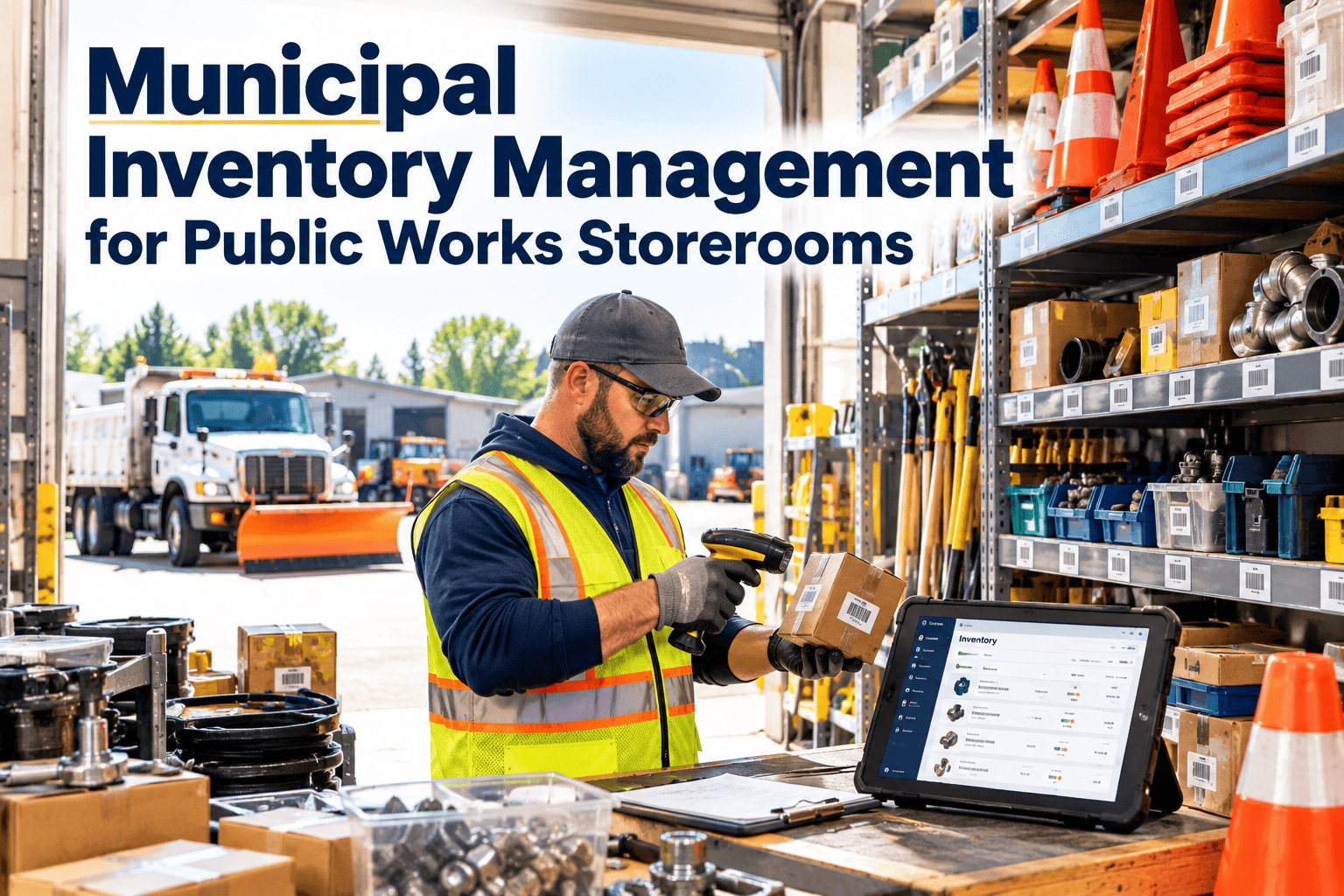
Municipal Inventory Management for Public Works Storerooms
A practical framework for cutting stockouts and excess stock at the same time — criticality tagging, data-driven min/max, and CMMS-linked reordering tuned to your actual lead times and usage history.
The two failures of an undisciplined storeroom
Stockout
Critical part missing when the asset is down — emergency freight, extended downtime
Dead stock
Public funds frozen in parts for retired assets that will never be issued
Why Municipal Storerooms Are Different From Any Other Warehouse
MRO inventory is not production inventory. A retail warehouse moves stock to generate revenue; a public works storeroom holds parts that keep roads, water, fleet, and facilities running but never become a sellable product. That distinction changes every rule — the goal is availability of the right part, not throughput, and the cost of a wrong call is measured in downtime and public trust, not margin.
Consequence, not volume, drives stocking
A $12 valve seal that idles a lift station outranks a $900 part used weekly. Criticality has to be scored separately from cost and usage.
Seasonality is brutal and predictable
Snow, leaf collection, and mowing create demand spikes on narrow windows of parts. A reorder point tuned for July fails in January.
Procurement is slower and rule-bound
Public purchasing thresholds, blanket POs, and bid requirements stretch lead times well beyond a private shop's — safety stock has to absorb that.
Budgets are scrutinized line by line
Every dollar on a shelf is a dollar a council can question. Carrying cost and obsolete stock are political as well as operational liabilities.
Where Public Works Inventory Actually Breaks
Before fixing a storeroom, name the failure points. These are the recurring reasons crews lose field time to parts — and almost none of them are about the storekeeper working too slowly.
No reorder triggers
Reorder points were set years ago, written on a bin card, and never revisited. Nothing fires when stock drops, so the shortage is discovered at the point of use.
No criticality tiers
Every SKU is treated the same, so a vital spare and a nice-to-have consumable get the same (often zero) safety stock. The wrong parts run out.
Parts not linked to assets
"Which O-ring fits this pump?" becomes a ten-minute hunt. Unlinked catalogs cause wrong orders, re-work, and duplicate SKUs for the same part.
Vendor fragmentation
The same part is bought from four suppliers at four prices with four lead times — the hidden cost driver in most public works parts programs.
No consumption history
Without rolling usage data, stocking is guesswork. Squirrel stores appear — crews hoard parts privately because they don't trust the shelf.
Step One: Classify Every SKU by Criticality and Spend
You cannot set smart stocking levels on an undifferentiated parts list. Two overlapping classifications do the work: criticality (what happens if the part is missing) and ABC by spend (where the money sits). Together they tell you which parts can never stock out and which you can afford to run lean.
Tier 1 · Critical
Asset-down parts with no substitute and long lead time. Plow hydraulics, lift-station seals, pump motors. Never stock out. Safety stock sized to worst-case lead time.
Tier 2 · Important
Needed for planned work and common repairs; a short delay is tolerable. Filters, belts, standard fittings. Min/max tuned to usage, modest safety stock.
Tier 3 · Standard
Readily available, low consequence, short lead time. Fasteners, consumables, shop supplies. Candidate for vendor consignment — stock it on their dime.
Layer ABC analysis over the tiers
A well-known storeroom pattern holds: a small fraction of SKUs accounts for the overwhelming majority of issues and spend. Classify Class A as the top slice of spend plus all Tier 1–2 critical items, Class B the middle, Class C the long tail. This drives how often you count and how tightly you control each part.
Class A
Top ~20% of spend + all critical items — count monthly, tight min/max control
Class B
The middle band — count quarterly, standard reorder rules
Class C
The low-value long tail — count annually, bulk or consignment
Step Two: Set Min/Max From Data, Not Memory
The single highest-leverage change in any municipal storeroom is replacing habit-based reorder points with a formula tied to real lead time and rolling usage. The math is simple; the discipline of refreshing it is what most shops miss.
Refresh cadence matters more than the first calculation
Most municipal shops set reorder points once and never touch them again. A defensible program resets the top SKUs by usage volatility quarterly and runs a full recalculation annually against fresh CMMS data — plus a pre-season pass on Tier 1 seasonal parts about 30 days before peak demand hits.
Turn Your Usage History Into Stocking Levels
OxMaint loads your parts master, calculates min/max from real CMMS consumption data, and auto-triggers reorders when stock crosses the line — so the shelf funds uptime instead of dead stock. Start with your Tier 1 critical parts and expand from there.
Step Three: Close the Procurement-Delay Gap
A perfect min/max still fails if the reorder sits in someone's inbox for a week. Public procurement adds steps a private shop never sees — and each step is a place the part can stall. The fix is to automate the trigger and pre-authorize the routine buys.
01
Stock hits minimum
CMMS flags the SKU automatically the moment a work order consumes the part that crosses the reorder point — no manual shelf check.
to
02
Auto-PO against blanket agreement
Routine parts reorder through a pre-approved blanket PO, skipping the quote-and-approve cycle that stalls emergency buys.
to
03
Receive, put away, link
Received stock is logged to a bin location and tied to the asset it serves, so the next tech finds it in seconds, not minutes.
to
04
Consume & replenish on close
Closing the work order decrements the count and updates usage history — feeding the next min/max recalculation automatically.
Measure the Storeroom Like an Operation
A storeroom you can't measure is a storeroom you can't defend at budget time. Four KPIs tell you whether the program is working — and give a public works director the numbers a council actually responds to.
Stockout rate
Share of parts requests that can't be filled from the shelf. The number that directly maps to lost field time — drive it toward zero on Tier 1.
Inventory turnover
How many times the stock value cycles per year. Low turnover signals cash frozen on shelves; track it by class, not just in aggregate.
Obsolete stock %
Value of parts for retired assets or with no issue in 24 months. The cleanup target — and the easiest early win to show finance.
Carrying cost
Total working capital tied up in the storeroom. A data-driven min/max typically recovers a meaningful share in year one.
Before and After a CMMS-Driven Storeroom
The shift is not theoretical. The same department, run two ways, produces very different numbers on the three budget lines that matter: carrying cost, emergency freight, and asset downtime.
| Dimension |
Reactive storeroom |
CMMS-driven program |
| Reorder points |
Set once, never revisited |
Recalculated on rolling 12-month usage |
| Criticality |
Undifferentiated — all SKUs equal |
Tiered; critical spares never stock out |
| Reordering |
Manual, discovered at point of use |
Auto-triggered at minimum via blanket PO |
| Parts search |
"Go check the shelf" — minutes lost |
Asset-linked catalog with bin locations |
| Counting |
Annual wall-to-wall, error-prone |
Cycle counts by ABC class, continuous |
| Obsolete stock |
Accumulates unnoticed |
Flagged by no-issue aging reports |
Frequently Asked Questions
How often should a municipal storeroom recalculate min/max levels?
Review the top SKUs by usage volatility quarterly and run a full recalculation annually against rolling 12-month data. Add a pre-season pass on seasonal Tier 1 parts about 30 days before peak.
Start free and let the system recalc from your usage history.
What's the difference between MRO inventory and spare parts inventory?
Spare parts are replacement components tied to specific assets — bearings, motors, valves. MRO is the broader category including consumables, tools, and shop supplies that keep assets running but aren't asset-specific.
Book a demo to see both managed in one catalog.
How do we handle obsolete parts for assets we've retired?
Run a no-issue aging report to flag SKUs with no movement in 24+ months, cross-check against your active asset registry, and dispose or transfer. Asset-linked catalogs make this automatic rather than a manual audit.
See how it works in a trial.
How does criticality tagging prevent cost-cutting from backfiring?
When every SKU is classified by consequence, a budget cut can trim dead stock without ever touching a vital spare. Criticality is the safeguard that makes lean stocking safe.
Book a demo to see criticality-based stocking applied to your parts list.
Can OxMaint link spare parts directly to assets and work orders?
Yes. Parts are tied to the assets they serve and consumed directly on work orders, so counts update as jobs close and techs find the right part without guessing. That connection feeds usage history for the next min/max.
Start a free trial to connect your catalog.
Stock the Right Part, Free the Public Funds
OxMaint connects your parts catalog, asset registry, and work orders into one system — criticality tiers, data-driven min/max, auto-reorder, and cycle counting built for the way public works storerooms actually run. Talk to our team about your storeroom and procurement setup.