Public works crews dig trenches, work inside live traffic lanes, lock out heavy equipment, and enter confined spaces — sometimes all in the same week. Federal OSHA does not directly cover state and local government employees, but workers in states with an OSHA-approved State Plan receive the same protections as private sector employees, and general duty obligations still apply almost everywhere else. The hazards themselves do not change with jurisdiction, and a single missed protective system or lockout step can end in a fatality investigation regardless of who enforces the standard. This page covers the 29 CFR 1910 and 1926 requirements public works operations run into most, the penalty structure behind them, and the program elements that keep crews protected and documented. Departments building this program can start a free trial to see how OxMaint tracks training, inspections, and safety records for public works crews.
OSHA COMPLIANCE · 29 CFR 1910 & 1926 · PUBLIC WORKS · SAFETY PROGRAM 2026
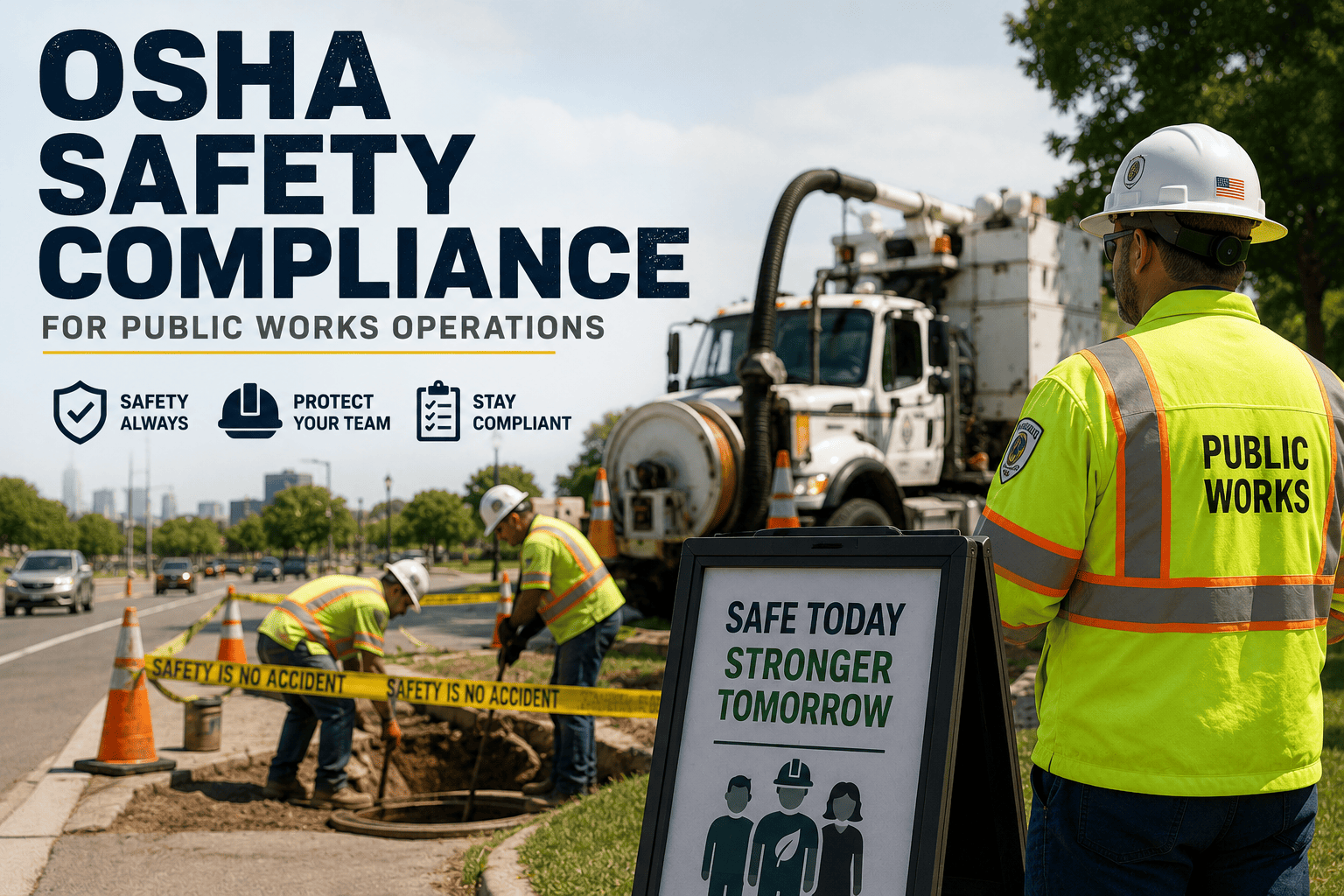
OSHA Safety Compliance for Public Works Operations
A trench without a protective system, a truck locked out without a written procedure, a crew working a live lane without a traffic control plan — these are the citations that show up after an inspection, and the injuries that show up before one. Structured compliance closes the gap before either happens.
$16,550
Maximum penalty per serious OSHA violation in 2026
$165,514
Maximum penalty per willful or repeat violation in 2026
5 ft
Trench depth that triggers a mandatory protective system
28 states
Have OSHA-approved State Plans extending coverage to public sector workers
Hazard Areas
The 6 OSHA Hazard Areas Every Public Works Crew Runs Into
Public works operations touch more OSHA standards than almost any other municipal function — often in a single shift. These six areas account for the majority of citations and injuries across street, water, and utility crews.
1926 Subpart PHigh Risk
Trenching & Excavation
Cave-ins remain one of the deadliest hazards in public works. A protective system — shoring, shielding, or sloping — is required at 5 feet unless the excavation sits entirely in stable rock.
MUTCD / §5(a)(1)High Risk
Traffic Control & Work Zones
Struck-by and backover incidents in live traffic lanes are a leading cause of public works fatalities, driving the General Duty Clause obligation to control the work zone.
1910.147Moderate Risk
Lockout / Tagout
Trucks, pumps, mowers, and treatment equipment all require written energy control procedures before service or repair work begins.
1910.146High Risk
Confined Space Entry
Manholes, lift stations, and storage tanks require atmospheric testing, a permit, and a designated attendant before any entry.
1926 Subpart MModerate Risk
Fall Protection
Elevated work on towers, structures, and equipment above 6 feet requires guardrails, harnesses, or another fall arrest system.
1926.1153Moderate Risk
Respiratory & Silica Exposure
Concrete cutting, grinding, and demolition generate silica dust that requires engineering controls and, in some tasks, respirators.
Penalty Structure
What a Missed Requirement Actually Costs — 2026 Penalty Tiers
OSHA penalties are not flat fees — they scale sharply with how the violation is classified. A single inspection with multiple findings can move from a manageable correction to a six-figure exposure fast.
Up to $16,550
Violations with a direct relationship to safety but unlikely to cause serious harm
Up to $16,550
Substantial probability that death or serious harm could result from the hazard
Up to $16,550 / day
Charged for every day a cited hazard remains uncorrected past the deadline
Up to $165,514
Intentional disregard or the same violation cited again within five years
A Documented Safety Program Is the Best Defense Before an Inspector Arrives
OxMaint keeps training records, JHAs, PPE issue logs, and lockout procedures attached to every asset and every crew member, so your department can answer an OSHA request the same day it arrives.
Program Framework
Building an OSHA Safety Program for Public Works — 5 Core Elements
A defensible safety program is built from five connected elements, each one feeding documentation into the next. Skipping any single element is what turns a preventable incident into a citation.
1
Management Commitment & Written Program
Leadership signs a written safety policy that assigns responsibility for every hazard area and sets the expectation crews are trained against.
2
Hazard Identification & Job Hazard Analysis
A competent person evaluates each task before crews start — trench depth, soil type, traffic pattern, or confined space classification.
3
Training & Documented Competency
Lockout, confined space, trenching, and PPE training are logged per employee, with renewal dates tracked before certifications lapse.
4
PPE & Equipment Provisioning
High-visibility apparel, respirators, and fall arrest gear are issued, inspected on a schedule, and replaced before they fail a crew.
5
Incident Reporting & Corrective Action
Near misses and injuries are logged immediately and closed out with a corrective work order, not left as an open note in a binder.
OxMaint Platform
How OxMaint Manages OSHA Compliance for Public Works
OxMaint applies the same structured tracking used for fleet and facility maintenance to safety compliance — giving public works departments the training records, checklists, and audit trail that 29 CFR 1910 and 1926 expect. Teams can start a free trial or book a demo to configure a safety compliance workflow.
Training Records
Certification Expiry Tracking
Every employee's LOTO, confined space, and trenching training is logged with renewal dates that flag before certifications lapse.
JHA Library
Task-Specific Hazard Checklists
Standardized job hazard analyses for trenching, traffic control, and confined space entry, ready for a competent person to complete on site.
PPE Inventory
Issue, Inspect, Replace on Schedule
Track every high-visibility vest, harness, and respirator issued to a crew member along with its next inspection or replacement date.
Incident Logging
Near-Miss to Corrective Action
Report an incident from the field and route it straight into a corrective work order, closing the loop instead of losing the record.
LOTO Procedures
Digital Lockout Checklists per Asset
Attach a written energy control procedure to every truck, pump, and machine so crews follow the same steps every time.
Audit-Ready Reports
Exportable Safety Documentation
Generate a full safety record for any crew, asset, or date range in one export, formatted for an OSHA or State Plan inspection request.
Questions
Frequently Asked Questions
Does OSHA apply to public works departments?+
Federal OSHA does not directly cover state and local government employees, but workers get the same protections in states with an OSHA-approved State Plan.
Start a free trial to build a compliant program either way.
When does a trench require a protective system?+
A protective system is required at 5 feet of depth or more unless the excavation is entirely in stable rock, and a registered engineer must design systems past 20 feet.
Book a demo to see trenching JHAs in action.
What is the maximum OSHA fine for a serious violation in 2026?+
A serious violation carries a maximum penalty of $16,550 in 2026, while willful or repeat violations can reach $165,514 per citation.
Start a free trial to reduce the documentation gaps that trigger findings.
How often should lockout/tagout procedures be reviewed?+
1910.147 requires periodic inspection of energy control procedures at least annually, with immediate updates whenever equipment or a process changes.
Book a demo to see digital LOTO checklists per asset.
Do public works crews need confined space entry permits for manholes?+
Yes — manholes, lift stations, and tanks that meet the definition of a permit-required confined space need atmospheric testing, a permit, and an attendant before entry.
Start a free trial to standardize entry checklists.
The Next Inspection Will Test Your Safety Program Whether It Is Documented or Not
Every undocumented training session, missing JHA, or expired PPE inspection is a finding waiting for the next OSHA or State Plan visit. OxMaint keeps public works safety records complete, current, and ready to produce on demand.