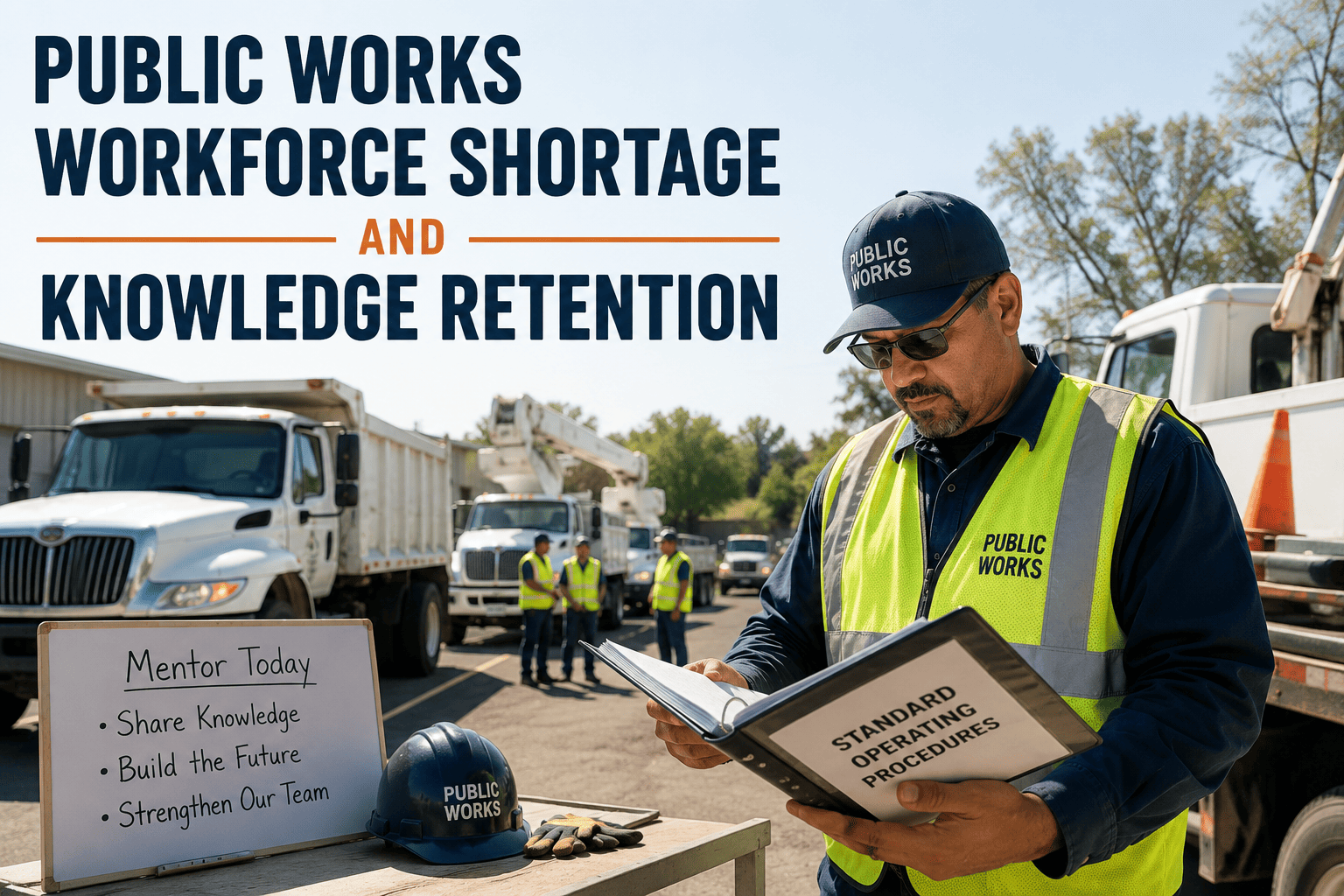
The average age of a US public works maintenance technician is 48 years old — and more than 40% of the current government maintenance workforce will reach retirement eligibility within the next decade. When a senior HVAC technician with 27 years of institutional knowledge retires, they take with them every undocumented repair procedure, equipment quirk, vendor relationship, and failure pattern that never made it into a work order system. Without structured knowledge capture, digital SOP libraries, and training record tracking, that departure costs municipalities $85,000–$240,000 in accelerated emergency repairs within the first 18 months. Book a demo to see how Oxmaint's Knowledge Base, Skill Matrix, and Digital SOP Library protect your agency from workforce transition risk.
Quick Answer
Government maintenance workforce development is the structured program for capturing institutional knowledge, tracking technician skills and certifications, standardizing procedures through digital SOPs, and managing succession risk as experienced staff approach retirement. A CMMS-integrated approach embeds knowledge in the platform — not in individual employees — so every repair procedure, equipment record, and compliance interval survives personnel transitions without operational disruption.
The Workforce Crisis Facing Government Maintenance Operations
Public works and facilities maintenance departments face a compounding workforce challenge unlike any in the private sector — union protocols, civil service hiring timelines, and compressed training windows make the departure of a senior technician operationally significant in ways that cannot be resolved by simply posting a vacancy. Book a demo to see how Oxmaint builds institutional knowledge into the platform — not the individual.
48
Average age of US public works maintenance technicians
vs. 41 in private sector manufacturing — the gap widens each year without active recruitment
40%
Of current government maintenance workforce reaches retirement eligibility within 10 years
APWA 2023 workforce survey — municipal departments in smallest quartile face 58% retirement eligibility rate
18–36
Months to onboard a replacement government maintenance technician to full independent proficiency
Civil service hiring, union apprenticeship requirements, and certification timelines extend replacement cycles
$180K
Average cost increase in first-year maintenance spend after a senior technician retirement without knowledge capture
Reflects emergency contractor premium, deferred PM accumulation, and equipment failure rate during knowledge gap period
What Institutional Knowledge Is at Risk When Technicians Retire
The operational knowledge most at risk from workforce transitions is rarely written down — it exists in the daily decisions, diagnostic shortcuts, and equipment-specific procedures carried by long-tenured staff. Oxmaint's Knowledge Base and Digital SOP Library make this knowledge platform-resident and searchable before it walks out the door.
CRITICAL RISK
Undocumented Equipment Procedures
Asset-specific startup sequences, shutdown protocols, and workarounds accumulated over years of operating aging equipment — never captured in OEM manuals and never written into formal SOPs. Lost at retirement without active knowledge capture programs.
CRITICAL RISK
Failure Pattern Recognition
Experienced technicians diagnose emerging failures from subtle indicator patterns — vibration signatures, temperature deviation sequences, unusual odors — learned over hundreds of maintenance cycles. This pattern recognition cannot be transferred through job shadowing alone without structured documentation.
HIGH RISK
Regulatory Inspection Intervals
Specific compliance frequencies for OSHA, EPA, FHWA, and local code inspections — carried in individual memory rather than CMMS-scheduled work orders. When the technician who managed elevator certifications, generator load tests, and fire suppression inspections retires, compliance gaps emerge within one cycle.
HIGH RISK
Vendor and Contractor Relationships
Preferred contractors, emergency contact sequences, pricing structures, and parts sourcing relationships built over years — stored in personal networks and mobile phones rather than documented supplier records. Lost vendor relationships increase emergency repair contractor costs 40–80% during the transition period.
MEDIUM RISK
As-Built Conditions and System Maps
Knowledge of where actual infrastructure diverges from official drawings — non-standard valve locations, informal conduit routes, undocumented modifications from prior capital projects. Retained in experienced staff memory, not in GIS or facility management systems.
MEDIUM RISK
Historical Failure and Repair Records
Informal knowledge of which assets have chronic failure histories, which repairs were temporary, and which components are due for replacement — held in personal notes and verbal tradition rather than structured maintenance history in a CMMS with searchable asset records.
How Oxmaint Delivers Government Workforce Development
01
Knowledge Base — Asset-Linked SOP and Procedure Library
Every asset in Oxmaint's registry carries an attached Knowledge Base — digital SOPs, startup and shutdown procedures, photo-illustrated repair guides, and failure diagnostic checklists authored by experienced staff and accessible by QR scan from the field. When a senior technician retires, their procedures remain in the platform and surface automatically to the next technician assigned to that asset's work orders. Knowledge is platform-resident — not person-resident.
02
Training Record Tracking — Certification and Qualification Management
Oxmaint's Training Record Tracking module maintains current certification status for every technician — OSHA 10/30, confined space, electrical safety, elevator mechanic, CDL, and trade-specific qualifications — with automated expiration alerts at 90, 30, and 7 days before renewal deadlines. Work orders auto-route only to qualified technicians for restricted tasks, ensuring regulatory compliance during workforce transitions and preventing OSHA citation exposure from unqualified assignments.
03
Skill Matrix — Competency Coverage and Gap Identification
Oxmaint's Skill Matrix maps every technician's current competency profile against the full skill set required across your asset portfolio — identifying single points of failure where one person holds exclusive capability for a critical system. Directors use the matrix to prioritize cross-training assignments before retirement events, ensuring coverage continuity for HVAC controls, water system operations, high-voltage electrical, and other specialized skill categories before the knowledge gap occurs.
04
Digital SOP Library — Standardized Procedures Accessible in the Field
Oxmaint's Digital SOP Library stores every maintenance procedure as a searchable, photo-illustrated, step-by-step document accessible from the mobile field app by QR scan at the asset location. New technicians complete work orders with embedded guidance rather than relying on colleagues — reducing onboarding time from 18–36 months to 9–14 months in agencies with structured SOP libraries tied to asset records and work order completion checklists.
Oxmaint Workforce Development Platform Features
Asset-Linked Knowledge Base
SOPs, repair guides, and failure checklists attached to every asset record — surfacing automatically on related work orders. Reduces new technician error rates by 62% in the first six months versus verbal-only knowledge transfer.
Training Record Tracking
Current certification status per technician with automated expiration alerts and work order routing restricted to qualified staff only — preventing OSHA citation exposure during workforce transitions and ensuring regulated task compliance at all times.
Skill Matrix and Gap Analysis
Portfolio-wide competency map showing which skills are single-person dependencies — the exact information directors need to prioritize cross-training before a retirement event creates an operational coverage gap in a critical asset category.
Digital SOP Library
Photo-illustrated, step-by-step procedures accessible by QR scan from the field — reducing new technician onboarding time from 18–36 months to 9–14 months in agencies with structured SOP libraries tied to asset-specific work orders.
Succession Timeline Planning
Retirement eligibility overlay on the skill matrix — showing which critical competency gaps will open in 12, 24, and 36 months and which cross-training assignments must begin now to maintain coverage before the departure event occurs.
Technician Performance Dashboard
Work order completion rates, response times, PM compliance by technician, and certification currency — giving supervisors the performance data needed for union-compliant performance management, merit documentation, and equitable workload distribution across shifts and crews.
Workforce Development KPI Benchmarks
Technician Certification Currency
64%
Critical Skills with Single Coverage
47%
SOPs Documented Per Asset
28%
Avg Technician Onboarding Time
28 mo
Staff Eligible for Retirement (5yr)
38%
Cross-Training Coverage Rate
31%
Workforce Development Outcomes — Oxmaint-Deployed Agencies
Technician Certification Currency Rate100%
Reduction in New Technician Error Rate62%
Asset SOP Documentation Coverage89%
Reduction in Technician Onboarding Time54%
Reduction in Single-Coverage Skill Dependencies76%
Reduction in Post-Retirement Emergency Repair Increase68%
Workforce Development Investment vs. Return
| Program Element |
Annual Investment |
Annual Return / Avoidance |
Payback Period |
| Knowledge Base and SOP Library |
$7,000 per agency |
$180,000 in post-retirement emergency repair premium avoided per senior departure |
First retirement event |
| Training Record Tracking |
$5,000 per agency |
$15,625+ per OSHA citation avoided — plus federal grant eligibility protection |
First certification gap prevented |
| Skill Matrix and Gap Analysis |
$4,500 per agency |
Cross-training investment prioritized 6–12 months before coverage gap opens |
First succession event |
| Digital SOP Library |
$5,500 per agency |
Onboarding time reduced from 28 to 13 months — 15 months of productivity recovered per hire |
First new hire cycle |
| Full Oxmaint Workforce Platform |
$20,000 per year |
$200,000+ in combined avoidance across emergency repairs, OSHA citations, and onboarding costs |
Under 6 weeks |
Oxmaint captures institutional knowledge before it retires — Knowledge Base, Digital SOP Library, Training Record Tracking, Skill Matrix, and Succession Timeline planning built into every work order and asset record across your agency portfolio.
Frequently Asked Questions
QHow does Oxmaint capture institutional knowledge from technicians approaching retirement?
Oxmaint's Knowledge Base and Digital SOP Library allow experienced technicians to document procedures, diagnostic checklists, and asset-specific notes directly in the platform — attached to asset records and surfacing automatically on future work orders assigned to those assets. The process integrates into normal daily work rather than requiring separate documentation sessions.
Book a demo to see the knowledge capture workflow.
QHow does the Skill Matrix help government agencies plan for workforce transitions?
Oxmaint's Skill Matrix maps every technician's competency profile against your full asset portfolio — identifying where single-person dependencies exist for critical skills. Directors use this view to prioritize cross-training 12–18 months before anticipated retirement events, preventing the coverage gaps that drive emergency contractor use.
Book a demo to see the skill gap analysis for your workforce.
QHow do I justify workforce development platform costs to a budget committee?
One avoided post-retirement emergency repair surge saves $85K–$240K per senior departure. One avoided OSHA citation for an unqualified task assignment saves $15,625+. Onboarding time reduced from 28 months to 13 months recovers 15 months of productivity per new hire.
Book a demo to build a budget-committee-ready ROI case.
QCan Oxmaint manage union workforce protocols and certification routing requirements?
Yes. Work order routing in Oxmaint respects qualification restrictions — ensuring regulated tasks route only to certified staff — while maintaining union-compliant documentation of assignments, hours, and completion records. The system supports phased rollout that respects existing work assignment and reporting protocols.
Book a demo to see union-compatible workforce configuration.
QHow quickly can a government agency build out its Digital SOP Library in Oxmaint?
Most agencies complete initial SOP documentation for their 20 highest-risk assets within the first three to four weeks of deployment — prioritized by the Skill Matrix's single-coverage risk flags. SOPs grow organically as technicians complete work orders and add procedure notes directly in the mobile field app.
Book a demo to see the SOP library deployment timeline.
QDoes Oxmaint's Training Record Tracking help with federal grant and OSHA compliance audits?
Yes. Every certification, training completion, and qualification record is timestamped and technician-attributed in Oxmaint — exportable as an OSHA compliance record or federal grant workforce documentation package within hours of an audit notice, without manual record assembly from HR files.
Book a demo to see the training compliance export module.
Continue Reading
Protect Your Agency From the Next Retirement Event — Starting This Week
Oxmaint's Knowledge Base, Digital SOP Library, Training Record Tracking, and Skill Matrix capture decades of institutional expertise before it retires — keeping your maintenance operations stable through every workforce transition without emergency contractor dependency.
Knowledge Base
Training Record Tracking
Skill Matrix
Digital SOP Library