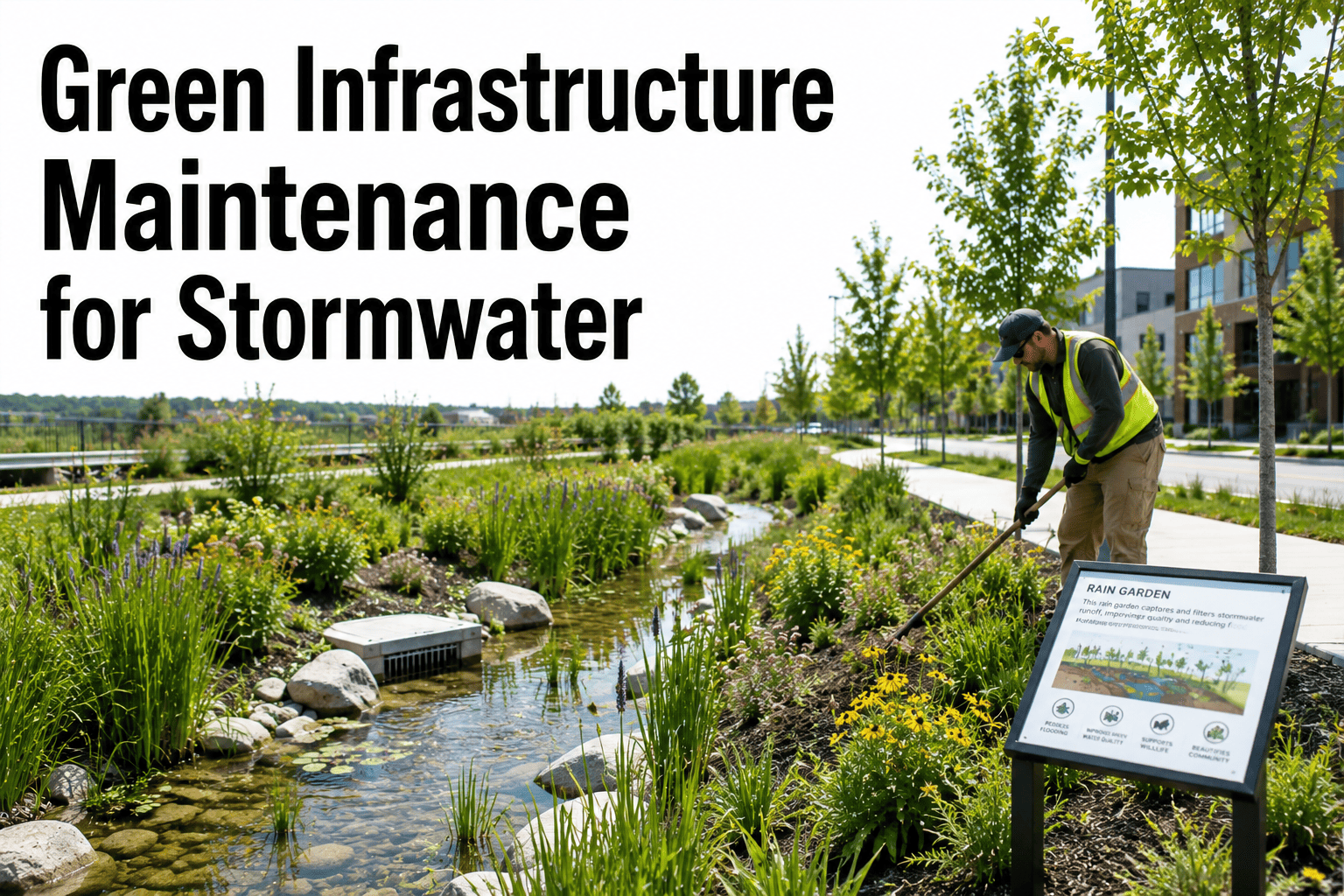
Green infrastructure maintenance for stormwater — bioswales, rain gardens, permeable pavement, bioretention — is what keeps these systems infiltrating, filtering and detaining runoff the way they were designed and permitted to. Neglect it, and within 2–5 years most green stormwater infrastructure (GSI) loses a large share of its treatment capacity, clogs, erodes, and falls out of MS4 permit compliance. The challenge for public works and municipal crews is that GSI maintenance is part landscaping, part civil engineering, and part compliance documentation — a discipline most teams have to build from scratch. This guide covers GSI maintenance requirements, vegetation management, inspection cadence, and how a CMMS-driven program keeps every asset performing. If you want to see it running on your own inventory, Start Free Trial and build your first GSI preventive-maintenance plan in minutes.
Is your green infrastructure still treating stormwater — or just landscaping?
Clogged forebays, choked media and invasive vegetation quietly strip bioswales and rain gardens of their design function. Here is the maintenance system that keeps GSI performing and permit-ready.
Why green stormwater infrastructure fails without maintenance
A bioretention cell is a treatment device, not a flower bed. When sediment, trash and thatch build up faster than they are removed, infiltration rates collapse — and the asset stops doing the job it was permitted to do.
Green infrastructure stormwater controls are deliberately shallow, vegetated and soil-based — which means they are living systems. Plants grow, spread and die; mulch decomposes; sediment accumulates at inlets; underdrains clog. A municipal green infrastructure maintenance program has to manage all of it on a schedule, not after a complaint or a flooded intersection.
GSI maintenance checklist: bioswales, rain gardens & permeable pavement
Each green infrastructure asset type has its own failure modes. Use this task grid as the backbone of your preventive-maintenance library.
Bioswale & Vegetated Swale Maintenance
- Mow / trim vegetation to 4–6 in.; remove thatch annually
- Clear sediment & trash from inlets, check dams and forebays
- Repair erosion rills and re-stabilize bare soil within 30 days
- Confirm positive drainage — no standing water 48–72 hrs after a storm
- Remove invasive species before they exceed ~10% cover
Rain Garden & Bioretention Maintenance
- Refresh 2–3 in. mulch layer annually; keep mulch off inlets
- Prune, weed and replace dead plants to keep ~90% cover
- Scrape and replace top 2–3 in. of media when drawdown slows
- Inspect underdrains and cleanouts; jet if flow is restricted
- Test infiltration rate every 1–2 years against design spec
Permeable Pavement Maintenance
- Vacuum-sweep (regenerative air) 2–4× per year — never pressure-wash fines in
- Keep stockpiled sand/salt off the surface; limit winter sanding
- Spot-treat clogged joints; re-fill paver aggregate as needed
- Measure surface infiltration annually (ASTM C1701)
- Inspect edge restraint, inlets and overflow structures
How often should you inspect green infrastructure?
A defensible municipal GSI maintenance program pairs a fixed calendar with event-driven checks. Here is a cadence most public works departments can sustain.
| Frequency | Inspection / Task | Applies To |
|---|---|---|
| Monthly (growing season) | Visual sweep: trash, weeds, erosion, standing water, inlet blockage | All GSI assets |
| Quarterly | Vegetation health, sediment depth in forebay, mulch condition, pest/invasive check | Bioswales, rain gardens, bioretention |
| After major storms | Event-driven check: drawdown time, washouts, debris dams, overflow activation | All GSI assets |
| Annually | Full condition assessment, infiltration/drawdown test, underdrain inspection, photo log | All GSI assets |
| Every 3–5 years | Media top-up or replacement, major replanting, structural repair | Bioretention, permeable pavement |
The pattern that matters: frequent light-touch inspections catch cheap problems early, while the annual deep assessment generates the documentation your permit requires. A CMMS turns this table into recurring work orders assigned to a crew, with mobile checklists and photo capture in the field.
What a CMMS-driven GSI program looks like in practice
Consider a mid-sized city with 120 green stormwater infrastructure assets — 60 bioswales, 40 rain gardens and 20 permeable-pavement installations — maintained by one 4-person crew.
Before: reactive & undocumented
- Work tracked in a spreadsheet and a whiteboard; no recurring schedule
- ~30% of assets missed their annual inspection
- Two bioswales failed and needed $18K rehabilitation each
- MS4 annual report took 3 weeks to assemble from paper notes
After: OxMaint preventive program
- Every GSI asset on a recurring PM schedule with mobile checklists
- 100% inspection completion, time-stamped and geo-tagged
- Early sediment catch cut rehab events to zero in year one
- Permit report exported in under a day from maintenance analytics
Run your entire green infrastructure maintenance program in OxMaint
OxMaint is an AI-powered CMMS + EAM platform built for teams that maintain distributed public assets. Here is how it maps to GSI upkeep.
Recurring Preventive Maintenance
Turn the inspection cadence above into auto-generated work orders for every bioswale, rain garden and paver — so no asset ever misses its annual check.
Asset & Compliance Records
Every inspection, photo and repair is time-stamped against the asset, giving you an audit-ready trail for MS4 and stormwater permit reporting.
Mobile Field Checklists
Crews complete GSI checklists on a phone, attach photos of erosion or clogging, and close work orders on-site — no paper, no double entry.
Maintenance Analytics
See cost per asset, overdue tasks and repeat failure spots at a glance — so you can defend budget and target the assets that need capital renewal.
See OxMaint on your GSI assets — book a 30-minute demo
We will load one of your bioswales or rain gardens and show you the full preventive-maintenance workflow, live.
Green infrastructure maintenance: common questions
What is green infrastructure maintenance for stormwater?
It is the routine inspection, vegetation care, sediment removal and structural upkeep of green stormwater infrastructure — bioswales, rain gardens, bioretention and permeable pavement — so these systems keep infiltrating and treating runoff to their design standard and stay permit-compliant.
How often should a bioswale or rain garden be maintained?
Plan a monthly visual check in the growing season, a quarterly vegetation and sediment inspection, an event-driven check after major storms, and a full annual condition assessment with an infiltration or drawdown test. A CMMS like OxMaint can auto-schedule all of it.
What happens if green stormwater infrastructure is not maintained?
Sediment and thatch clog the surface media, infiltration rates can drop by half or more, plants die back, and the asset stops treating stormwater — often within 2–5 years. Rehabilitation then costs 3–5× more than routine upkeep, and you risk MS4 permit violations.
How do you maintain permeable pavement?
Vacuum-sweep with a regenerative-air sweeper 2–4 times a year, keep sand and de-icing stockpiles off the surface, spot-clear clogged joints, and test surface infiltration annually (ASTM C1701). Never pressure-wash fines into the pores.
Can a CMMS help with municipal GSI maintenance and compliance?
Yes — a CMMS schedules recurring inspections, gives crews mobile checklists, and stores time-stamped photos and records per asset, which makes MS4 annual reporting far faster. Book a demo to see a municipal GSI workflow end to end.
Keep every rain garden, bioswale and paver performing
Build your green infrastructure maintenance program in OxMaint today — schedules, checklists, assets and compliance records in one place.
Free 14-day trial · No credit card · Set up in minutes